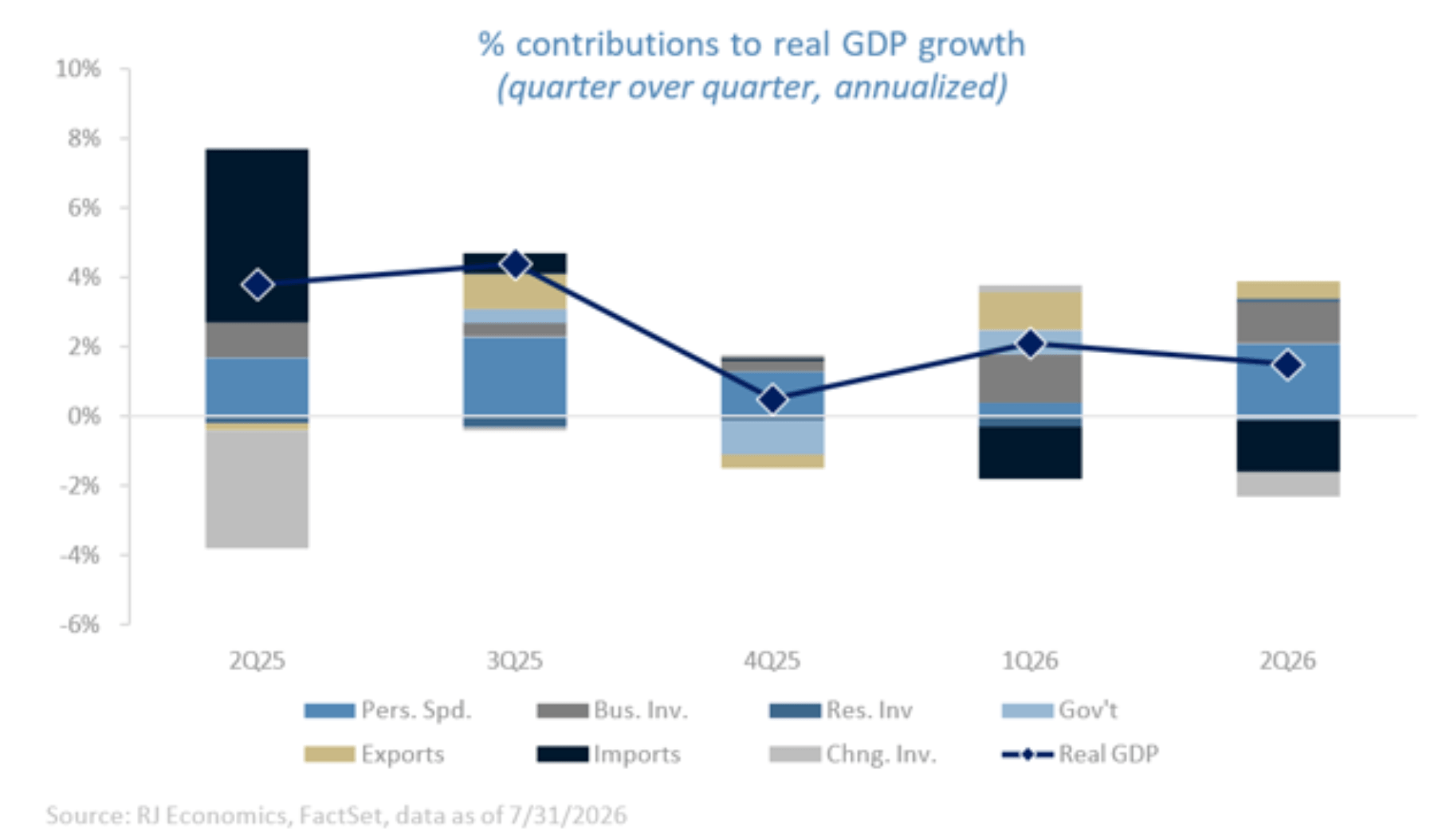
The US economy grew less than expected during the second quarter of the year, up 1.5% quarter over quarter, dragged down by strong growth in imports. However, final sales to private domestic purchasers increased by 3.9%, underscoring the strength in domestic demand, which continues to rely too heavily in AI investment spending and strong spending from high-income consumers, or what has been called the K economy.
At the same time, at the end of the Federal Open Market Committee (FOMC) meeting – the second meeting for the new Chairman of the Federal Reserve (Fed) Kevin Warsh – the Fed decided to keep interest unchanged but three members of the FOMC dissented, preferring to increase interest rates by 25 basis points. This means that the path for monetary policy is becoming more and more difficult, as the next FOMC meeting is in September and is the only chance the Fed will have to raise interest before the midterm elections in November, as the FOMC rarely raises interest rates after an October meeting during an election year.
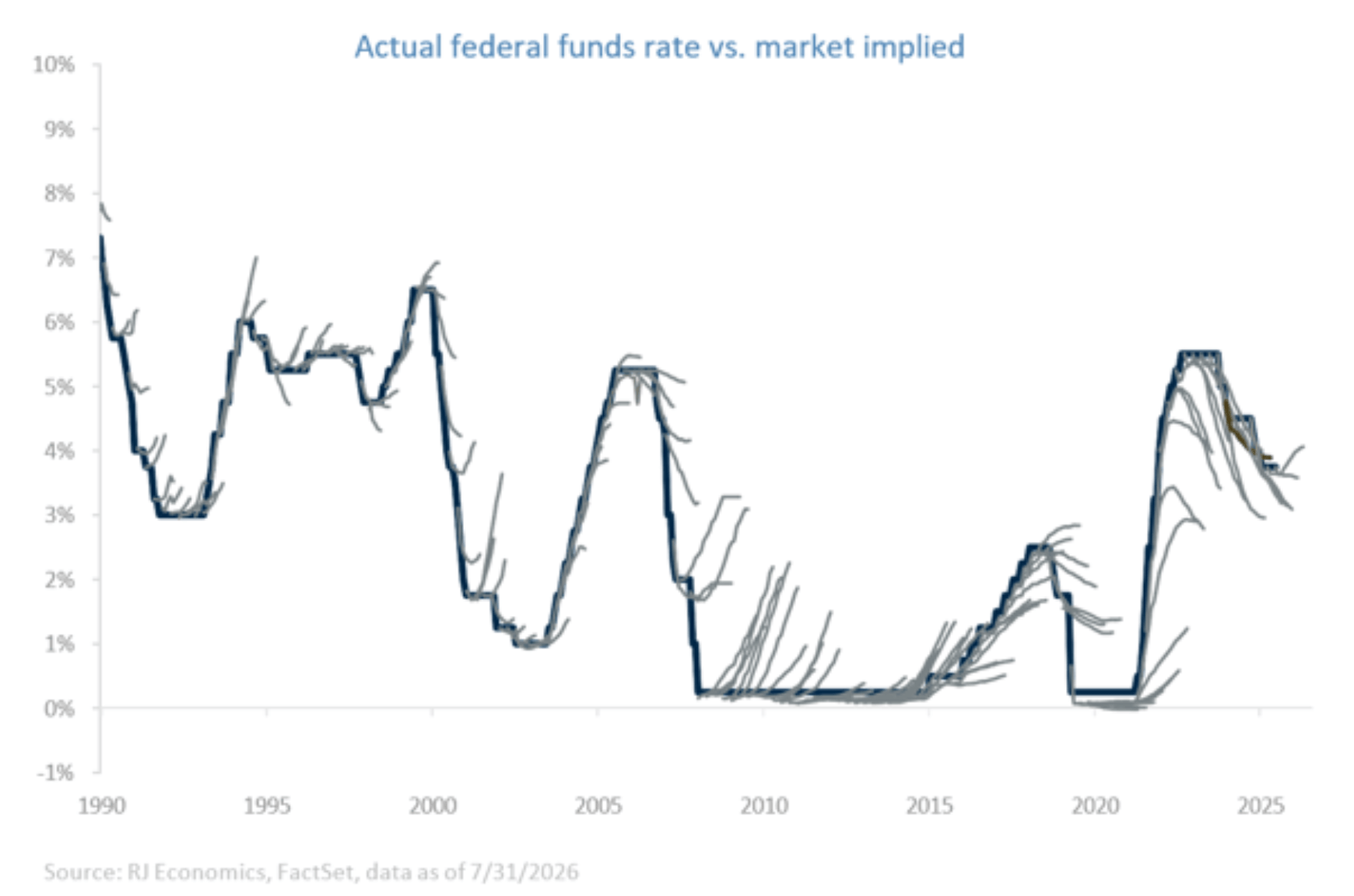
But we disagree with initial press commentaries regarding the chairman’s reluctance to increase the federal funds rate. First of all, as we have said before, the chairman of the Fed is not a dictator and the FOMC is not a dictatorship. He cannot unilaterally overrule the committee’s decision. Second, his job is to persuade his colleagues in the FOMC and probably the markets that the FOMC’s expectations on inflation are correct and that markets are wrong. Third, even if the Fed did not increase rates, markets did increase rates, making interest rates more restrictive today. So, as he probably implied during the press conference, there is no need for the Fed to increase rates because markets have already increased them.
See more: Old-Fashioned Bond Math for a New-Fashioned Fed
We think the chair and many economists and analysts have made the mistake of arguing that “inflation has been above the target for more than five years,” or something similar. So what? That is sunk cost, i.e., it does not matter for all intents and purposes. What matters is the future: Are today’s rates consistent with the disinflationary process continuing once the “one-offs” are over? We think they are.
Furthermore, the chairman has said, and history has shown, that interest rates work with a lag of six to 12 months. What he is seeing in six to 12 months’ time is the same thing we are seeing, which is a Personal Consumption Expenditures (PCE) price index, barring any further shock, close to the target without having to further increase interest rates.
We do understand how analysts are struggling to read the new Fed chairman and his communication strategy because it is very different than what we were accustomed to getting before from the Fed. Is this better or worse for conducting monetary policy? The answer is not clear yet. Before, it was clear that the Fed worked hard, using forward guidance, to convince the markets of what they needed to do and, in the end, would not go against market expectations on rates. Today, that is no longer clear, even though market expectations were in line with the Fed decision this time around.
Today, betting markets are expecting a rate increase in September. However, there is still time for markets to change their mind, which they do more often than not. Between today and September’s FOMC meeting, the Fed will have two more releases of the Consumer Price Index (CPI), for July and August. If, in principle, there are two more months of relatively benign core CPI data close or similar to what we saw with June’s data, we believe the Fed chairman will make a case for keeping interest rates at their September meeting unchanged and he would probably retain a voting majority within the FOMC. If that is not the case and core inflation data starts to deteriorate, then we will see an increased probability of a rate increase at the September FOMC meeting.
Eugenio J. Alemán, Chief Economist
Economic and market conditions are subject to change.
Opinions are those of Investment Strategy and not necessarily those of Raymond James and are subject to change without notice. The information has been obtained from sources considered to be reliable, but we do not guarantee that the foregoing material is accurate or complete. There is no assurance any of the trends mentioned will continue or forecasts will occur. Past performance may not be indicative of future results.
Links are being provided for information purposes only. Raymond James is not affiliated with and does not endorse, authorize or sponsor any of the listed websites or their respective sponsors. Raymond James is not responsible for the content of any website or the collection or use of information regarding any website's users and/or members.
Raymond James & Associates, Inc., member New York Stock Exchange / SIPC, and Raymond James Financial Services, Inc., member FINRA / SIPC, are subsidiaries of Raymond James Financial, Inc.
Raymond James® and Raymond James Financial® and power of personal® are registered trademarks of Raymond James Financial, Inc.
A message from Advisor Perspectives and VettaFi: Discover something new! Click here to register for our upcoming webcasts.
© Raymond James
More Small Cap Topics >