Old-Fashioned Bond Math for a New-Fashioned Fed
Membership required
Membership is now required to use this feature. To learn more:
View Membership BenefitsEvery so often, markets present an opportunity to reset the muscle memory of a generation of investors. The arrival of a new U.S. Federal Reserve chair – one who has heralded a genuine changing of the guard – is one such moment.
Kevin Warsh's early signals have been clear: Expect less forward policy guidance, lighter use of the Fed’s balance sheet, more debate among officials, and a greater willingness to act aggressively – and even to be wrong – in both directions. Expect the Fed to be less reliant on interest-rate projections and less inclined to act as a risk manager for financial markets.
This change is significant. For the better part of two decades, the Fed's implicit job description has included suppressing market volatility, telegraphing intentions, and smoothing the path for risk assets. Investors were rewarded for moving as a herd in accordance with the Fed’s “dot plot” forecasts rather than doing their own analysis.
See more: Fed Policymaker Comments Raise the Stakes for Inflation Data
A Warsh Fed appears prepared to let markets stand more on their own, with less explicit guidance or implicit backstop. That stands to increase volatility, dispersion, and two-way risk. Those happen to be the raw materials for active investment managers to pursue enhanced returns. And those raw materials are especially beneficial at a time when basic bond math is already working in investors' favor again.
Exorcising the ghosts of 2022
Amid an era of relentless stock market gains, the renewed case for fixed income has been overshadowed, especially after the Fed’s post-COVID policy path produced some rough patches for bonds. In 2022, fixed income faltered as the Fed hiked rates sharply to combat an inflation spike. Bonds have endured a repricing of the front end of the yield curve, a selloff at the long end, a testing of the "duration diversifies" narrative, and a steady drift of financial advisers toward equity risk.
And yet, bonds have quietly gone back to work. This year, even with the 10-year Treasury yield above where it began 2026, high-quality bonds have done their job – posting positive total returns and outperforming cash across most segments of the curve.
Meanwhile, disinflationary forces appear to be reasserting themselves after the energy-price shock triggered by the conflict in Iran. Inflation data released in July showed a broad-based cooling in price pressures, with both headline and core inflation surprising to the downside as energy prices retraced and services inflation moderated.
Real (inflation-adjusted) yields sit near multi-decade highs that not only reward investors but also give policymakers ample room to move in either direction as the data dictate. The Fed’s institutional independence and credibility on inflation are no longer in doubt.
Still, the muscle memory of recent years has kept many allocators from noticing the merits of fixed income. Now, it’s time to revisit those merits.
The math
The 10-year Treasury note today yields about 4.55% – roughly four percentage points above the all-time lows seen in 2020. Historically, starting yields have been highly correlated with five-year forward returns. That suggests a solid baseline for returns in a steady-state economy.
Now imagine the next genuine growth scare, credit event, or geopolitical shock. In that scenario, our baseline view is that central banks would cut rates significantly. If that happened, the total return on that 10-year Treasury could be 10% or more over the following year. In a severe recession scenario, the total return could approach 20%.
That means that in the adverse economic scenario – the case where equity investors most need help – a high-quality bond position could plausibly deliver a double-digit offset. And investors are being paid a starting yield of about 4.55% simply to wait for that optionality to matter.
Our baseline view is that the Fed will hold its policy rate steady through the rest of 2026 amid gradually easing price pressures, and recent inflation data reinforce that view. Importantly, investors do not need an aggressive easing cycle for bonds to generate attractive returns from current yield levels. Indeed, the beauty of bonds today is that performance isn’t predicated on a single macro outcome.
Across a range of growth and inflation outcomes – soft landing, no landing, recession, and stagflation – high-quality bonds could deliver positive total returns, including meaningful upside in the scenario that matters most to a balanced portfolio. Even if rates were to rise, today’s yields offer a significant income cushion to offset price losses.
This is convexity in plain English: A truncated downside and a meaningful upside.
The case for bonds, not the case against equities
Equity valuations remain historically elevated, a concern we hear in client conversations. But valuations have been stretched for a while and stocks have kept climbing. Rather than trying to forecast an equity downturn, the more useful observation is that you don't need a bearish view on stocks to justify owning bonds.
Instead, the case for fixed income rests on standalone bond math: starting yields that compound, convexity that protects, attractive global yields that diversify (for more, see our 24 June publication, Global Bond Diversification: Higher Yields and New Opportunities for Alpha), and a more laissez-faire Fed.
Bonds also look increasingly compelling on a relative basis as diversification has grown scarce elsewhere in portfolios. In equities, the top 10 issuers account for roughly 37% of the S&P 500, concentrating exposure in a handful of mega-cap names (see Figure 1). In private direct lending, the fastest-growing corner of many portfolios, roughly 31% of business development company (BDC) exposure sits in software and technology.
Figure 1: Avoid the illusion of diversification in equity and private corporate credit

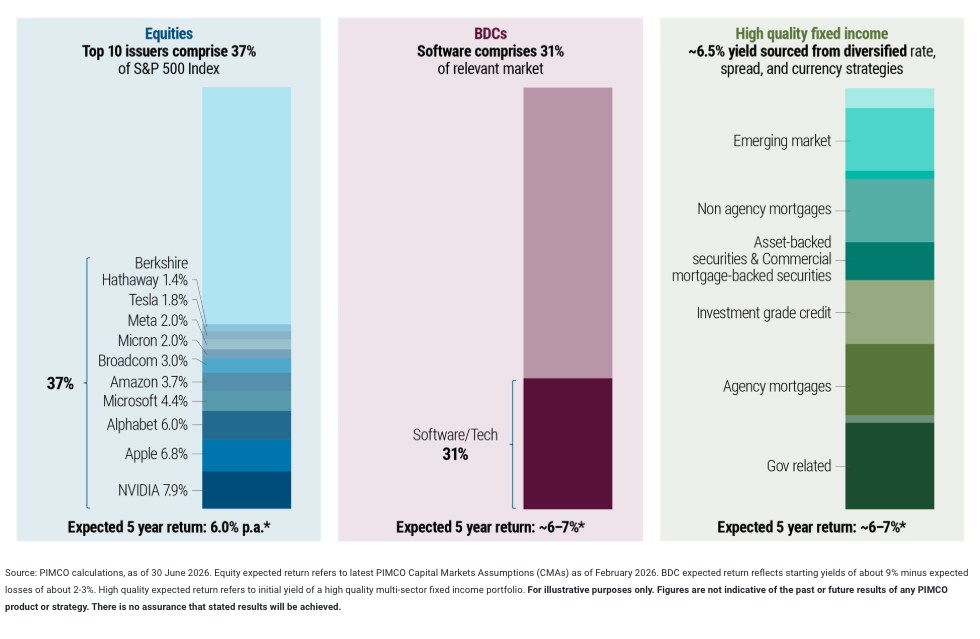
A high-quality fixed income allocation, by contrast, sources from a genuinely diversified mix of rate, credit spread, and currency exposures across sectors and regions.
The Warsh dividend
A generation ago, the Fed reshaped itself in the aftermath of the global financial crisis, laying the groundwork for the investor muscle memory that endures today. Large-scale asset purchases flattened the yield curve, while calendar-driven forward guidance sedated the front end. Dot plots and press conferences trained markets to expect the Fed to telegraph its every move. Passive investing flourished as active decisions migrated to Washington, and bond yields marched toward all-time lows.
In a Warsh regime, that machinery is set to recede (for more, see our 24 June Macro Signposts, “Will Greater Monetary Policy Uncertainty Lead to Tighter Financial Conditions?”). Volatility will be absorbed by markets rather than managed away, and a Fed that telegraphs less certainty is a Fed that reinvigorates opportunities for active managers — including curve analysis, directional views, currency positioning, and relative value trades.
The result is a doubly supportive backdrop, in our view. Higher starting yields have brought old-fashioned bond math back in investors' favor, and a Warsh Fed stands to enable active investors to build on that already attractive baseline for returns.
A message from Advisor Perspectives and VettaFi: Discover something new! Click here to register for our upcoming webcasts.
Disclosures
This material is being provided for informational purposes only and does not constitute an offer to sell or a solicitation of an offer to buy interests in a fund or any other PIMCO trading strategy or investment product in any jurisdiction.
It should not be assumed, and no representation is made, that past investment performance is reflective of future results. Nothing herein should be deemed to be a prediction or projection of future performance.
References, either general or specific, to securities and/or issuers are for illustrative purposes only and are not intended to be, and should not be interpreted as, recommendations to purchase or sell such securities.
All investments contain risk and may lose value. Investing in the bond market is subject to risks, including market, interest rate, issuer, credit, inflation risk, and liquidity risk. The value of most bonds and bond strategies are impacted by changes in interest rates. Bonds and bond strategies with longer durations tend to be more sensitive and volatile than those with shorter durations; bond prices generally fall as interest rates rise, and low interest rate environments increase this risk. Bond investments may be worth more or less than the original cost when redeemed. Equity investments may decline in value due to both real and perceived general market, economic and industry conditions. Mortgage- and asset-backed securities may be sensitive to changes in interest rates, subject to early repayment risk, and while generally supported by a government, government-agency or private guarantor, there is no assurance that the guarantor will meet its obligations. Certain U.S. government securities are backed by the full faith of the government. Obligations of U.S. government agencies and authorities are supported by varying degrees but are generally not backed by the full faith of the U.S. government. Portfolios that invest in such securities are not guaranteed and will fluctuate in value. Private credit involves an investment in non-publicly traded securities which may be subject to illiquidity risk. Portfolios that invest in private credit may be leveraged and may engage in speculative investment practices that increase the risk of investment loss. An investment in a BDC is subject to credit and investment risk, leverage risk, market and valuation risk, price volatility, liquidity risk, interest rate risk, structural and regulatory risk. Diversification does not ensure against loss.The current regulatory climate is uncertain and rapidly evolving, and future developments could adversely affect any particular market sector or investment strategy.
Hypothetical illustrations have many inherent limitations, some of which are described below. No representation is being made that any account will or is likely to achieve results similar to those shown. In fact there are frequently sharp differences between hypothetical results and actual results subsequently achieved by any particular trading program.
One of the limitations of hypothetical results is that they are generally prepared with the benefit of hindsight. In additional, hypothetical scenarios do not involve financial risk, and no hypothetical illustration can completely account for the impact of financial risk in actual trading. For example, the ability to withstand losses or to adhere to a particular trading program in spite of trading losses are material points which can also adversely affect actual trading results. There are numerous other factors related to the markets in general or to the implementation if any specific trading program which cannot be fully accounted for in the preparation of a hypothetical illustration and all of which can adversely affect actual results.
The material contains statements of opinion and belief. Any views expressed herein are those of PIMCO as of the date indicated, are based on information available to PIMCO as of such date, and may not have been updated to reflect real time market developments. Statements of opinion are subject to change, without notice, based on market and other conditions. No representation is made or assurance given that such views are correct. PIMCO has no duty or obligation to update the information contained herein.
PIMCO as a general matter provides services to qualified institutions, financial intermediaries and institutional investors. Individual investors should contact their own financial professional to determine the most appropriate investment options for their financial situation. This material has been distributed for informational purposes only and should not be considered as investment advice or a recommendation of any particular security, strategy or investment product. Information contained herein has been obtained from sources believed to be reliable, but not guaranteed. No part of this material may be reproduced in any form, or referred to in any other publication, without express written permission. PIMCO is a trademark of Allianz Asset Management of America LLC in the United States and throughout the world.
Pacific Investment Management Company LLC (“PIMCO”) is an investment adviser registered with the U.S. Securities and Exchange Commission (“SEC”). PIMCO Investments LLC (“PIMCO Investments”) is a broker-dealer registered with the SEC and member of the Financial Industry Regulatory Authority, Inc. (“FINRA”). PIMCO and PIMCO Investments is solely responsible for its content. PIMCO Investments is the distributor of PIMCO investment products, and any PIMCO Content relating to those investment products is the sole responsibility of PIMCO Investments.
The information provided herein is not directed at any investor or category of investors and is provided solely as general information about our products and services and to otherwise provide general investment education. No information contained herein should be regarded as a suggestion to engage in or refrain from any investment-related course of action as none of PIMCO nor any of its affiliates is undertaking to provide investment advice, act as an adviser to any plan or entity subject to the Employee Retirement Income Security Act of 1974, as amended, individual retirement account or individual retirement annuity, or give advice in a fiduciary capacity with respect to the materials presented herein. If you are an individual retirement investor, contact your financial advisor or other fiduciary unrelated to PIMCO about whether any given investment idea, strategy, product or service described herein may be appropriate for your circumstances.
Check the background of this firm on FINRA's BrokerCheck.
PIMCO is a trademark of Allianz Asset Management of America LLC in the United States and throughout the world. ©2026 PIMCO. All Rights Reserved. Investment Products: NOT FDIC INSURED | MAY LOSE VALUE | NOT BANK GUARANTEED.
© PIMCO
Membership required
Membership is now required to use this feature. To learn more:
View Membership BenefitsSponsored Content
Upcoming Virtual Events View All