Key takeaways:
-
The unusual cheapness of U.S. Treasuries relative to interest rate swaps makes corporate bond spreads appear tighter when measured against Treasuries than when measured against swaps. This effect is real, but primarily one of measurement rather than valuation.
-
Despite this mechanical effect, changes in Treasury-swap spreads show little relationship with changes in U.S. corporate credit spreads, suggesting Treasury-swap dynamics are not a major driver of credit spread behavior over time.
-
Europe is different. A more swap-centric market structure and shared exposure to banking sector funding conditions create a stronger link between Treasury/Bund-swap spreads and corporate credit spreads.
The relative cheapness of Treasuries versus interest rate swaps mechanically affects how corporate bond spreads are measured, but it appears to have limited influence on how corporate bond spreads actually behave. This distinction matters: While negative swap spreads can make valuations appear richer, the evolution of credit spreads remains driven primarily by credit fundamentals, investor risk appetite, flows, and broader market technicals rather than relative value between Treasuries and swaps.
Quick background: Corporate bond spreads represent the extra yield investors demand to lend to a company instead of a safer benchmark. The key question is which benchmark to use. Traditionally, investors measure spreads relative to U.S. Treasuries by comparing a corporate bond’s yield with the yield on a Treasury of similar maturity. Treasuries are often treated as the closest approximation of a risk-free asset, but their yields can deviate from the theoretical, and ultimately unobservable, risk-free yield curve due to temporary supply and demand imbalances. For example, quantitative easing – large scale central bank bond purchases – can push Treasury yields below fair value by removing supply from private investors. Large fiscal expansions and rising Treasury issuance can have the opposite effect by increasing the amount of government debt that private investors must absorb.
An alternative is to measure spreads relative to the interest rate swap curve. Many market participants view swaps as a useful alternative benchmark because they are less directly affected by Treasury-specific supply and demand dynamics. That does not necessarily make swaps a closer approximation of the theoretical risk-free rate. Like Treasuries, swap rates can also be influenced by market-specific technical factors, including hedging flows and shifts in demand from pension funds, insurers, mortgage investors, and other large market participants.
In other words, just as Treasury yields can be affected by technical forces unrelated to credit risk, swap rates can be influenced by dynamics in derivative and funding markets. The practical question is often less about which benchmark is “correct” and more about which set of market distortions investors wish to abstract from.
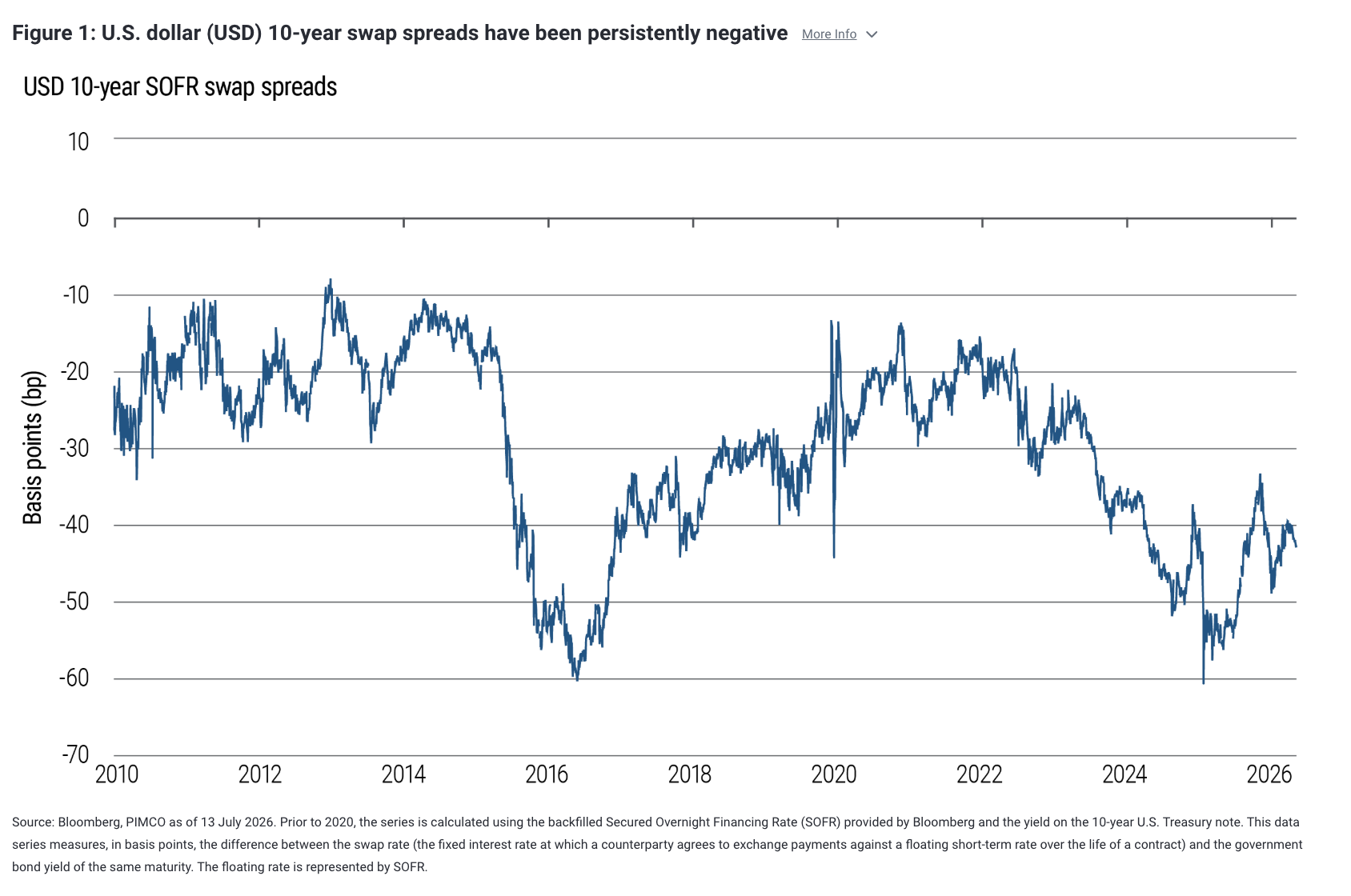
In practice, spreads to Treasuries are often better for communication, and most bond index spreads are reported on that basis. Spreads to swaps, however, can be useful for valuation work because they remove Treasury-specific distortions from the comparison. Today, the difference between the two is material. As shown in Figure 1, Treasury yields appear unusually cheap relative to swaps, with 10-year swap spreads remaining deeply negative by historical standards.
See more: Credit Spreads: Under the Radar, but Influential
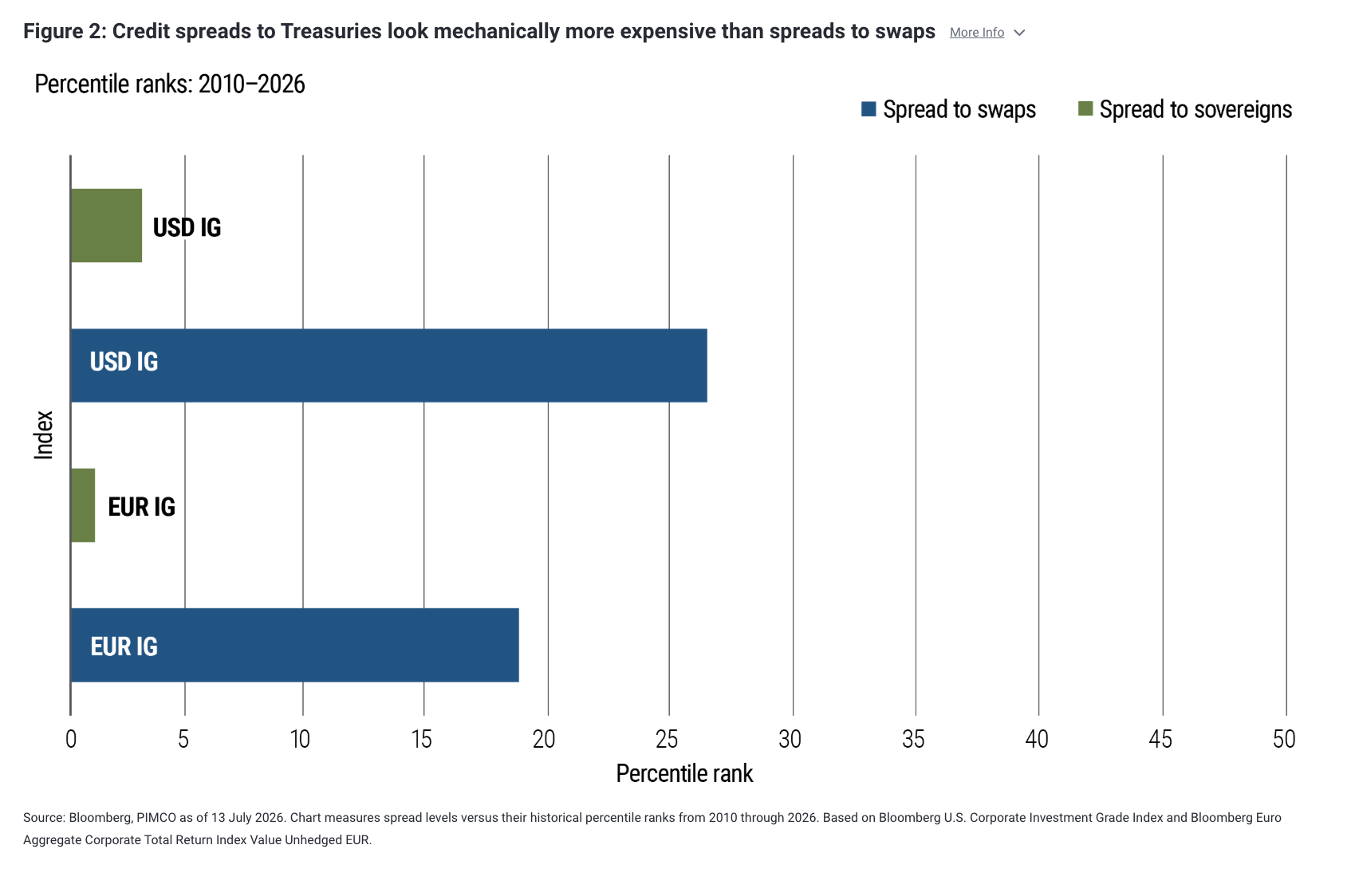
This has fueled an interesting debate among market participants. One argument that has gained traction over the past two years is that the apparent richness of corporate bond spreads to Treasuries – that is, how unusually tight they appear relative to history – is partly a byproduct of unusually cheap Treasury valuations. The logic is that if Treasury yields are unusually high relative to swap rates, spreads measured against Treasuries will mechanically look tighter than they otherwise would.
Figure 2 illustrates the point. When spreads are benchmarked against interest rate swaps rather than Treasuries, valuations appear somewhat less stretched relative to history. Put differently, spreads measured to Treasuries will mechanically appear tighter than spreads measured to swaps. The more important question, however, is whether Treasury-swap dynamics explain why investors are willing to accept such low compensation for bearing corporate credit risk in the first place. Those are not necessarily the same thing.
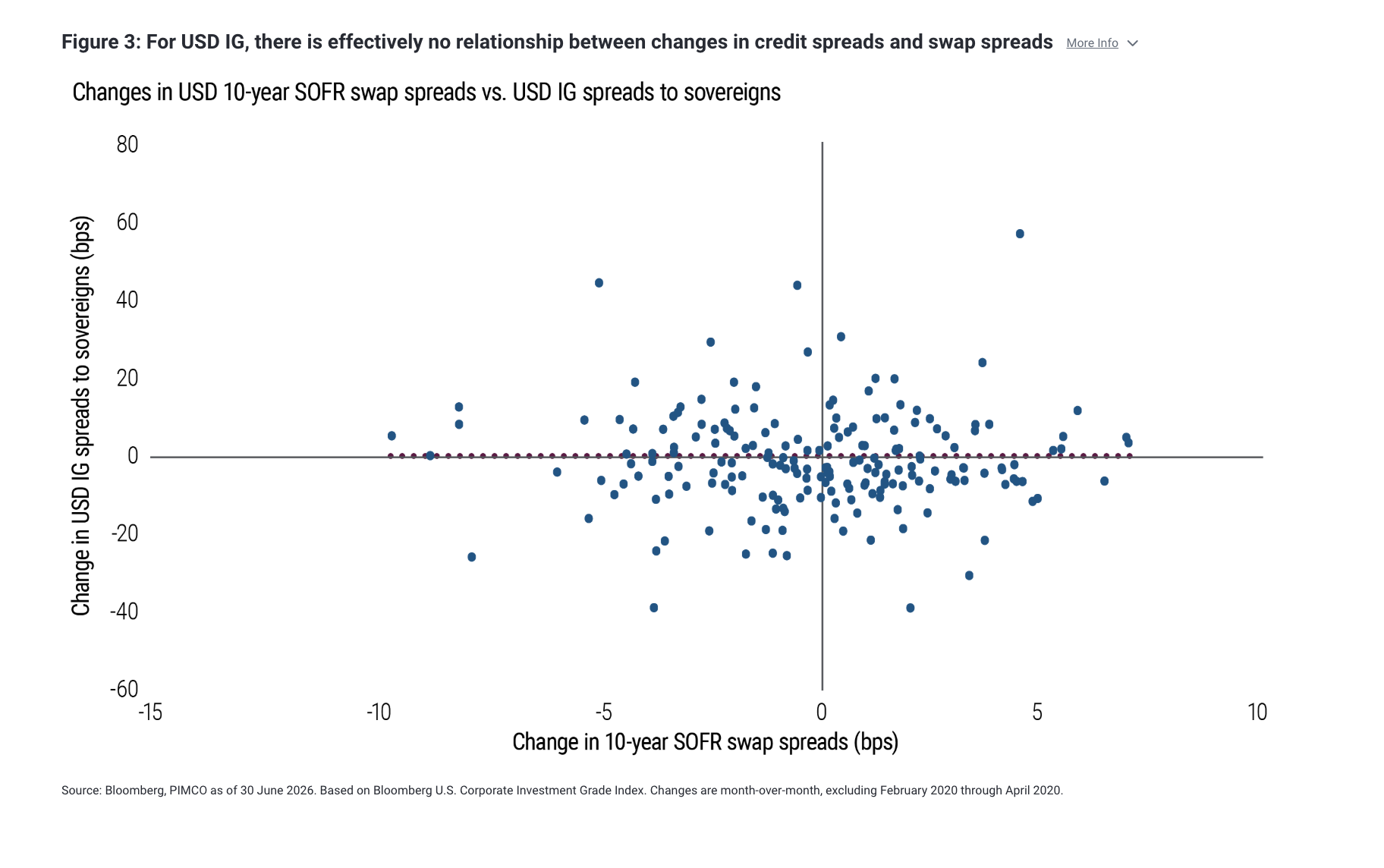
Advocates of the Treasury-cheapness thesis are often making a structural argument: namely, that persistently negative swap spreads have contributed to tighter corporate spreads over a multi-year horizon. That hypothesis is difficult to test directly. But a simpler question is whether changes in swap spreads help explain changes in corporate spreads through time. If Treasury-swap dynamics were a major driver of corporate credit valuations, the two should exhibit at least some tendency to move together.
In practice, a simple scatter plot of monthly changes shows almost no relationship between changes in swap spreads and changes in U.S. investment grade (IG) credit spreads (see Figure 3).
The absence of a relationship in monthly changes does not invalidate the level effect. A structural shift toward more negative swap spreads can make corporate bond spreads to Treasuries appear tighter than they otherwise would, and it is possible that such shifts have influenced the equilibrium level of corporate spreads over longer horizons.
However, the lack of any meaningful relationship in month-to-month changes suggests that Treasury-swap dynamics explain little of the ongoing evolution of corporate spreads. Instead, spreads continue to be driven primarily by credit fundamentals, investor risk appetite, flows, and broader market technicals.
Put differently, Treasury cheapness may influence where corporate spreads are measured, but it appears to have limited power in explaining how corporate spreads behave.
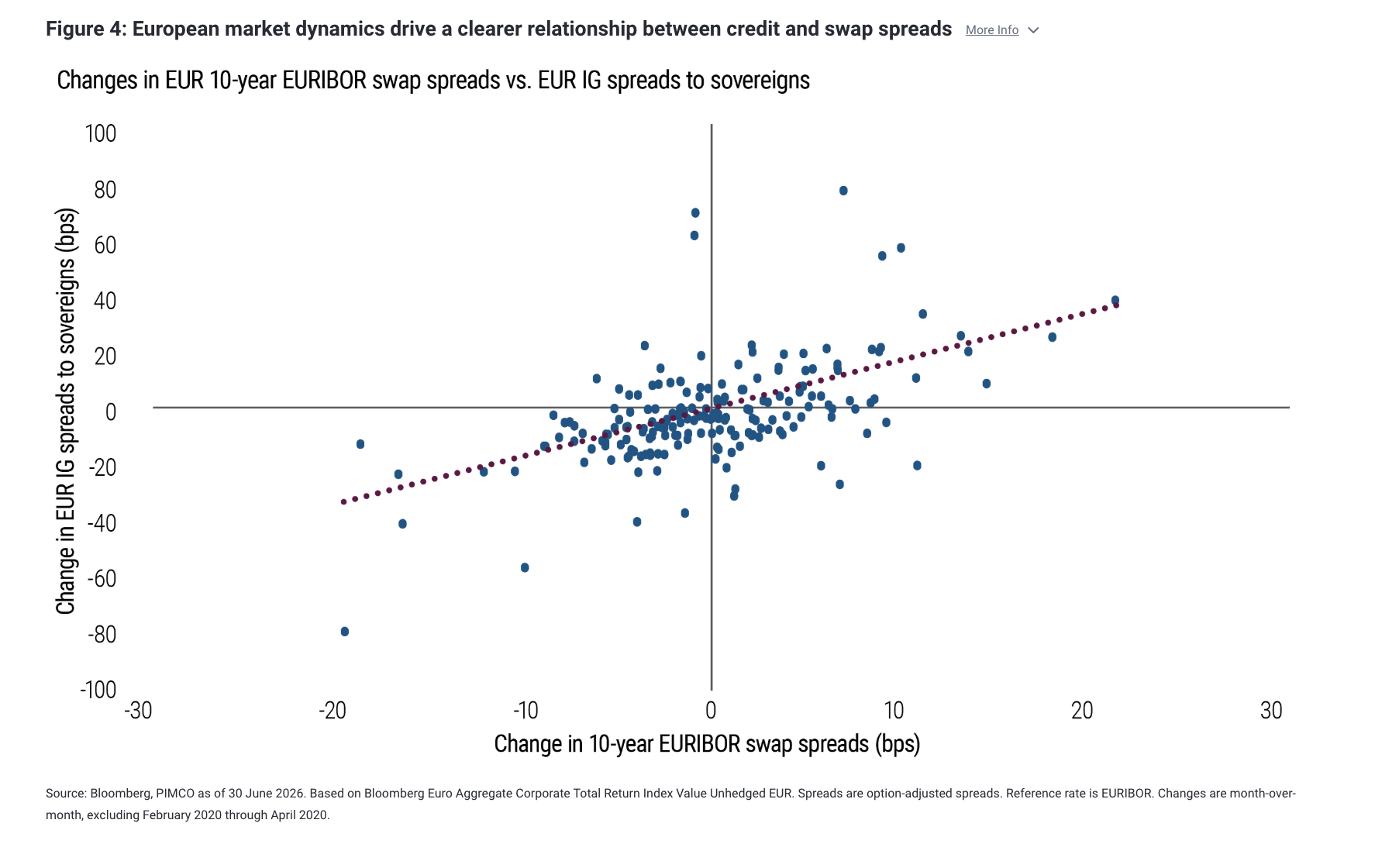
Europe looks somewhat different. Changes in corporate spreads to German Bunds show a noticeably stronger relationship with changes in swap spreads (see Figure 4). Part of the reason is structural: The euro-denominated (EUR) credit market is more swap-centric than the USD market, with investors, dealers, and issuers more often viewing bonds through an asset-swap framework than through a government-bond one.
In addition, swap spreads and credit spreads in Europe are often exposed to the same underlying risk factors. Even after collateralization and central clearing reduced counterparty risk, EUR swap spreads still tend to reflect broader funding conditions in the banking system. Because those same forces also affect corporate spreads – especially given the large weight of financials in the Bloomberg Euro Aggregate Corporate Total Return Index Value Unhedged EUR IG index – changes in swap spreads and credit spreads often move in the same direction.
Overall, the key drivers of corporate spreads are credit fundamentals, market technicals, and the broader economic cycle. It is precisely this dispersion – rather than the mechanics of the swap market – that creates the opportunity set for alpha generation through active management in fixed income.
Michael Puempel and Gabriel Cazaubieilh contributed to this report.
Don’t miss the latest episode of Accrued Interest where Lotfi discusses private credit and the AI capex supercycle – listen on Apple and Spotify.
Disclosures
Statements concerning financial market trends or portfolio strategies are based on current market conditions, which will fluctuate. There is no guarantee that these investment strategies will work under all market conditions or are appropriate for all investors and each investor should evaluate their ability to invest for the long term, especially during periods of downturn in the market. Outlook and strategies are subject to change without notice.
Past performance is not a guarantee or a reliable indicator of future results. Forecasts, estimates and certain information contained herein are based upon proprietary research and should not be considered as investment advice. There is no guarantee that results will be achieved.
All Investments contain risk and may lose value. Investing in the bond market is subject to risks, including market, interest rate, issuer, credit, inflation risk, and liquidity risk. Corporate debt securities are subject to the risk of the issuer’s inability to meet principal and interest payments on the obligation and may also be subject to price volatility due to factors such as interest rate sensitivity, market perception of the creditworthiness of the issuer and general market liquidity. Sovereign securities are generally backed by the issuing government. U.S. Treasury securities are backed by the full faith of the U.S. government. Investing in foreign-denominated and/or -domiciled securities may involve heightened risk due to currency fluctuations, and economic and political risks, which may be enhanced in emerging markets. Swaps are a type of derivative; swaps are increasingly subject to central clearing and exchange-trading. Swaps that are not centrally cleared and exchange-traded may be less liquid than exchange-traded instruments.
The option adjusted spread (OAS) is the spread over an issuer's spot rate curve, developed as a measure of the yield spread that can be used to convert dollar differences between theoretical value and market prices. The terms “cheap” and “rich” as used herein generally refer to a security or asset class that is deemed to be substantially under- or overpriced compared to both its historical average as well as to an investment manager’s future expectations. There is no guarantee of future results or that a security’s valuation will ensure a profit or protect against a loss.
References to specific securities and their issuers are not intended and should not be interpreted as recommendations to purchase, sell or hold such securities. PIMCO products and strategies may or may not include the securities referenced and, if such securities are included, no representation is being made that such securities will continue to be included. It is not possible to invest directly in an unmanaged index.
PIMCO as a general matter provides services to qualified institutions, financial intermediaries and institutional investors. Individual investors should contact their own financial professional to determine the most appropriate investment options for their financial situation. This material contains the opinions of the author and such opinions are subject to change without notice. This material has been distributed for informational purposes only and should not be considered as investment advice or a recommendation of any particular security, strategy or investment product. Information contained herein has been obtained from sources believed to be reliable, but not guaranteed. No part of this material may be reproduced in any form, or referred to in any other publication, without express written permission. PIMCO is a trademark of Allianz Asset Management of America LLC in the United States and throughout the world.
CMR2026-0716-5756313
A message from Advisor Perspectives and VettaFi: Discover something new! Click here to register for our upcoming webcasts.
© PIMCO
Read more commentaries by PIMCO