In August of 2023 we published a blog post discussing AI’s enormous potential to drive secular growth, and despite our bullishness at the time, it has managed to exceed our expectations. The scale of the AI buildout has been both breathtaking and historic, and in this piece we explore what is motivating such extreme enthusiasm and what it means for small cap investors.
To understand how we are assessing this moment, it is helpful to review our framework for secular growth. We believe there are three primary categories:
-
Foundational Technology: These are platforms that allow other businesses to build new types of products and services on top of them.
-
Replacement Product, Existing Market: This is the most common type of secular growth, and there are countless examples throughout history.
-
New Product, New Market: These goods and services are entirely new to the economy, often emerging after a foundational technology is established.
In our 2023 essay, we argued that AI belonged in the first category, which is the most impactful, since these innovations generally trigger wholesale changes to both the economy and society. The internet is a textbook example, as it led to ecommerce, streaming video, social media, etc.
We still believe AI is a foundational technology — in fact, we think it may be the most important technological advancement ever — but now we also believe it fits squarely into the second category – a replacement product in an existing market. Specifically, AI is the ultimate replacement product: a virtual workforce that can be trained to do many different types of human jobs. There are limitations, of course, but the possibilities are vast, and already smart companies are using it to improve efficiency and boost productivity.
AI is the only technology we are aware of that meets the criteria for two different secular growth categories, and we believe this explains why it continues to attract unprecedented levels of capital. It is the rarest type of innovation — universally accessible and useful to virtually every individual and business — which ensures demand will be robust for the foreseeable future. Moreover, AI uses a consumption-based pricing model, so investing in additional capacity increases potential (recurring) revenues.
As small cap investors, we are not interested in owning the giant technology companies, commonly referred to as “hyperscalers” (i.e., Microsoft, Alphabet, Amazon, Oracle, Meta), that are leading the AI buildout. In fact, many of these companies, which formerly generated enormous cash flows, are now tapping the capital markets to pay for data center investments they cannot finance on their own. Rather, we are focused on finding the small companies in the AI ecosystem that are benefiting from this once-in-a-generation wave of capital expenditure. Additionally, we are looking for innovative startups that are using AI to take market share from incumbents, as we believe AI will spawn a new generation of secular growth companies, just as the internet did.
Read more: Could the U.S. Be the Frog in the Pot?
AI: A Foundational Technology Like No Other
Foundational technologies leave a lasting imprint on both the economy and society, and we believe AI clearly fits this description. Technically speaking, AI is similar to iOS, the iPhone’s operating system, which is a feature-rich development environment for hosted apps. AI platforms are customizable development environments that combine an answer engine (i.e., inference) with bots capable of executing real-world tasks (i.e., agents). Companies in every industry are deploying custom AI solutions to address an ever-increasing range of business needs.
But conceptually, AI has no analog. Prior to AI, computers were essentially sophisticated rule-following machines that could only execute tasks they were specifically programmed to understand. Now humans can tell a computer what outcome they want to achieve, using a natural language prompt, and AI will figure out the best way to make it happen. Of course, not all outcomes are achievable, and occasionally AI will make a mistake (i.e., “hallucinate”), but the key distinction is that AI-enabled computers are not constrained by existing code – they can find their own solutions.
The paradigm shift is transformative, and computers will forever be more useful than they used to be. In our 2023 piece we shared Bill Gates’s thoughts on the impact of AI, and we continue to agree with his perspective:
The development of AI is as fundamental as the creation of the microprocessor, the personal computer, the Internet, and the mobile phone. It will change the way people work, learn, travel, get healthcare, and communicate with each other. Entire industries will reorient around it. Businesses will distinguish themselves by how well they use it.
His last point is particularly relevant for our market, as venture-funded AI-native startups are becoming the norm. Those businesses rely heavily on agentic software development rather than human engineers, saving both time and money. As those companies mature and begin taking share from less efficient incumbents, we anticipate they will eventually become the IPO pipeline for small cap investors like us.
AI Is Everywhere
Foundational technologies are ubiquitous by definition, and AI has already achieved that status. According to a recent survey by McKinsey, in 2025 88% of companies reported using AI in at least one business function. And AI adoption rates are roughly twice as high as they were for either the internet or the personal computer during their first three years.
Still, the AI buildout is in the early stages, and the hyperscalers are investing at a historic pace. According to a report from MUFG, 2026 CapEx spending will be $700 billion, which is a 75% increase from 2025 and roughly 2% of projected 2026 U.S. GDP. To put that in context, Goldman Sachs estimates only the railroad buildout in the 1880s attracted materially more capital, accounting for roughly 3.5% of GDP. Importantly, this trend is expected to continue, with McKinsey forecasting cumulative hyperscaler CapEx at $5.2 trillion through 2030.
Essentially, these companies are operating as though any capacity they create will be utilized immediately, which has been the case thus far. In fact, both Amazon and Microsoft reported in the first quarter that their data centers were significantly oversubscribed and that demand has increased. Over the long term, supply may eventually exceed demand, but even if that happens, we are confident the slack will only be temporary, as innovative businesses will eventually find ways to utilize such a valuable resource. In the meantime, hyperscalers are much more worried about losing market share to their competition, so they are investing extremely aggressively.
Not surprisingly, this massive wave of capital expenditure has been a powerful tailwind for companies across the AI value chain, some of which are small caps that we own. At the end of this blog post we will provide a few case studies from our portfolio.
The Ultimate Replacement Product: Virtual Labor
The fact that AI is so widely accessible is obviously important, but in our view AI’s potential as a replacement for human labor is what makes the technology so compelling to investors. Computers have always been able to make humans more productive, automating some tasks and simplifying others, but until now, it has not been possible to talk to a machine as though it were a human and instruct it to execute complex, multi-step tasks. Perhaps more importantly, it has never been possible to “hire” a machine to do the entirety of a human’s job.
Achieving that level of proficiency requires employers to commit both time and money, so companies are going to need to be thoughtful about how much AI they consume, but those who do it well will be rewarded. Below are a couple of real-world examples from Salesforce, the large customer relationship software company based in San Francisco, that underscore how AI can improve efficiency and increase revenue.
Successful Use Cases: Software Engineering and Sales
Roughly 15,000 of Salesforce’s 81,000 employees are engineers. But this year, rather than adding new developers, the company spent $300 million on agentic AI tokens from Anthropic, and the hybrid engineering team boosted the company’s software output 150%. Given that our estimate of Salesforce’s engineering payroll is roughly $3-$4 billion, the ROI is quite impressive.
In a separate initiative, the company used AI to help pursue millions of sales opportunities that had accumulated throughout its 27-year history. Using automated AI agents, Salesforce systematically called back 50,000 historical leads in a single week to automatically qualify them and hand off high-intent buyers to human reps.
Both of these examples demonstrate that a strategic approach to deploying AI can result in tangible gains, and we expect other well-run organizations will begin to identify similar opportunities for themselves.
How Can Small Cap Investors Capitalize on AI?
The AI ecosystem already has many smaller companies that are benefiting from the current wave of capital investment, which we believe is the first phase of the AI evolution. Going forward, we anticipate opportunities will present themselves in two additional, subsequent phases, which are described below.
-
Phase I: Direct participation in the ongoing AI buildout: Current CapEx levels are unprecedented, so smaller pick-and-shovel companies that are well positioned should experience rapid revenue growth for at least the next few years. Semiconductors are obviously in high demand, but we are focusing on attractive opportunities in other areas, including hardware, software, and infrastructure.
-
Phase II: Emerging companies benefiting from AI applications and inference: Thus far, the two most powerful use cases of AI have been coding, as exemplified by companies like Anthropic and Cursor, and customer service, as exemplified by companies like Twilio and Sierra. We are increasingly focused on how AI moves up the stack into the application layer and where usage could broaden beyond coding and customer service. We anticipate this will be a significant growth area for us, as both existing companies and startups in a wide range of verticals are figuring out how to leverage AI to take share from incumbents.
-
Phase III: Broader distribution of AI beyond technology companies (e.g., AI-enabled scientific breakthroughs): Health care has always been a material portion of the small cap growth market, and AI has proven it can help accelerate research that should result in novel treatments that benefit patients.
Regardless of the precise timing of each phase, there is no doubt that AI is a seismic event that will trigger a wide range of structural economic changes, many of which we expect to be a windfall for small cap investors.
Case Studies
AI has already had a profound impact on equity markets, and we have several positions in our portfolio from across the AI ecosystem that continue to benefit from its rapid growth. Initially we were focused on smaller semiconductor and semiconductor capital equipment companies, both of which performed well, but more recently we have expanded into other areas.
Twilio (TWLO)
Twilio is a software company that builds sophisticated communication tools enabling large businesses to engage with their customers via multiple channels, including voice, text, email, etc. It was established in 2008, and businesses such as Uber and United Airlines rely on the platform to interact with their extensive user base.
The company has recently expanded its strategy to focus on voice AI agents, which the company believes will increasingly supplement human contact center agents. Twilio is uniquely positioned in Voice AI because it merges global carrier-grade telephony with model-agnostic AI orchestration.
The total AI agent population is expected to grow exponentially in the next few years, which should result in a protracted expansion cycle for Twilio. Currently the population is estimated to be under 1 million agents, and the International Data Corporation is forecasting it will expand to 1 billion by 2029.
DigitalOcean (DOCN)
DigitalOcean was founded in 2012 and has reinvented itself to capitalize on the expanding AI ecosystem. The company is essentially a smaller version of Amazon Web Services, except it is increasingly focused on AI inference and an emerging cohort of AI-native companies.
We believe the company is well positioned for sustained growth, as new software projects will continue to migrate towards agentic-based development. In fact, DigitalOcean is forecasting a 10x increase in the number of daily inference tokens from 50 trillion per day to 500 trillion per day by 2030.
Twist Bioscience (TWST)
Twist Bioscience develops synthetic DNA used in drug discovery. It has a highly automated, scalable process that allows it to provide leading turnaround times and competitive pricing.
Growth has been accelerating recently, partly due to the fact AI-enabled dry labs are developing new proteins much more quickly than they used to. AI has been a substantial tailwind for that type of research, but dry labs lack the ability to test their own products, so they have been outsourcing that work to Twist, as it has the capability to act as an outsourced wet lab for these customers. We are currently estimating that the company can grow revenues 20% per year with 30% profit margins and achieve $1 billion in revenue by 2030.
Final Thoughts
AI is an incredibly significant innovation with far-reaching implications for both the present and the future. In this piece, we have focused on the issues that we believe are most relevant to our strategy in the near-to-medium term, as those will have the biggest impact on our investment decisions.
At the same time, we are paying careful attention to several key risks, including: (1) a potential slowdown in model improvement and inference demand, (2) the pace of the AI buildout and hyperscaler CapEx, which will moderate eventually, (3) return on investment or ROI, which will be scrutinized more closely over time. Our objective is to remain disciplined and invest in companies that are trading at attractive valuations.
Finally, as AI matures and becomes more embedded in the economy, it will undoubtedly lead to a variety of changes that are hard to predict today. Some economists believe that AI will result in historic productivity gains, much like the Industrial Revolution at the turn of the 20th century, while others are concerned machines will take jobs from humans en masse. We are cautiously optimistic that a hybridized workforce becomes the norm, and no matter how it plays out, we will continue to search for high-quality companies benefiting from secular growth.

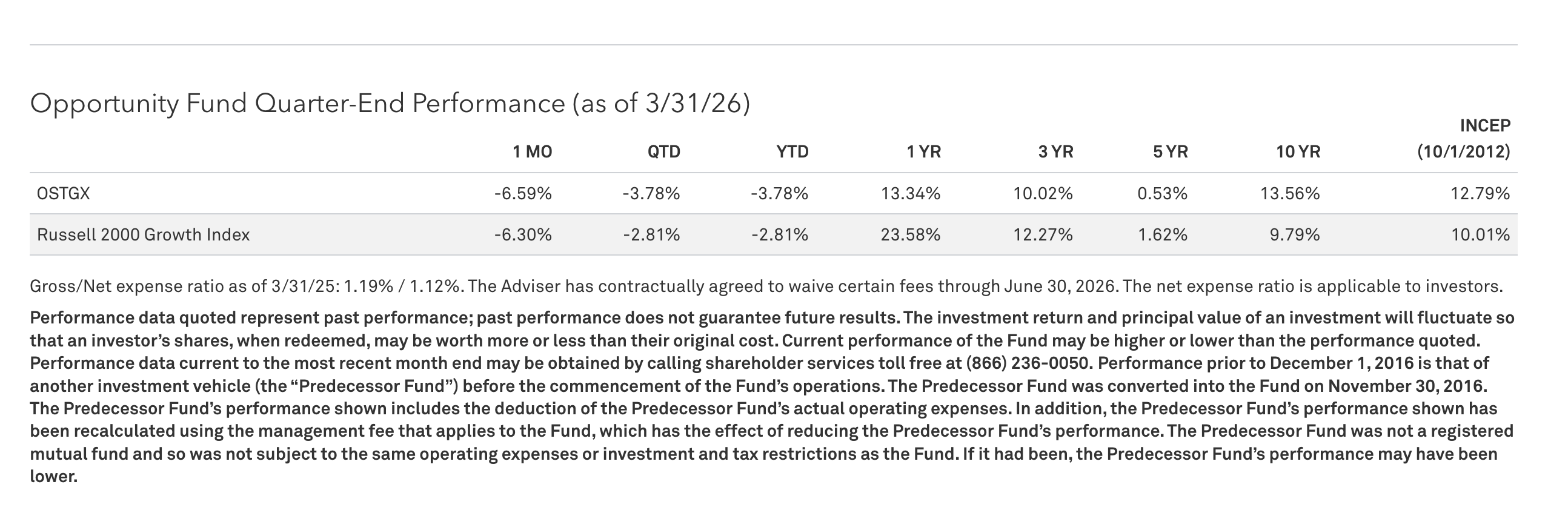
Rates of return for periods greater than one year are annualized.
Where applicable, charts illustrating the performance of a hypothetical $10,000 investment made at a Fund’s inception assume the reinvestment of dividends and capital gains, but do not reflect the effect of any applicable sales charge or redemption fees. Such charts do not imply any future performance.
The Russell 2000 Growth Index (Russell 2000G) is a market-capitalization-weighted index representing the small cap growth segment of U.S. equities. This index does not incur expenses and is not available for investment. This index includes reinvestment of dividends and/or interest.
References to specific companies, market sectors, or investment themes herein do not constitute recommendations to buy or sell any particular securities.
There can be no assurance that any specific security, strategy, or product referenced directly or indirectly in this commentary will be profitable in the future or suitable for your financial circumstances. Due to various factors, including changes to market conditions and/or applicable laws, this content may no longer reflect our current advice or opinion. You should not assume any discussion or information contained herein serves as the receipt of, or as a substitute for, personalized investment advice from Osterweis Capital Management.
Complete holdings of all Osterweis mutual funds (“Funds”) are generally available ten business days following quarter end. Holdings and sector allocations may change at any time due to ongoing portfolio management. Fund holdings as of the most recent quarter end are available here: Opportunity Fund
As of 3/31/2026, the Osterweis Opportunity Fund did not own Microsoft, Alphabet, Amazon, Oracle, Meta, or Salesforce.
Mutual fund investing involves risk. Principal loss is possible. The Osterweis Opportunity Fund may invest in unseasoned companies, which involve additional risks such as abrupt or erratic price movements. The Fund may invest in small and mid-sized companies, which may involve greater volatility than large-sized companies. The Fund may invest in IPOs and unseasoned companies that are in the early stages of their development and may pose more risk compared to more established companies. The Fund may invest in ETFs, which involve risks that do not apply to conventional funds. Higher turnover rates may result in increased transaction costs, which could impact performance. From time to time, the Fund may have concentrated positions in one or more sectors subjecting the Fund to sector emphasis risk. The Fund may invest in foreign and emerging market securities, which involve greater volatility and political, economic and currency risks and differences in accounting methods. These risks may increase for emerging markets.
The Osterweis Funds are available by prospectus only. The Funds’ investment objectives, risks, charges, and expenses must be considered carefully before investing. The summary and statutory prospectuses contain this and other important information about the Funds. You may obtain a summary or statutory prospectus by calling toll free at (866) 236-0050, or by visiting www.osterweis.com/statpro. Please read the prospectus carefully before investing to ensure the Fund is appropriate for your goals and risk tolerance.
Gross Domestic Product (GDP) is the monetary value of all the finished goods and services produced within a country’s borders in a specific time period.
Capital expenditures (CapEx) are funds used by a company to acquire, upgrade, and maintain physical assets such as property, plants, buildings, technology, or equipment.
Return on investment (ROI) is a calculation used to assess a company’s efficiency at allocating the capital under its control to profitable investments.
Osterweis Capital Management is the adviser to the Osterweis Funds, which are distributed by Quasar Distributors, LLC. [OCMI-956483-2026-06-23]
A message from Advisor Perspectives and VettaFi: Discover something new! Click here to register for our upcoming webcasts.
© Osterweis Capital Management
More Emerging Markets Topics >