Could the U.S. Be the Frog in the Pot?
Membership required
Membership is now required to use this feature. To learn more:
View Membership BenefitsKey Takeaways:
-
Rather than a single shock event, U.S. debt concerns are showing up as an insidious increase in borrowing costs tied to weaker fiscal credibility.
-
Since the U.S. lost its AAA sovereign credit rating, markets have increasingly priced Treasuries as riskier than debt issued by most AAA-rated countries.
-
Higher Treasury yields can ripple through the economy by increasing financing costs across mortgages, corporate borrowing, and other private-sector credit.
The old saying is that a frog will jump out of a pot of boiling water but will sit and cook if one turns up the heat slowly. The idea is that slow, insidious temperature increases go unnoticed relative to massive shocks.
Some investors have been worried for years about a day of reckoning for U.S. debt. Consensus has been that investors will wake up one day and the financial market will be unwilling to hold the ever-increasing amount of U.S. government debt (Exhibit 1).
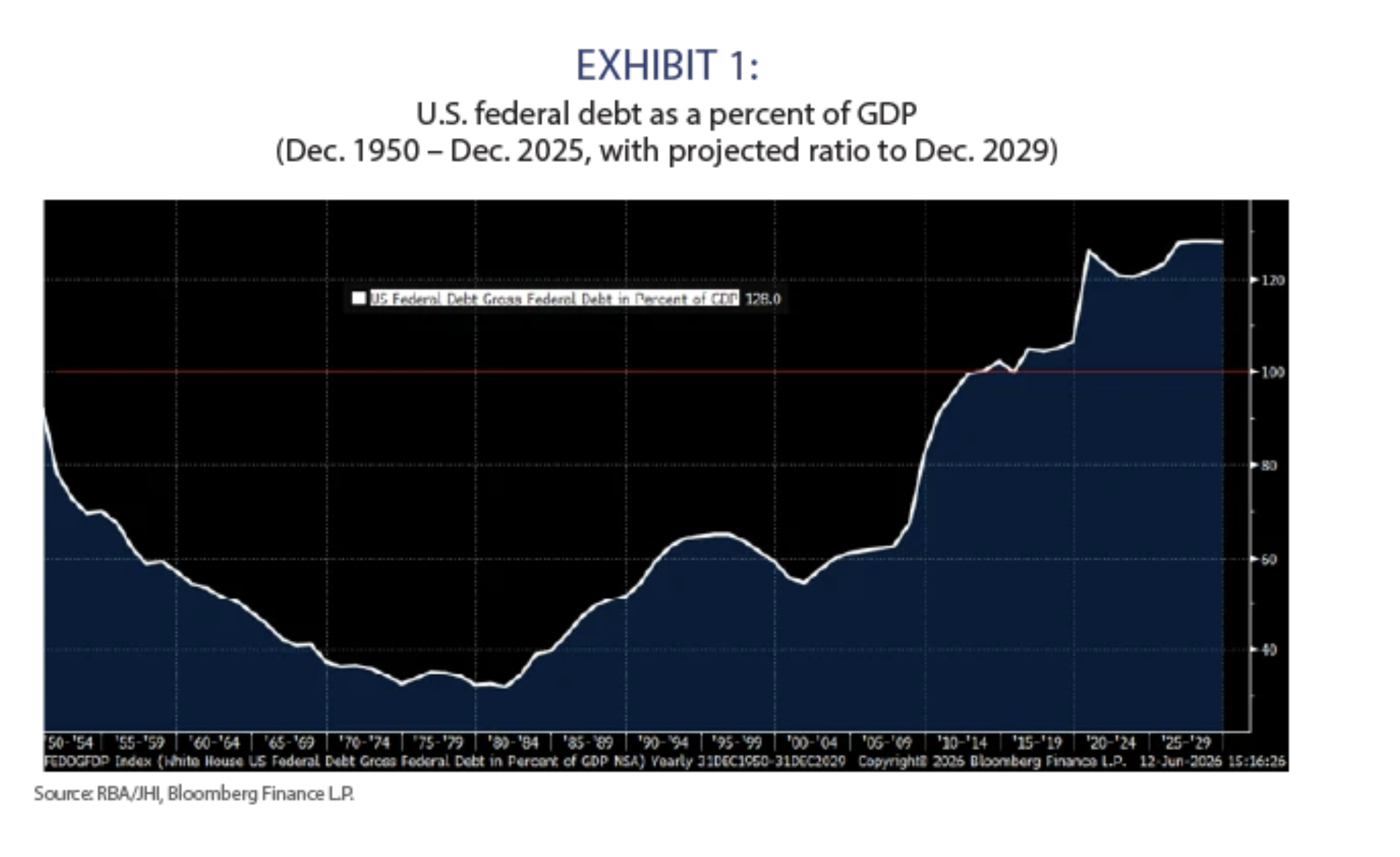
The day of reckoning analogy seems wrong to us. In our view, the markets have been slowly penalizing the U.S. for its fiscal imprudence. The U.S. economy has been punished for more than a decade (importantly, through both Democratic and Republican administrations). The result is that corporations, municipalities, and individuals have been paying higher interest rates than they otherwise might have paid.
An economy doesn’t quickly become uncompetitive, and the added interest expense the private sector has had to pay relative to similar borrowers in other countries has almost certainly contributed to the U.S.’s gradual loss of productive market share.
There is no boiling pot of water that will cause the U.S. to suddenly realize its mistake. Rather, the markets are slowly turning up the heat.
Read more: The Federal Reserve’s New Leader Lays Out His Agenda
The U.S. isn’t AAA rated anymore
Regardless of whether a borrower is a country, a company, or an individual, lenders charge higher interest rates to lower-quality, riskier borrowers to offset the risk of potential delinquencies or default.
Investors price lower-quality bonds so the bonds have higher yields to compensate for the additional risk. Generally, AAA rated bonds would have lower yields than BBB rated bonds, which in turn would have lower yields than junk bonds.
Individuals’ borrowing is not rated by an agency but by FICO score or VantageScore rating. Lower scores denote riskier borrowers, and those borrowers’ higher rates offset the perceived increased risk of default.
Although 2011’s initial downgrade of U.S. government debt from AAA was treated by many as a non-event, the markets almost immediately began to re-price U.S. debt as riskier relative to countries that maintained AAA ratings.
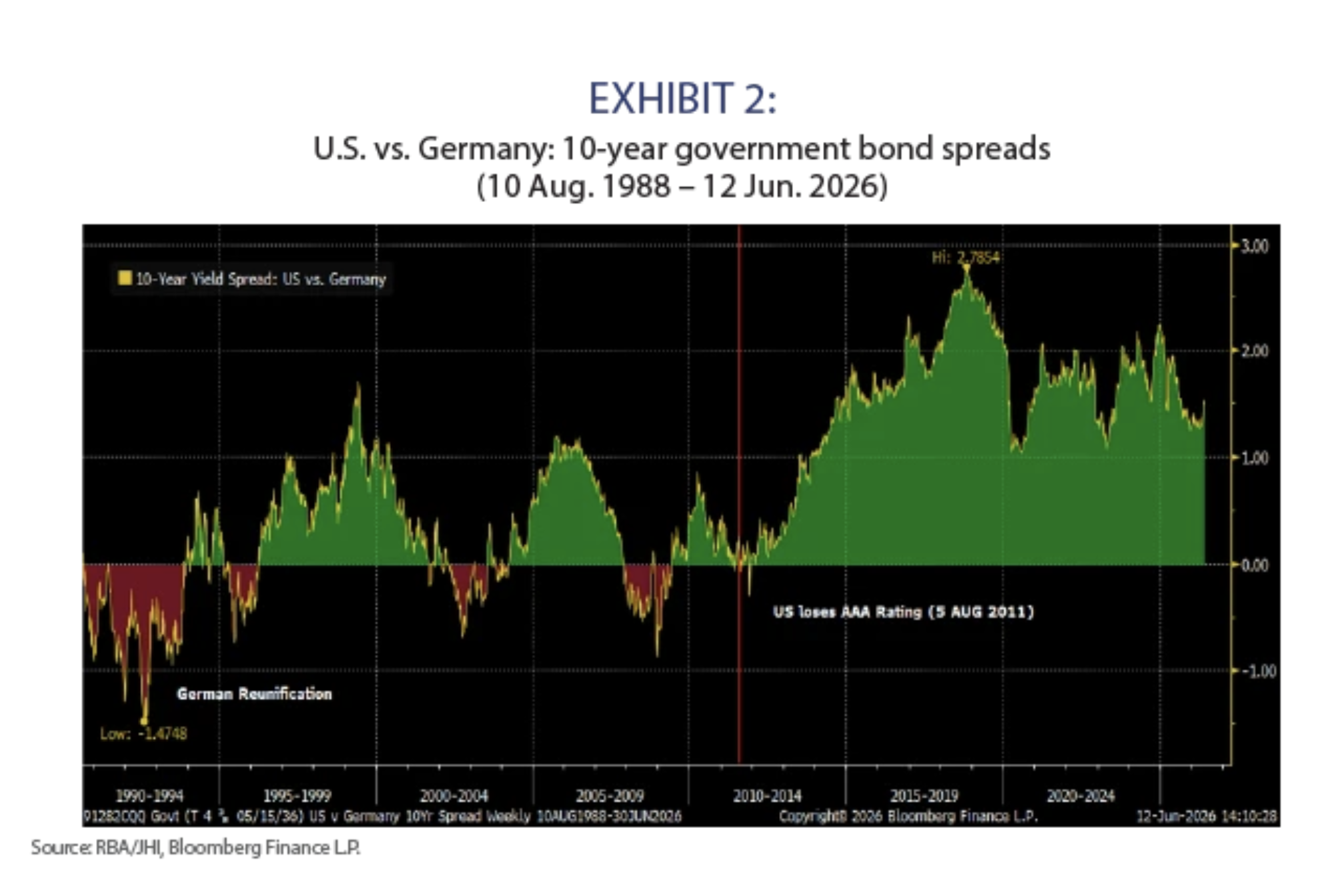
Exhibit 2 shows the spread between the U.S. 10-year Treasury and German 10-year notes. German bonds were priced as riskier (i.e., higher yields) in the early portion of the chart because of the spending that was anticipated for reunification between East and West Germany. After that period, the yields of U.S. and German bonds fluctuate back and forth.
However, U.S. bonds began to trade at consistently higher yields once the U.S. was downgraded. German bonds are still rated AAA and continue to offer lower yields than Treasuries (i.e., borrowing costs for the German government are lower than that of the U.S. government).
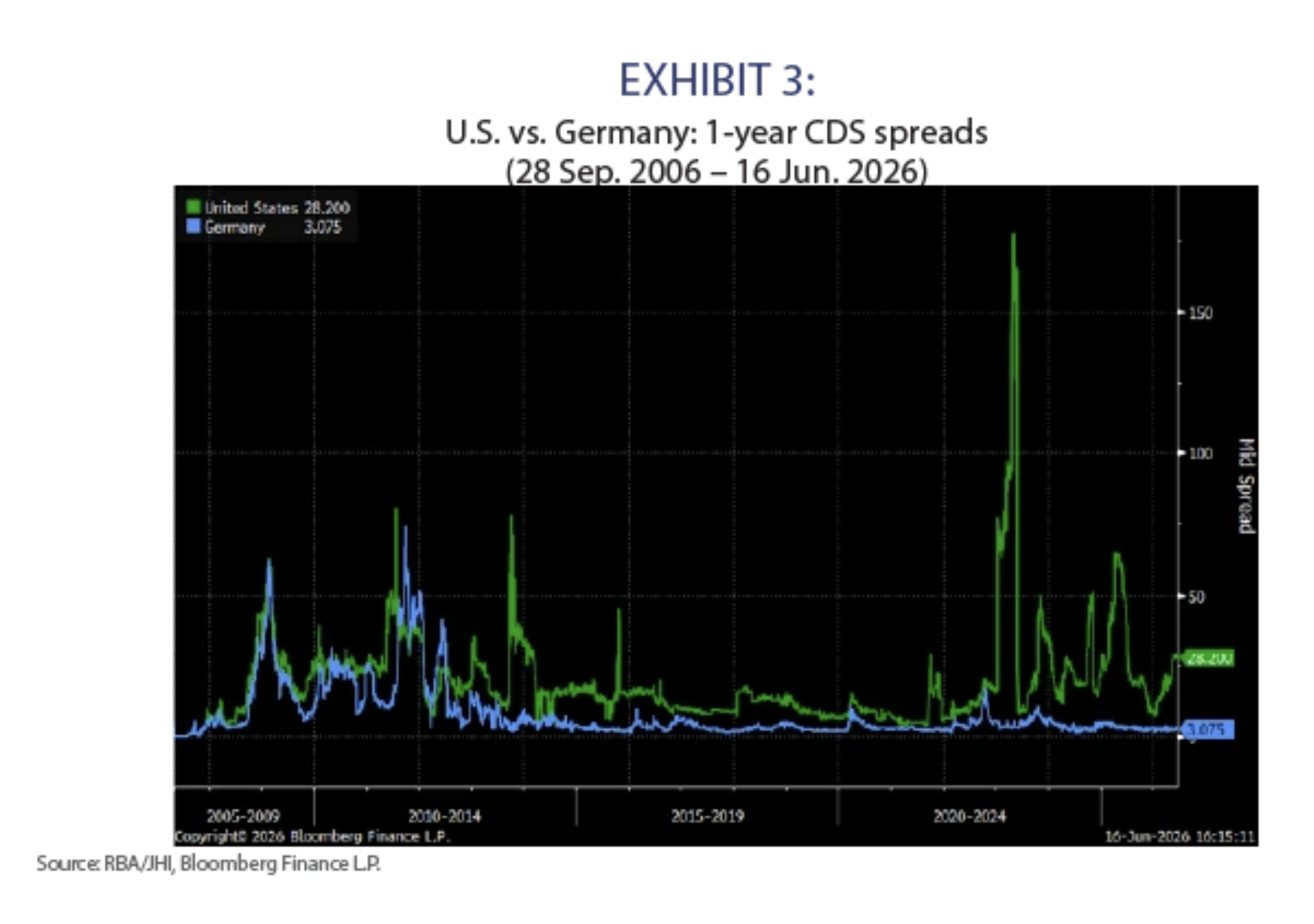
One could argue that there are many reasons why spreads could be wider, but the credit default swap (CDS) market has also priced U.S. Treasuries as incrementally risky. (A CDS is a hedge against default, and CDS spreads are measured in basis points.)
Exhibit 3 shows one-year CDS spreads for U.S. and German debt. Like the earlier spread chart, CDS spreads are roughly similar between the two countries. However, CDS spreads on US debt are marginally higher after the ratings downgrade and has never been lower than Germany’s since that downgrade.
De facto versus de jure “risk-free rate”
The U.S. Treasury market is the deepest and most liquid bond market in the world, and, as such, is often considered to set the “risk-free rate”. U.S. Treasuries were for decades both the de facto and de jure “risk-free rate” for global assets. That isn’t quite true anymore.
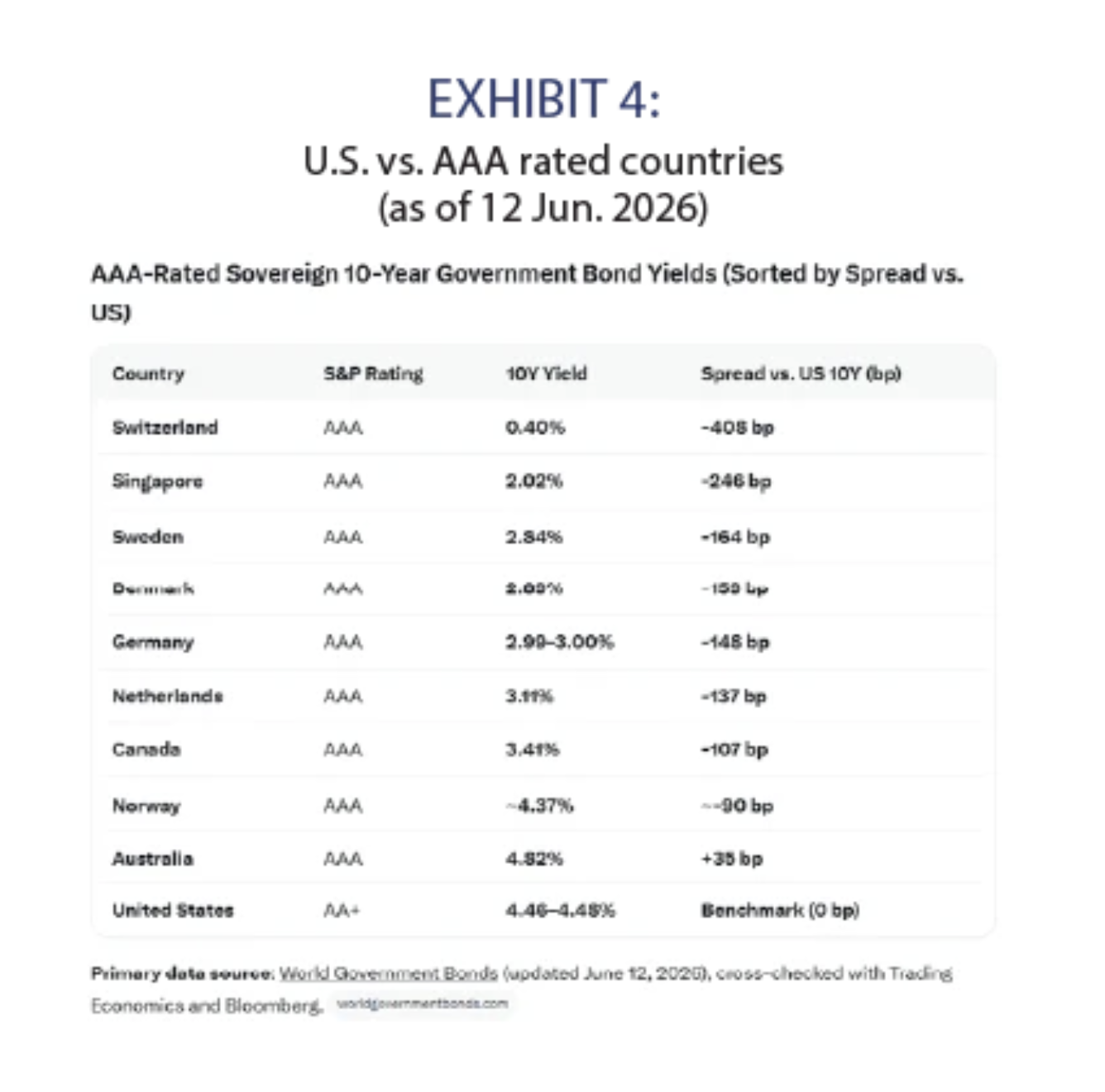
Because of the breadth and depth of the U.S. Treasury market versus the bond markets of AAA rated countries, the U.S. Treasury has remained the de facto “risk-free rate”. However, it has lost its status as the de jure “risk-free rate”: Many other countries are rated AAA and are considered less risky than the U.S.
Exhibit 4 (compiled by xAI) shows the credit ratings and 10-year yields of AAA rated countries versus the U.S. Eight of the nine AAA rated countries presently borrow at yields lower than the US.
The entire U.S. economy has suffered
Sovereign debt in most developed markets is generally considered safer than private-sector debt. Because private-sector yields are based on government yields plus a risk premium, an increase in sovereign debt yield accordingly translates to higher borrowing costs for the private sector.
The downgrade of U.S. debt and the resulting higher government borrowing costs has translated into higher borrowing costs for the entire U.S. economy.
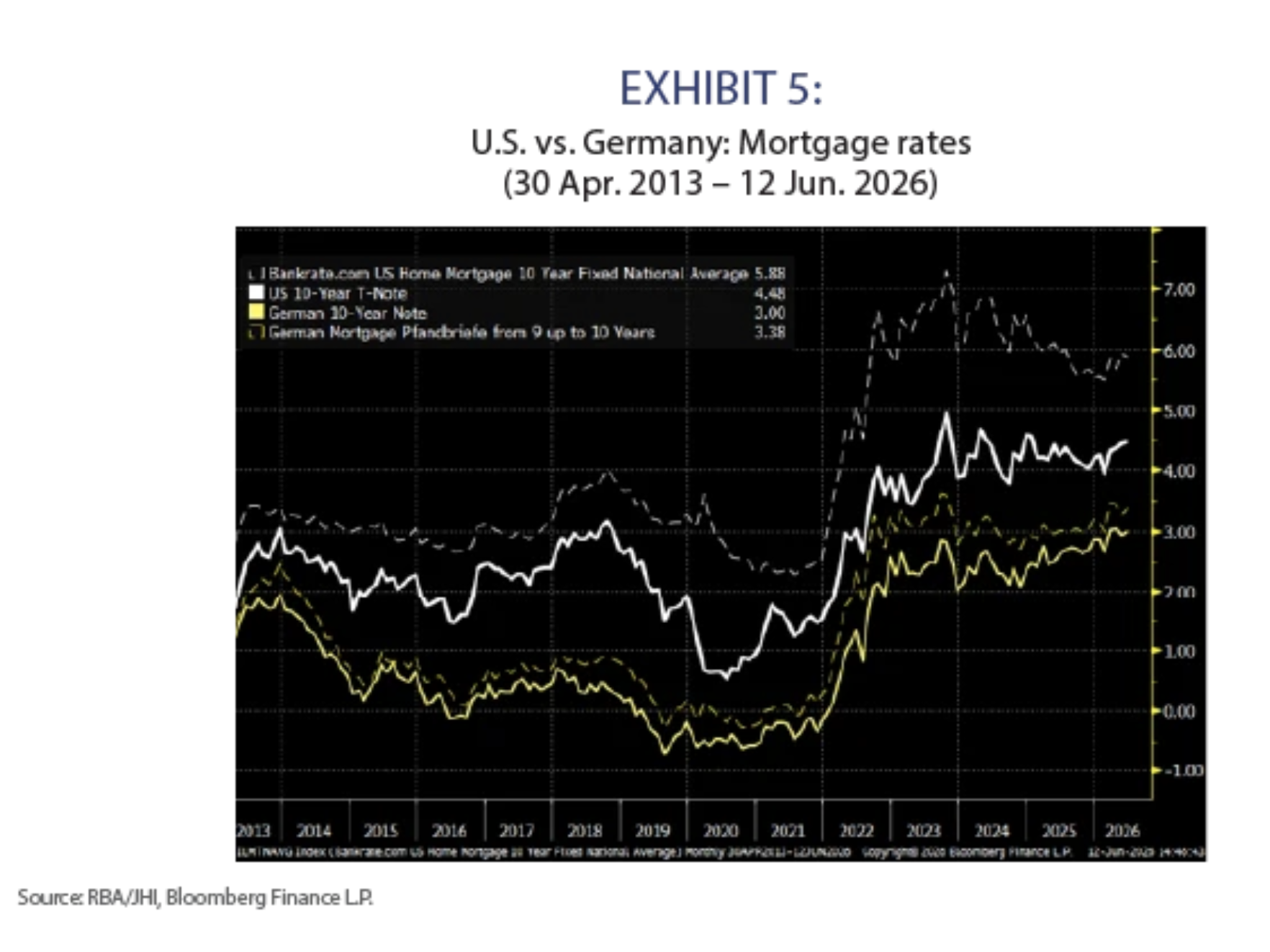
Exhibit 5 compares mortgage rates in the U.S. to those in Germany. Admittedly, these comparisons do not use totally comparable mortgage data, but the story remains important. Mortgage rates in both countries are, of course, higher than government debt yields because individuals are not as creditworthy as the government.
However, mortgage rates in Germany are lower than mortgage rates in the U.S. because U.S. mortgages are based on the yield of the U.S. 10-year Treasury, which has a higher yield than Germany’s 10-year bund.
Whether this chart represents a perfect comparison or not misses the point. The chart does reflect higher borrowing costs in the U.S. because of higher Treasury yields, which are directly related to Washington’s fiscal imprudence.
The entire U.S. economy has been paying a penalty.
The frog had a spine
When a company is in financial trouble, a standard route to repair the damage includes increasing revenues and cutting costs. Unless the U.S. actively decides to follow the path of an emerging market and fosters inflation to alleviate debt issues, the standard route to improve the nation’s balance sheet will be increasing revenue and cutting costs.
However, both Democrats and Republicans refuse to admit this reality. Republicans refuse to raise taxes (i.e., increase revenues) and Democrats refuse to rationalize spending (i.e., cutting costs). Both are necessary, but each party blames the other for the country’s debt problems. Each party’s political dogma apparently is more important than lowering borrowing costs for Americans.
Frogs are vertebrates. Their skeletal system aids them in jumping out of pots of hot water. Investors should certainly hope Washington finds its spine and jumps out of the already warming pot – and does so before it reaches the boiling point.
DEFINITIONS:
10-Year Treasury Yield is the interest rate on U.S. Treasury bonds that will mature 10 years from the date of purchase.
Basis point: One basis point (bp) equals 1/100 of a percentage point, 1bp = 0.01%.
Credit rating: A score given by a credit rating agency such as S&P Global Ratings, Moody’s and Fitch on the creditworthiness of a borrower. For example, S&P ranks investment grade bonds from the highest AAA down to BBB and high yields bonds from BB through B down to CCC in terms of declining quality and greater risk, i.e. CCC rated borrowers carry a greater risk of default.
Credit default swap (CDS): A form of derivative contract between two parties used to manage the credit risk of a bond. The buyer makes regular payments to the seller, while the seller agrees to pay off the underlying debt if there is a default on the bond. A CDS is considered a hedge against non-payment and is also a tradable security. This allows a fund manager to take positions on a particular issuer or index without owning the underlying security or securities. A CDS may expose investors to counterparty risk, liquidity risk, valuation risk, and the potential for losses that exceed the initial investment. Market disruptions or a counterparty’s failure to perform may impact the effectiveness of a CDS strategy or result in unexpected losses. There can be no assurance that the use of CDS will achieve its intended objective.
Credit spread: The difference in yield between securities with similar maturity but different credit quality. Widening spreads generally indicate deteriorating creditworthiness of corporate borrowers, and narrowing indicate improving.
Default: The failure of a debtor (such as a bond issuer) to pay interest or to return an original amount loaned when due. High yield bond: Also known as a sub-investment grade bond, or ‘junk’ bond. These bonds usually carry a higher risk of the issuer defaulting on their payments, so they are typically issued with a higher interest rate (coupon) to compensate for the additional risk.
Fiscal policy: Refers to government policy relating to setting tax rates and spending levels. It is separate from monetary policy, which is typically set by a central bank. Fiscal austerity refers to raising taxes and/or cutting spending in an attempt to reduce government debt. Fiscal expansion (or ‘stimulus’) refers to an increase in government spending and/or a reduction in taxes.
Inflation: The rate at which the prices of goods and services are rising in an economy. The consumer price index (CPI) and retail price index (RPI) are two common measures; the opposite of deflation.
Investment grade bond: A bond typically issued by governments or companies perceived to have a relatively low risk of defaulting on their payments, reflected in the higher rating given to them by credit ratings agencies.
Sovereign bond/government bond: Bonds issued by governments to pay off debt or finance spending. They are typically backed by a country’s capacity to levy taxes on its citizens and/or capacity to print money.
Treasuries/US Treasury securities: Debt obligations issued by the US government. Treasury bills and US government bonds are guaranteed by the full faith and credit of the US government. They are generally considered to be free of credit risk and typically carry lower yields than other securities.
The views presented are as of the date published. They are for information purposes only and should not be used or construed as investment, legal or tax advice or as an offer to sell, a solicitation of an offer to buy, or a recommendation to buy, sell or hold any security, investment strategy or market sector. Nothing in this material shall be deemed to be a direct or indirect provision of investment management services specific to any client requirements. Opinions and examples are meant as an illustration of broader themes, are not an indication of trading intent, are subject to change and may not reflect the views of others in the organization. It is not intended to indicate or imply that any illustration/example mentioned is now or was ever held in any portfolio. No forecasts can be guaranteed and there is no guarantee that the information supplied is complete or timely, nor are there any warranties with regard to the results obtained from its use. Janus Henderson Investors is the source of data unless otherwise indicated, and has reasonable belief to rely on information and data sourced from third parties. Past performance does not predict future returns. Investing involves risk, including the possible loss of principal and fluctuation of value. Not all products or services are available in all jurisdictions. This material or information contained in it may be restricted by law, may not be reproduced or referred to without express written permission or used in any jurisdiction or circumstance in which its use would be unlawful. Janus Henderson is not responsible for any unlawful distribution of this material to any third parties, in whole or in part. The contents of this material have not been approved or endorsed by any regulatory agency. Janus Henderson Investors is the name under which investment products and services are provided by the entities identified in the following jurisdictions: (a) Europe by Janus Henderson Investors International Limited (reg no. 3594615), Janus Henderson Investors UK Limited (reg. no. 906355), Janus Henderson Fund Management UK Limited (reg. no. 2678531), Tabula Investment Management Limited (reg. no. 11286661), (each registered in England and Wales at 201 Bishopsgate, London EC2M 3AE and regulated by the Financial Conduct Authority) and Janus Henderson Investors Europe S.A. (reg no. B22848 at 78, Avenue de la Liberté, L-1930 Luxembourg, Luxembourg and regulated by the Commission de Surveillance du Secteur Financier); (b) the U.S. by SEC registered investment advisers that are subsidiaries of Janus Henderson Group plc; © Canada through Janus Henderson Investors US LLC only to institutional investors in certain jurisdictions; (d) Singapore by Janus Henderson Investors (Singapore) Limited (Co. registration no. 199700782N). This advertisement or publication has not been reviewed by Monetary Authority of Singapore; (e) Hong Kong by Janus Henderson Investors Hong Kong Limited. This material has not been reviewed by the Securities and Futures Commission of Hong Kong; (f) South Korea by
Janus Henderson Investors (Singapore) Limited only to Qualified Professional Investors (as defined in the Financial Investment Services and Capital Market Act and its sub-regulations); (g) Japan by Janus Henderson Investors (Japan) Limited, regulated by Financial Services Agency and registered as a Financial Instruments Firm conducting Investment Management Business, Investment Advisory and Agency Business and Type II Financial Instruments Business; (h) Australia and New Zealand by Janus Henderson Investors (Australia) Limited (ABN 47 124 279 518) and its related bodies corporate including Janus Henderson Investors (Australia) Institutional Funds Management Limited (ABN 16 165 119 531, AFSL 444266) and Janus Henderson Investors (Australia) Funds Management Limited (ABN 43 164 177 244, AFSL 444268); (i) the Middle East by Janus Henderson Investors Middle East Limited (DIFC branch), regulated by the Dubai Financial Services Authority as a Category 4 licensed entity. This document relates to a financial product which is not subject to any form of regulation or approval by the Dubai Financial Services Authority ("DFSA"). The DFSA has no responsibility for reviewing or verifying any prospectus or other documents in connection with this financial product. Accordingly, the DFSA has not approved this document or any other associated documents nor taken any steps to verify the information set out in this document, and has no responsibility for it. The financial product to which this document relates may be illiquid and/or subject to restrictions on its resale. Prospective purchasers should conduct their own due diligence on the financial product. If you do not understand the contents of this document you should consult an authorised financial adviser. No transactions will be concluded in the Middle East and any enquiries should be made to Janus Henderson. We may record telephone calls for our mutual protection, to improve customer service and for regulatory record keeping purposes.
Outside of the U.S., Australia, Singapore, Taiwan, Hong Kong, Europe and UK: For use only by institutional, professional, qualified and sophisticated investors, qualified distributors, wholesale investors and wholesale clients as defined by the applicable jurisdiction. Not for public viewing or distribution. Marketing Communication.
Richard Bernstein Advisors LLC is an investment adviser and a wholly-owned subsidiary of Janus Henderson US (Holdings) Inc. Janus Henderson® and any other trademarks used herein are trademarks of Janus Henderson Group plc or one of its subsidiaries. © Janus Henderson Group plc.
A message from Advisor Perspectives and VettaFi: Discover something new! Click here to register for our upcoming webcasts.
Membership required
Membership is now required to use this feature. To learn more:
View Membership BenefitsSponsored Content
Upcoming Virtual Events View All