Resilient Private Income in Late-Cycle Markets
Membership required
Membership is now required to use this feature. To learn more:
View Membership BenefitsInvestors have increasingly embraced private income-producing assets amid a “lower for longer” outlook for rates and credit spreads, which has reduced the perceived opportunity cost for giving up liquidity. Yet most also recognize that the sheer volume of capital being allocated can compress the very illiquidity premium they are targeting. This is particularly true for corporate direct lending, the area that has seen the most vigorous capital formation in recent years. But potential sources of attractive income with resilient risk profiles do exist in other sectors – most notably in areas where traditional bank lenders face constraints and many non-bank lenders face barriers to entry.
In the later stages of an extended economic cycle, however, it is critical to focus on resilience. While many participants are more concerned with deploying capital, we believe it is important to focus on the “three D’s” of portfolio construction (discipline, diversification, and disintermediation) and the “three R’s” of asset underwriting (repayment, refinancing, and recovery).
Attention to the ‘Three D’s’ is critical in an aging expansion
The significant growth of the private credit market has been concentrated in lending to sponsors acquiring middle-market companies – an area with few barriers to entry but one familiar to many yield-starved investors. Private equity sponsors can usually fend for themselves, and since corporate credit came through the global financial crisis relatively unscathed, the thrust of post-crisis re-regulation has instead focused on protecting consumers while making the banking system safer. But each cycle is different. Today, corporate credit is attracting headlines for aggressive leverage, earnings adjustments, and covenant erosion.
Discipline: Requires the right incentives
We believe retaining investment discipline is far easier if you aren’t under pressure to deploy a specific amount of capital in a particular sector in a limited period of time. Raising too much capital (particularly late in the cycle) or having too narrow a mandate may increase the temptation to stretch underwriting assumptions to fit the price needed to “win” deals. Broad, flexible mandates may help relieve that pressure by permitting a pivot to other sectors, origination channels, and asset types that are less crowded and offer more resilient characteristics. For example, we currently find lending standards in residential mortgage credit, and certain specialty finance sectors, to be more conservative than long-term averages.
Diversification: Requires a breadth of capabilities
The huge variety of private income-producing assets and structures provides significant scope to build meaningful economic diversification, in our view. Different sectors have varying sensitivities, including timing, to personal incomes, to profit margins, to lease rates and to specific collateral values. For example:
- Corporate earnings recessions may coincide with record employment.
- Rising wages can enhance debt service coverage for consumers while eroding corporate profit margins.
- Oil well completion and rig capacity utilization are not intuitively correlated to hotel occupancy rates!
Disintermediation: Requires sourcing and structuring expertise
As Figure 1 illustrates, the breadth of private income-producing assets that exist can facilitate a disciplined and diversified investment approach. It also shows that private forms of the assets often map to more homogenized forms of similar risk in the public securities markets, where decades of performance history spanning multiple cycles can be found. Banks were previously dominant in originating or accumulating the private forms of exposure shown on the right, often exiting or financing these assets via structuring them into bonds for the public markets on the left. But regulation has accelerated the secular trend of disintermediation, particularly around residential mortgage and other forms of consumer lending, creating opportunities for non-banks lenders.
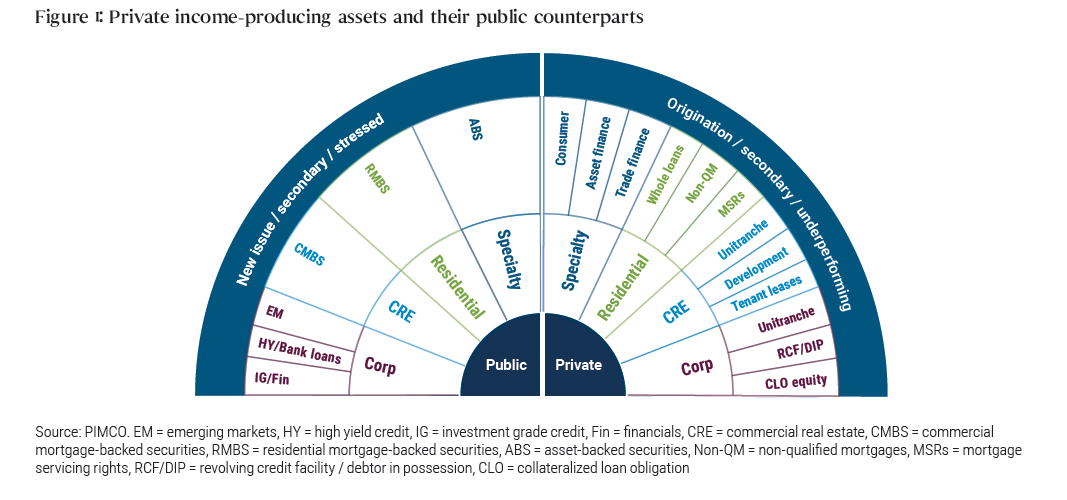 Image Pop Up
The ‘Three R’s’ are key when assessing late-cycle investments in private assets
A focus on repayment, refinancing, and recovery underpins a thoughtful approach to investments in private markets.
Repayment: With little compensation for term risk, seek shorter weighted average life
It might seem obvious that lenders should care about how they get repaid, but when competition to make loans is fierce, the emphasis is often on reinvestment risk rather than repayment risk. If the term structure of interest rate and credit risk is flat, offering little compensation for extending tenor, then keeping average life short is often attractive from a risk perspective, even if it requires working harder to stay invested.
In that regard, pools of consumer loans may offer an attractive combination of a short term and an even shorter weighted average life. Loan terms of three to four years often translate to weighted average lives of 16 to 24 months, given the propensity of individuals to prepay higher-cost unsecured borrowings. Low unemployment, the deleveraging of household balance sheets since the financial crisis, and incomes that comfortably exceed expenditures (on average) for borrowers with prime and near-prime credit scores each support credit fundamentals in this sector. But if there is any deterioration in realized versus modelled loan pool performance, existing exposure can be allowed to run off rapidly.
Secondary acquisitions of seasoned loan pools represent another means to shorten weighted average life. Weaker borrowers often become delinquent or default early in the term of their loans, while borrowers who have remained current generally become more incentivized to repay their borrowing lines to preserve their credit scores. Sales of near-prime and even prime consumer loan pools, such as auto loans or credit card receivables, are frequently made by institutions that view those assets (or the business line itself) as non-core. The role of loan servicer, critical in maximizing repayments, may be retained by the seller or transferred to a new group, depending on the buyer’s strategy and knowledge of the respective strength of servicers across the market.
Average life can also be materially shortened by scheduled amortization of principal. Banks used to insist on amortization for corporate term loans they retained, while syndicating bullet maturity loans to investors. The unitranche loans (combining senior and subordinated debt) that have become the staple financing offered by direct lenders almost always have bullet maturities. In contrast, certain forms of equipment finance offer full amortization of principal over four to five years, even when the asset has a far longer useful life. The coupons that can be negotiated on these asset-backed loans are often equivalent to those for cash-flow-backed direct corporate loans. Such lending requires specialized underwriting of the value of the collateral, taking into full account cyclical usage scenarios. This provides barriers to entry for many non-bank, non-specialist lenders, while banks frequently hit concentration limits in such business lines.
Refinancing: For non-conforming assets, look to the “next lender”
Another area worthy of focus in the later stages of the credit cycle is “next-lender analysis.” Focusing on asset types that don’t fit the criteria of most lenders is a great way to thin out competition when sourcing assets, but if the criteria can be met over the holding period, the number of parties that will be willing to refinance the original loan may increase significantly.
A good example is legacy residential mortgage loan pools in which the underlying loans have been heavily modified to reduce prospective delinquencies and enhance performance. Most buyers of whole loan pools, or of bonds issued through the securitization of such pools, prefer to observe a few years of performance following such modifications. Recently modified re-performing loan pools thus provide a buying opportunity for investors with the analytics and special servicing experience needed to gauge prospective pool performance. Once the loans are held for a few years and performance history improves, investors may exit these pools in part or in full via securitization.
A similar concept can apply when originating loans, particularly shorter-term loans that serve as a bridge to stable long-term financing. In commercial real estate lending, for instance, some sponsors focus on acquiring transitional properties that require combinations of refurbishment, redevelopment, repositioning, and re-leasing in order to stabilize cash flows at higher levels. Those sponsors seek customized but short-term financing to help execute their value-add business plans, but want the flexibility to refinance with longer-term, lower-cost debt once the assets are stabilized.
Note, however, that today’s stabilized asset can become tomorrow’s destabilized asset! The asymmetry of capped upside but essentially uncapped downside should be factored into underwriting and is typically included in expected-loss credit rating methodologies, though private debt is rarely rated. Transitional, re-performing, and specialist lending, while complex, actually tends to benefit from greater symmetry in terms of future cash flow. Upside scenarios stem from the simplification as well as the stabilization of cash flows. Downside scenarios for private assets, assuming they can be held for the requisite period, can be defined by the recovery of principal and interest that is ultimately achievable.
Recovery: Independent valuation is key
For unsecured lending, recoveries are typically very low, making it critical to incorporate expected cumulative losses into underwriting. For secured lending, collateral value is the critical factor determining recoveries likely to be achieved. Reasonable loan-to-value ratios (LTVs) imply a reasonable equity cushion to absorb depreciation in collateral value before debt impairment becomes probable. However, the cushion may not prove robust if the initial value is inflated, cyclically or otherwise.
The popular practice of lending based on a company’s enterprise value relies on an equity capitalization that does not prove overly optimistic. As ever, dispersion in valuations is significant, and the ability to independently value collateral is critical. Within U.S. real estate markets, valuations of multifamily (apartment) properties are now some 70% higher on average than their pre-crisis peak, while single-family home price indices are only 14% higher in nominal terms (see Figure 2) – and far less in real terms after nearly 13 years.
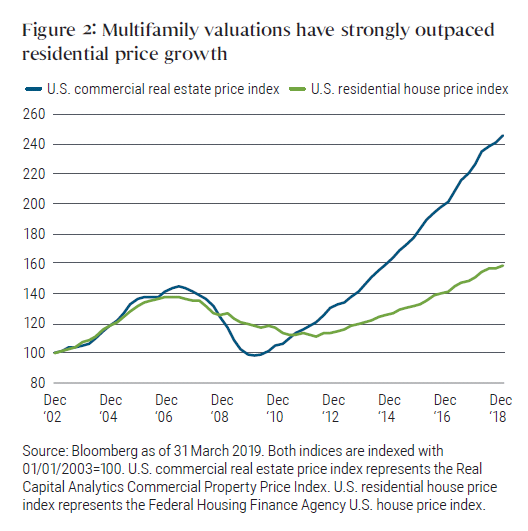
U.S. residential house prices are supported by the underbuilding of new homes and reasonable affordability ratios, and servicing a mortgage remains less costly than renting. We believe lending against this collateral at around 70% LTVs offers resilient profiles across house price scenarios, given high, if not full, expected recovery rates in the event of default. Focusing on non-qualified borrowers – those abandoned by the banks, which have lost safe harbor from potentially being sued for this type of lending – may offer attractive excess returns. In our view, performance of this type of mortgage has been excellent over the past five years (ended 20 September 2019), with cumulative losses of approximately 0.02%,1 barely eating into coupon rates that have been materially higher than for qualified borrowers. Also, pools of those mortgages further benefit from amortization and prepayments, materially shortening their average life relative to the underlying term.
A first mortgage represents a clear and time-tested form of security – certainly when compared with many direct corporate loans that may enjoy first-lien status but are often secured only by a pledge of shares in the company. Covenants are also a tested form of protection for lenders, both by constraining borrower behavior and by providing triggers to force borrowers to negotiate. In “plain vanilla” corporate lending, the amount of headroom or scope of exceptions has rendered covenants far less valuable, if they are included at all. But for more specialist or customized private income-producing assets, the negotiation of covenants, and monitoring of business plan milestones, may prove key to recoveries if cash flows do deteriorate.
Resilient private income
Gaining exposure to sources of private income-producing assets remains a key imperative for institutional investors. Resilient risk-reward profiles do exist, even at this late stage of the cycle, but we believe that the design of the investment process and the investment vehicle must equally be resilient.
A broad and flexible mandate that facilitates disciplined deployment and efficient reinvestment across sectors, and one that seeks to eliminate any asset-liability mismatch, will prove critical to success in navigating this and future cycles.
1Based on PIMCO holdings
© PIMCO
Membership required
Membership is now required to use this feature. To learn more:
View Membership BenefitsSponsored Content
Upcoming Virtual Events View All