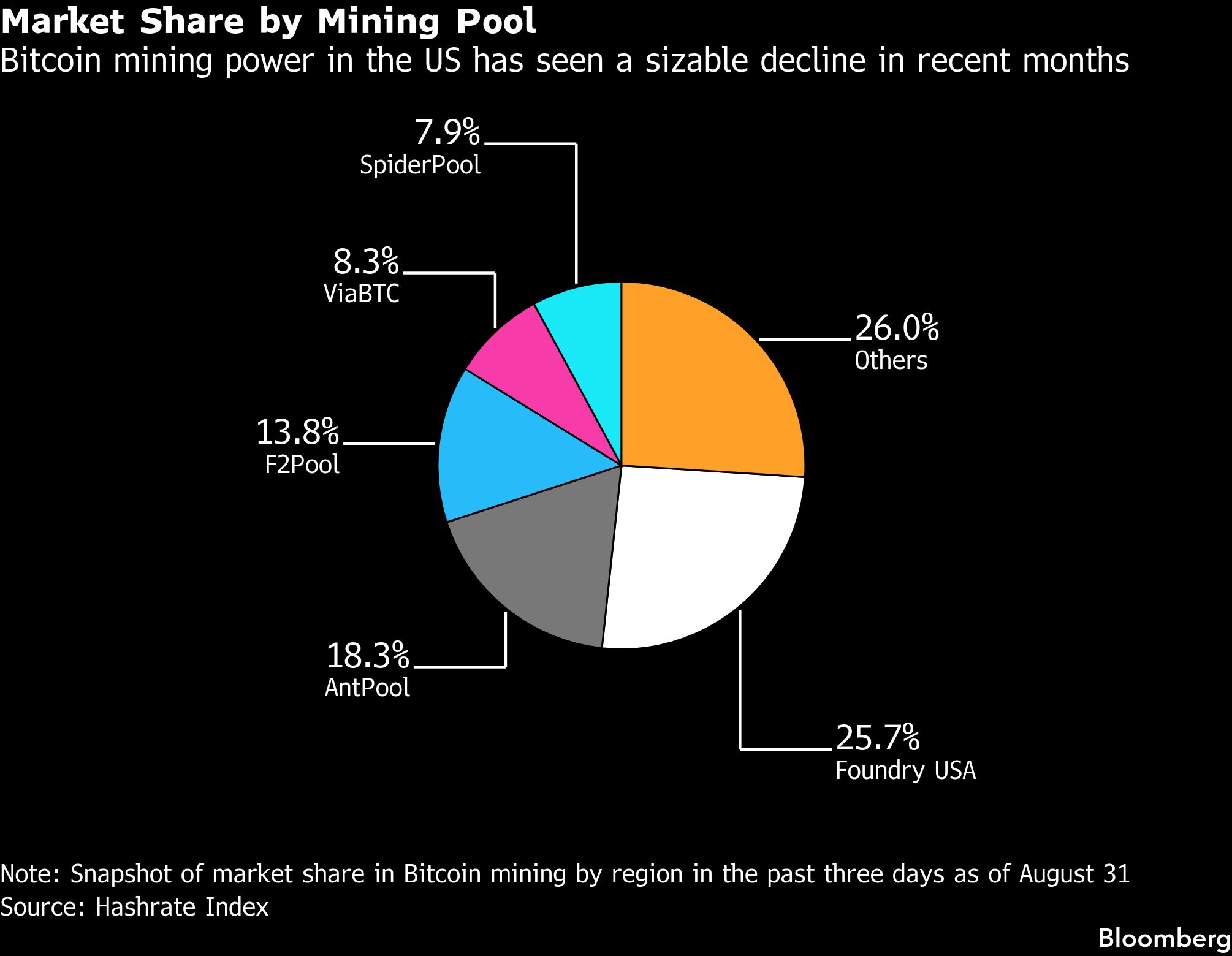
Donald Trump’s pledge to ensure that Bitcoin mining activity is centered in the US is rapidly disintegrating under the twin forces of the artificial intelligence boom and a prolonged crypto slump.
Even after a recent rally, Bitcoin’s overall market value is down about $1 trillion from an October 2025 peak, while the economics of mining the token — verifying transactions to earn rewards — have scarcely ever looked less appealing.
Soaring AI consumption has triggered a rush among miners to convert their facilities into data centers tailored to the industry’s needs. By the end of the year, public miners are expected to generate most of their revenue from AI. Some manufacturers of crypto mining hardware are following suit by pivoting to AI.
Consequently, Bitcoin mining is using up 18% less compute power today than in October last year, according to data tracked by Seattle-based crypto mining services provider Luxor Technology. But the market isn’t just shrinking, its center of gravity is shifting too — away from the US toward China and Russia, reversing a years-long trend.
“The largest decline is for US-publicly listed companies, as they turn to deploy their energy into AI,” said Luxor Chief Operating Officer Ethan Vera. “We expect this trend to continue.”
It’s a dramatic turnaround for a once-budding market that formed a major part of Trump’s pitch to the crypto faithful on the campaign trail in 2024. Mindful of potential competition from China, Trump said he wanted every Bitcoin to be “made, mined and minted” in the US.
Trump’s family has felt the shift, too. American Bitcoin Corp., the Trump family-backed miner launched last year just before the cryptocurrency tumbled from record highs, has posted losses for three consecutive quarters and saw its shares tumble around 90% in the past year.
China used to dominate the crypto mining industry thanks to cheap energy and easy access to machines produced in the country by the likes of Bitmain Technologies Ltd. A sweeping crackdown by Beijing authorities in 2021 changed that, sparking an exodus. The US then became the market fulcrum, and a flurry of public companies such as MARA Holdings Inc. and Riot Platforms Inc. rapidly scaled up their operations.
These companies rely on institutional mining pools — platforms that aggregate compute power to increase miners’ chances of earning rewards. Because MARA and its rivals are US-listed, they tend to use US-compliant pools, like Foundry USA. AntPool and F2Pool, meanwhile, are more popular among miners outside of the US. Foundry’s share of total mining activity has fallen from more than one-third of the computing power for the entire Bitcoin network to 26%, according to the Hashrate Index.
The pools can only offer a rough estimate of how mining is changing, but the shift away from the US is clear, Vera said.
Hardware Issues
It’s a change that can also be observed in the business decisions of crypto mining hardware manufacturers.
In March, Santa Clara, California-based mining hardware startup Auradine Inc. rebranded to Velaura AI, and began touting a new silicon design and intellectual property platform. The firm said in August that it raised $110 million in Series A financing, bringing its total valuation to more than $1 billion.
“Our work in Bitcoin ASICs helped us prove these technologies at high volume and in demanding real-world deployments,” said Rajiv Khemani, co-founder and CEO of Velaura AI. Over the past few years, “it became clear that power and energy efficiency are becoming among the most important constraints in AI data centers as well as in emerging physical AI applications,” he added.
Auradine’s repositioning suggests that the past few years of heightened crypto mining activity in the US may ultimately prove a blip. While most kinds of crypto businesses are formally banned in China, the country maintains a vicelike grip on the hardware side of the business. Bitmain remains a near-monopoly.
The reality is setting in even for pro-crypto lobbyists.
It’s very difficult to build manufacturing facilities in the US, particularly for energy-intensive facilities, according to The Digital Chamber, a blockchain lobbying group. Mining manufacturing companies are actively seeking to onshore their capabilities but are often deterred because of factors including long permitting timelines, access to power, supply-chain vulnerabilities and tariffs, it said.
At least some of those efforts are ongoing, however. Jack Dorsey’s Block Inc. a year ago unveiled its own mining machine: the Proto Rig, a sleek, gray box with outlets for fans. But Block has largely kept quiet on Proto since then.
In July, Singapore-based Bitdeer Technologies Group said it would invest $36 million to build its first US manufacturing facility in Sparks, Nevada. From there, it expects to make 10,000 of its Sealminer machines — used for mining crypto — each month.
“We still see Bitcoin mining as a core pillar,” said Retainna Lin, vice president of Bitdeer AI, in an interview.