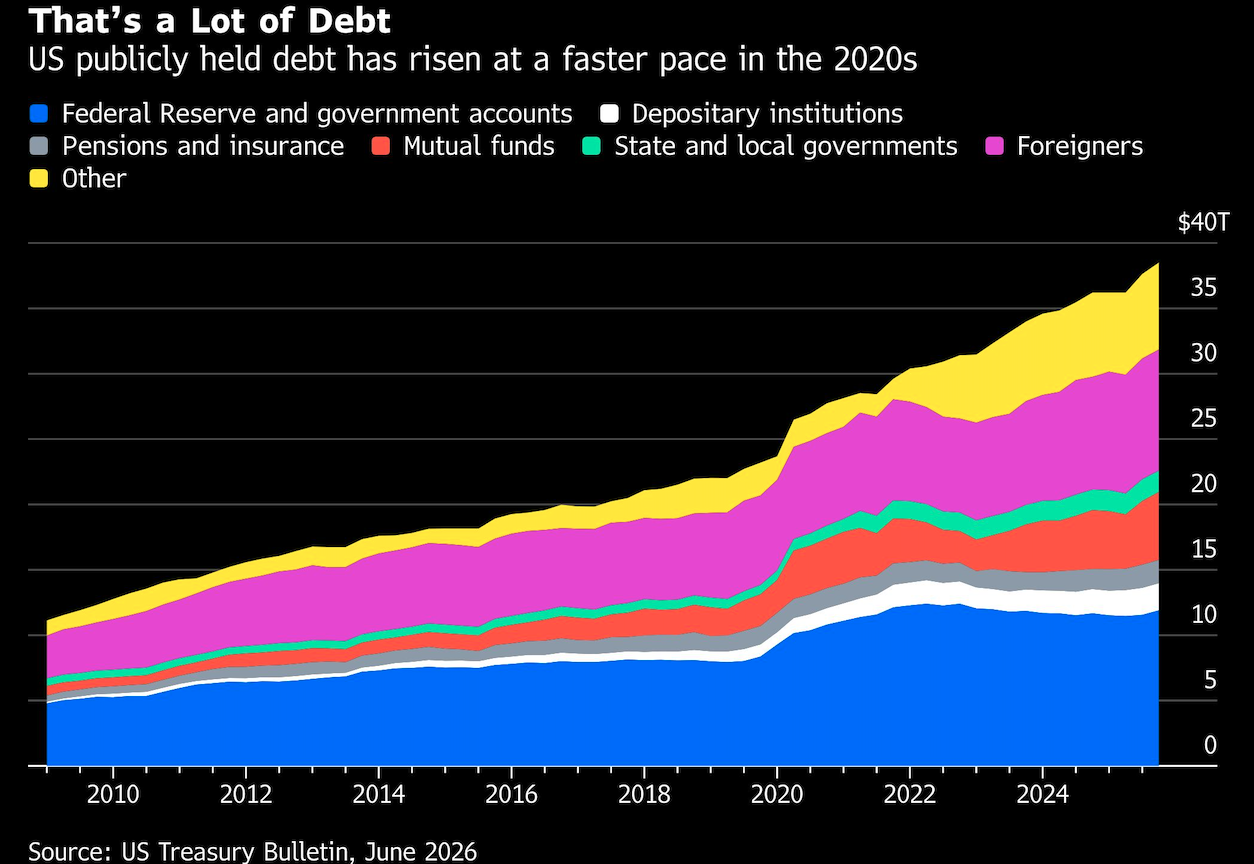
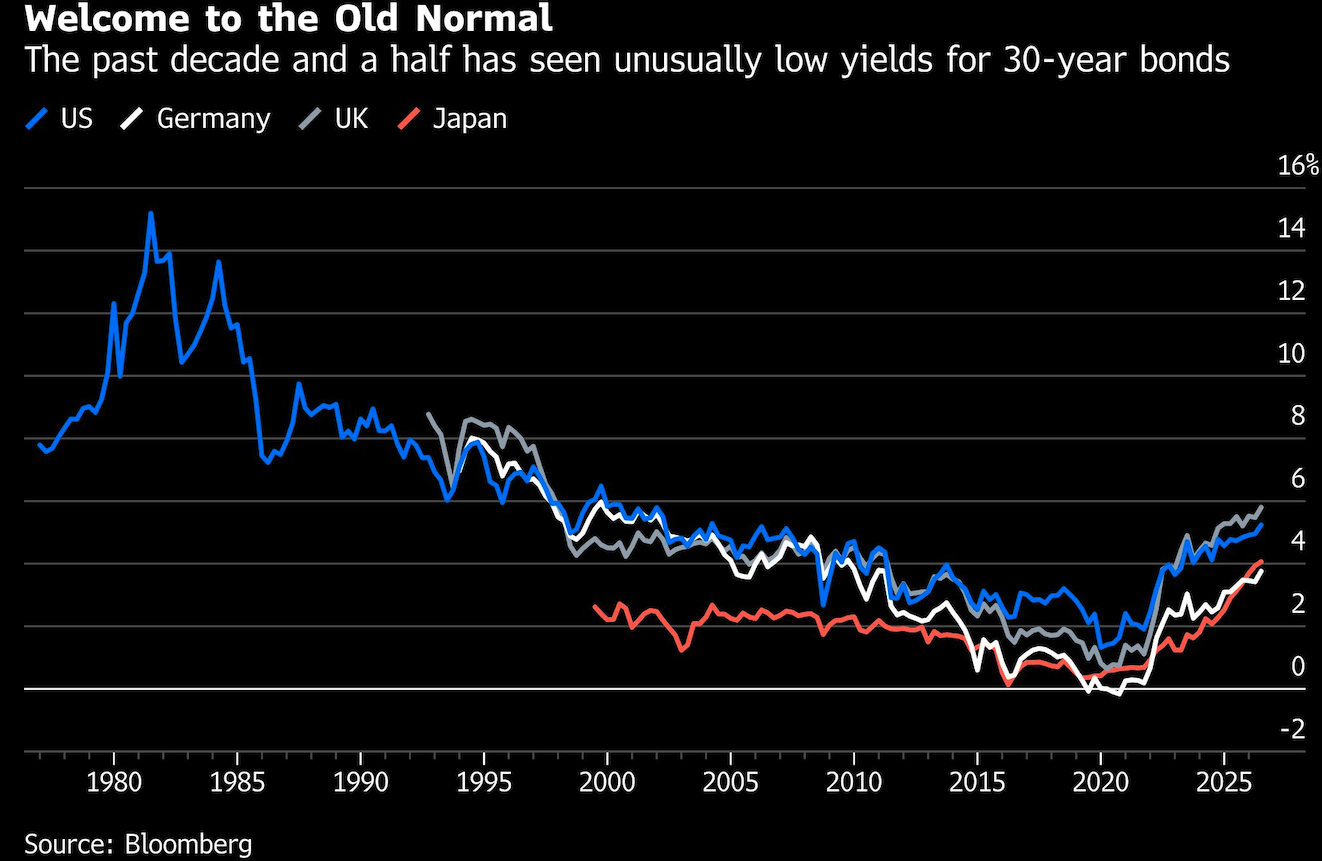
Yields on 30-year US bonds broke 5% last week, a level not seen since before the Great Financial Crisis. The Treasury Department bought bonds in an attempt to lower yields. It worked — for a day, then bond yields went back up. Meanwhile, in a not-exactly-unrelated development, the US national debt just passed $40 trillion.
Bond doomers (I am one) have been waiting for this moment for about 15 years. But we are not yet vindicated. Yields may fall again, though it’s unlikely the low-rate environment of the 2010s is coming back. We may be in for a rocky time, when long-duration debt earns its term premium. Here are three things I’ve learned about the bond market that are helping me navigate this uncertainty.
If the 2010s were about excess demand for bonds, then the rest of the 2020s will be about excess supply. In the 2010s, there was a lot of money sloshing around looking for a safe place to go: Foreign governments wanted to manage their currencies. Banks needed bonds for regulatory reasons. Foreign pension funds wanted to reduce their risk exposure. But there was a limited supply of bonds. US Treasuries were the largest and most liquid market, and demand was pretty much unlimited.

Now this is changing. Pensions are holding more equity, as well as private assets. Deglobalization means countries have less need to manage currencies with foreign assets. Foreign investors are still buying US bonds for now, but because they are attracted more to higher yields than to safety, demand is fickle.
Meanwhile, the global supply of bonds keeps growing. Almost all countries face a bigger debt burden as their populations age and their social spending grows. There is also more investment-grade corporate debt in the public and private markets. It all adds up to more supply and softer demand. It may not bring on a full-on sovereign debt crisis, or even bond vigilantes waking up to unsustainable debt, but it does mean structurally higher rates.
See more: The Hidden Concentration Between a Portfolio's Equity & Bond Sleeves
This is not a new normal — it is just normal, period. On of the first things I learned about long-term bonds is that, unlike stocks, they revert to the mean. Bond prices can’t keep going up forever, because that would involve negative yields. Bond yields tend to oscillate around a long-term average. That average may change over time, and it has fallen since the Middle Ages as the world became a less risky place.
But it can fall only so much. Long-term yields usually reflect human nature; they compensate us for the fact we value the present more than the future, and that the future is uncertain. Those things don’t change.
That said, yields might deviate from their long-term average for decades at a time. But eventually they come back. A near zero-rate environment was never “the new normal”; it was a holiday from history. That holiday is probably over — and for the entire bond market, not just US Treasuries.
Trying to control the yield curve is expensive and ultimately futile. The popular saying is that you can’t fight the Fed, but it should also be that you can’t fight the long end of the curve. Monetary policy can set short-term rates, but it doesn’t control long-term rates. Monetary policy has some influence — some of the current spike could be because the new Fed chairman is less transparent, or the Fed may be giving up on its inflation target. But no matter what the Fed does or says, long-term yields are set mostly by markets.
A government or central bank can try to keep rates low by buying bonds itself or requiring banks and pensions to buy them. But eventually market conditions will prevail. Financial repression also comes at a steep cost; Japan is a cautionary tale. Its government tried for decades to cap long-term rates, and the result was low growth and distortions in financial markets. Now that inflation has returned to Japan, its central bank must choose between higher rates or inflation, and it is struggling to defend the yen.
The lesson is that if a government wants to keep long-term interest rates low, there is really only one way: debt reduction. This truth was forgotten, and sometimes denied, for the last 20 years.
The return to higher rates will also have big implications for households. On the bright side, people can expect a higher return on their savings and cheaper annuities. And sometimes higher rates might reflect promising investment opportunities or the possibility of faster growth. But they also increase the costs of borrowing. A 6% mortgage is probably the new normal.
And governments will have much less fiscal space. Interest payments are already the third biggest expense in the US federal budget. They will take up an even bigger share if rates stay high, which could require cutting spending. Higher rates may also cause dislocations in the private sector. Higher yields lower the value of stocks and increase the cost of borrowing. Many companies borrowed cheaply before the pandemic, and their debt is now coming due. They will have to refinance at a higher rate, and some may go bust.
Still, while adjusting to the old normal may be rocky, it needn’t be disastrous. There have been periods of high interest rates before, and the economy functioned — and even grew. Bond yields set the price of risk throughout the economy. The very low rates of the 2010s were never realistic. Returning to a more normal yield on long bonds may cause some dislocations — not to mention a fiscal reckoning. But the US, and the world, could end up in a more honest place.
A message from Advisor Perspectives and VettaFi: Discover something new! Click here to register for our upcoming webcasts.
Bloomberg News provided this article. For more articles like this please visit
bloomberg.com.
Read more articles by Allison Schrager