It’s easy to make the case that the US equity market is in bubble territory. After all, the major metrics point in the same direction:
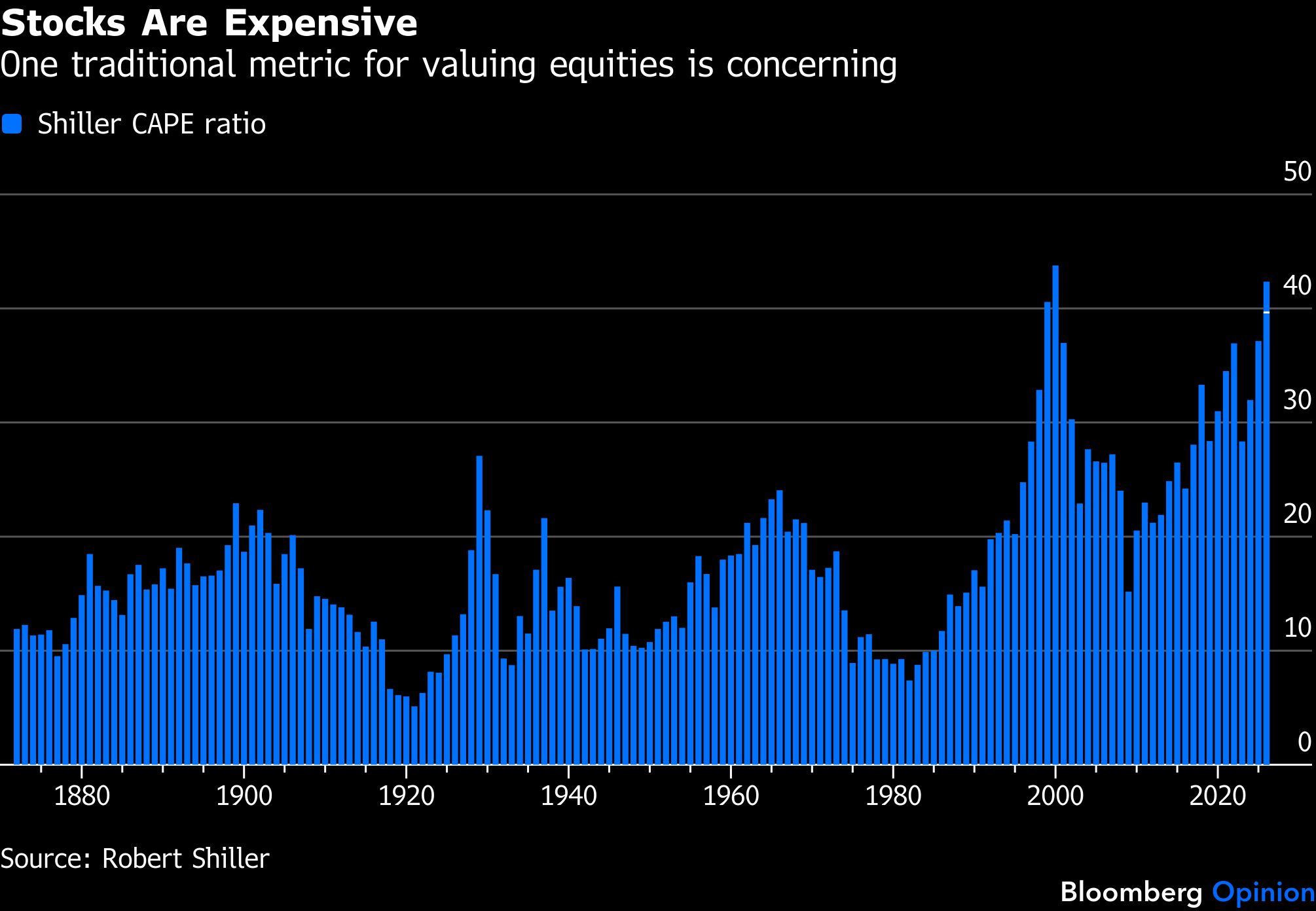
- The Shiller cyclically adjusted price-to-earnings ratio: Currently 41, compared with a long-run average of around 17 and a high of 44 in December 1999.
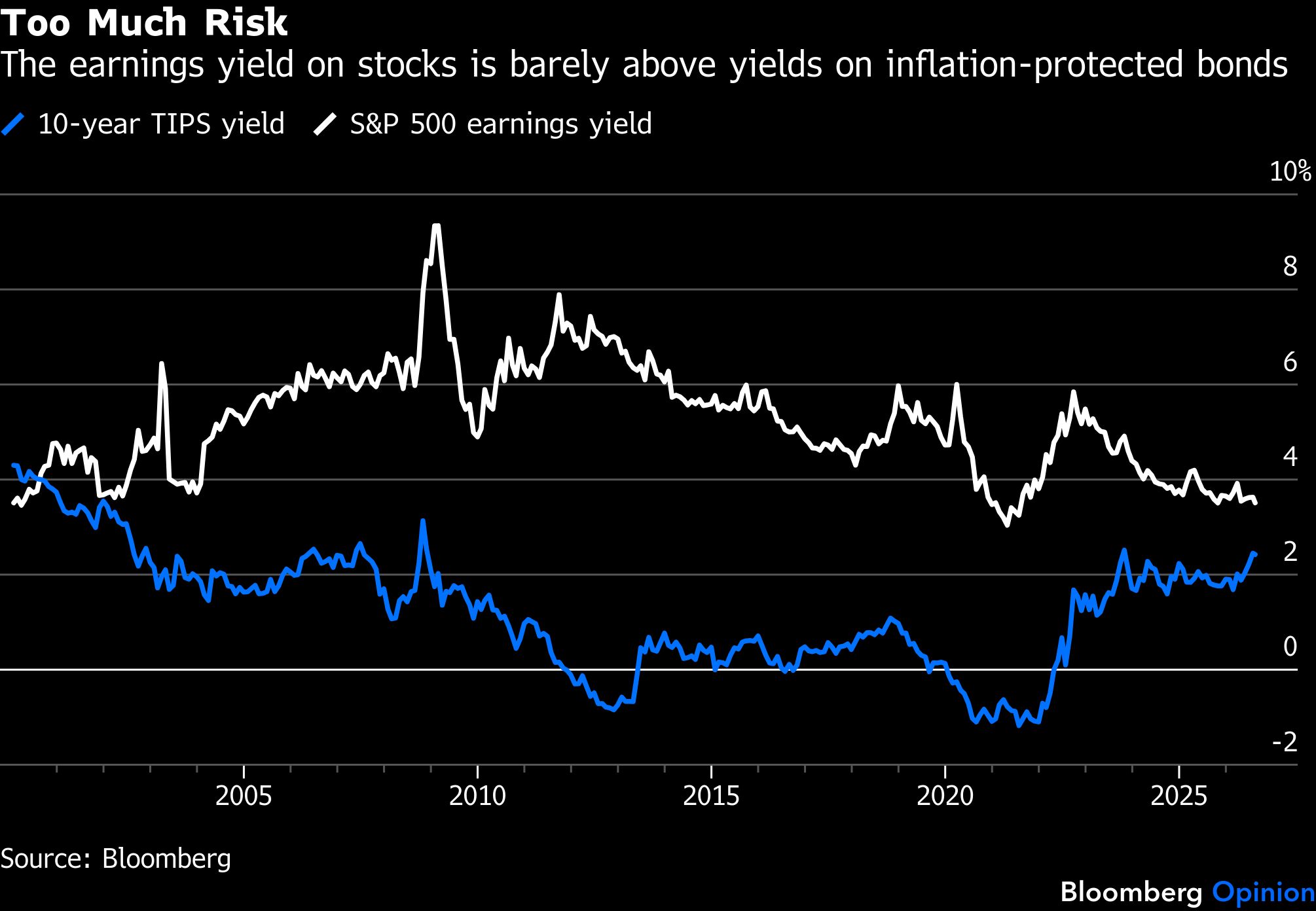
- The real equity risk premium (the expected pickup in return from holding equities versus inflation-indexed Treasury bonds): Currently around 1.1%, or less than half the average since 2010.
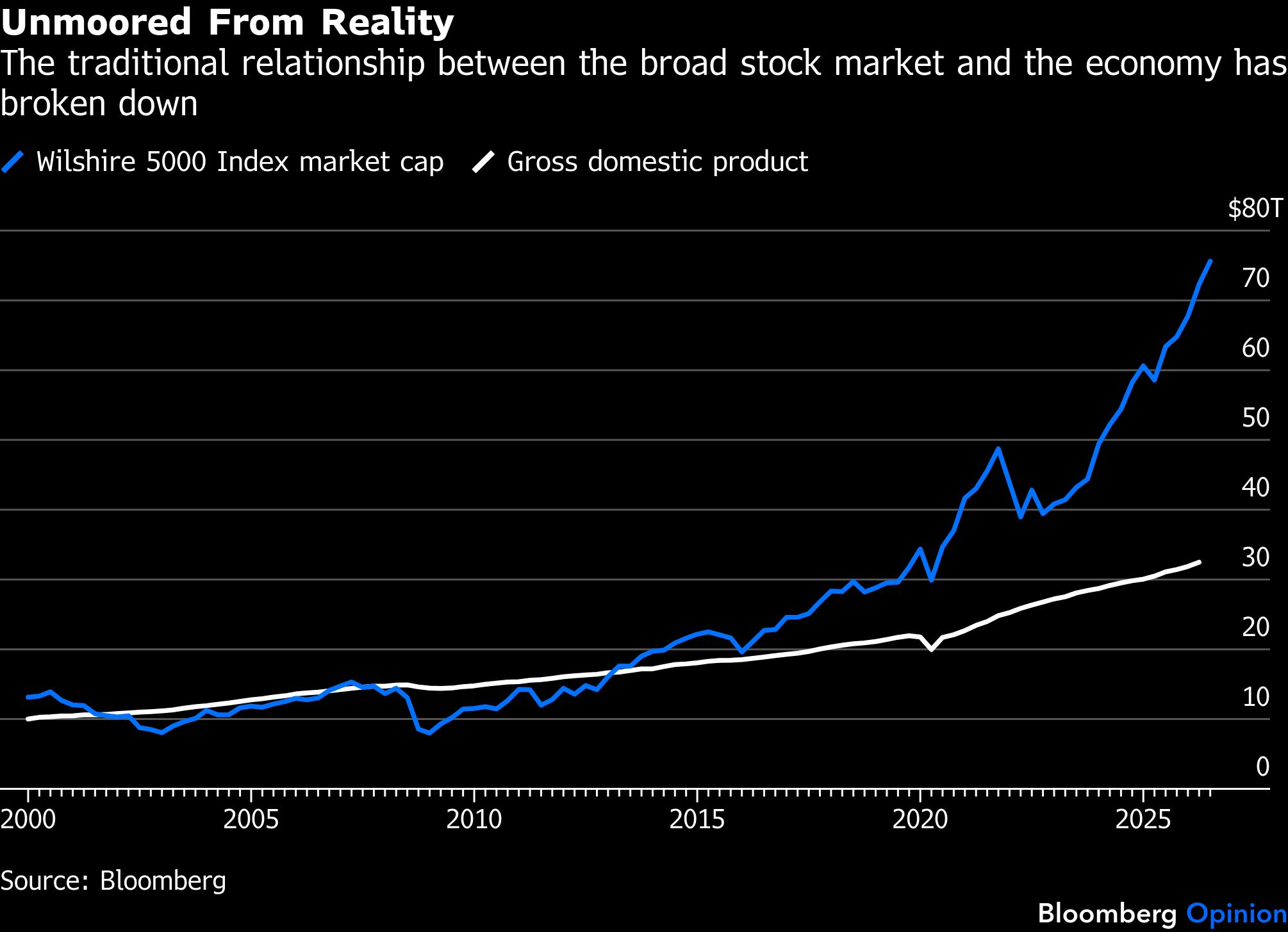
- The Buffett Indicator (the US market cap-to-GDP ratio): Currently 240%. Warren Buffett has said he considers the US stock market overvalued when the ratio is above 100%.
Of course, just because something is a bubble doesn’t mean it will soon burst. Bubbles often become much bigger and last longer than anticipated because the expansion of the bubble sustains the investment and profit growth that led to the bubble in the first place. The beliefs of advocates are reinforced, while skeptics lose conviction and influence.
See more: The Market Crash of 1873 and the Depression That Wasn’t
Nevertheless, there are several reasons why this bubble will likely burst before the end of 2027.
First, the favorable impact of the artificial intelligence investment boom on economic activity and earnings will likely diminish significantly in 2027. That’s because what’s relevant for growth is how much investment is increasing, not its level. The increase in investment in 2026 will almost certainly be the peak. There aren’t sufficient resources — construction workers, electrical generation capacity, or chip manufacturing capacity - to increase investment by the same magnitude in 2027. Nor are the dominant hyperscalers likely to have the free cash flow and balance sheet capacity to sustain a bigger increase in investment in 2027 compared with 2026.

Second, as the growth of investment spending slows, the growth in earnings of hyperscaler suppliers will falter, profit expectations will diminish and price-earnings ratios will shrink. The “picks and shovels” providers will suffer a double whammy - slower demand growth and profit margin compression. On the way up, higher demand leads to wider profit margins that sustain equity market valuations. On the way down, the outlook for earnings deteriorates quickly as the shortfall of demand relative to expectations is exacerbated by a collapse in profit margins.
Third, as the investment cycle matures, the focus will shift to the returns that the hyperscalers are expected to earn on their massive investments. I suspect it will be difficult for the AI hyperscalers to generate sufficient revenue ($2 trillion or more per year) to generate the returns needed to justify an AI capital base that is likely to reach $5 trillion.
In the same vein, the lending to finance data centers and other AI infrastructure will look riskier as exposure grows and the growth rate decreases. The financing of the boom is becoming increasingly interconnected and opaque. With chip providers such as Nvidia Corp. providing financing to the hyperscalers to buy the chips needed for their new data centers, this increases the risk of a negative feedback loop when the boom ends.
Fourth, the supply of US equities will increase due to the sharp rise in initial public offerings and the sale of equities by corporate insiders as lock-up periods end. This should weigh on equity market valuations.
Fifth, the macroeconomic environment is likely to become more challenging. Real and nominal long-term rates have increased significantly this year, with yields on 30-year Treasury bonds rising to the highest since 2007. The rise in yields puts increased strain on equity market valuations. The risks are tilted toward a further rise in yields given the lack of political will and progress to address the nation’s unsustainable federal debt trajectory.
In its early stages, a bubble’s growth is often self-reinforcing. The demand from the investment boom supports rapid profit growth, wider profit margins, and higher equity valuations. But on the downside, the feedback loop can run powerfully in reverse with a collapse in demand leading to a drop in cash flows and a reevaluation of the risks of lending to support the bubble’s further expansion.
The Great Financial Crisis illustrates this lesson. On the way up, the innovation of subprime lending boosted the demand for housing, which pushed prices higher, making it easier for troubled borrowers to refinance loans when their promotional “teaser” borrowing rates ended. The ability to refinance reduced delinquencies and defaults and made subprime lending appear to be not particularly risky. Eventually, the increase in demand was followed by an increase in housing supply, which capped further home price appreciation. When this occurred, subprime borrowers found it difficult to refinance, delinquencies and defaults soared, undermining the viability of subprime lending. When subprime lending collapsed, the demand for housing fell and home prices declined, exacerbating the squeeze on housing credit and reinforcing the downward pressure on housing prices.
I expect that AI will follow the broad trajectory of other great technology booms and busts. Like the railroad and internet booms, AI will have a significant impact on productivity and economic growth over the long run. There will also be an inevitable glut of overcapacity that will weigh on profits and stock prices — turning the investment boom rapidly into a bust.
It’s hard to resist a stock market bubble when it’s inflating. When Jeremy Grantham of Grantham, Mayo, Van Otterloo & Co. warned about the Nasdaq bubble in the late 1990s, he was right but years too early. As a result, the firm’s assets under management shrank by about one-third before he was vindicated. However, this was still a considerably better strategy than the alternative, as famously uttered by Citigroup Chief Executive Officer Chuck Prince in 2007: “…as long as the music is playing, you’ve got to get up and dance.”
Grantham emerged from the internet boom with his reputation not only intact but enhanced. The same cannot be said for Prince in the aftermath of the Great Financial Crisis.
Originally posted on Bloomberg.com
A message from Advisor Perspectives and VettaFi: Discover something new! Click here to register for our upcoming webcasts.
Bloomberg News provided this article. For more articles like this please visit
bloomberg.com.
Read more articles by Bill Dudley