The Market Crash of 1873 and the Depression That Wasn’t
Membership required
Membership is now required to use this feature. To learn more:
View Membership BenefitsThe views presented here do not necessarily represent those of Advisor Perspectives.
2008. 1929. 1907. 1893. These dates strike fear into the hearts of investors. Panics, crashes, and bear markets have been part of the investing ecosystem for as long as markets have existed. Some say they are the price of progress — others, a flaw in the system. Whatever you think of periodic market crashes, they’re here to stay.
But the farther back you go, the less we know about each episode. Thanks to the investor and financial historian Liaquat Ahamed’s beautifully written new book, “1873: The Rothschilds, the First Great Depression, and the Making of the Modern World,” we can learn a lot more about the wild events of 1873 in Europe (and to some extent the United States) and the period that followed, sometimes called the Long Depression. I argue that the aftermath of 1873 was not a depression, but a deflationary boom — a pattern with which most modern readers are unfamiliar.
Ahamed describes this period, which Mark Twain and Charles Dudley Warner called the Gilded Age, in language as colorful and lively as I’ve encountered in a financial history book. If you want to learn about this critical period in our history while having fun, you should buy and read “1873."
Yet one of Ahamed’s central conclusions is almost certainly wrong.
The Vienna Stock Market Crash of May 9, 1873
The central event of the book is the 45% decline —in one day! — of the Vienna Stock Exchange on May 9, 1873. The crash was real, coming after (as crashes usually do) a long period of rising markets and the pursuit of increasingly risky ventures. The runup to the crash featured:
- A sudden surge in global trade and cross-border investment
- A very large proportion of market capitalization concentrated in one industry (railroads)
- A boom in lending to emerging markets in Latin America, Africa, and the Middle East
- Several technological revolutions at once — collectively known as the Second Industrial Revolution
- Political turmoil based on poverty coexisting with rising middle and upper classes
Does any of this sound familiar?
While the specifics of a boom-and-crash cycle are different each time, this story can be told repeatedly throughout recorded financial history, beginning — as Will Goetzmann reminds us in his masterpiece, "Money Changes Everything: How Finance Made Civilization Possible” — 4,000 years ago in ancient Mesopotamia. Human nature doesn’t change much over time!
In the 1870s, Austria-Hungary was a leading European empire. The Vienna Stock Exchange (Wiener Börse) was not the backwater that it later became — it ranked third, after London and Paris, among the exchanges of Europe. Austrian stock prices rose some 300% between 1870 and 1873. The Austrian market also absorbed massive government bond issues in the wake of the Franco-Prussian War, which left France swamped with debt due to its obligation to pay five billion gold francs to the German Empire.
In early 1873, however, a flood of new securities was met with lackluster interest. Investors became nervous that the bubble was about to burst, yet — as we’ve seen many times since — prices remained high for longer than seemed rational.
Then selling pressure turned into panic. Quoting an anonymous English journalist, Ahamed describes the mood on the Vienna exchange:
The Bourse became a Pandemonium. Men cursed one another, shook their fists at one another, raged and stamped and tore. . . . Outside a miserable crowd had assembled . . . ex-princes of the Bourse, chamberlains, billiard-markers, haggard clerks. . ., grocers and countesses, servant-maids and singers from the opera.
Exhibit 1 is a contemporary artist’s rendition of this scene.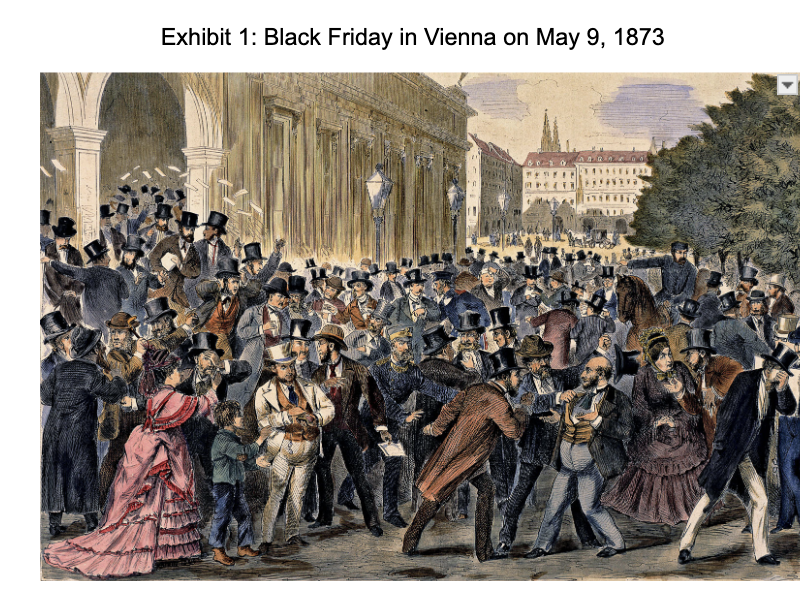
Source: Wikimedia Commons. Public domain. Artist unknown.
Depression? What Depression?
The conventional story is that Europe and the United States then fell into a “Long Depression” that, by some accounts, lasted for the rest of the nineteenth century. A
soberer appraisal was that the Long Depression had ended by 1879. A group of authors at the New York Fed wrote,
The fatal spark for the Panic of 1873 was . . . tied to railroad investments—a major bank financing a railroad venture [Jay Cooke & Co.] announced that it would suspend withdrawals. As other banks started failing, consumers and businesses pulled back and America entered what is recorded as the country’s longest depression.
This narrative has entered our consciousness despite a lack of evidence that a U.S. depression occurred at all. We usually judge business conditions by industrial production, unemployment, and stock prices. Of these variables, only unemployment rose to recession-like levels, peaking at 8.25% in 1878. (During the Great Depression of 1929–1939, unemployment reached an unbelievable 24.9%.) The U.S. stock market fell sharply on September 18, 1873, but by modern standards there wasn’t even a bear market. The Shiller real total return index of U.S. stocks reached a monthly high of 124.18 in August 1873 and fell to 108.45 in October, down 13%, before rising to new highs. (There was a bear market in 1876–77.)
But the real narrative is in the GDP and wage data. Exhibit 2 shows GNP (a predecessor to GDP), prices, GNP per capita, and an index of real wages over the last third of the nineteenth century. Real GNP more than tripled during that period, with no year-to-year interruptions until the 1890s. Real wages rose almost as much, with the curve flattening a bit in the 1870s but never turning downward. The Gilded Age was one of the fastest periods of economic growth in American history — not a depression!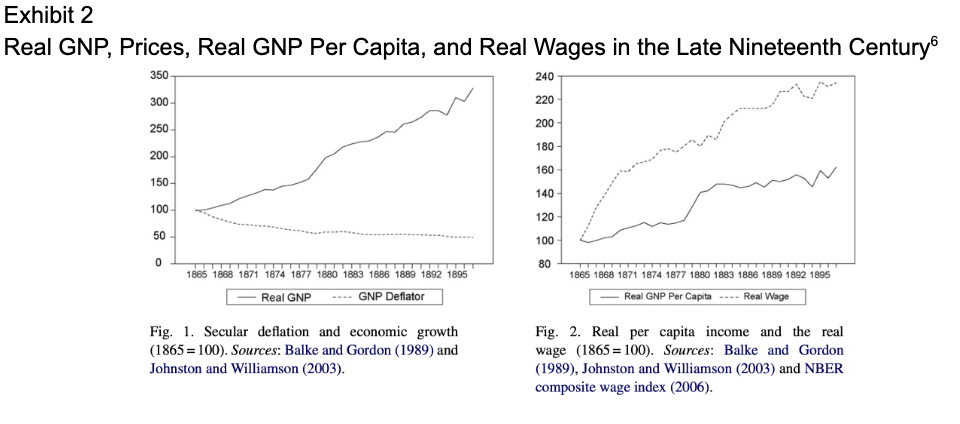
Source: https://mh19870410.wordpress.com/wp-content/uploads/2025/01/the-postbellum-deflation-and-its-lessons-for-today-beckworth-2007.pdf.
So, where did the depression narrative come from? One factor is that economic outcomes are always experienced very unevenly, and during a major transition — in this case, from a farm-dominated to a factory-dominated economy — many individuals experience real pain, especially when there was no social safety net to speak of. We should not minimize this pain.
While I believe that there was no general depression, one major sector of the economy was indeed depressed: farming. Agricultural prices fell sharply as farming became mechanized and farmers lost their jobs and farms. Many moved to the cities to get factory jobs, but some never recovered.
The rural vote share was much larger than it is now, and the radical mood of farmers and their families led the Democratic Party to nominate the young firebrand William Jennings Bryan, famous for his “Cross of Gold” speech, as its candidate for president in 1896. (He did not win.) His platform would have tried to end the agricultural depression by going off the gold standard, an inflationary policy.
Where you stand depends on where you sit, so if you were a farmer, the aftermath of the Panic of 1873 was a depression; if you were a factory worker, you experienced rising wages and improving working conditions; if you were a consumer, you enjoyed increased abundance and low prices; and if you were a stockholder, you got rich.
A hypothetical U.S. index fund investor at the end of 1872 would have doubled their wealth in real terms by the end of 1879 and made six times their money by the turn of the century. No wonder there was tension between social classes!
Meanwhile, Back in Europe . . .
In Europe, which is the main focus of Ahamed’s narrative, things were worse. Other than the one-day -45% stock market crash in Vienna, I don’t have rates of return for the Austro-Hungarian market. However, we can get some idea of the market mood from Britain, which was the bellwether market for Europe and, to a degree, the world.
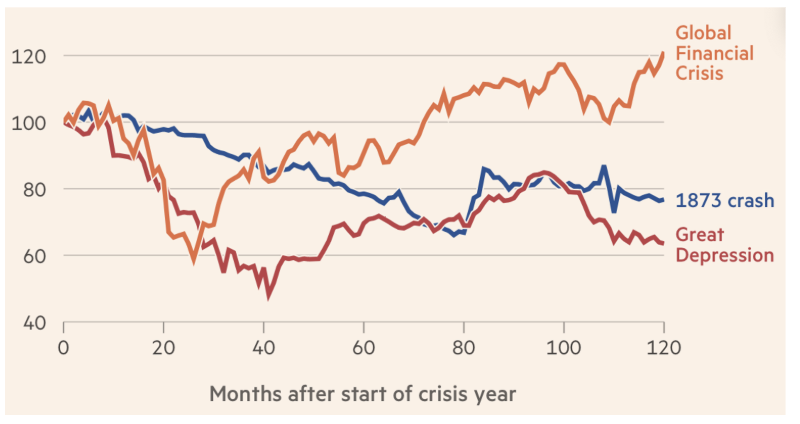
Exhibit 3 shows the U.K. results. The exhibit compares 10-year equity market price returns (starting with the crash year) from the 1870s with two more recent crises, which began in 1929 and 2007, respectively.
Exhibit 3
U.K. Share Price Level in Three Crises (January of crisis year = 100)
Source: Financial Times, June 4, 2026
As measured by U.K. stock prices, the Great Depression of the 1930s was the worst of the three crises, both in the extent of the decline and the slowness of the recovery (and that was in a country that held up well compared to the collapsing U.S. market, which fell 85% between 1929 and 1932). In contrast, the 1870s decline in the U.K. was not a sudden crash but a long, slow decline that amounted to a more than 30% loss by the seventh year after the crash date.
That’s a long time for a bear market to last! Without examining production or unemployment data, it’s probably fair to call the episode a long depression in Europe, or at least in Britain.
The Crash and the Rothschilds
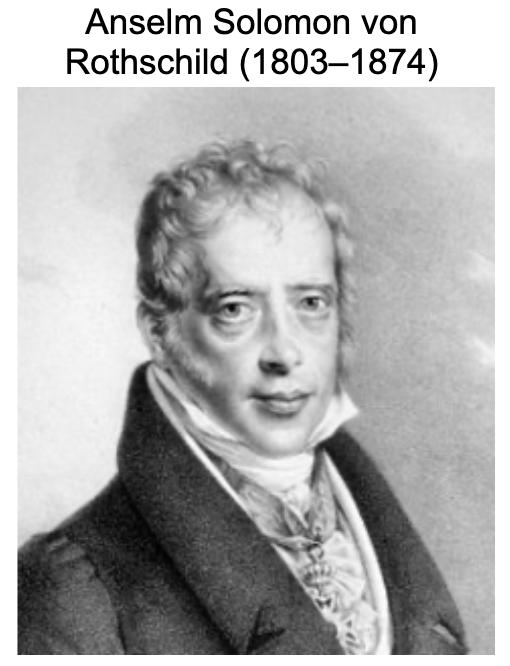
Ahamed recounts the European crash and its aftermath through the story of the Rothschild banking family, which was an island of stability and prudence amidst chaos. Anselm von Rothschild had not participated in the speculative runup to the crash, so the family held on to its startling fortune, which is estimated at a half trillion dollars in today’s money.
Along with some other ultra-wealthy market participants, the Rothschilds acted to stabilize stock and, especially, bond prices, enabling governments and businesses to continue borrowing through this difficult period. I’d note, as an aside, that holders of private fortunes have often behaved this way, the best-known example being John Pierpont Morgan’s attempt to stabilize the U.S. stock market with his own funds during the 1907 crash..
The financial system, then, has the interesting positive attribute that participants acting to save their own hides often wind up helping to protect the system. We could also look through the other end of the telescope and observe that people acting to protect the system tend to come out ahead themselves. (By buying when others are panic selling, they take the risk of huge losses in the short term.) The philosopher-businessman Nassim Nicholas Taleb would call such a system antifragile.
 .
.
Source: Wikipedia
By taking the long view and acting on it with their own money, then, liquidity providers like the Rothschilds enable the financial system to survive. Having put their fortunes at great risk in the clutch, they are in a position to make big profits when (or if) the markets later recover and move to new highs. This alignment of interests is a marker of a system that works pretty well, although it’s obviously not perfect. Investors and policymakers should keep these observations in mind when the next crisis occurs.
Ahamed’s great contribution to this dialogue is to weave a rich lode of historical detail into the story outlined above. That and his wonderful storytelling make “1873” a great read, despite my doubts about some of the author’s conclusions. I learned a lot from this book!
Crime and Crashes
Big money always attracts big trouble, but you don't need crime to get booms and crashes. You just need human nature and the branch of finance that studies it, called behavioral finance. From time to time, investors will overestimate future profits and bid up popular stocks and bonds beyond their fair value, and later overestimate future losses and crash the price.
But Ahamed seems to relish the venality of the characters he portrays in “1873.” Trevor Jackson, an economic historian reviewing the book for the New York Times, bemusedly summarizes:
The . . . cast of speculators, bankers, journalists and politicians in “1873” are nearly all corrupt, venal, duplicitous, stupid or some combination thereof. The cumulative effect is impressive. . . . Ahamed presents a world-spanning financial system that was rotten to its core.
I don’t quite believe it. Having worked in the financial sector, I know there are a hundred, perhaps a thousand, honest and hardworking profit seekers for every Bernie Madoff or Sam Bankman-Fried. I wonder where Ahamed picked up the attitude — also evident in his earlier book about the 1929 crash, “Lords of Finance: The Bankers Who Broke the World” (the subtitle is telling), that finance people are, by and large, bad guys. They’re not.
If the cause of these crashes is not a venal and greedy cast of characters, what could it be? A cause based in human behavior, and requiring no villains, was laid out in Irving Fisher’s brilliant 1933 paper, “The Debt-Deflation Theory of Great Depressions.”
Here is a stylized summary: a new technology with high expectations for growth; a debt-fueled investment boom; then a bust and a fall in the price level, increasing the real value of the debt; finally, a cycle of forced selling and bankruptcy until the liquidation ends. This can all be made worse if the monetary system shrinks the supply of currency. Deflation, like any major economic change, always has winners and losers.
Deflation — Bad or Good?
Who are these winners and losers, and is deflation always bad? Readers who have only experienced a fiat-currency monetary system — at this point, that’s all of us — are accustomed to thinking of deflation as terrible. We associate it with the crash of 1929 and 10 years of the worst depression the U.S. has ever experienced.
When the price level briefly turned down during the crisis of 2008, the Fed unprecedentedly lowered interest rates to near zero, where they stayed for the better part of a decade. This policy was effective, and (unlike in the 1930s) the economy and markets sprang back fairly quickly.
With a gold standard, however, the association of deflation with economic collapse goes out the window. The money supply under a gold standard is almost literally fixed in the short run — gold is hard to find, expensive to mine, and cumbersome to store. That’s the whole point — countries adopt a gold standard to keep the money supply stable.
As a result, there was no inflation on net during the gold standard period in the United States. But sharp swings in the price level nonetheless occurred . Periods of inflation, such as during wars, alternated with periods of deflation, typically in times of peace and prosperity; after such a cycle, the price level generally ended up about where it started.
The period from 1873 to 1899 was one of those deflationary times with strong economic growth. It was “good deflation,” caused by an ever-greater quantity of goods and services being represented by a relatively fixed quantity of money. We see this in the left panel of Exhibit 2, where the “GDP deflator” is the price level. It goes steadily downward, with the Shiller consumer price index falling from 12.94 at the beginning of 1873 to a low of 6.28 in 1896–97. Prices fell by half! Nothing like that has ever happened under a fiat money standard, because the central banks would not allow it.
Of course, not everyone experiences deflation in the same way. Unexpected inflation transfers wealth from creditors to debtors; unexpected deflation, from debtors to creditors. Debtors are usually poorer than creditors, and with deflation it becomes harder and harder to service one’s debts. Farmers and small businesses, but especially farmers, are particularly dependent on debt because of the seasonality of their cash flows.
Thus, the deflation of 1873–1899, while reflecting a generally rising tide of economic activity, was especially hard on the farmer who, in the words of a then-contemporary song, is “the man who feeds us all.” The Long Depression was real in this sense, even while industrial and commercial prosperity grew and grew.
Did the Modern World Emerge From This Episode?
Ahamed stretches a metaphor too far by adding “the making of the modern world” to the book’s subtitle. The events described in “1873” did not make the modern world.
I agree that 1870, or thereabout, was a hinge of history: Robert J. Gordon, in “The Rise and Fall of American Growth,” makes a compelling case that economic progress in the Western world (plus Japan) took a sharp turn upward at that time.
But, as Gordon explains, the turn was due to the massive technological advances of the Second Industrial Revolution. Peace, free enterprise, and free trade also helped a lot. The changes in financial institutions and practices spurred by the events of 1873 were of far less immediate importance — the modern financial world evolved over the subsequent half-century in response to the needs of the mushrooming industrial economy, not ahead of them.
Conclusion
Despite my reservations about some of Liaquat Ahamed’s conclusions, I recommend “1873” if only for the beauty of his storytelling. How many other authors could portray a mostly forgotten American tycoon this vividly?
[Jay] Gould was the brains behind the [stock-manipulating] operation. He was a small, nervous man, only five feet four and hardly 110 pounds. His appearance — dark, haggard eyes, Svengali beard, fidgety and furtive demeanor — added to his sinister reputation. One observer described him as looking like a bearded little ferret.
If we think about Gilded Age robber barons at all, we picture them as rotund, boisterous men with bushy mustaches, accompanied by clones of the chorus girl and troublemaker Evelyn Nesbit. Gould, one of the most influential figures of the time, was the opposite. Ahamed needs only a few witty sentences to paint this picture. His ability to make an important period in our history come alive is not a trivial contribution. It isAhamed’s greatest strength.
To sum up, Ahamed’s book enables readers to experience the Gilded Age as if we were there. But it doesn't really hang together as economic history. It is more like a series of short stories that leave us knowing little more about the root causes of crashes, booms, and depressions than we already did.
If Ahamed had broadened his vision beyond the strict New Keynesian macroeconomic framework that is widely taught and used by central bankers but is probably not correct, he could have arrived at more realistic conclusions and written a more elucidating book.
Read “1873” for fun and learn macroeconomics elsewhere.
See more by Laurence B. Siegel:
- The Emperor’s No Clothes: Steven Pinker on What We Think That Others Know
- A Nobel for the Deep Roots of Growth and Prosperity
- Johan Norberg’s History of the World in 7 Golden Ages , and a Clarion Call for Today
Laurence B. Siegel is the Gary P. Brinson director of research, emeritus, at the CFA Institute Research Foundation, economist and futurist at Vintage Quants LLC, and an independent consultant, writer, and speaker. His books, Fewer, Richer, Greener, Unknown Knowns, and On Progress and Prosperity, explore ideas in economics, investing, technology, the environment, and human progress. His website is http://www.larrysiegel.org. He may be reached at [email protected].
A message from Advisor Perspectives and VettaFi: Discover something new! Click here to register for our upcoming webcasts.
1By 1985, the Austrian stock market had lost its mojo to the point that, when investor and wild man Jim Rogers wanted to take a position in it, he was told he was crazy and would be unlikely to find anyone to sell him Austrian stocks. His purchases and the publicity around them triggered a huge bull market in Austrian stocks and they are once again mainstream.
2https://libertystreeteconomics.newyorkfed.org/2016/02/crisis-chronicles-the-long-depression-and-the-panic-of-1873/
3This low peak unemployment rate, reported in Vernon, J. R. (1994), “Unemployment Rate in Postbellum America 1869–1899,” Journal of Macroeconomics 16, 701–714, has not gone unchallenged. The New York Fed group writes, “The terms ‘tramp’ and ‘bum’ . . . became commonplace American terms. Relief rolls exploded in major cities, with 25-percent unemployment (100,000 workers) in New York City alone.” Other sources report that overall unemployment reached 14%.
4I don't know the exact size of the decline because there are no daily stock price indices covering this period.
5For a more detailed analysis, see Ting, Chao Chiung (2025) “1869–1879 United States: Depression or Prosperity,” International Journal of Economics and Finance 17(7), https://ccsenet.org/journal/index.php/ijef/article/download/0/0/51864/56430.
6The “Gordon” in the underlying source, Balke and Gordon (1989), is Robert J. Gordon of Northwestern University, one of the world's most respected economists and economic historians, often mentioned for a Nobel Prize. The famously pessimistic Gordon is profiled in my 2015 Advisor Perspectives review of his book, “The Rise and Fall of American Growth.”
7“You shall not crucify mankind upon a cross of gold,” at the Democratic National Convention, Chicago, July 9, 1896.
8We later found out (no surprise to monetary economists) that going off the gold standard does produce inflation: When President Nixon “closed the gold window” — that is, ceased selling gold to foreign buyers at the statutory price of $35 per ounce on August 15, 1971 — the price level in the United States doubled in a decade.
9But far from uniformly: See Jacob Riis’ “How the Other Half Lives” (1890), Upton Sinclair’s “The Jungle” (1905), and accounts of the Triangle Shirtwaist Factory fire (1911) for the unfortunate side of rapid industrialization.
10The Shiller real total return index of U.S. stocks, based on the S&P Composite index with dividends reinvested and adjusted for inflation or deflation, closed 1872 at 118.01, 1879 at 242.05, and 1899 at 925.54. No index funds existed at the time, so this rate of return should be regarded as an average of different investors’ experiences, not the return that any particular investor could have achieved.
11Source of the estimate: https://www.youtube.com/shorts/HtF_r3plmHI.
12https://www.nytimes.com/2026/06/01/books/review/1873-liaquat-ahamed.html
13Fisher, Irving (1933), “The Debt-Deflation Theory of Great Depressions,” Econometrica 1(4): 337–357.
14See https://voices.pitt.edu/TeachersGuide/Unit%205/FarmeristheMan.htm.
Membership required
Membership is now required to use this feature. To learn more:
View Membership BenefitsSponsored Content
Upcoming Virtual Events View All











