The Emperor’s No Clothes: Steven Pinker on What We Think That Others Know
Membership required
Membership is now required to use this feature. To learn more:
View Membership BenefitsThe views presented here do not necessarily represent those of Advisor Perspectives.
What’s a book reviewer to do when one of his favorite writers — Steven Pinker, a great explainer of tough concepts in many different fields — produces a book that’s a snoozefest? Three things: (1) remind readers of Pinker’s better writing and thinking in other works; (2) indicate my reservations about his latest book; and (3) summarize the book anyway, because it contains quite a few nuggets of wisdom, although those could have been conveyed in a much shorter tome.
That is what I will do in this review of Pinker’s When Everyone Knows That Everyone Knows: Common Knowledge and the Mysteries of Money, Power, and Everyday Life. First, I’ll explain the goofy title. Then, I’ll touch on themes that the book raises, including a distant connection — that may exist only in my imagination — to money management firms and Thomas Pynchon’s classic 1966 seriocomic novel of paranoia, The Crying of Lot 49.
The Emperor’s New Clothes
The basic theme of When Everyone Knows is sound: Our society is organized, not around what each of us knows, but around what each of us thinks (or “knows”) that everyone else knows. (Note that I used the phrasing “What We Think That Others Know” in my title, a deviation from Pinker’s book title — we can never know what’s in other people’s heads!)
Pinker opens the book with Hans Christian Andersen’s story of the little boy and the naked emperor. Each person viewing the emperor with his own eyes acquires the private knowledge that the emperor’s gorgeous new suit of clothes, of which he is so proud, does not exist. The emperor has been conned by a traveling swindler into buying clothes that are supposed to be visible only by the wise and invisible to fools (a crucial detail that Pinker leaves out, making the story almost incomprehensible unless you know it already from your childhood).
Because people don’t want to be thought of as fools, no one wants to say that the emperor is naked until a little boy blurts it out. At that point, the private knowledge becomes common knowledge: Not only does everyone know that the emperor is naked; everyone knows that everyone else knows the emperor is naked, and so on in an infinite circle. The result is that it’s the emperor who is shown to be a fool, and the people lose all respect for him.
Note that Pinker’s use of the term “common knowledge” differs from the usual meaning of “something that is widely known” (it’s common knowledge that the Earth revolves around the Sun). He uses the term to mean “knowledge that is held reciprocally in the sense that everyone knows that everyone else knows it, too.” In other words, I don’t just know that the emperor is naked — with the boy having spoken, I now know that everyone else sees the same picture that I do.
The Explanatory Power of Common Knowledge
Whew! It took all that storytelling and verbal dancing just to explain the title of Pinker’s book. I’ll now move on to the consequences of this insight, which turn out to be surprisingly profound.
Pinker argues that common knowledge — in the special sense in which he uses the phrase — explains much of the way we interact socially, communicate effectively, and behave as a species. Like many nonfiction books, When Everyone Knows shows, chapter by chapter, how the author’s pet theory applies in every aspect of life. That this format has become standard for creative nonfiction is a testament to the powerful argumentative style of Richard Dawkins, who introduced it in his groundbreaking book on genetics and evolution, The Selfish Gene.1
We Need Coordination, Not Just Cooperation
In particular, Pinker reminds us that he has written five books on why people (and animals) cooperate. Reciprocal altruism is one familiar reason: We do things for others with the expectation, but not the guarantee, that they will do things for us when the need arises. Dawkins’ The Selfish Gene explains this mechanism beautifully, as does Pinker’s The Blank Slate. But society does not just function on cooperation. Pinker explains:
Only recently have I appreciated that the story of cooperation makes up just one side of the problem of what makes humans social. The other side is coordination.
It often happens that two people want to cooperate on something but can’t find each other or can't identify the right mechanism for cooperating. It is then that the coordination problem comes into play, as Pinker illustrates with an example: In the era before cell phones, when two people lost each other in New York, they would head for the clock in Grand Central Station, typically at noon. They didn’t verbally agree to do so, because they didn't expect to lose track of each other — and they didn’t need to agree in advance. They “just knew” that they should meet at that particular place and time after exhausting other options.
These pre-programmed and often barely conscious solutions to problems are called conventions and rely on common knowledge:
Among society-wide conventions, an obvious one…is the vocabulary of a language. Other examples include closing businesses on Sunday, accepting paper currency in exchange for goods and services, using appliances that run on 110 volts, and driving on the right side of the road (or the left; it doesn’t matter, as long as everyone sticks to the same side). It’s irrelevant that this last convention is enforced by the police. As with many conventions, people have an incentive to conform to it as long as others do.
Pinker is justified in attributing to common knowledge a lot of explanatory power in many facets of life. In painting that picture, however, he fails at the task of generating the intellectual excitement to which his readers are accustomed. The Better Angels of Our Nature or Enlightenment Now, it’s not.
Nevertheless, the book has some gems in it — as can be seen from these introductory examples — and I’ll focus on those. I follow that exposition with some thoughts on trust, because a high-trust society is by far the most pleasant kind to live in. Common knowledge is the raw material of which mutual trust is made, and Pinker’s book skips over that important theme.
I now briefly summarize two of Pinker’s chapters: “Weasel Words” (because I use them all the time) and “The Canceling Instinct” (because Pinker has been an unbending advocate of free speech in the university and elsewhere).
Weasel Words
“Why,” asks Pinker, “don’t we just come out and say what we mean?” The answer is that we usually do, but not in situations that involve potential conflict, damage to one’s reputation, or a blow to one’s self-image. It’s in those times that we seek plausible deniability, which weasel words provide.
The iconic example, to which Pinker gives several pages more than needed, is that of a driver trying to bribe a traffic cop. Weaselly: “Is there some way we can work this out?” Plainspoken: “I will give you $50 if you don’t give me a ticket.”
Both are perfectly clear, but only because the driver and the cop both know what “work this out” means. It is common knowledge — a linguistic convention. The weaselly version allows both the driver and the cop to pretend that no bribe was proposed — and also allows the bribe to proceed if that is the cop’s inclination. Quite a useful dodge!
Pinker sets forth some amusing examples of weasel wording, all of which point in the direction of saving face, minimizing embarrassment, or avoiding a potential upset of power relations. “Netflix and chill” is widely understood to be a sexual proposition, but can also be defended — by the embarrassed fellow and relieved girl — as an innocent invitation to a quiet evening together. (Again, Pinker is far too prolix, devoting several pages to peeling back the six layers of meaning that he discovers in this three-word phrase.) We don’t come right out and ask the manager of a chic restaurant what it would cost to be seated ahead of other waiting customers, so we weasel-word the request, preserving both the manager’s self-image as an honest executive and his authority with employees.
To sum up, Pinker says that we use weasel words to “generate uncertainty about the speaker’s intent.” No kidding! He concludes that
Direct speech generates common knowledge. Common knowledge steers people into social relationships. When people are leery about consummating such a relationship, they want to avoid that common knowledge…so they resort to indirect speech.
It’s good pop sociology, but — as The Atlantic’s Andrew Ferguson said of Malcolm Gladwell’s work (which is far inferior to Pinker’s) — every nineteenth-century schoolteacher knew these principles. We’re just now rediscovering them and dressing them up in fancier clothes.
The Canceling Instinct
Pinker has distinguished himself in the recent culture wars by taking principled pro-free speech positions on a wide range of topics, from the legitimately worrisome (are some ethnic groups less intelligent than others?) to the truly ridiculous (a professor was censured for sexual harassment after calling out “ladies’ lingerie” in an elevator, mimicking a department store elevator operator from the last century). That such exquisitely delicate sensibilities coexist with popular song lyrics that would shock a troop of infantrymen is one of the puzzles of our age.
Because of Pinker’s helpful involvement in these controversies, I had hoped that his chapter on “the canceling instinct” would shed new light on the bizarre desire to ruin, rather than argue with and engage, those with views dissimilar to one’s own. But the chapter disappoints. It is mostly a restatement of what we already know: “Like the Savonarolas, Mathers, and Comstocks in earlier centuries, censorious [academics] are convinced that they are safeguarding the moral order.”
The ironic aspect, Pinker correctly claims, is that most of the people expressing “deviant” views are in sympathy with the moral aims of the cancellers: Few in academia who question the equal intelligence of all ethnic groups, he says, seriously want to discriminate against a group’s individual members.2 (We’re keenly aware that there are those who would gladly discriminate, but Pinker, a committed liberal, is not one of them.) “The ideal of equality,” Pinker writes,
is not the empirical dogma that all human groups are indistinguishable but a moral commitment to treat people as individuals and not prejudge or mistreat them based on their membership in a group.
This is Moral Philosophy 101 (Pinker’s phrase; it also could be mine) and it’s sad, in 2026, that it needs to be said at all.
So far, I’m in agreement and sympathy with Pinker. But this is a book on common knowledge! The connection between the cancelling instinct and common knowledge is a thin thread indeed. Pinker forces it, using a nineteenth-century joke about Darwinism:
[A] woman…, upon learning of Darwin’s theory, exclaimed, “My dear, descended from the apes! Let us hope it is not true, but if it is, let us pray that it will not become generally known.” …[H]er reaction captures the attitude of many people about disconcerting ideas. They hope the ideas are not true, but whether or not they are, they want them not to become…commonly known.
Pinker goes on to say:
“[S]cientists are all too eager to police common knowledge… In 2022 the editors of a major journal, Nature Human Behaviour, announced that they would thence forth reject or retract any article they thought would cast some human group in an unflattering light, even if it was scientifically sound.”
That’s reprehensible behavior on the part of scientists, and it subtracts from the sum of human knowledge, including knowledge that would help us address pesky social problems. But this observation has little to do with the importance of common knowledge in shaping human life. I think Pinker just wanted to present his views on cancellation in a visible place, and I can’t really blame him.
Trust
Pinker’s emphasis on common knowledge is important because it gives us insight into how trust emerges. Let’s return to the example introduced earlier, the sometimes death-defying activity of driving a car.
Red Light, Green Light
We drive unconcernedly through green lights because we know that drivers on the cross street, seeing a red light, know they are supposed to stop. The system of reciprocal knowledge about red and green lights works pretty well, with “only” about 10,000 fatalities in the roughly 2 trillion times a year that a car passes through an intersection with a traffic light in the United States.3 That’s a success ratio of 99.9999995% (ignoring non-fatal crashes).
Because we know in advance that the success ratio isn’t exactly 100%, however, we “trust but verify,” as Ronald Reagan presciently said we should do with the Russians. That’s because our knowledge is incomplete. For us to drive confidently through the green, we have to believe that (1) the cross-street drivers know they are supposed to stop, (2) they will choose to stop, and (3) they can stop (we don’t know the condition of their vehicle). What seems like a simple action can be grounded in multiple layers of unconscious belief and knowledge.
Driving is a good example of the subtleties involved in trust (and in common knowledge) because, as with most things in life, we are operating with incomplete information that gets updated moment-to-moment. We are constantly updating our decision to go or not go accordingly. We’re usually not even aware that we’re doing all that thinking. Our limbic system, or “reptile brain,” is doing much of the thinking for us — as it so often does.
Why Is Trust So Important?
We’re often told that we live in a low-trust society but that we’d be better off living in a high-trust society, which was the case in some imagined far-off past. Or we’re told that many regions of the world are poor because they are low-trust societies, and we’re rich because we’re high-trust. These are contentious claims and the evidence on them is mixed; at the very least, we can thank Francis Fukuyama, best known as the author of the optimistic book, The End of History and the Last Man, for bringing the topic to our attention in Trust, his excellent 1995 book on the topic.
But I can’t get through an essay on the human condition without using some data. So, in Exhibit 1, I show one research team’s attempt to relate trust to economic success on a cross-sectional (comparing countries at a point in time) basis.4 The fit is pretty good: Zimbabwe has the lowest indicators of social trust and the lowest per capita income;5 the most trusting country, Denmark, has a high income, as do all the other high-trust locales. But there are outliers — in particular the United States, which is only middling in terms of trust (I suspect that is a recent development) but is the richest large country in the world.6
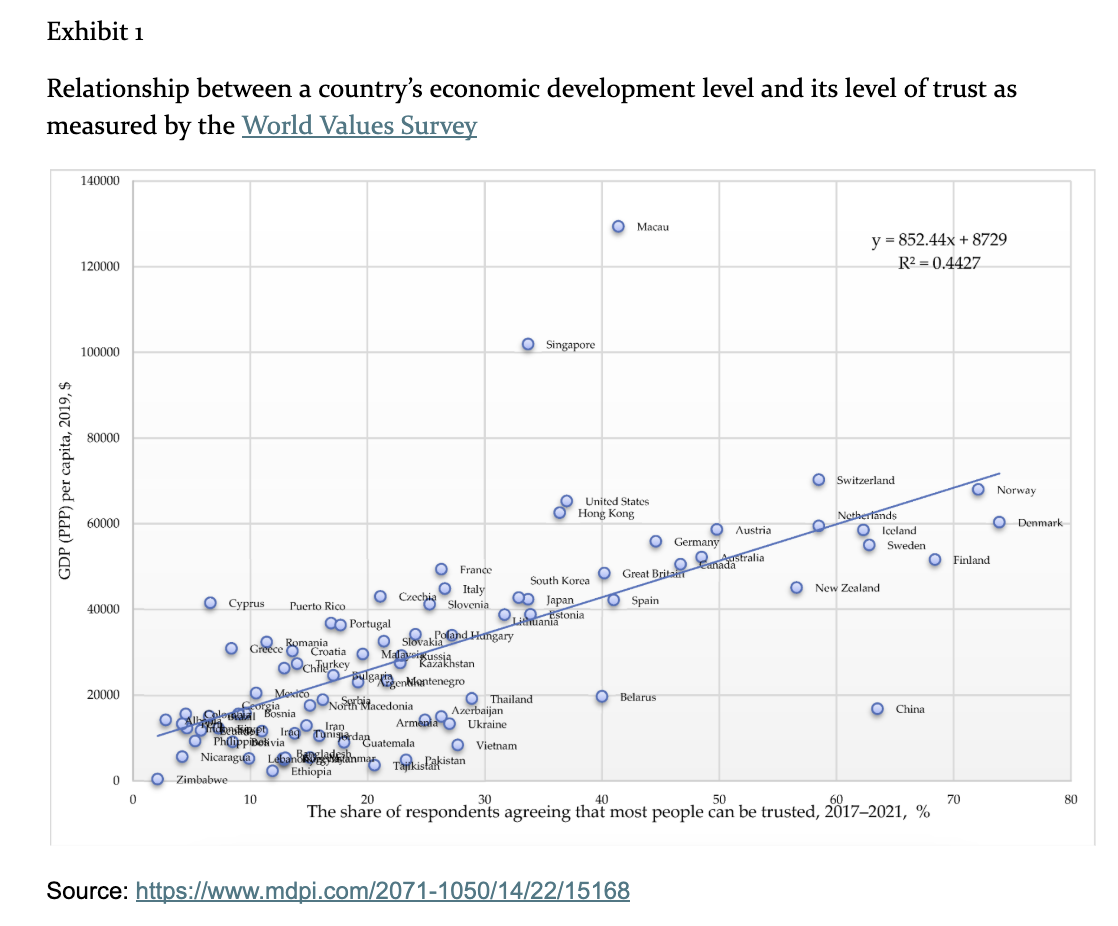
It seems from the data in Exhibit 1 that any proposal to increase social trust should be seriously considered, whether you care only about prosperity or also find a trusting society to be more pleasant. Whether it’s Pinker or some other author who draws more clearly the connection between common knowledge (in the Pinkerian sense) and social trust, I’ll be interested in that literature when it emerges.
Shipping, Trust, and Investment Management
Common knowledge and social trust play a role in investment management. That is why many investment firms are called “trust companies” or evolved out of such companies. Interestingly, several of today’s most respected investment firms emerged out of shipping companies, including some that have been in business for centuries. Why this unexpected connection?
Because, when you hire a shipping company to move goods or money to some faraway place, you are trusting the company to deliver your valuables to the destination instead of stealing them. Such a transaction, in legal terms called a bailment, differs from most other purchases, where you can see what you are buying.
When you hire a money management firm you are doing much the same thing. You are entrusting them with your money — expecting a return on your capital, but first, as Will Rogers is said to have wisecracked, a return of your capital!
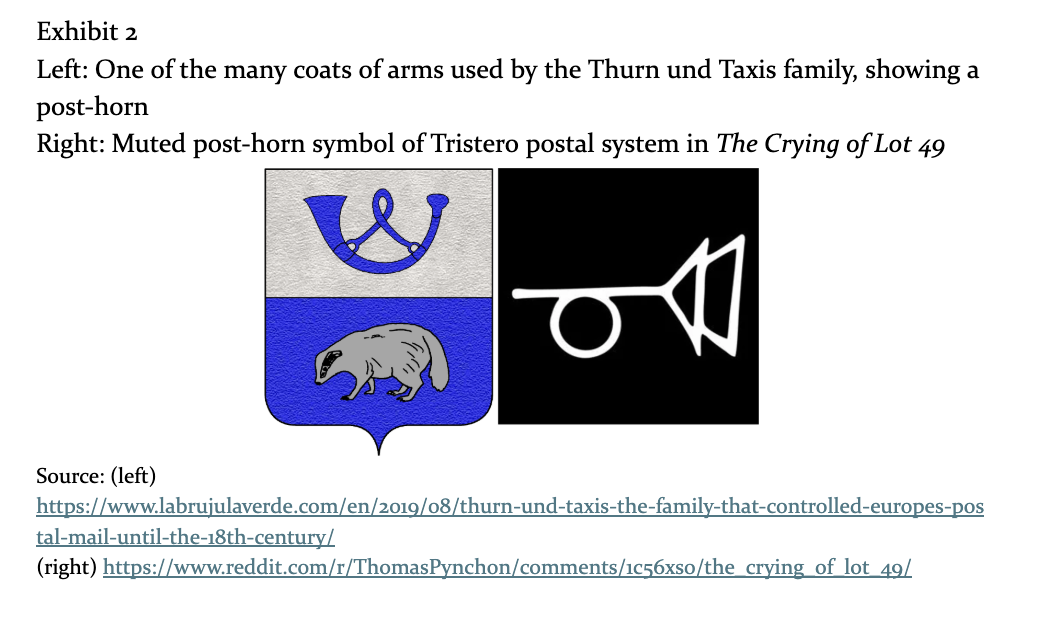
An early overland shipping company in the United States was Wells Fargo. In Europe, the Renaissance-era postal monopoly called Thurn und Taxis carried goods and money, in addition to letters, over long distances. Thurn und Taxis is best known to modern readers as the (real) competitor to the (fictional) Tristero postal system in Thomas Pynchon’s satirical novel The Crying of Lot 49, but in real life it played an important role in central European history. The family’s coat of arms is contrasted with the fictional Tristero company’s symbol in Exhibit 2.
How did the customers of these companies know that they were trustworthy carriers of valuables? They didn't. What they knew is that everyone else seemed to think they were trustworthy.
This is where common knowledge, trust, and reputation intersect. And it is why these firms were able to start money management businesses.7 Wells Fargo Investment Advisors launched the first index fund in 1971, and after a series of transactions lives on as BlackRock. (The current Wells Fargo Advisors is a different, but related, organization.)
Thurn und Taxis’s investment arm survives as Prinz Karl Thurn und Taxis Management AG, based in Switzerland — and this organization called on me as a potential customer when I worked at the Ford Foundation. The surname of the firm’s representative was Thurn und Taxis; I don’t remember if it was Prince Karl or some other family member. It’s a small world.
Conclusion
In this book-length treatment of what could have been an excellent blog post, Steven Pinker finds an interesting pressure point in society and overanalyzes it. This fault isn’t typical of Pinker. His best works — The Better Angels of Our Nature, Enlightenment Now, The Blank Slate, Rationality, The Language Instinct, and The Stuff of Thought — form a canon that rivals that produced by any writer of literary nonfiction, including the man who practically invented the genre, Stephen Jay Gould. Pinker has also produced some clunkers. At 71 years old (the same age as me), he has many more good books in him. Don’t give up on Steve.
"
Laurence B. Siegel is the Gary P. Brinson director of research, emeritus, at the CFA Institute Research Foundation; economist and futurist at Vintage Quants LLC; a senior advisor at Quent Capital; and an independent consultant, writer, and speaker. His books, which include Fewer, Richer, Greener and On Progress and Prosperity, explore ideas in economics, investing, the environment, technology, and human progress. His website is http://www.larrysiegel.org. He may be reached at [email protected].

Endnotes
1. If anyone knows of an earlier example, please tell me. Nearly every seemingly original thought has antecedents.
2. The scare quotes around “deviant” are mine; Pinker did not use the term.
3. 6.35 million vehicles per traffic signal per year, multiplied by 320,000 signals in the U.S. Source: http://www.streetlightdata.com, via Gemini 3. Source of fatalities data: https://lmdlawfirm.com/.
4. Storonyanska, Iryna, Olena Ivashko, and Elena Mieszajkin. 2022. “Trust as a Catalyst of Economic Growth: A National and Regional Breakdown.” Sustainability 14(22), 15168.
5. Purchasing power parity-adjusted GDP per capita, which is a good proxy for real income (what the income can buy in terms of a standard of living).
6. Looking at the relationship between trust and prosperity time-serially (comparing the same country at different points in time, instead of different countries at a single point in time as Storonyanska et al. do in Exhibit 1), there is an odd effect: As trust moves from low to medium levels, incomes improve, but then fall off when trust reaches maximum levels. So trust is not unambiguously a predictor of economic success; there is more than one side to the story. See Roth, Felix. 2009. “Does Too Much Trust Hamper Economic Growth?” Kyklos, https://onlinelibrary.wiley.com/doi/10.1111/j.1467-6435.2009.00424.x.
7. Looking at the relationship between trust and prosperity time-serially (comparing the same country at different points in time, instead of different countries at a single point in time as Storonyanska et al. do in Exhibit 1), there is an odd effect: as trust moves from low to medium levels, incomes improve, but then fall off when trust reaches maximum levels. So trust is not unambiguously a predictor of economic success; there is more than one side to the story. See Roth, Felix. 2009. “Does Too Much Trust Hamper Economic Growth?” Kyklos, https://onlinelibrary.wiley.com/doi/10.1111/j.1467-6435.2009.00424.x.
A message from Advisor Perspectives and VettaFi: Discover something new! Click here to register for our upcoming webcasts.
Membership required
Membership is now required to use this feature. To learn more:
View Membership BenefitsSponsored Content
Upcoming Virtual Events View All