3% Real TIPS Yields: Boring but Valuable
Membership required
Membership is now required to use this feature. To learn more:
View Membership Benefits Advisor Perspectives welcomes guest contributions. The views presented here do not necessarily represent those of Advisor Perspectives.
Would you consider investing in a bond that earns more than 3% after accounting for inflation? What if that security has zero chance of default?
Such an opportunity exists today in U.S. Treasury Inflation-Protected Securities (TIPS).
Would your answer change if the expected real return on stocks over the next 10 years was well below 3%?
The scatterplot below shows the correlation between S&P 500 CAPE10 valuations and the 10-year forward real returns that ensued. While the graph doesn't show the path of returns over the following 10 years, the strong correlation allows us to reasonably forecast the S&P 500 annualized real return over the next 10 years. Based solely on the graph, we should expect a real return ranging from -1.4% to -3.8% for the S&P 500.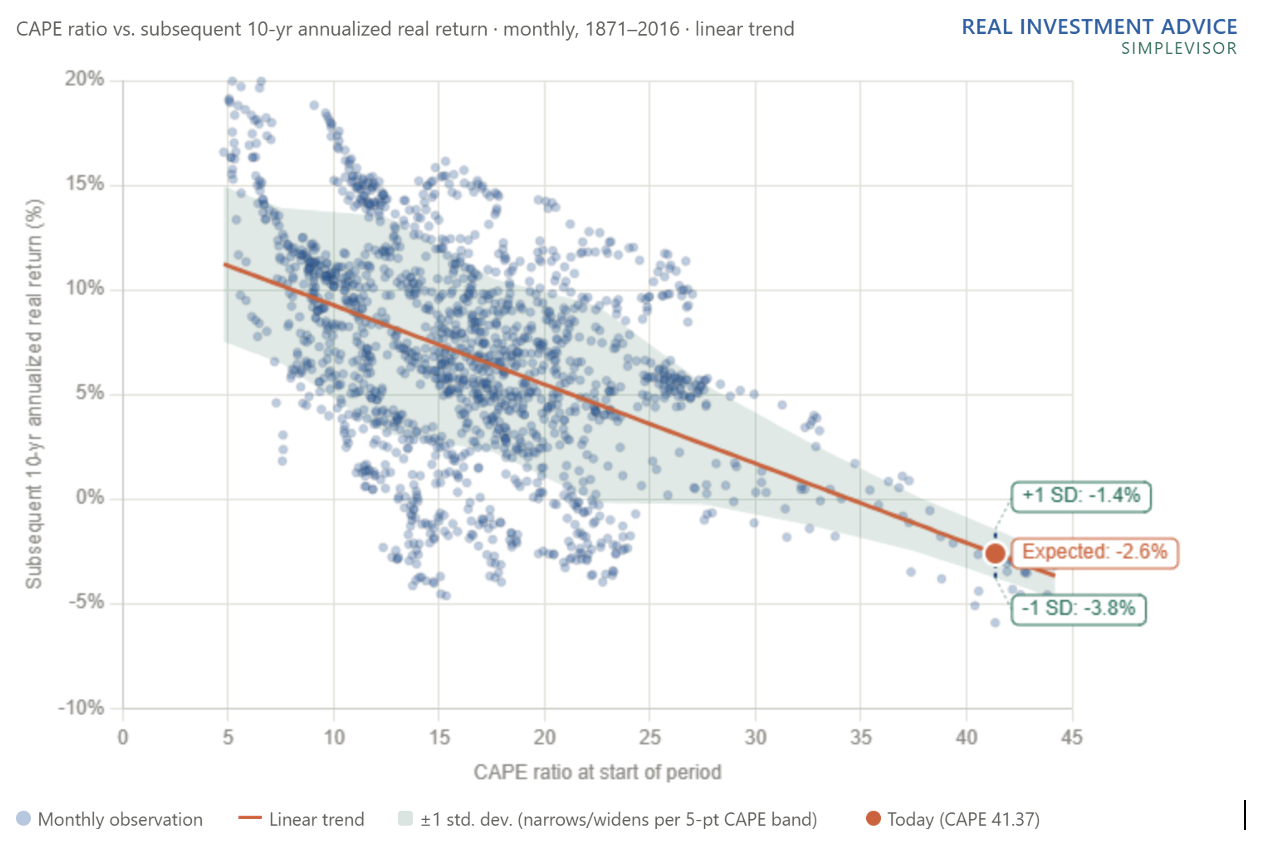
The objective of this article is not to pound the table urging investors to sell stocks and buy 30-year 3% TIP bonds. Instead, it highlights current bond market dynamics and shows how cheap bonds have gotten.
For more on the topic, I recently summarized why long-term bond bull Lacy Hunt suddenly turned bearish.
What Are TIPS?
TIPS are U.S. Treasury securities that share many similarities with regularly issued Treasury bonds but differ in an important way. Like nominal U.S. Treasury securities, TIPS have a stated maturity and coupon rate. However, the TIPS principal value adjusts with the CPI inflation index every six months. This mechanism operates through the inflation factor.
Additionally, each period's coupon payment is calculated off the inflation factor-adjusted principal amount rather than the original par value. As a result, a TIPS bond will always pay its holders the CPI inflation rate. Plus, when TIPS offer a positive yield (as they do today) the real return (after inflation) is guaranteed to be positive. No other liquid security provides a perfect inflation hedge!
The yield difference between a nominal bond and a TIPS bond of equal maturity provides the market’s expected inflation rate. If you think inflation will run above that expected rate, TIPS will offer a better return over the life of the bond, and vice versa if you think inflation will be lower than the expected rate.
TIPS, like nominal bonds, fluctuate in price. Thus, with a 30-year TIPS, you face significant price loss or the potential for large gains if you sell the bond before it matures.
Current Market Context
Before discussing how 3% 30-year TIPS yields compare to historical yields, it's worth noting that the history for 30-year TIPS yields is limited. The Treasury first offered 30-year TIPS in April 1998 but discontinued the offerings in October 2001, when budget surplus projections suggested long-term borrowing wouldn't be needed. The Treasury reintroduced them in February 2010. Thus, due to the low supply of bonds, liquidity was limited from 1998 to 2010, resulting in exaggerated yield volatility and patchy data.
During the short window from 1998 to 2001, 30-year TIPS peaked at an all-time high yield of 4.40%. The graph below shows the history of 30-year TIPS yields since they were reintroduced in 2010.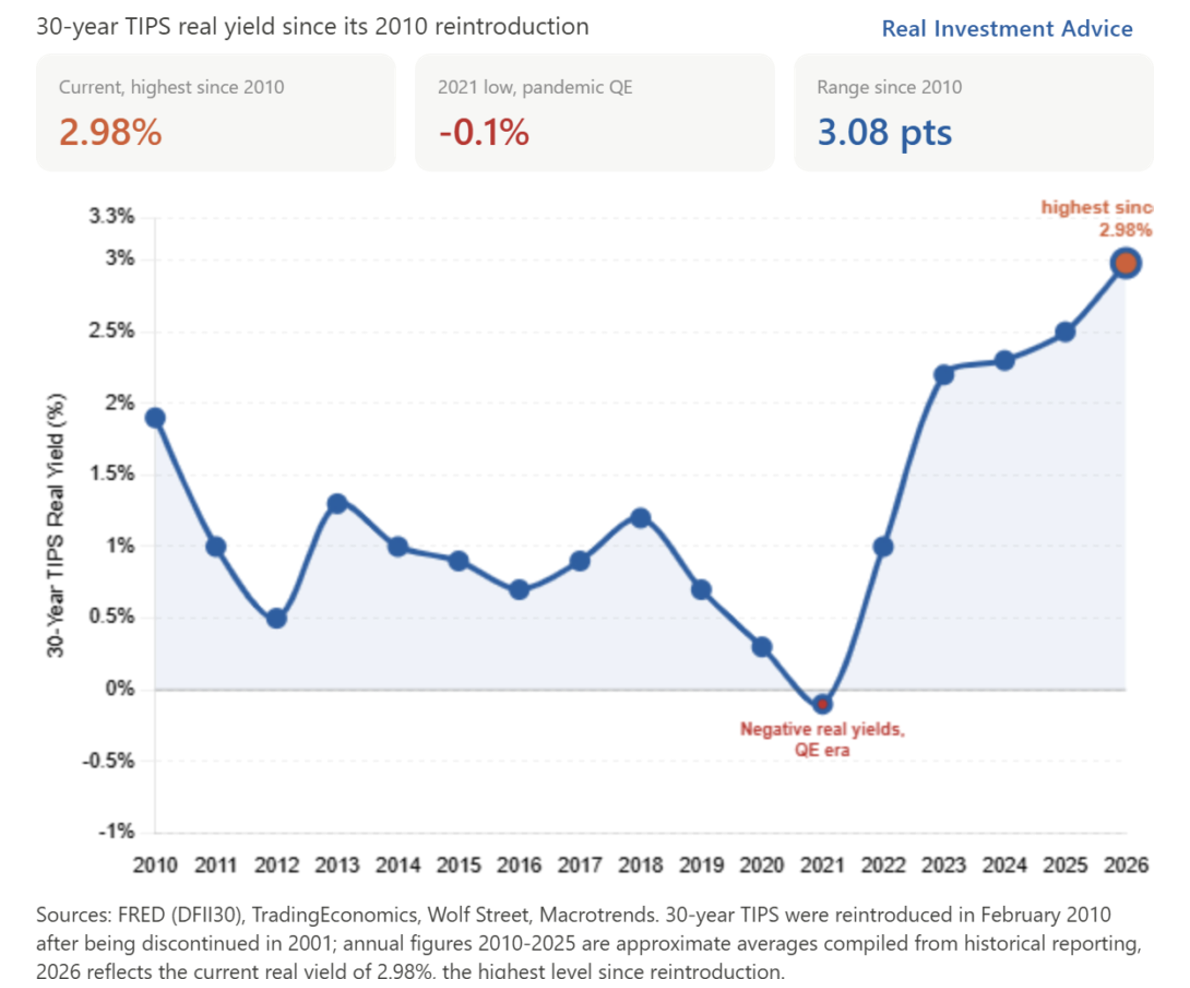
As of mid-July 2026, the 30-year TIPS real yield is at 3.05%, the highest level since the security was reintroduced in 2010.
The yield on the newest 10-year TIPS auctioned on July 30, 2026, is 2.50%, trailing only the 2.85% recorded on October 8, 2008, in the middle of the financial crisis sell-off. According to David Enna at tipswatch.com, “A chance to get the highest real yield at auction in nearly 18 years is appealing and tempting.”
The fact that today’s yield is closing in on the yield during the most illiquid and stressful days of the financial crisis underscores how unusual this moment is.
The Conventional Bearish Case
Real yields rise when investors demand more compensation for holding government debt, and three reasons may be at play today.
Inflation Risk
If markets believe the Fed will struggle to contain inflation, they will demand a higher real return to compensate for that uncertainty. Many claim the jump in oil and related prices explains the recent surge in yields.
I don’t agree. Since the Iranian conflict started, 5-year inflation expectations have fallen by nearly 0.25%, and 30-year inflation expectations are at their lowest level since September 2024.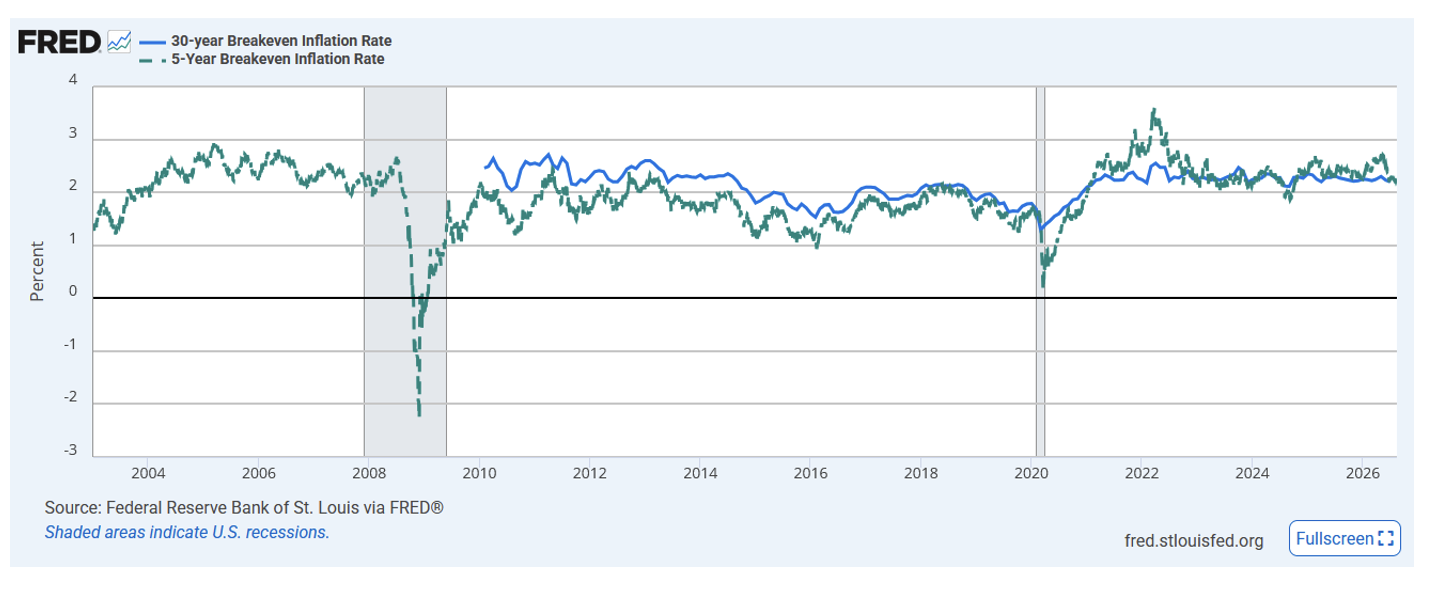
However, inflation sentiment, as judged solely by surveys, is poor.
Deficit Woes
The national debt is approaching $40 trillion and being driven higher by net interest payments, which are the fastest-growing line item in the federal budget. While an ever-expanding supply of Treasury debt is a cause for concern among bond investors, context is needed to better assess the situation.
The debt-to-GDP ratio is at the same level today (1.22x) as it was five years ago. Thus, debt growth has been commensurate with economic activity. If interest rates had not risen precipitously over the last five years, the ratio would be 1.09x, not far from where it was before the pandemic.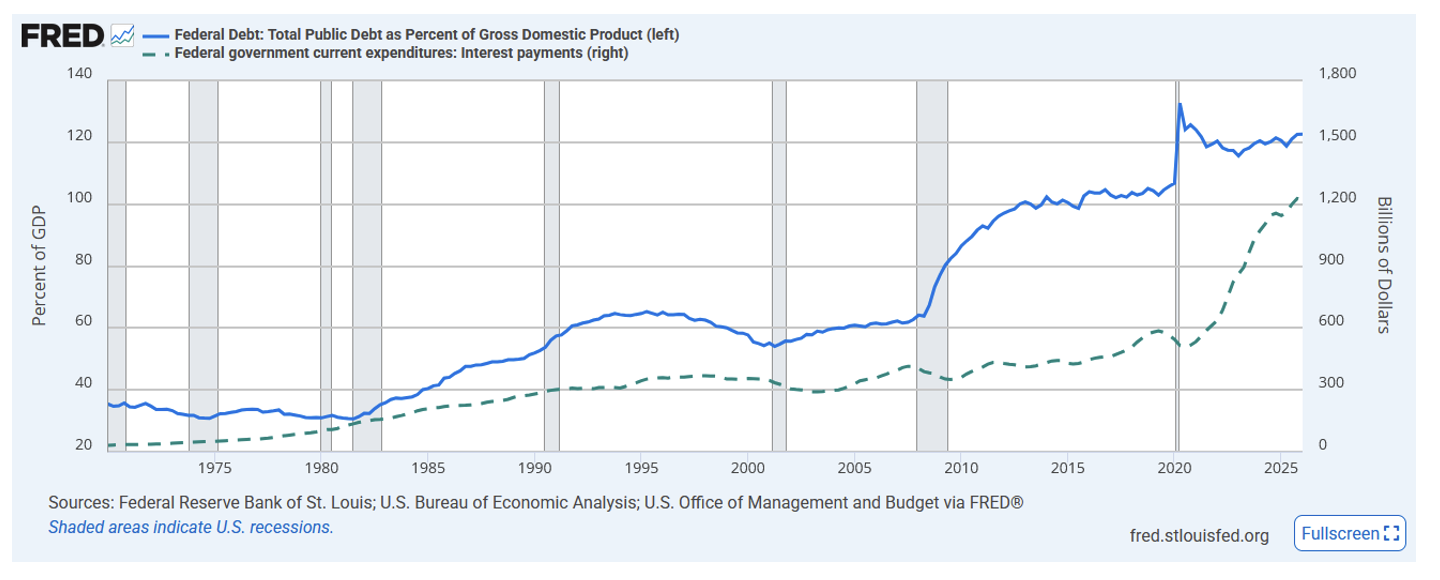
Safe Haven Status
Term premium measures the additional yield that investors demand for the risks of holding Treasury securities over longer periods. Today, some pundits claim higher yields reflect that long-term Treasuries are no longer the ideal safe haven security. That may sound good in theory, but the graph below sheds light on the term premium.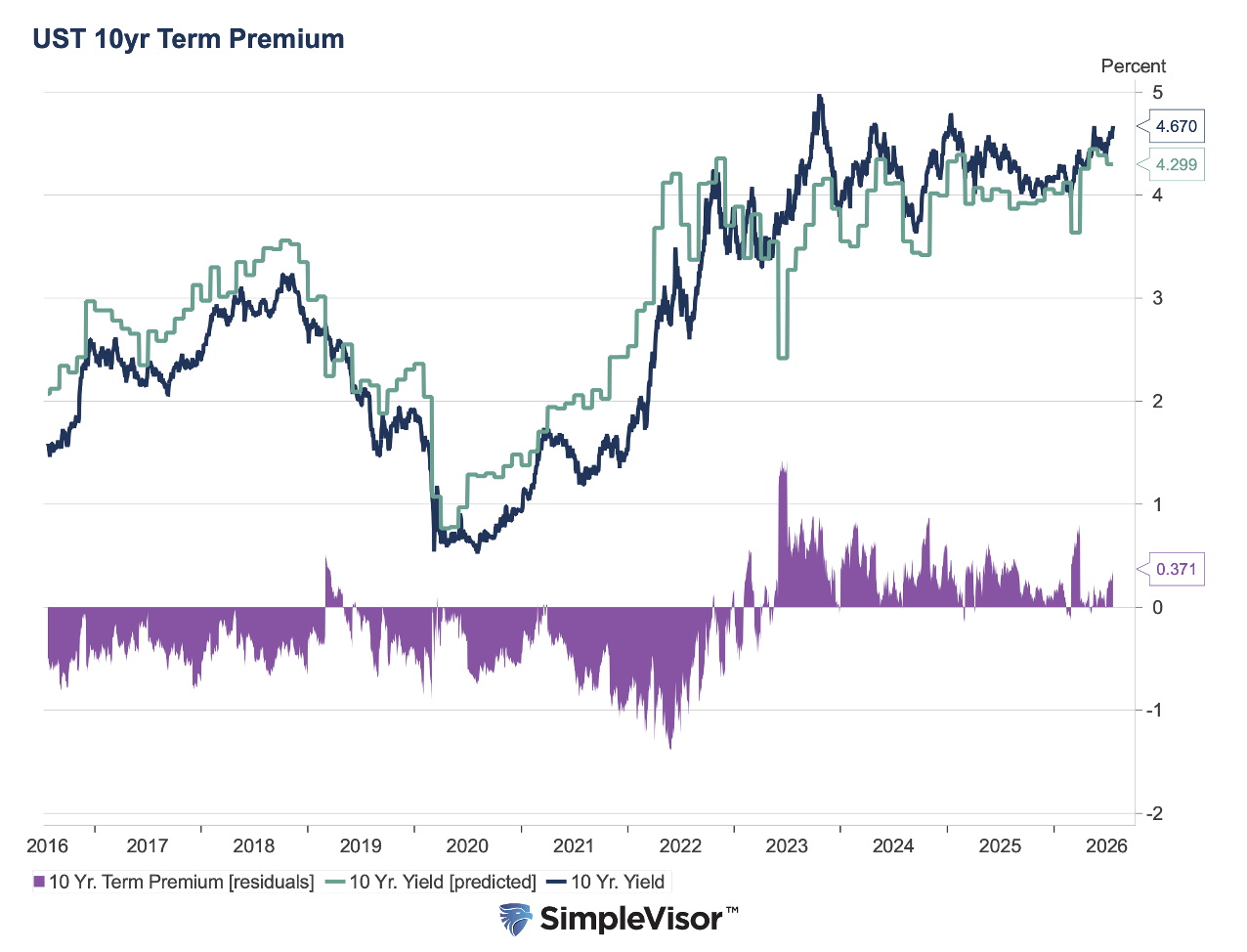
The graph shows 10-year U.S. Treasury yields compared with the 10-year inflation expectations index produced by the Cleveland Fed. The Fed expectations index includes three subcomponents: current CPI, breakeven CPI derived from TIPS, and surveyed inflation results.
Given that inflation and inflation expectations are very highly correlated with yields, the difference, 37 basis points, can be described as the term premium. That’s relatively low, so the term premium (safe-haven status or deficit concerns) is not a major factor driving yields higher. We can thus deduce that the recent spurt higher in yields is more due to inflationary concerns.
As stated earlier, market-implied breakeven inflation rates have fallen since the Iranian conflict started. CPI jumped from March through May, with the annualized inflation rate since the hostilities started being 3.91%. However, a more recent view of inflation over the last three months points to 0.50% annualized inflation.
Given that breakeven inflation expectations are flat to lower and CPI is normalizing quickly, surveyed inflation expectations are the main driver of higher yields. In my view, poor inflation sentiment due to higher oil prices and, to a lesser extent, political views are the primary factors driving yields higher. As such, the fundamentals supported by market or actual inflation data point to lower yields once sentiment improves.
Another Explanation
Real yields do not rise only because of the three rationales discussed here: inflation, deficits, and concerns about safe-haven status. They may also rise when the market forecasts stronger long-run productivity growth, which may result in stronger economic growth.
For instance, the 10-year TIPS yield hit an all-time high of 4.41% in January 2000, when the internet and enterprise software were fundamentally reshaping the economy's capacity to grow. High real yields reflected optimism that the American economy could sustain a faster underlying growth rate than it had in the prior three decades. Investors also demanded additional compensation to hold fixed-rate instruments in markets where real returns on capital were rising rapidly.
I believe today's setup has similarities to that period. The increasing adoption of AI tools across the economy is the main ingredient of productivity acceleration. While we have yet to see durable productivity benefits at scale, they are most likely to occur; the question is when.
While there are reasons to be hopeful that AI will drive stronger economic growth, ample evidence suggests productivity growth is disinflationary. If having fewer workers results in higher profits, corporations can lower prices or at least not raise them as much due to reduced compensation.
I suspect this battle between the growth benefits of AI and the disinflationary benefits for prices will create periods of bond volatility until the disinflationary benefits become evident.
It's worth noting that the massive capital required for the AI buildout is also behind the push higher in yields. I discussed this capital scarcity problem in my article on Lacy Hunt.
Diversification Benefits
I led this article with a graphic showing expected real stock returns for the next 10 years are negative. The last time expectations were that low was in 1999. Had one bought the April 1999 issue of a 30-year TIP maturing in 2029 with a real yield of 3.89%, they would have earned 6% annually through July 2026. As I share below, for the first 20 years of the investment, the TIP would have outperformed the S&P 500.
I want to stress that I am not recommending selling equities to buy TIPS. But given stock valuations, there is a strong case for the diversification benefits of holding or adding TIPS at 3% real yields to an equity portfolio.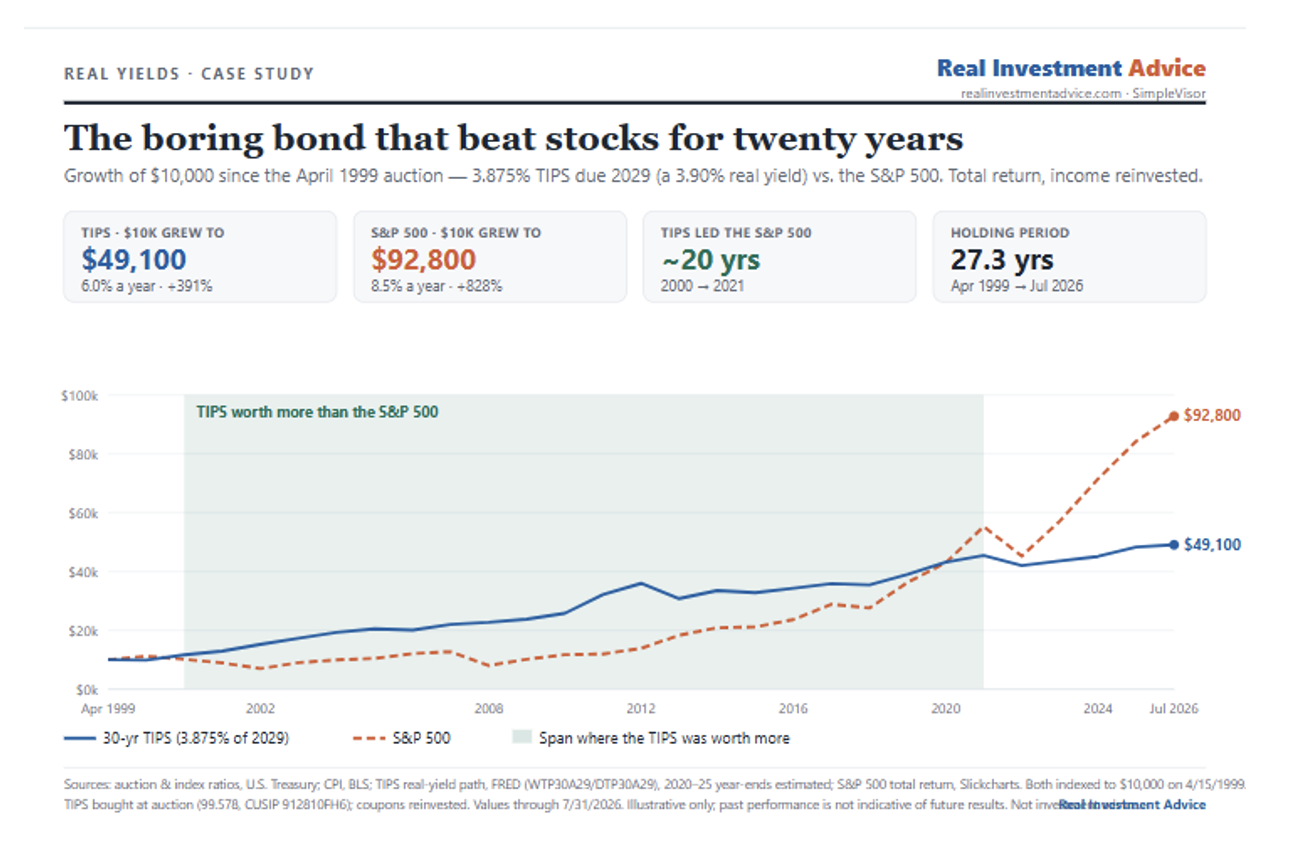
Summary
I think today's 3% real yields reflect a genuine blend of forces working simultaneously: A bond market demanding more premium for a larger and faster-growing supply of government debt and AI-related debt, inflation worries, speculative behaviors driving investors out of bonds to chase equity returns, and a budding productivity story.
The history of TIPS suggests that the last time yields were this elevated outside of a crisis, the American economy was in the early stages of one of its most productive periods in a century. Whether artificial intelligence delivers a comparable structural boost remains to be seen. But if it does, disinflationary forces are likely to accompany it, and 3% real yields may prove valuable.
Read more by Michael Lebowitz:
- Lacy Hunt Turns Bearish: Studying His Reversal
- Hidden Debt: Is Our Hyperscaler Thesis Wrong?
- Is There Really Carnage in Hyperscaler Credit?
- Can SpaceX Fire on All Cylinders?
Michael Lebowitz is a portfolio manager with RIA Advisors and author for Real Investment Advice. For more information, contact him at [email protected] or 301.466.1204.
Join RIA Advisors and elevate your career within a deeply experienced team focused on innovation. Our collaborative environment is built on a foundation of advanced technology and effective investment models, designed to enhance your ability to serve clients and grow your practice. Benefit from a supportive culture that encourages professional development and fosters a forward-thinking approach. By joining our team, you’ll be part of a group dedicated to excellence and continuous improvement, empowering you to focus on building meaningful client relationships and pursuing your business ambitions. Discover the advantages of working with our accomplished advisory team by starting your conversation today.
A message from Advisor Perspectives and VettaFi: Discover something new! Click here to register for our upcoming webcasts.
Membership required
Membership is now required to use this feature. To learn more:
View Membership BenefitsSponsored Content
Upcoming Virtual Events View All