Is There Really Carnage in Hyperscaler Credit?
Membership required
Membership is now required to use this feature. To learn more:
View Membership Benefits Advisor Perspectives welcomes guest contributions. The views presented here do not necessarily represent those of Advisor Perspectives.
“Carnage in hyperscaler bond land,” GLJ Research founder and CEO Gordon Johnson wrote on X, claiming what the the graph below illustrates: exploding yield spreads for hyperscalers. Such hyperbolic messages are generating a growing fear among some investors that the largest tech companies are in financial trouble.
The bearish hyperscaler narrative is not all it's cracked up to be, as I will explain.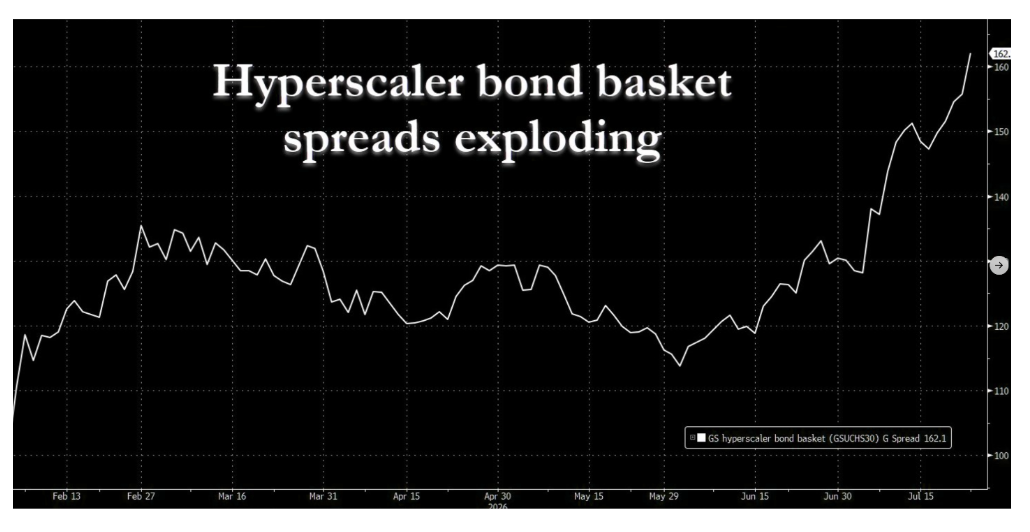
The graph shows that a basket of credit default swaps (CDS) for the five largest U.S. hyperscalers is exploding, rising from 115 basis points to 162 basis points over the last few months. Given that the basket comprises some of the largest U.S. companies (Amazon, Meta, Microsoft, Google, and Oracle), a prospective credit event that could potentially spread to the broader market would be troubling.
CDS are derivative swap agreements that serve as insurance for bondholders, protecting against a default. The cost to contain this risk has risen by almost 50%. As a result, the odds of a default in any of the five names over the next five years have risen from 8.6% to 11.8%.
Background
Before assessing the bearish narrative, it's important to ask why the fear of financial difficulties is increasing.
The primary answer is the massive funding the hyperscalers require to build out data centers and the poor visibility into the timing and amount of future revenue from those investments.
The amount of capital Amazon, Meta, Google, Microsoft, and Oracle require is rising rapidly. The need to raise both debt and equity capital is relatively new because the companies are shifting from cash flow–positive to cash flow–negative positions. Their profits are no longer large enough to cover their AI-related investments.
Currently, the five hyperscalers have combined 2026 capital budgets of roughly $725 billion to $770 billion — up from less than $100 billion in 2021. Alliance Bernstein estimates that spending from the group could reach nearly $1.6 trillion by 2030.
There has been a sharp decline in free cash flow for the hyperscalers and a commensurate surge from semiconductor companies that are on the receiving end of their capital expenditures.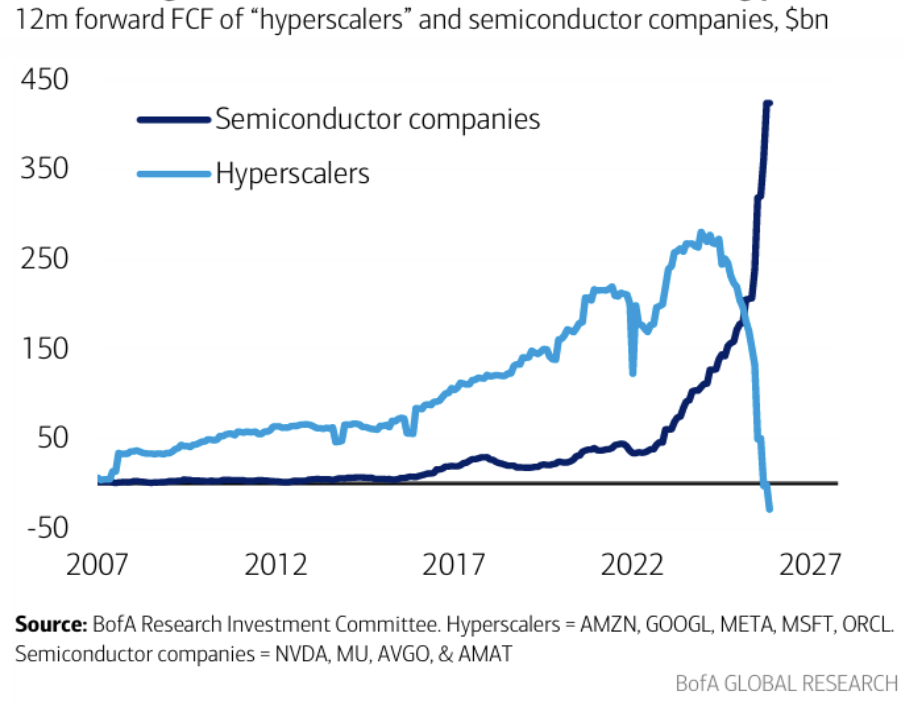
Is the Bond Market Concerned?
Growing worries about rising debt issuance are reflected in higher CDS spreads. While CDS spreads are an important gauge of creditworthiness, it's important to recognize that CDS trading can be illiquid and volatile, which causes unjustified comfort or concern.
Credit spreads are a more robust way to track credit conditions for a company or the broader market. A credit spread is the difference between a bond yield or a corporate index yield and a comparable-maturity Treasury bond. A rising spread indicates investors are demanding an additional yield premium to compensate for increased default risk.
The two charts below help us assess whether the bond market is truly pricing in higher default risk.
The first graph shows the yields of the five hyperscalers alongside U.S. Treasury yields. The second graph answers the question: Is the bond market concerned? It charts the hyperscalers' credit spreads as compared to the credit spread of the corporate bond BOA ICE AA-rated Index.
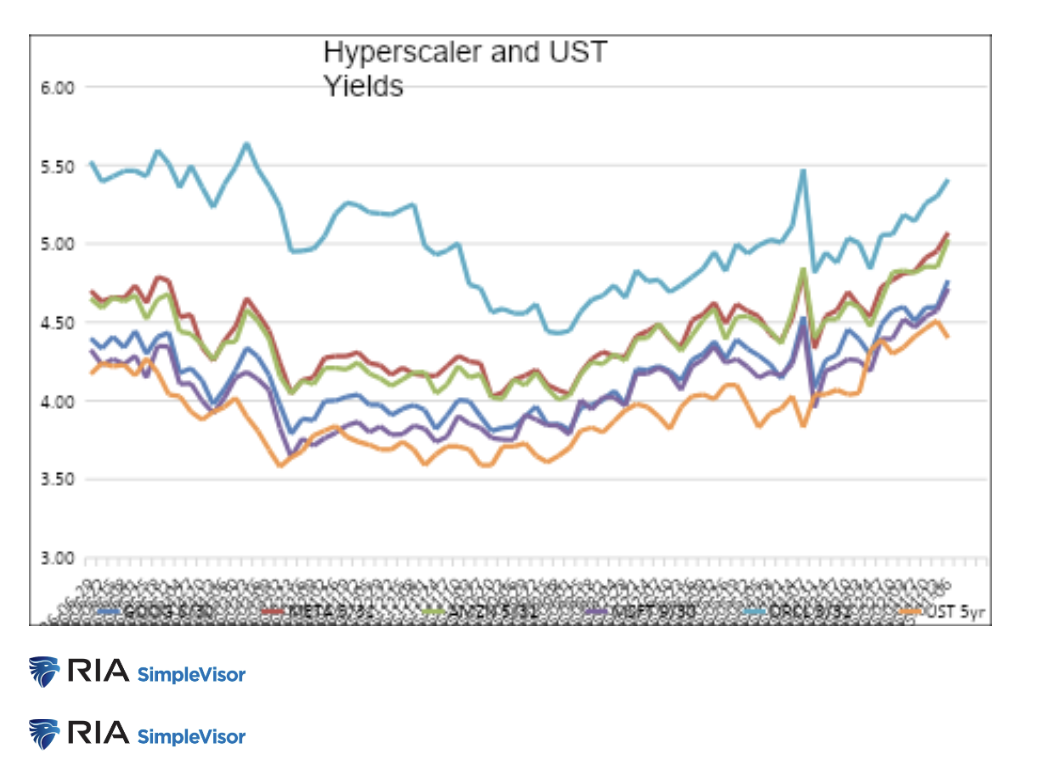
Excluding Oracle, the four other hyperscaler credit spreads have been relatively flat and, since the start of 2025, have been at or below the index representing all AA-rated bonds.
Based on the data, the fear being spread is an Oracle story — not an indictment of Google, Microsoft, Meta, or Amazon.
Oracle
Oracle's five-year CDS spread has risen quickly, from below 50 basis points in mid-2025 to 200 basis points today.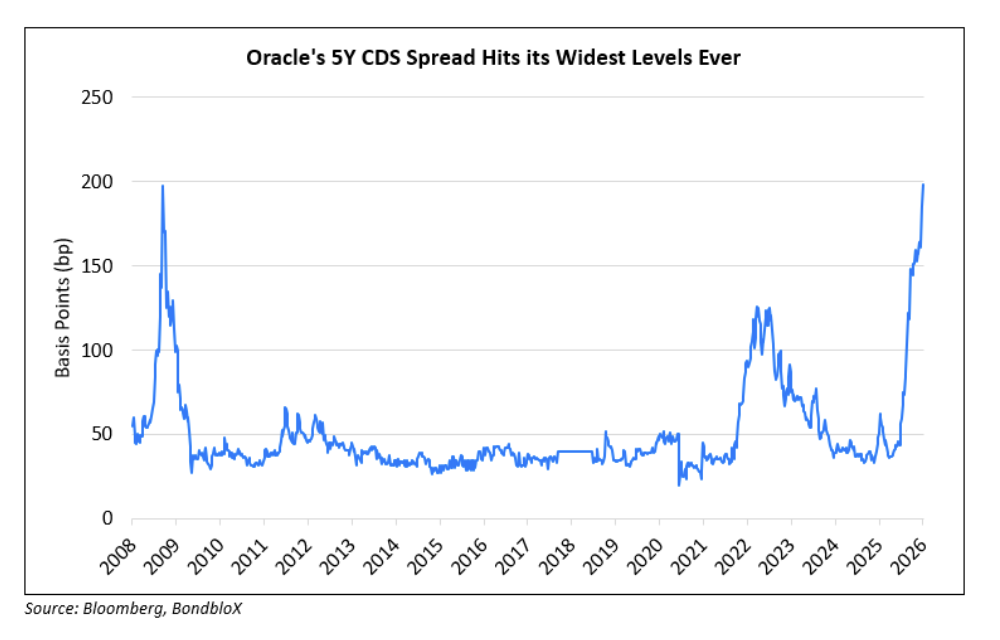
On the cash-bond side, an Oracle bond maturing in February 2031 trades at a yield of 6.23%, about 180 bps above the five-year Treasury. Currently, Oracle has a BBB- rating from S&P Global. Based on the table below from SimpleVisor, Oracle yields are much higher than BBB-rated bonds and in line with junk-rated BB bonds.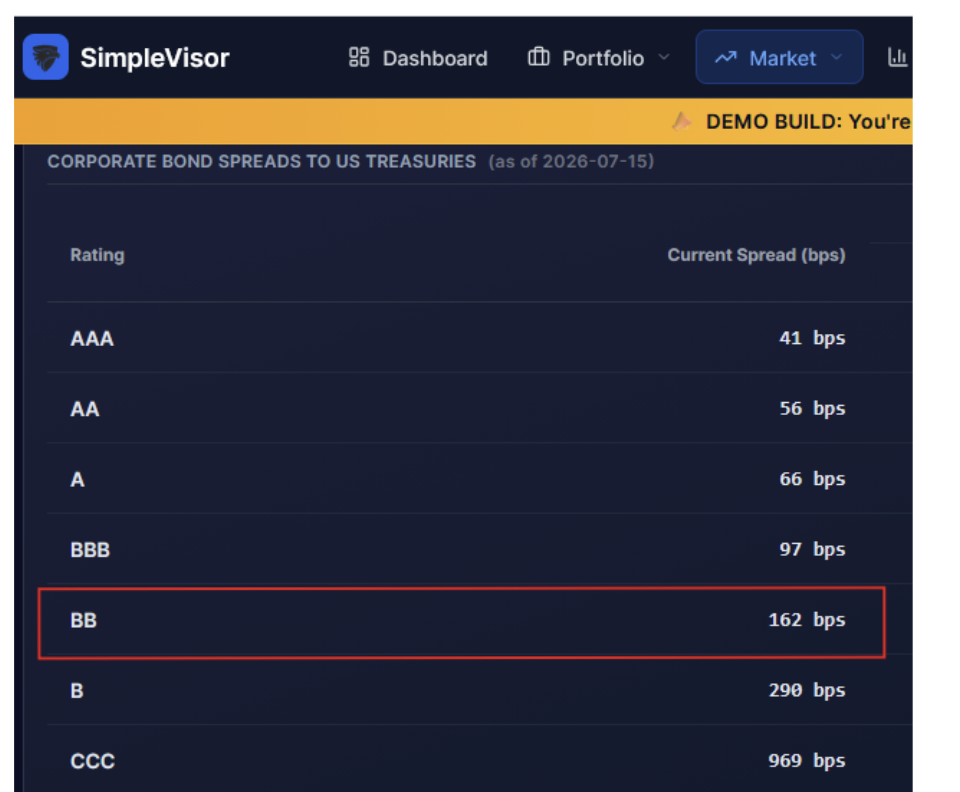
Oracle's 2026 capital expenditure was $55.7 billion. The company has negative free cash flow of $23.7 billion and total debt near $130 billion. Its debt-to-equity ratio is near 4x. Its key debt ratio is also well above the other hyperscalers:
- Microsoft .30x
- Meta .36x
- Google .18x
- Amazon .51x
Amazon, Microsoft, Alphabet, and Meta
Unlike Oracle, credit ratings for this group remain firmly in the high investment-grade tier:
- Microsoft is AAA (S&P) and Aaa (Moody's), one of only two U.S. public companies at the AAA rung.
- Amazon is AA (S&P), AA- (Fitch), and A1 (Moody's).
- Google is rated AA+ (S&P) and Aa2 (Moody's).
- Meta was recently upgraded to Aa3 (Moody's) and holds AA- at S&P.
The high credit ratings are not surprising given the low debt-to-equity ratios. According to Credit Sights data, the ratios are well below the approximate .80x average for S&P 500 companies in aggregate.
The credit profile of these four hyperscalers is not a concern today. However, investors should not get complacent. Rapidly rising debt without commensurate income could change the hyperscalers’ credit standings rapidly.
Summary
“Carnage” and “exploding” are very misleading descriptors of what is happening to hyperscaler credit spreads. Yes, the basket of CDS spreads is certainly moving upward, but it is not evenly distributed. Oracle's CDS spreads have moved by multiples, while the other four hyperscalers' CDS spreads have increased by a much more subdued amount, and from unusually tight initial levels.
At face value, the first graph greatly overstates the risks facing Microsoft, Amazon, Alphabet, and Meta bondholders.
What it really highlights is an Oracle problem. Driven by a balance sheet stretched by debt-fueled AI infrastructure spending and a credit rating teetering a notch above junk, investors are rightfully concerned. They are pricing Oracle bonds as if they have already been downgraded into junk territory.
The question investors should be asking isn't whether Oracle is an outlier because it clearly is. The question is whether Oracle is a preview of what happens to credit markets more broadly if AI capital spending keeps outrunning AI revenue.
Read more by Michael Lebowitz:
- Can SpaceX Fire on All Cylinders?
- Headwinds & Tailwinds: Minding The Market Weather
- Yield Curves & Style Rotations: Omen or Deception?
Michael Lebowitz is a portfolio manager with RIA Advisors and author for Real Investment Advice. For more information, contact him at [email protected] or 301.466.1204.
Join RIA Advisors and elevate your career within a deeply experienced team focused on innovation. Our collaborative environment is built on a foundation of advanced technology and effective investment models, designed to enhance your ability to serve clients and grow your practice. Benefit from a supportive culture that encourages professional development and fosters a forward-thinking approach. By joining our team, you’ll be part of a group dedicated to excellence and continuous improvement, empowering you to focus on building meaningful client relationships and pursuing your business ambitions. Discover the advantages of working with our accomplished advisory team by starting your conversation today.
A message from Advisor Perspectives and VettaFi: Discover something new! Click here to register for our upcoming webcasts.
Membership required
Membership is now required to use this feature. To learn more:
View Membership BenefitsSponsored Content
Upcoming Virtual Events View All











