Hidden Debt: Is Our Hyperscaler Thesis Wrong?
Membership required
Membership is now required to use this feature. To learn more:
View Membership Benefits Advisor Perspectives welcomes guest contributions. The views presented here do not necessarily represent those of Advisor Perspectives.
Shortly after we published "Is There Really Carnage in Hyperscaler Credit?", a reader pointed us to an article from Nikkei Asia titled "Five US Tech Giants’ Hidden Debt Soars To $1.65tn On Opaque AI Funding.” The reader asked if the article — and its claims that off-balance-sheet obligations at Alphabet, Microsoft, Amazon, Meta, and Oracle have grown roughly eightfold in four years to an estimated $1.65 trillion — changes our opinion.
To recap, our prior article opened with a chart showing hyperscaler credit default swap spreads jumping, or as some claim, “exploding,” from 115 to 162 basis points. While the graph is eliciting fear in some investors, we concluded the brewing credit concerns are overwhelmingly an Oracle story. Oracle's five-year credit default swap (CDS) spread has jumped from below 50 basis points to roughly 200, its debt-to-equity ratio sits near 4x, and its bonds are trading like junk bonds despite an investment-grade rating.
By contrast, Microsoft, Amazon, Alphabet, and Meta have debt-to-equity ratios between 0.18x and 0.51x, credit ratings firmly in the AA to AAA tier, and credit spreads that have remained relatively flat and at levels at or below the broader AA-rated bond index. Our conclusion was that the graph overstates the risk embedded with four of the five hyperscalers.
Nikkei Asia’s reporting of hyperscalers’ hidden debt doesn't change our conclusion, but it does complicate it.
Hidden Debt Structures
Nikkei's analysis traces the $1.65 trillion in off-balance sheet obligations to three main mechanisms: long-term data center lease commitments, GPU supply contracts structured as take-or-pay obligations, and joint venture or special-purpose-vehicle (SPV) financing arrangements.
Long-term data center lease commitments
A hyperscaler leases a data center built to its specifications rather than buying and financing the facility directly on its balance sheet. Because the commitment is an operating lease, the payment obligation is reported in the footnotes of the financial statement rather than a line item on its balance sheet.
GPU supply contracts structured as take-or-pay obligations
A hyperscaler commits to paying for a set volume of GPU chips, whether it uses them or not. This is a binding future cash obligation, but not a loan, so it doesn't show up as debt on the balance sheet.
Joint venture or SPV financing arrangements
Unlike a straight lease, where the hyperscaler is solely a tenant, the hyperscaler helps create a special-purpose financing vehicle, often with a private credit or private equity partner. The SPV borrows money and builds the data center, and the hyperscaler signs a long-term contract to use it.
The debt sits on the SPV’s books, not the hyperscaler's, so it doesn't negatively impact the company's leverage ratios. However, the hyperscaler's payments are binding, and the relationship is more involved than a simple rent payment like in the first item listed above.
Hidden Hyperscaler Debt
The distribution of hidden off-balance-sheet debt for the five hyperscaler companies is uneven. The following data are pulled from their respective SEC filings. The $1.65 trillion figure for off-balance-sheet obligations that Nikkei reports is nearly identical to what we found in the SEC filings.
Meta
Meta’s off-balance-sheet obligations are estimated at $420 billion, nearly three times its approximately $140 billion in disclosed on-balance-sheet debt.
Oracle
Oracle's hidden debt is reported at roughly $273 billion. This reinforces our original thesis on Oracle. The off-balance-sheet debt stacked on top of the roughly $130 billion in on-balance-sheet debt makes Oracle’s debt problem even more concerning and helps us understand why the bond market trades its debt at yields similar to junk-rated bonds.
Alphabet
Alphabet has a very low debt-to-equity ratio of 0.18. However, its most recent 10-Q discloses nearly $76 billion in leases not yet commenced and over $332 billion in purchase and other contractual commitments, a total of roughly $408 billion, including approximately $30 billion in equity-derivative structures.
Microsoft
Microsoft's recent SEC filings disclose nearly $197 billion in leases not yet commenced, primarily for data centers, plus a separate contractual-obligations table showing roughly $32 billion of construction commitments and $110 billion of purchase commitments. Combined, Microsoft's total comes to approximately $339 billion. Microsoft is one of only two companies rated AAA.
Amazon
Amazon has $106 billion in leases not yet commenced and $104 billion in unconditional purchase obligations, adding up to roughly $210 billion, the smallest of the five hyperscalers in absolute terms.
The graphic below shows the composition of the $1.65 trillion in off-balance-sheet obligations for the five big hyperscalers.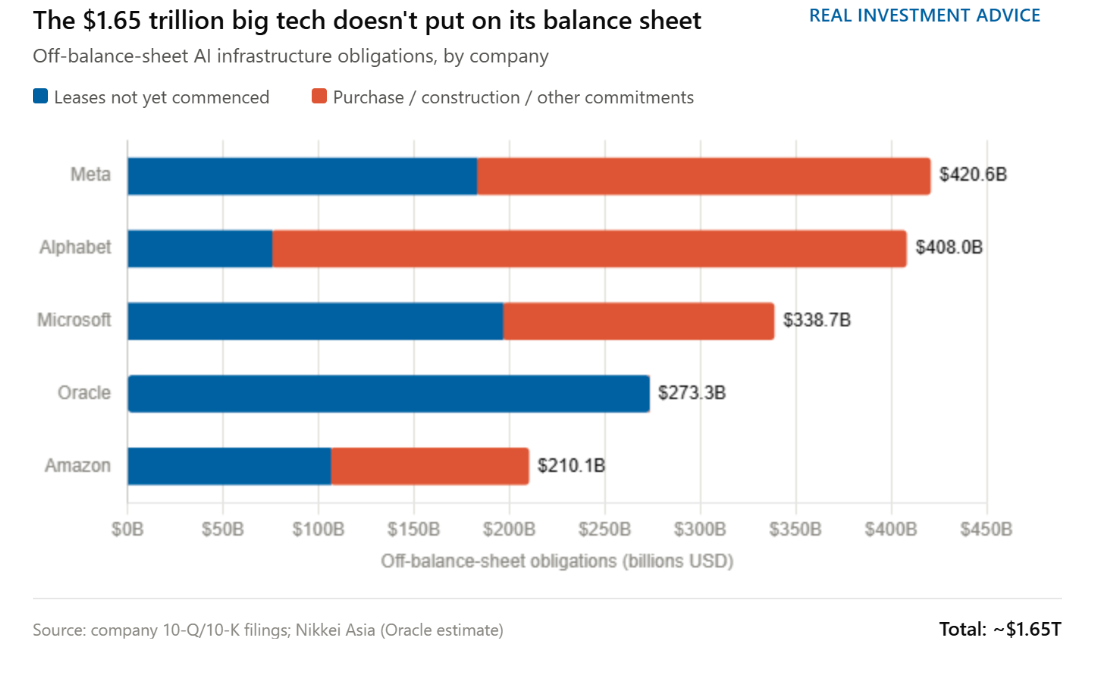
On- & Off-Balance-Sheet Financial Ratios
The information in the graph below will help us conduct a complete analysis of the five companies' on- and off-balance-sheet obligations
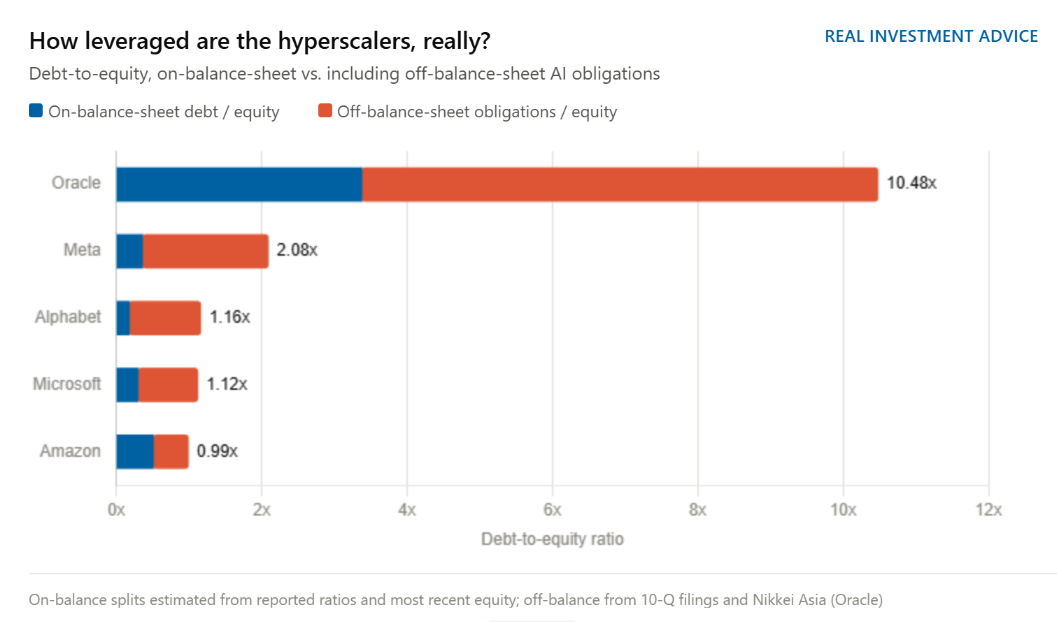
In the previous article, we showed that Oracle bonds were trading on par with junk-rated debt. The graph shows it has an on- and off-balance-sheet debt-to-equity ratio over 10x, which justifies the bond market’s assessment of Oracle’s credit situation. While not nearly to the same degree as Oracle, Meta’s debt-to-equity ratio increases substantially from .36 to 2.08 when we include hidden debt. The ratios for the other three — Alphabet, Microsoft, and Amazon — hover around 1.00.
For reference, consider that the average debt-to-equity ratio for the S&P 500 has recently ranged between 0.75 and 0.95. However, the S&P 500 average does not include off-balance-sheet obligations.
Why Off-Balance-Sheet Obligations Don’t Change Our Verdict
CDS spreads and bond yield spreads are the market's real-time judgment on default probabilities. The market’s assessment is based on all available information, such as SEC-required financial statements, which include data like on-balance-sheet debt, cash flow, and leverage ratios. However, bond investors are not stupid, so they seek out any other data, including off-balance-sheet obligations, that may affect a company’s credit standing.
Thus, the market’s verdict on a company's credit as shown by CDS and bond yield spreads incorporates the off-balance-sheet obligation concerns that Nikkei raises in its article.
The reason Oracle's spreads are widening rapidly while Microsoft's, Amazon's, Alphabet's, and Meta's are relatively calm is that Oracle's reported balance sheet is extremely stretched. Its off-balance-sheet obligations complete the story we told in our previous article.
What to Watch
Three things would tell us whether off-balance-sheet debt at Meta, Microsoft, Amazon, and Alphabet is becoming a bigger problem for them and the broader financial markets.
- Whether rating agencies begin incorporating off-balance-sheet AI commitments into their leverage calculations. So far, Moody's and S&P have continued to rate hyperscalers on the strength of their reported balance sheets. If that changes, credit spreads could widen on concerns of ratings downgrades.
- Whether these lease and supply obligations start showing up as impairments or restructuring charges. A take-or-pay GPU contract becomes a problem if the compute capacity it locked in goes underused. That may raise the specter that a company has overinvested in compute capacity, and AI-related revenue may not be ample to fulfill its debt obligations.
- Whether more hyperscalers follow Alphabet's Blackstone model. Alphabet’s joint venture with private capital moves risk off the balance sheet, but it doesn't make the risk disappear. Rather, it relocates the risk to private credit investors, who are already facing scrutiny over AI-linked exposure.
Summary
The conclusion we reached in "Is There Really Carnage in Hyperscaler Credit?" largely stands. Today's “exploding” CDS spreads and bond yields are pricing an Oracle problem, not a problem with the other four hyperscalers. But Nikkei's reporting is a useful warning that a growing share of the AI buildout is being financed through structures that don't show up in traditional debt ratios.
Remember that bond yields price in default odds and not necessarily profit growth, as the stock market does. Thus, hyperscaler investments may prove to be poor, which would weigh on their stock prices. For bondholders, the analysis is whether they have ample cash flow from all revenue sources to pay their obligations.
Our thesis remains largely unchanged. Accordingly, we think it's appropriate to end this article as we did the last one:
The question investors should be asking isn't whether Oracle is an outlier. It clearly is. The question is whether Oracle is a preview of what happens to credit markets more broadly if AI capital spending keeps outrunning AI revenue.
Read more by Michael Lebowitz:
Michael Lebowitz is a portfolio manager with RIA Advisors and author for Real Investment Advice. For more information, contact him at [email protected] or 301.466.1204.
Join RIA Advisors and elevate your career within a deeply experienced team focused on innovation. Our collaborative environment is built on a foundation of advanced technology and effective investment models, designed to enhance your ability to serve clients and grow your practice. Benefit from a supportive culture that encourages professional development and fosters a forward-thinking approach. By joining our team, you’ll be part of a group dedicated to excellence and continuous improvement, empowering you to focus on building meaningful client relationships and pursuing your business ambitions. Discover the advantages of working with our accomplished advisory team by starting your conversation today.
A message from Advisor Perspectives and VettaFi: Discover something new! Click here to register for our upcoming webcasts.
Membership required
Membership is now required to use this feature. To learn more:
View Membership BenefitsSponsored Content
Upcoming Virtual Events View All