The SEC has granted Dimensional exemptive relief to offer dual share class funds, a move that allows certain mutual funds to offer an ETF share class under the same structure. This monumental decision, following the expiration of Vanguard's patent, is expected to open the floodgates for other asset managers seeking to offer their existing mutual fund clients the tax efficiency and structural benefits of ETFs.
Vanguard continues its push into the active ETF market with the introduction of three news funds focused on equities. These are the Vanguard Wellington U.S. Value Active ETF (VUSV), Vanguard Wellington U.S. Growth Active ETF (VUSG), and Vanguard Wellington Dividend Growth Active ETF (VDIG). This bolsters the current active equity roster to now eight funds for the issuer.
Corporate bonds typically appeal to those seeking higher yield potential relative to safer government debt, but current market uncertainty may keep fixed income investors from making the move. However, strong fundamentals are also underpinning corporate bonds, which only add to their appeal despite ongoing risks.
According to a survey conducted by BlackRock and YouGov, ETF adoption continues to expand while also seeing a shift demographically.
The equity arena is certainly booming with cheers following the Fed’s second rate cut. But the reaction from the fixed income crowd might be more mixed.
When it comes to inflows, it seems like ETFs are content with beating themselves. After a record 2024 that saw inflows amass just under $1.14 trillion, ETFs did it again by edging past that level today. And they’re not done. State Street Investment Management is projecting total inflows could end the year at $1.4 trillion.
After implementing the first interest rate cut of the year, the prospect of further easing by the U.S. Federal Reserve could make fixed income investors nervous.
After the first rate cut of 2025 and the prospect of more rate cuts to come, the capital markets are now wondering at what pace the U.S. Federal Reserve will institute them. For fixed income investors looking for options that balance credit quality and yield, municipal bonds should be considered.
U.S. tech equities driven by the artificial intelligence (AI) theme have been a prime catalyst for market gains this year. Have valuations exceeded their underlying fundamentals? If so, one potential avenue to diversify tech exposure is the Invesco China Technology ETF (CQQQ).
When it comes to taking financial advice, humans still prefer their own kind. That's crucial in helping to meet an advisor shortage.
Advisors may sometimes feel like they’re venturing out to solve the world’s personal financial problems alone. They don’t have to feel that way when they’re recommending active funds with the requisite expertise and experience behind them. Vanguard active ETFs can offer that.
Rather than toil over the construction of an ideal fixed income portfolio for a client, advisors can simply apply a template primed for success using Vanguard’s model portfolios. On that note, Vanguard just introduced two new dynamic asset allocation fixed income model portfolios that can suit various investor profiles.
As widely expected, the U.S. Federal Reserve cut the federal funds rate by 25 basis points for a second time this year. This gives fixed income investors an opportunity to reposition their portfolios with intermediate bonds or reconsider active exposure if they don’t have it already.
Artificial intelligence (AI) continues to be a prime catalyst for large-cap ETFs tilted toward growth. Companies integral to meeting the hardware demands of AI infrastructure buildout may be Broadcom, Palantir, and Nvidia. All three are core holdings currently in the VictoryShares Free Cash Flow Growth ETF (GFLW).
A weakening greenback is being compounded by global de-dollarization and lower interest rates, creating an environment for emerging markets (EM) ETFs to prosper. In turn, more investors are flocking into EM equities, but for more targeted exposure, South Korea could present an intriguing alternative.
As noted by TMX VettaFi Head of Research Todd Rosenbluth, fixed income ETFs are having a banner year amid record inflows. The Vanguard Total Bond Market ETF (BND) and Vanguard Total International Bond ETF (BNDX) were two of the top funds responsible for the $325 billion in net inflows (as of October 15).
Northern Trust Asset Management provided justification for the mounting interest in munis in the fixed income space.
They may have never encountered unidentified flying objects, but something savvy investors can identify with is outperformance. And the Procure Space ETF (UFO) has been doing just that this year: outperforming the S&P 500 with an over 60% gain.
As investor adoption of crypto, retail and institutional, continues to grow exponentially, discussions are typically centered around bitcoin and ethereum. The former is lauded for its store of value while the latter carries more functional utility when taking into account its role in the blockchain network.
Pictet Asset Management just added three funds to a 2025 that’s seen a record number of actively managed ETF launches: the Pictet AI Enhanced International Equity ETF (PQNT), Pictet Cleaner Planet ETF (PCLN), and Pictet AI & Automation ETF (PBOT).
As the bond market expects more rate cuts to come after September’s drop of 25 basis points, investors may want to consider intermediate bonds as a way to maximize income.
There's a base layer that underpins technological buildouts for disruptive technology — the need for natural resources.
Often pitted against each other, gold and Bitcoin are both benefiting from the effects of the current “debasement trade.” In turn, this creates investment opportunities to capture upside in ETFs that offer exposure to cryptocurrencies.
The U.S. Federal Reserve instituted its first interest rate cut of the year, which could force investors to reassess their fixed income portfolios to plan for further monetary policy changes. Given this, it’s an opportune time to consider using more flexible active funds in order to mute any rate cut noise.
Vanguard announced the debut of a new low-cost, emerging markets (EM) exchange-traded fund (ETF) — the Vanguard Emerging Markets ex-China ETF (VEXC). EM assets have been garnering increased investor attention this year and could see additional interest with the prospect of more interest rate cuts to come.
Given the current market environment, should investors include China, the top economy in emerging markets (EM), or simply avoid it?
Even as rate cuts occupy center stage in the 24-hour financial news cycle, surprise inflation could strike anytime. In the current macro environment, inflation could stem from the constant wildcard of tariff policy.
The healthcare sector has certainly been fraught with a myriad of challenges this year, but weakness in the sector could have investors looking for value-oriented plays. That, in turn, could positively affect value-focused funds like the VictoryShares Free Cash Flow ETF (VFLO).
There are growing pains associated with scaling a financial advisory business, but a way to alleviate these pains is practice management.
Figma, Circle, and CoreWeave are just a few names to remind investors that the initial public offering (IPO) market is alive and kicking despite the market challenges in 2025. This opens the door into a room with IPO-focused exchange-traded funds (ETFs) that can provide niche exposure to these up and comers.
The VettaFi Q3 Fixed Income Symposium came just less than 24 hours after the Federal Reserve instituted its first rate cut of the year. While this was widely expected by the capital markets, investors may not be well-positioned to maximize their fixed income exposure. It’s an ideal opportunity to take advantage of active management.
The Federal Reserve’s recent rate cut of 25 basis points didn’t come as a surprise to the majority of the capital markets.
Investors must know how to navigate the current fixed-income environment in which the Fed is easing monetary policy, and how best to maximize cash as opposed to letting it sit idly by on the sidelines.
Vanguard continues to bolster its active ETF lineup with a new, high yield fund — the Vanguard High-Yield Active ETF (VGHY). It’s the first high yield active ETF from Vanguard, bringing their current active ETF roster to nine funds.
The U.S. Federal Reserve today implemented an interest rate cut of 25 basis points. The question remains: Just how aggressive will they be the rest of the year and beyond? That may cause anxiety for fixed income investors who have long been accustomed to higher yields in an environment of persistent, sticky inflation.
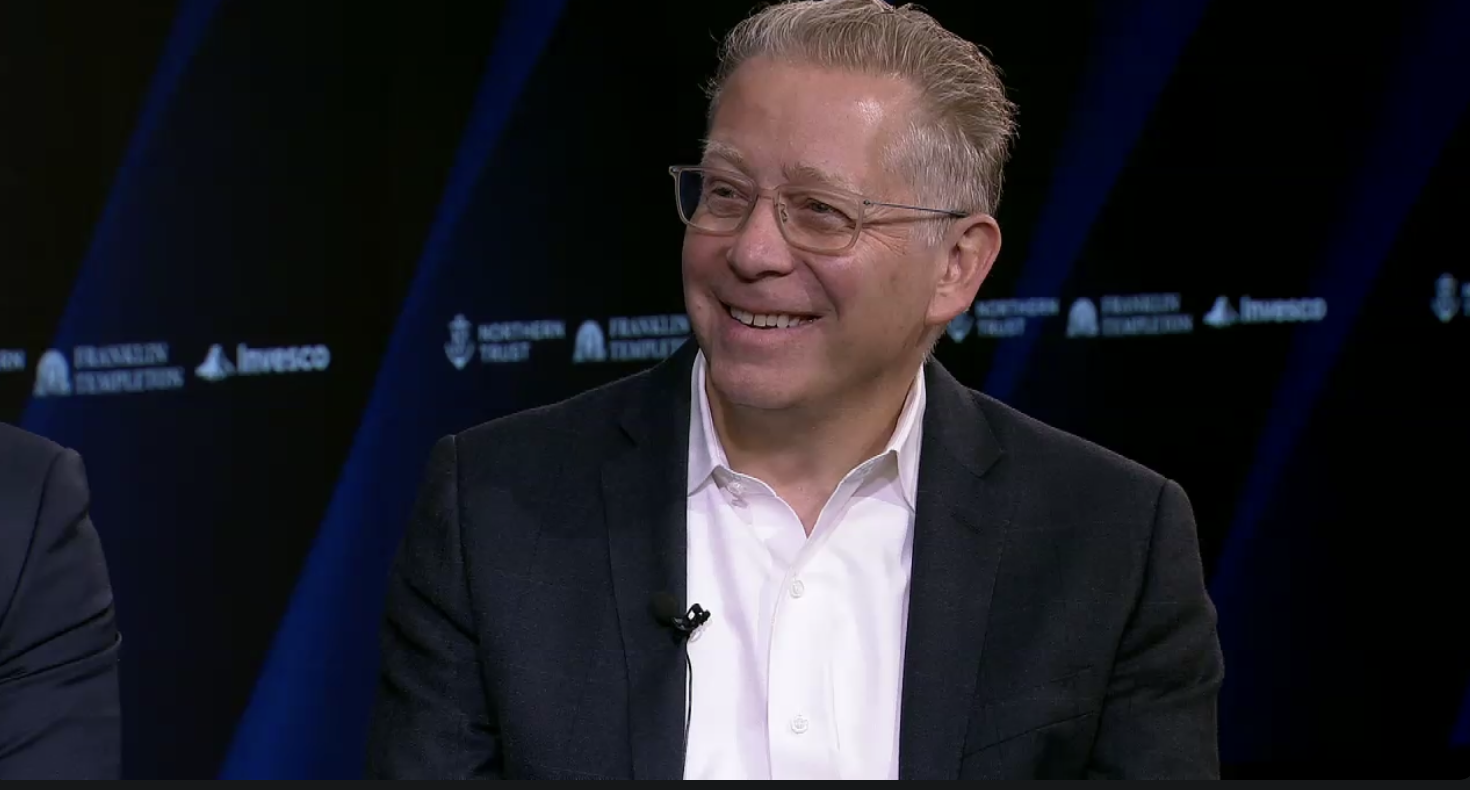
DoubleLine CEO/CIO Jeffrey Gundlach, widely known in the capital markets as the "Bond King," spoke at a Total Return Webcast.
Market uncertainty continues to linger in the back of fixed income investors’ minds. But that can force much-needed recalibration of portfolios as tariffs and rate cuts loom. A compelling option to consider: corporate bonds.
Bond investors may need to look elsewhere to supplant income lost from falling yields — they may want to try heading overseas. It's not just a weaker dollar that's been diverting attention to international bonds, but U.S. debt itself.
With an eye on mitigating rate risk, short-term bond funds have been the apple of fixed income investors’ eyes the past few years.
Muni & corporate bonds trading activity has been reaching record levels through the first half of 2025 at the Intercontinental Exchange.
The prospect of lower rates could translate to falling yields, forcing investors to diversify their fixed income portfolios. One area that's been seeing renewed interest is mortgage-backed securities (MBS).
While the majority of the capital markets are anticipating rate cuts, certain economic data continues to run counter to the forecast. That’s why in times of persistent inflation, getting commodities exposure can be beneficial.
VettaFi Voices provided a trailer on the current state of the ETF landscape and what's to come for the rest of 2025.
The regular college and professional football seasons are just around the corner. The smart money is betting on further upside with the Roundhill Sports Betting & iGaming ETF (BETZ).
The allocation into fixed income isn’t just happening on a retail level. Increasingly, more allocation is happening with asset managers, including heightened interest in active management.
Three summers ago, single-stock leveraged and inverse ETFs hit the market when AXS investments rolled out the first such fund in July 2022.
Lauded for their yield, credit quality, and of course, their federal tax-free income, municipal bond benefits are also extending into the containment of tariff contagion.
Investors seeking a Goldilocks option to balance yield and rate risk may want to consider intermediate bonds.
The 24-hour news cycle reminds investors that tariffs still remain a factor. As such, for those looking to get commodities exposure as a portfolio diversifier will want to make sure they allocate strategically.
Income diversification is necessary considering that rate cuts could be ahead. One area that could help bridge the gap — private credit.