Where the Money Is
How High Can You Go?
Las Vegas, Cleveland, NYC and Austin
“Don’t tax you, don’t tax me, tax that fellow behind the tree.”
- Senator Russell B. Longi
“What is a loophole? That is something that benefits the other guy. If it benefits you, it is tax reform.”
- Senator Russell B. Long, 1975ii
Voters chose change in the 2026 midterms. They’ll get some change, too, but our biggest problem – the debt – will almost certainly keep getting worse. No one in either party really wants to make the compromises it would take to stabilize debt growth, much less slow it down.
Every potential solution to this problem involves reduced spending, higher revenue or both. As you will see, none of the common proposals are attractive. We have ignored the problem for so long, it is now effectively out of control. Every solution is bad. All we can do is pick the least bad plan.
Since I started writing this series, numerous readers have suggested various ways to solve the problems. Specifically, on increasing taxes there is considerable diversity of opinion as to what and how much and why. What struck me wasn’t so much the left/right disagreement, but the various and very differing points of views within what would normally be considered the right or Republican view. Coming to an agreement is going to be more than simply getting the collective right and left to agree. Internal partisan disagreements matter, too. If there are 50 different ways to solve the deficit and debt problem, then there are at least 100 different proposals to do that. The amount of compromise necessary is beyond anything needed in my life.
With Democrats in control of Congress, I suspect we will hear many proposals to raise taxes. We will be told that making the rich pay their “fair share” is the best way to fund the government and get the debt under control. Today I will show you why that idea doesn’t add up. And I won’t ask you to take one think tank’s word for it. I’ve gathered work from Yale, Brookings, Cato, the Penn Wharton Budget Model, the Congressional Budget Office, the economists on the staff of Congress’s own tax scorekeeper and of course my own humble viewpoint. These people disagree about plenty. But on this question, the arithmetic takes them all to the same place. Even the economists who make the most aggressive case for taxing the rich come up short of what we need.
That’s not to say “the rich” (which in and of itself can be a very fluid definition) shouldn’t pay more. Getting out of this will require everyone to pay more (and receive less). Those are the bullets no one wants to bite. (Note that there are copious endnotes at the end of the document providing sources for many of the assertions in this letter.)
See more: Campaign Spending: The Hidden Boost Behind U.S. Consumer Resilience
Where the Money Is
Famous bank robber Willie Sutton supposedly said he robbed banks because that’s where the money is. (Sutton later swore he never said it and gave the credit to some enterprising reporter who needed to fill out his copy. He then titled his second memoir Where the Money Was, so he clearly knew a good line when he saw one.)iii Similarly, tax policy often focuses on the wealthy because that’s where the money is. At least it’s where some money is – but not nearly as much as most people think.
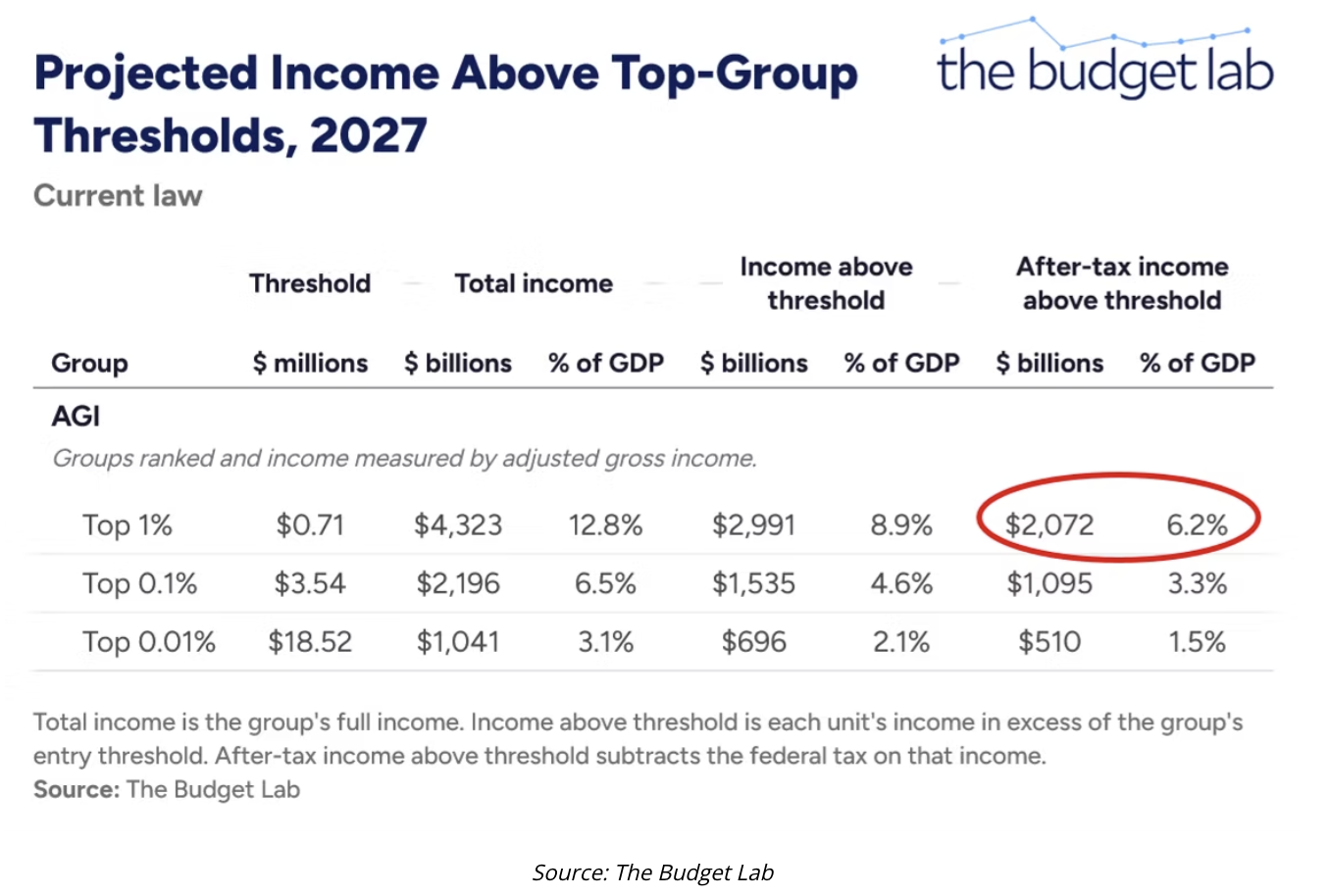
The Budget Lab at Yale University published a fascinating report on October 8 called Revenue Potential from Taxes at the Top, written by John Ricco, the Lab’s associate director of policy analysisiv. I should note this is not some left-wing think tank despite the Yale connection. The Budget Lab is run mainly by economists who worked in the Biden administration, so I’m sure they have their preferences. But they seem more like policy wonks than ideologues.
As a thought experiment, their report poses a deliberately extreme example. The cutoff for being in the top 1% of earners is $710,000 per year.v What if the government taxed all the income above that level? That’s right – a 100% tax rate on all income above $710,000. How much would that raise?
The answer, they estimate, is just under $3 trillion per year. Or, if you back out the taxes that group already pays, the additional revenue would be more like $2 trillion.
Put that in context. By the Budget Lab’s math, after-tax income above the top 1% cutoff comes to about 6.2% of GDP. The Congressional Budget Office projects deficits averaging 6.1% of GDP over the next decade. So, if Washington took literally every after-tax dollar above the line, from every one of those households, every single year, it would just barely balance the budget. On paper. Before anyone changed their behavior.vi
This isn’t just a Yale finding. Adam Michel at the Cato Institute ran a similar exercise using IRS data for 2023. His conclusion: if the government had confiscated every dollar earned over half a million dollars that year, it still would have run a budget deficit.vii Yale and Cato don’t agree on much. They agree on this.
But it’s even more complicated. Imposing such a policy would cause other things to change. The report explains:
“Of course, the actual revenue potential is lower than the simplest interpretation of these numbers—that all of this income can be collected as revenue—would suggest. These numbers do not include state and local taxes, and income cannot be taxed at high rates without causing behavioral feedback that reduces revenue raised (discussed in more detail in the sections below).
“A related point is that some underlying sources of income are subject to multiple taxes at the same time. This means that raising revenues using one tax instrument can reduce revenues raised by a separate tax instrument, underscoring the point that top incomes are a depletable taxable resource…
“In general, a tax increase on the top will be financed not only by lower consumption, but by lower saving. This mechanically leads to less top wealth in future years, which in turn reduces the investment income flows and estate values which are taxable under the income tax and estate tax, respectively. This effect compounds over time, small at first but meaningful at multi-decade horizons.”
Two points: first, a general economic principle. It is a mathematical identity, well accepted in economics, that savings equal investments. If you reduce savings you’re going to have less investment, whether in venture capital to start new businesses or simply buying bonds. Even savings in a bank allows the bank to make loans to individuals and businesses which will in turn boost the economy. If you reduce savings, you are reducing future growth, but like the Laffer Curve, it is along a continuum. At lower total tax rates, the effect on future economic growth is minimal. The effect increases until at some point you are impacting future economic growth.
Look at the various countries in Europe, especially the difference between “Old Europe” (mostly Western Europe) and “New Europe” (mostly Eastern Europe). Those with higher total tax extraction have lower growth and that has been happening for almost two decades.
One of the real solutions to the debt and deficit dilemma is the concept of “growing your way out of the problem.” And that is a legitimate element of the solution. If you reduce the deficit below nominal GDP, that means by simple arithmetic the economy (GDP) is growing faster than the debt. But that means the economy has to grow. So, it is important that whatever solutions we try have the least impact to future productivity and growth.
Secondly, there are what the report calls “mechanical effects” of tax rate increases. These are separate from “behavioral effects” that reduce revenue collected. People avoid capital gains taxes by not realizing gains, for example. Business owners restructure their income to fall in later years or simply go unreported. There are thousands of ways to do this. In the examples their report considers, mechanical and behavioral effects reduce actual revenue by between one-third and one-half of the theoretical, first-order gain.
So, the $2T or so in additional revenue we would get from taxing essentially all the 1%’s income would shrink, and fast. And those losses came from far gentler rate increases. At a 100% rate, almost nobody would bother to earn (or at least report) that last dollar, so the losses would be far larger. The report itself calls the 100% scenario clearly unrealistic. Even if we generously assume half of it survives, call it $1 trillion a year, that would make a big dent in the deficit, sure. But it could also wreck the entire economy through reduced consumer spending and far lower savings, among other things. Remember the accounting identity: what a country saves, plus what it borrows from abroad, equals what it can invest, whether in bonds, stocks, capital equipment or new businesses.
How High Can You Go?
Which brings us to a question economists love to argue about: what tax rate actually brings in the most money? This is the top of the famous Laffer curve. Set the rate at zero and you collect nothing. Set it at 100% and you also collect nothing, because nobody works for free. Somewhere in between is a peak, and past the peak, higher rates bring in less money, not more.
For years the favorite number among advocates of higher taxes came from Nobel laureate Peter Diamond and Berkeley’s Emmanuel Saez, who calculated in 2011 that the revenue-maximizing top rate was 73%.viii You will see that number in a lot of op-eds. What you usually won’t see is that it is an all-in figure, counting state, local and payroll taxes, not just the federal income tax rate.
This past August, three economists on the staff of the Joint Committee on Taxation, Congress’s official tax scorekeeper, published a paper with a wonderfully dry title: “Are Laffer Curves Flat?” Rachel Moore, Brandon Pecoraro and David Splinter built a model that recognizes something every tax accountant knows. High earners have many kinds of income, and they can move it from one tax base to another. Their answer to the title question is yes. The curve is flatter than we thought.ix
The numbers are sobering. For the federal income tax alone, they put the revenue-maximizing top rate at about 48%, and the extra revenue at that peak is only about $43 billion, roughly 0.2% of GDP. Add in state and local taxes and it gets worse. In the version of their model where businesses fully respond, whatever Washington gains is roughly offset by what the states lose, and the peak comes in around 39%. That is barely above today’s 37%. Add the Medicare tax, which takes 3.8% of high earners’ wages above $200,000 (counting the employer’s share) or of their net investment income, and the top federal rate is already above 40%.
In other words, we may already be close to the top of the curve. Push much harder and you mostly trade away future economic growth for the satisfaction of a higher posted rate. (In fairness, the authors note this is staff research, not the Committee’s official position, and other versions of their model put the peak somewhat higher.)
In 2019, when Rep. Alexandria Ocasio-Cortez floated a 70% top rate on income over $10 million, John Ricco and Richard Prisinzano at the Penn Wharton Budget Model pointed out a problem. With the corporate rate at 21%, wealthy owners of pass-through businesses could simply reorganize as C corporations. They estimated that kind of shifting could leave the 70% rate raising only 43% of the revenue it would otherwise collect.x A small footnote for the policy wonks: both men now work at the Budget Lab, and Ricco wrote the Yale report we started with. This is not a new insight for them.
We have seen this movie before. Before 1986, the highest personal tax rates were significantly higher than the corporate tax rate, creating incentives for income shifting into corporate entities. The 1986 reform lowered the top individual rate below the corporate rate, reversing that dynamic and making the tax system more uniform. Many businesses changed from C corporation into S corporations, pass-through entities for tax purposes. Federal revenue did not fall. It rose from 17.5% of GDP in 1986 to more than 18% in each of the next three years. OMB’s historical tables show federal revenue rising after the 1986 Act, from 17.5% of GDP in FY1986 to 18.4%, 18.1% and 18.3% in the next three years (in dollars, $769 billion to $991 billion). But the sources of that revenue did change, thanks to the shift to pass-through entities.xi
Your humble writer did exactly that. I vaguely recall that my taxes were personally somewhat lower, but from a macro perspective, the US government took in marginally more money.
Think of it like squeezing a balloon. Press hard on one side and the air just moves somewhere else. High earners have accountants, lawyers and a great deal of choice about when and how they get paid. Most people get a W-2.
(Note: we will finish this section next week. Stay tuned.)
Las Vegas, Cleveland, NYC and Austin
Shane and I will fly to Las Vegas for the largest longevity conference in the world December 10-13 and then I will fly to Cleveland for more procedures (nothing too serious, just annoying). I need to get into New York for a few days sometime in January or February, and then later in February we will be in Austin for an Inner Circle meeting. And pretty much everywhere I go now I am working on my book. It will be out in (hopefully early) mid-2027.
It is the season for being thankful. Spending a few days with my kids and grandkids was special. And we are all grateful that even after major brain surgery Abbi is her usual bubbly self, albeit a little slower but that is improving every day.
One of the things that I’m truly grateful for is you, my readers. In a world where time and attention are the most precious commodities, you graciously allow me into your digital home, many of you for decades. I was editor of the student paper at Rice University (The Thresher) which gave me an outlet and a love for writing. I dreamed of making my living through writing. You make it possible. Words cannot express my gratitude. I am one of the most blessed and luckiest people I know.
And with that, I will hit the send button. You have a great week!
Your just hitting my stride analyst,
John Mauldin
i Senator Russell B. Long (D-La.), longtime chairman of the Senate Finance Committee. See “Congress: The Princefish Calls It Quits,” Time: https://time.com/archive/6707394/congress-the-princefish-calls-it-quits. Quote Investigator traces the rhyme to 1930s doggerel that Long revived and made famous in the 1970s: https://quoteinvestigator.com/2014/04/04/tax-tree/.
ii Senator Russell B. Long, Senate floor debate, November 1975, as documented by Barry Popik: https://barrypopik.com/blog/a_tax_loophole_benefits_the_other_guy.
iii Willie Sutton with Edward Linn, Where the Money Was: The Memoirs of a Bank Robber (1976), in which Sutton denied ever saying it. See Quote Investigator, “I Rob Banks Because That’s Where the Money Is”: https://quoteinvestigator.com/2013/02/10/where-money-is/; and Federal Reserve Bank of New York, Liberty Street Economics: https://libertystreeteconomics.newyorkfed.org/2016/08/historical-echoes-thats-where-the-celebrity-advertising-was-or-the-gentleman-bank-robber.
iv John Ricco, “Revenue Potential from Taxes at the Top,” The Budget Lab at Yale, October 8, 2026: https://budgetlab.yale.edu/research/revenue-potential-taxes-top.
v Steve Thompson, “Is taxing the rich the answer to Washington’s budget problems?” The Washington Post, October 28, 2026, republished by The Philadelphia Inquirer: https://www.inquirer.com/politics/nation/high-taxes-wealthy-federal-budget-20261028.html.
vi Ricco, “Revenue Potential from Taxes at the Top,” Table 1 and accompanying text, citing CBO deficit projections: https://budgetlab.yale.edu/research/revenue-potential-taxes-top.
vii Adam N. Michel, “Taxing the Rich Can’t Close the Federal Deficit,” Cato Institute, August 25, 2026: https://www.cato.org/blog/taxing-rich-cant-close-federal-deficit.
viii Peter Diamond and Emmanuel Saez, “The Case for a Progressive Tax: From Basic Research to Policy Recommendations,” Journal of Economic Perspectives 25, no. 4 (2011): https://doi.org/10.1257/jep.25.4.165. For a critical review, see “Optimal Top Tax Rates: A Review and Critique,” Cato Journal, Fall 2019: https://www.cato.org/cato-journal/fall-2019/optimal-top-tax-rates-review-critique.
ix Rachel Moore, Brandon Pecoraro, and David Splinter, “Are Laffer Curves Flat? Bridging Structural and Sufficient-Statistic Approaches,” August 20, 2026: https://www.law.nyu.edu/sites/default/files/2026-09/Are-Laffer-Curves-Flat.pdf. The authors are Joint Committee on Taxation staff; the paper does not represent the views of any Committee member. Summarized by Alex Durante, “New Research Finds That Revenue-Maximizing Top Tax Rate Likely Lower Than Previous Estimates,” Tax Foundation, October 30, 2026: https://taxfoundation.org/blog/laffer-curve-revenue-maximizing-tax-rate/.
x John Ricco and Richard Prisinzano, “The Hidden Revenue Cost of a 70% Top Marginal Rate,” Penn Wharton Budget Model, January 22, 2019: https://budgetmodel.wharton.upenn.edu/p/2019-01-22-how-a-top-marginal-rate-of-70-would-affect-business-entity-choice/. For their current roles, see https://budgetlab.yale.edu/person/john-ricco and https://budgetlab.yale.edu/news/240412/budget-lab-yale-will-provide-depth-analysis-federal-policy-proposals.
xi Office of Management and Budget, Historical Tables, Table 1.2, “Summary of Receipts, Outlays, and Surpluses or Deficits as Percentages of GDP”: https://www.govinfo.gov/content/pkg/BUDGET-2005-TAB/html/BUDGET-2005-TAB-3-2.htm. Receipts were 17.5% of GDP in fiscal 1986, 18.4% in 1987, 18.1% in 1988 and 18.3% in 1989.
A message from Advisor Perspectives and VettaFi: Discover something new! Click here to register for our upcoming webcasts.
© Mauldin Economics
Read more commentaries by Mauldin Economics