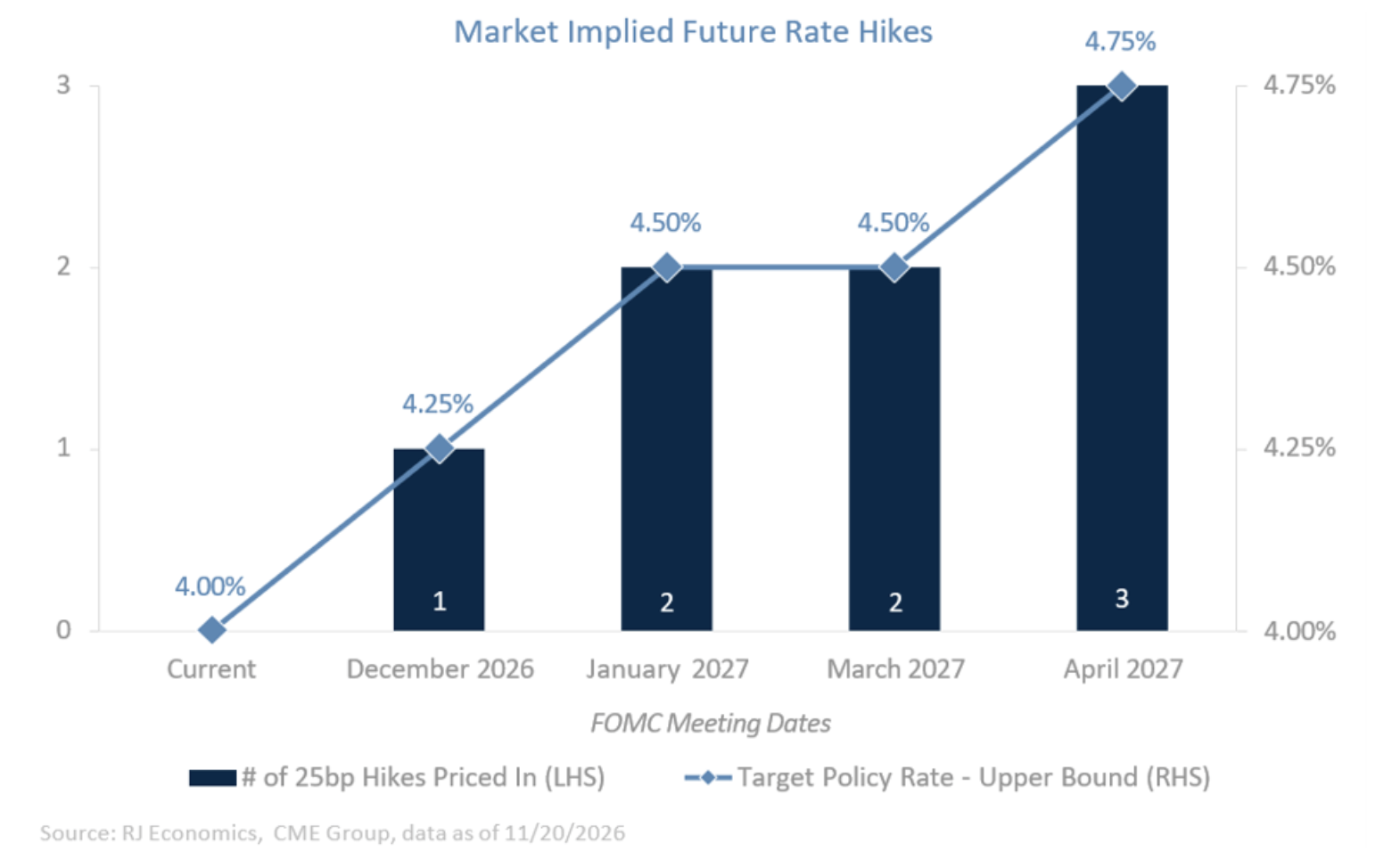
As the holiday season approaches, markets are beginning to grapple with the likelihood that the Federal Reserve (Fed) will raise interest rates in December, arguing that monetary policy remains insufficiently restrictive. We continue to believe that, after a December increase, the Fed should pause and allow time for the cumulative effects of recent rate hikes to work their way through the economy. Nevertheless, some Fed officials have discussed the possibility of a 50 basis-point increase in December, while others have suggested rates may need to rise by as much as 100 basis points by the middle of next year. In our view, such discussions are premature. We continue to believe that both markets and Fed officials will ultimately move closer to our assessment of the appropriate policy path.
If that seems difficult to envision amid today's heightened rate expectations, consider how quickly the narrative can change. We have described Beth Hammack, president of the Cleveland Federal Reserve Bank, as one of the more outspokenly hawkish members of the Federal Open Market Committee. Today, she sounds considerably more moderate than many of her colleagues. That shift underscores how rapidly expectations can evolve and suggests there is ample room for the current market narrative to move toward a more balanced outlook on rates.
We have repeatedly argued that today's inflation environment bears little resemblance to the inflationary surge following the pandemic recession, and we remain confident in that assessment. While inflation has remained above the Fed's target for an extended period, the underlying forces driving inflation today are fundamentally different. As a result, the risk of a repeat of the post-pandemic inflation episode remains low.
See more: With Inflation Trending up Again, the Federal Reserve Is Losing Patience
Recent housing data continue to depict a sector under significant strain. Existing home sales last week fell to levels not seen since the Great Recession, while the median price of existing homes was up just 0.4% from a year earlier. This week's National Association of Home Builders Housing Market Index (HMI) offered little encouragement, falling to a 14-year low as elevated mortgage rates, high construction costs and persistent labor shortages continue to weigh on builder sentiment. Although housing starts posted an increase, activity remains subdued, while building permits dropped to a six-year low, signaling a weaker pipeline of future construction activity.
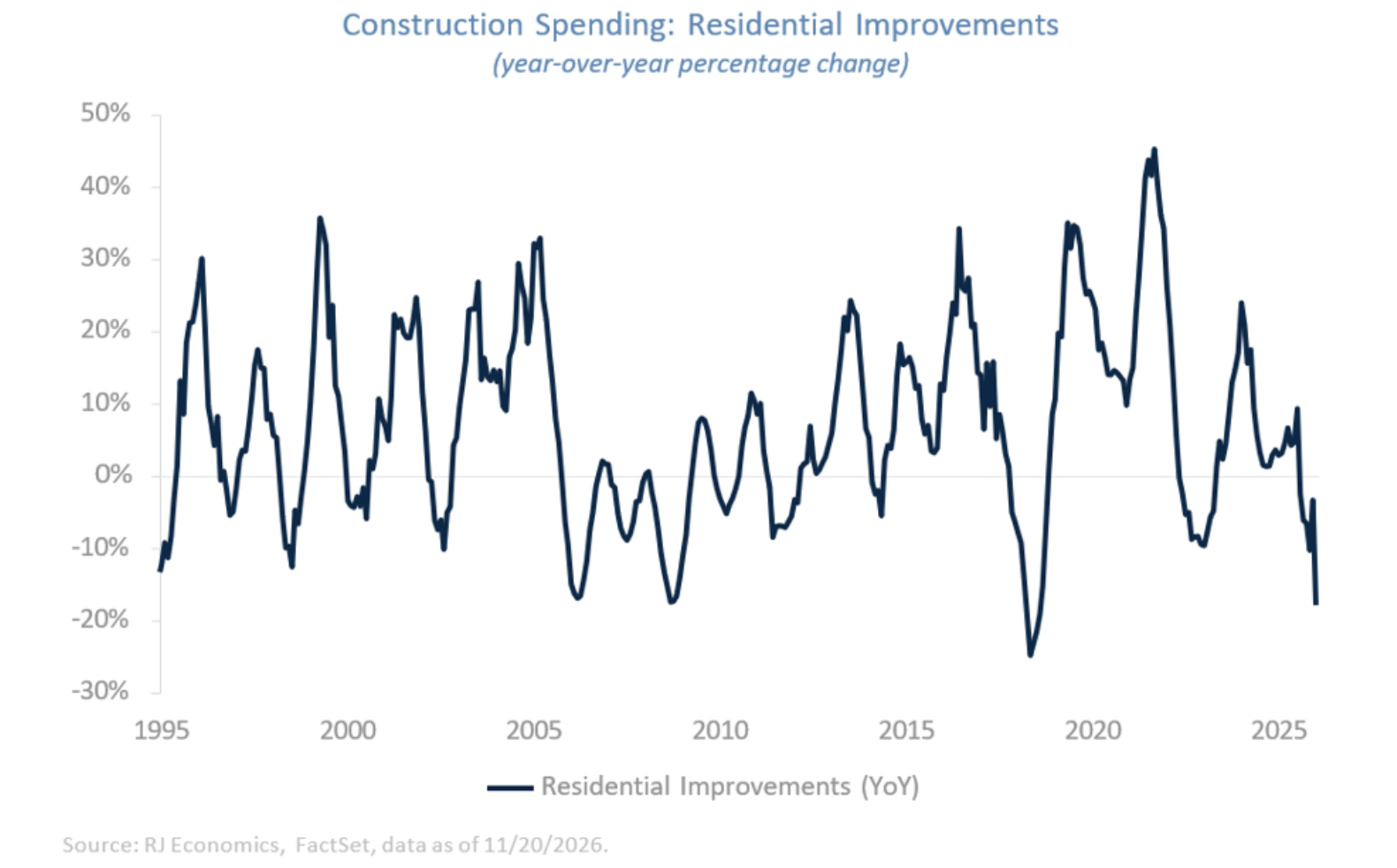
The latest source of weakness within residential construction has been residential improvements. After growing strongly through the first quarter of this year, activity has reversed course and is now declining at the fastest year-over-year pace since January 2019. Although this category is typically more volatile than single-family or multifamily construction, it has grown to represent nearly 40% of total residential construction activity. Importantly, residential improvements had been offsetting weakness elsewhere in the sector, as single-family construction has generally declined while multifamily activity has remained largely flat throughout the year.
While we do not expect housing weakness to evolve into a broader crisis, the sector is likely to remain under pressure through the remainder of this year and into next year. Elevated mortgage rates, high construction costs and still-expensive home prices are unlikely to improve materially in the near term.
We expect these conditions to place additional downward pressure on home prices during 2027, particularly in the new-home market. Such an adjustment would further challenge homebuilders and reinforce the recession already underway in residential investment.
Bottom line
Markets appear increasingly convinced that the Fed will need to remain aggressive well into 2027, but we believe those expectations are likely to moderate over time. At the same time, housing remains one of the clearest areas of economic weakness and should continue to act as a drag on economic growth and inflation going forward.
Economic and market conditions are subject to change.
Opinions are those of Investment Strategy and not necessarily those of Raymond James and are subject to change without notice. The information has been obtained from sources considered to be reliable, but we do not guarantee that the foregoing material is accurate or complete. There is no assurance any of the trends mentioned will continue or forecasts will occur. Past performance may not be indicative of future results.
Links are being provided for information purposes only. Raymond James is not affiliated with and does not endorse, authorize or sponsor any of the listed websites or their respective sponsors. Raymond James is not responsible for the content of any website or the collection or use of information regarding any website's users and/or members.
Raymond James & Associates, Inc., member New York Stock Exchange / SIPC, and Raymond James Financial Services, Inc., member FINRA / SIPC, are subsidiaries of Raymond James Financial, Inc.
Raymond James® and Raymond James Financial® and power of personal® are registered trademarks of Raymond James Financial, Inc.
A message from Advisor Perspectives and VettaFi: Discover something new! Click here to register for our upcoming webcasts.
© Raymond James
More Capital Growth Topics >