Election Day has markets watching how divided Washington will be over the coming two years. A Democratic House is the consensus outcome, and markets increasingly expect Democrats to win the Senate as well. What remains unknown is the size of each potential majority, which will determine whether the next two years bring gridlock and brinkmanship, or a bipartisan spending deal. Regardless of the result, we believe above-trend economic growth, powerful earnings delivery and a historically strong post-midterm window could support a more durable rally for equities in the year ahead.
A Low Bar for House Democrats
History suggests there is a low bar for Democrats to retake the House of Representatives. The president’s party has lost House seats in 18 of the 20 midterms since World War II, and both exceptions came when the president’s approval rating was in the 60% range. Today looks very different than those exceptions, with President Trump’s approval rating sitting in the mid-to-high 30s, Republicans holding only a slim House majority and current polling favoring the Democrats. Prediction markets have largely priced this in with the odds that Republicans lose the House at roughly 90%.
The Senate is a closer contest, but momentum has shifted toward Democrats. Prediction markets now give them roughly a 65% chance of winning control, which would require a net gain of four seats. A Democratic sweep of Congress is no longer an unlikely scenario, which shifts the focus to the margin in each chamber.
Margins Matter More Than the Majority
Speaker Johnson’s tenure has shown how hard it is to run the House with a majority of fewer than five seats, and the Senate has recently offered a similar lesson. With a 50-50 split early in the Biden administration, Senators Joe Manchin and Kyrsten Sinema often held the deciding votes and used them to reshape major Democratic priorities.
When the margin is that thin, a few members can block legislation, extract concessions or stall the legislative agenda entirely. If the midterms leave either chamber with a similarly slim majority, it would likely bring gridlock and brinkmanship over government funding, a higher risk of shutdowns and little new fiscal legislation.
The Case for a Grand Bargain
If Democrats win both chambers with workable margins, a grand bargain between congressional Democrats and the White House could emerge. Democrats could back higher defense spending in exchange for fully restoring social programs. The One Big Beautiful Bill Act included more than US$1 trillion in cuts to Medicaid and SNAP over 10 years, and Democrats want to reverse them.
The lesson from the first Trump administration, when Democrats won the House in the 2018 midterms, could be a useful case study for what lies ahead. The two parties went on to pass the Bipartisan Budget Act of 2019, which raised both defense and nondefense spending caps and led the Congressional Budget Office to raise its 10-year deficit projection by US$1.7 trillion.
A deal is far from certain, however, as both sides would need to sell a compromise to their bases with 2028 in view, and any agreement would likely follow a stretch of grandstanding. A deal, if enacted, could lift nominal growth and benefit defense contractors, Medicaid-exposed health care providers and consumer businesses serving lower-income households. The trade-off is a larger deficit, which could keep upward pressure on long-term yields and strengthen the case for the Fed to move further into restrictive territory.
See more: Why Securitized Assets Deserve a Larger Role in Advisor Portfolios
History Favors Investors After the Vote
Whatever the outcome, policy effects will likely show up only at the margin: modest tailwinds or headwinds for certain sectors rather than major changes for the broad index. For the S&P 500 Index, the most important thing has historically been simply getting past the midterms.
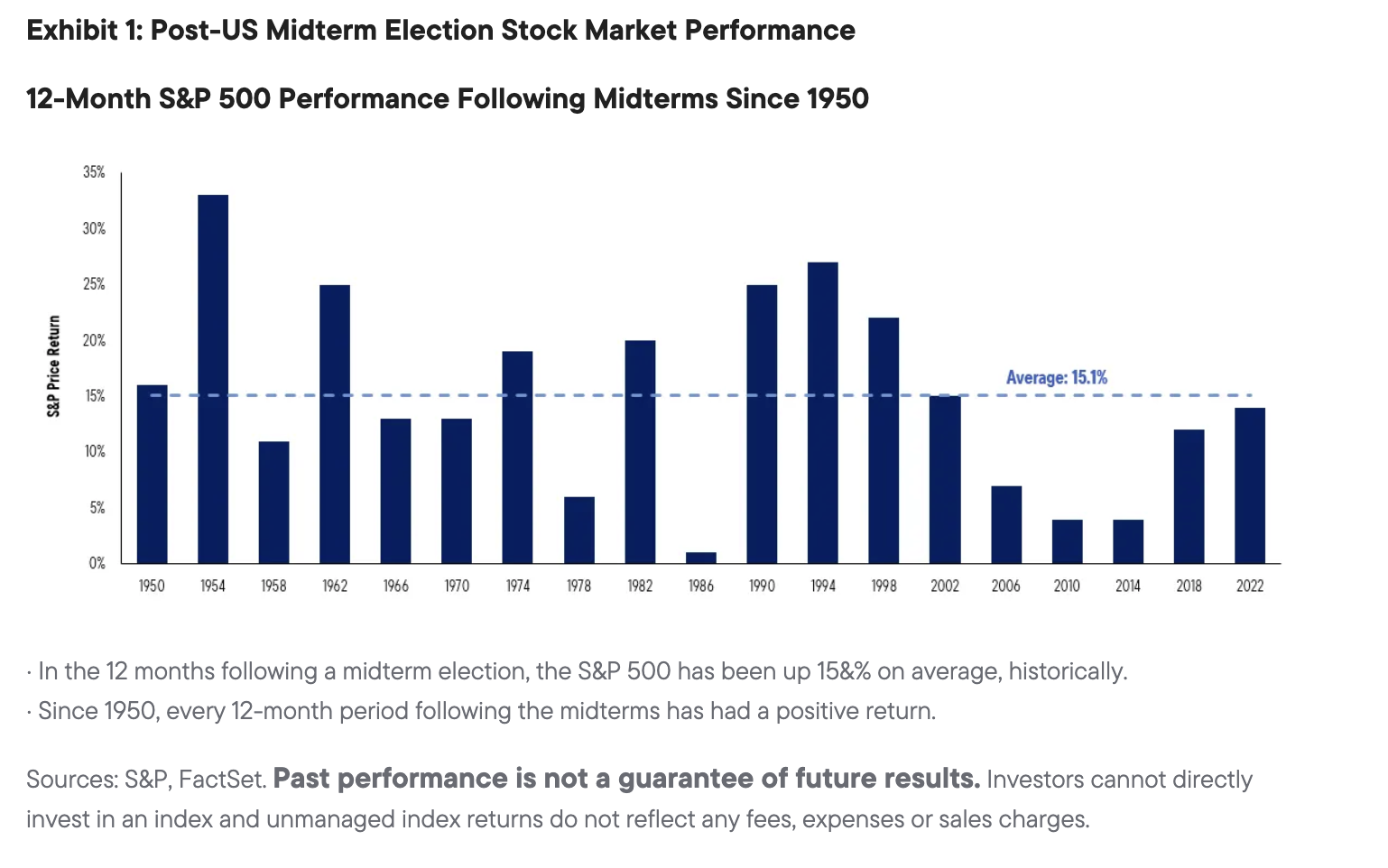
Since 1950, the S&P 500 has gained an average of 15.1% in the 12 months after the midterm election, which has tended to act as a clearing event. Every one of those 19 periods produced a positive return (see chart below). Stocks have typically benefited as election uncertainty dissipates, divided government limits big policy surprises and the post-midterm window overlaps with the third year of the presidential term, which historically has been the strongest stretch of the four-year cycle. Although past performance doesn’t guarantee future results, this seasonal tailwind is hard to ignore.
The Economy Is the Stronger Signal
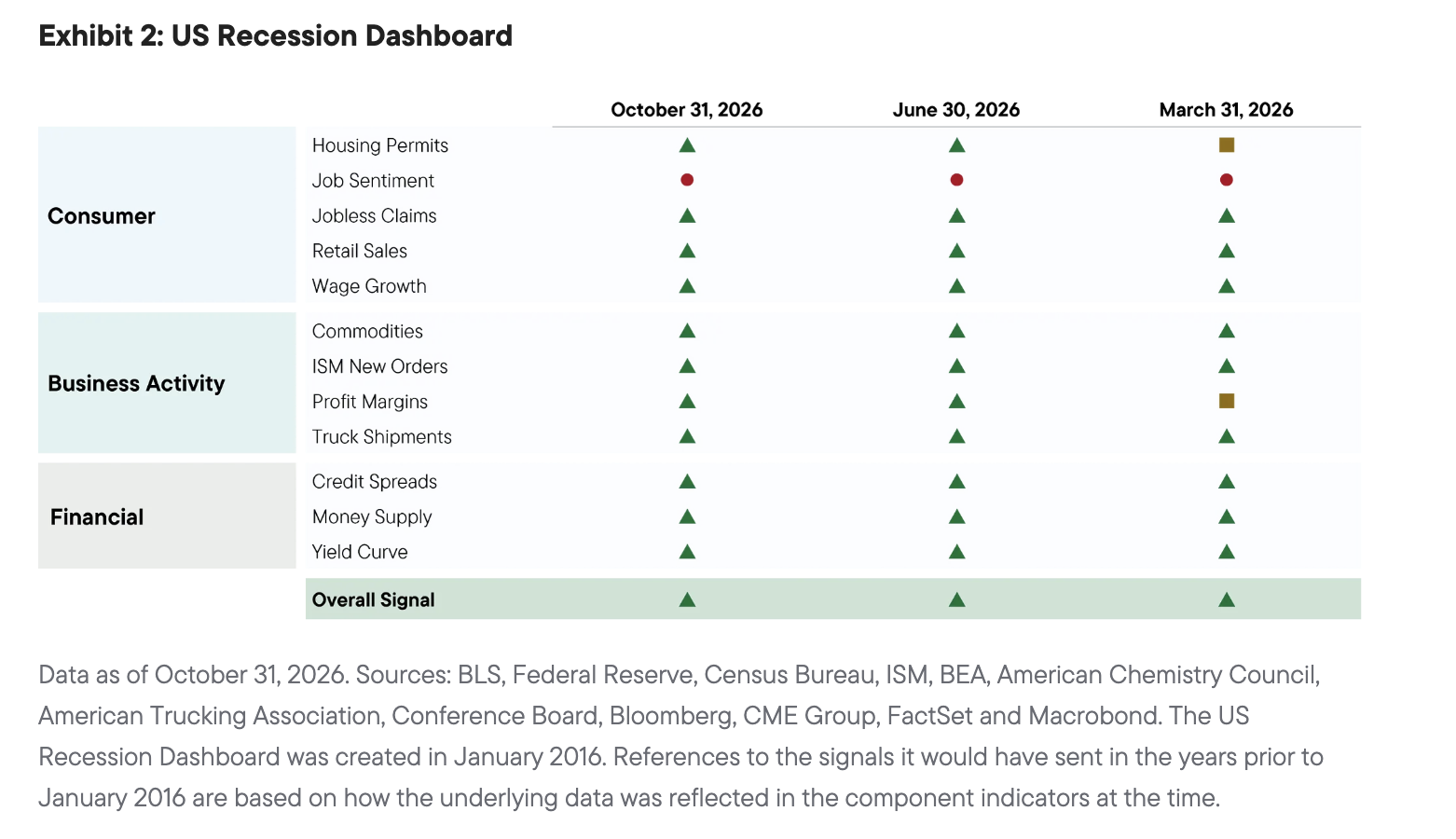
Beyond the calendar, an even bigger reason for optimism comes from a robust economy that is gaining momentum. US gross domestic product grew at a 3.4% annualized pace in the third quarter, accelerating from 2.2% in the second quarter. Business investment led the way as the artificial intelligence buildout continues and steady consumer spending provided additional support. Our Recession Dashboard tells a similarly resilient story. Eleven of its 12 indicators are flashing expansionary green, with no changes in October, a reading that implies recession odds of only 15% over the next 12 months.
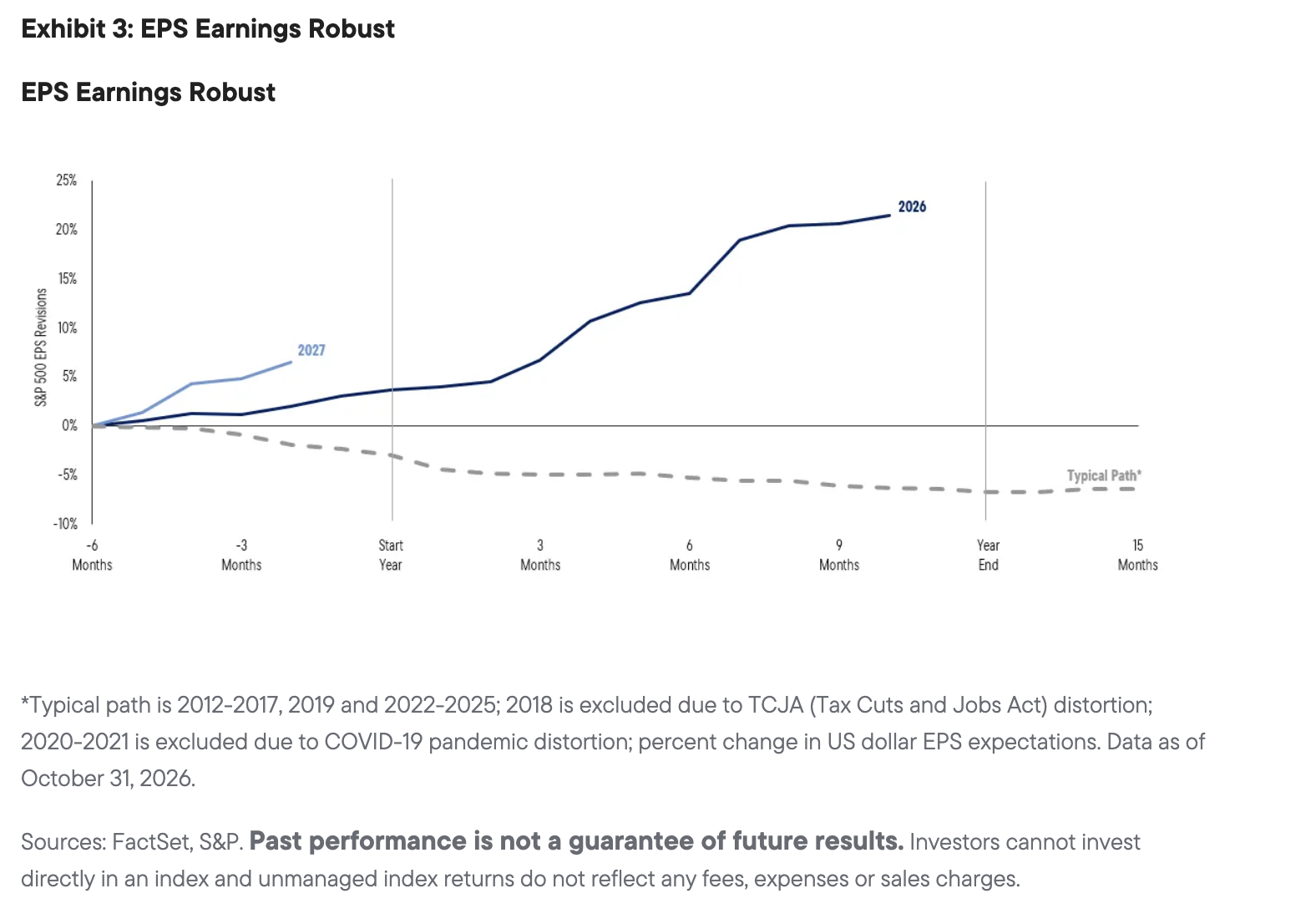
That economic momentum is showing up even more forcefully in corporate profits. S&P 500 earnings are on track for 30% year-over-year growth in the third quarter, which would mark a third consecutive quarter above 25%. Just as notable, estimates for both 2026 and 2027 continue to climb, bucking the typical tendency for forward estimates to drift lower over time. Rising earnings are what ultimately drive stock prices in the long run.
Big Picture > Politics
Putting it all together, prediction markets are decisively pricing a divided government scenario given the low bar in the House. However, history suggests that the size of the majorities will matter more for markets than which party wins control. A narrow Congressional majority would likely bring gridlock and brinkmanship, offering little new fiscal support while periodic shutdown scares add volatility. A Democratic sweep with healthy margins could yield a grand bargain that funds both parties’ priorities and adds a modest fiscal boost. That said, neither outcome changes the bigger picture with markets entering what has historically been a strong post-midterm period. Beyond that seasonal tailwind, we believe above-trend economic and earnings growth will overwhelm any election-related volatility to drive stocks forward in the year ahead.
Jeffrey Schulze, Head Investment Strategist
WHAT ARE THE RISKS?
All investments involve risks, including possible loss of principal.
Fixed income securities involve interest rate, credit, inflation and reinvestment risks and possible loss of principal. As interest rates rise, the value of fixed income securities falls. Low-rated, high-yield bonds are subject to greater price volatility, illiquidity and possibility of default.
Equity securities are subject to price fluctuation and possible loss of principal.
There is no assurance that any estimate, forecast or projection will be realized.
Important Information
This material is intended to be of general interest only and should not be construed as individual investment advice or a recommendation or solicitation to buy, sell or hold any security or to adopt any investment strategy. It does not constitute legal or tax advice. This material may not be reproduced, distributed or published without prior written permission from Franklin Templeton.
The views expressed are those of the investment manager and the comments, opinions and analyses are rendered as at publication date and may change without notice. The underlying assumptions and these views are subject to change based on market and other conditions and may differ from other portfolio managers or of the firm as a whole. The information provided in this material is not intended as a complete analysis of every material fact regarding any country, region or market. There is no assurance that any prediction, projection or forecast on the economy, stock market, bond market or the economic trends of the markets will be realized. The value of investments and the income from them can go down as well as up and you may not get back the full amount that you invested. Past performance is not necessarily indicative nor a guarantee of future performance. All investments involve risks, including possible loss of principal.
Any research and analysis contained in this material has been procured by Franklin Templeton for its own purposes and may be acted upon in that connection and, as such, is provided to you incidentally. Data from third party sources may have been used in the preparation of this material and Franklin Templeton ("FT") has not independently verified, validated or audited such data. Although information has been obtained from sources that Franklin Templeton believes to be reliable, no guarantee can be given as to its accuracy and such information may be incomplete or condensed and may be subject to change at any time without notice. The mention of any individual securities should neither constitute nor be construed as a recommendation to purchase, hold or sell any securities, and the information provided regarding such individual securities (if any) is not a sufficient basis upon which to make an investment decision. FT accepts no liability whatsoever for any loss arising from use of this information and reliance upon the comments, opinions and analyses in the material is at the sole discretion of the user.
Franklin Templeton has environmental, social and governance (ESG) capabilities; however, not all strategies or products for a strategy consider “ESG” as part of their investment process.
Products, services and information may not be available in all jurisdictions and are offered outside the U.S. by other FT affiliates and/or their distributors as local laws and regulation permits. Please consult your own financial professional or Franklin Templeton institutional contact for further information on availability of products and services in your jurisdiction.
Issued in the U.S. by Franklin Templeton, One Franklin Parkway, San Mateo, California 94403-1906, (800) DIAL BEN/342-5236, franklintempleton.com. Investments are not FDIC insured; may lose value; and are not bank guaranteed.
You need Adobe Acrobat Reader to view and print PDF documents. Download a free version from Adobe's website.
CFA® and Chartered Financial Analyst® are trademarks owned by CFA Institute.
A message from Advisor Perspectives and VettaFi: Discover something new! Click here to register for our upcoming webcasts.
© Franklin Templeton
More Municipal Bonds Topics >