Key takeaways
-
AI may be reshaping the economy more than expanding it. Despite an investment surge driving U.S. demand, overall U.S. growth has remained moderate, suggesting gains from AI are being offset elsewhere. Rising interest rates, among other factors, are accelerating economic reallocation.
-
Rate-sensitive sectors are bearing much of the cost. Because hyperscalers rely on strong cash flows and invest in shorter-lived assets, higher borrowing costs do little to slow their growth. The burden falls harder on housing, small firms, highly indebted companies, and traditional business investment.
-
Imports, bottlenecks, and credit markets shape the pace of change. The reliance on imported equipment eases the strain on U.S. capacity, infrastructure bottlenecks spread AI spending over a longer period, and wider credit spreads tighten conditions for riskier borrowers, including some AI firms. Together, these forces help determine how hard higher rates could squeeze the rest of the economy.
The AI investment boom has become one of the largest sources of demand in the U.S. economy. Announced annual capital spending across large U.S. technology companies points to more than $1 trillion in desired investment, up dramatically from only a few years ago. As we have discussed in previous editions of Macro Signposts, rising AI investment is already affecting inflation, labor markets, financial conditions, and the outlook for monetary policy.
The scale of the boom raises another question: Is AI investment adding to U.S. economic activity overall, or is it increasingly reallocating – or “crowding out” – investment and spending elsewhere?
As we discussed in the 15 October 2026 Macro Signposts, the GDP growth contribution from AI is probably larger than the investment impulse alone would suggest, particularly once wealth effects are taken into account. Yet aggregate GDP growth doesn’t look like an economy experiencing a historic investment boom. Real U.S. GDP growth has averaged roughly 2%–2.5% (according to the Bureau of Economic Analysis) since AI investment began accelerating in early 2025, even though the investment impulse is comparable in scale to the internet and telecommunications boom of the 1990s and larger than the housing and shale investment booms that followed.
This suggests that much of the growth impulse from AI has been offset elsewhere, either by unrelated economic drags or by the adjustments required to accommodate the boom.
Our view is that economic reallocation is underway as other areas of the economy make room for AI. Rising interest rates are a key mechanism accelerating the adjustment, but they aren’t the only factor. Higher government bond yields have catalyzed a broader repricing of credit risk, especially for lower-quality borrowers. These sector-specific market moves are further tightening financial conditions for exposed borrowers. Tariffs and higher uncertainty associated with shifting domestic and international policies are also likely contributing to the reallocation.
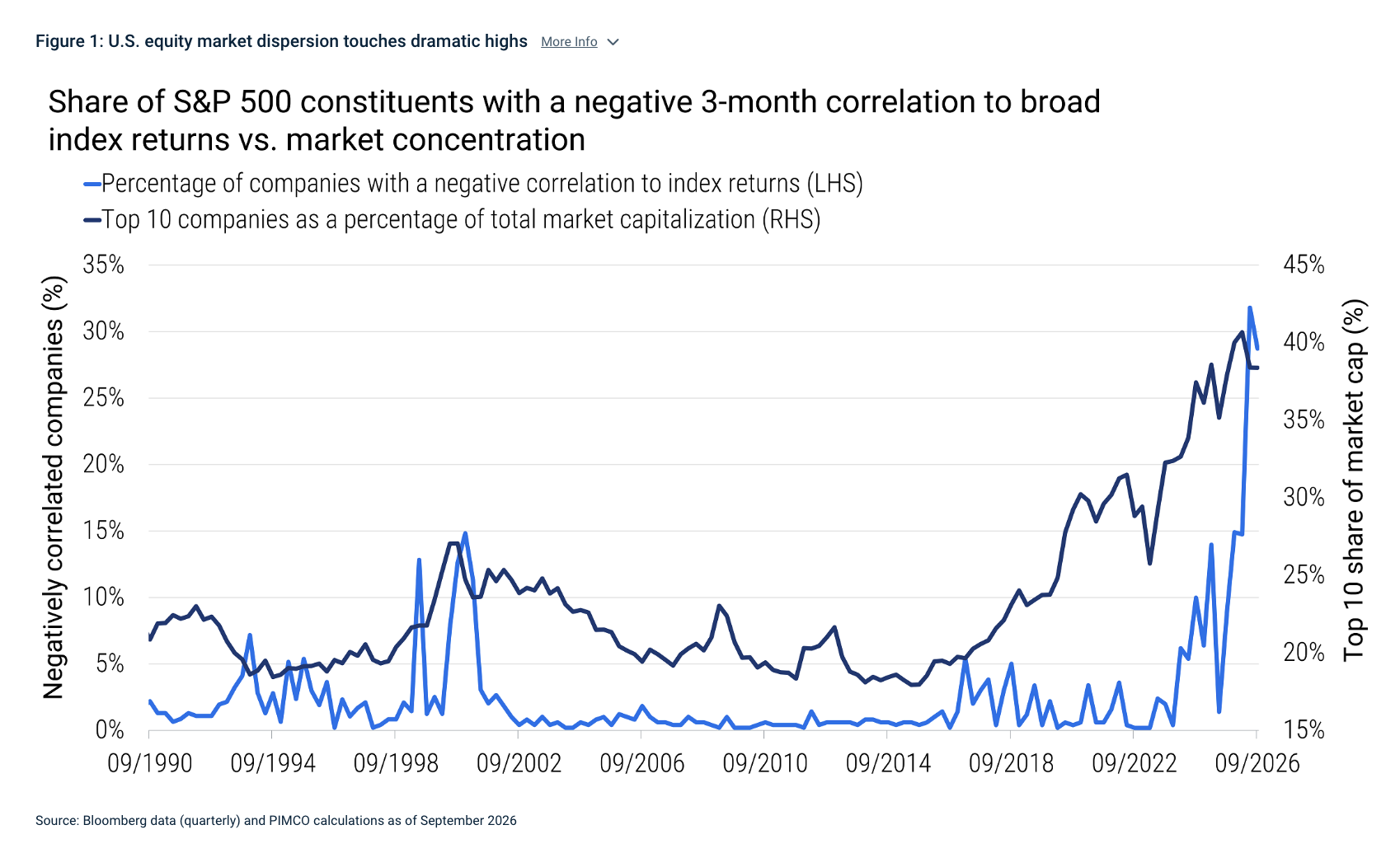
Equity market dispersion may already be reflecting these trends. The percentage of companies that have a negative correlation to the aggregate S&P 500 Index has reached historically high levels (see Figure 1). This has happened despite the index’s roughly 12% year-to-date increase.
See more: Bonds, AI, and a Bull Market That Has Kept Going
“Crowding out” is the economy’s adjustment to a new equilibrium
The concept of crowding out is much older than the term itself, which became prominent during the Keynesian-monetarist disputes over the economic impact of government spending in the 1960s and 1970s. A 1975 research paperFootnote1 published by the Federal Reserve Bank of St. Louis surveyed the relevant research at the time by posing the question directly: Does government spending displace private spending?
If an increase in government demand, financed through taxes or public borrowing, failed to produce a sustained increase in total economic activity, private activity was said to have been crowded out by government action.
The authors of the 1975 research concluded that the crowding-out effect was more nuanced: Federal spending initially raised activity, but financing the expansion set in motion forces that gradually offset part of the stimulus. Competition for saving could raise interest rates and reduce private investment, ultimately leaving the economy with a smaller private capital stock than would otherwise have prevailed. In terms of the economic adjustment, they came to three other key conclusions about the transition:
- Crowding out is a matter of degree, not an all-or-nothing outcome. A dollar of new spending might displace 30 cents of other spending, a full dollar, or potentially more through secondary effects.
- Interest rates are only one possible channel. Changes in consumer confidence and savings preferences, higher prices that erode real wealth, and tighter credit availability can all contribute to the adjustment.
- In practice, crowding out reflects constraints on both financing an investment boom and producing the goods, services, infrastructure, and labor needed to support it.
In terms of the implications for AI investment, it’s a surge in private rather than government spending, but the logic carries over. If desired investment exceeds the saving and productive resources immediately available, particularly when the economy is already operating close to or above potential as it is today, then some combination of adjustments has to occur.
Generally speaking, an economy has four ways to accommodate the increase in desired investment: Generate more domestic saving, import capital goods and foreign saving, increase productivity of the current capital and labor stock, or reallocate resources away from other domestic uses. Changes in monetary policy, financial conditions, and relative price adjustments are mechanisms for bringing about these adjustments.
The bonds financing AI investment therefore do not need to crowd out U.S. Treasuries or other assets directly in portfolios (often termed the “portfolio balance” effect) for broader economic crowding out to occur. As my colleague Lotfi Karoui discusses in the 21 September 2026 edition of The Credit Market Lens, we see little systematic evidence that unexpected AI bond issuance directly raises Treasury yields, term premia, or swap spreads.
Indeed, a sufficiently large increase in desired private investment can run up against real economic capacity constraints that can generate higher prices, alter central bank policy, tighten financial conditions, and as a result reduce demand elsewhere.
What adjustments are happening today?
Higher rates and a shift in central bank policy expectations have been important adjustment mechanisms. As we discussed in the recent Cyclical Outlook, the increase in U.S. government bond yields has been driven mainly by a repricing of expected real short-term interest rates. There’s been relatively little adjustment in estimated term premia (i.e., the compensation investors are paid for the risk of holding longer-term bonds), although the precise decomposition depends on the model used.
Higher energy prices resulting from the Middle East conflict have been an important driver of that repricing. Major central banks have tightened policy, or maintained tighter policy for longer, in response to a supply shock as they seek to prevent higher near-term inflation from becoming embedded in inflation expectations.
AI-related demand running up against resource constraints has likely contributed to the repricing as well. Strong demand for advanced semiconductors and related components has dramatically raised prices and created shortages. More resilient consumption – at least among wealthier households – supported by AI-related wealth gains is another likely driver.
More importantly, regardless of what drives them, higher interest rates are likely to accelerate economic reallocation. Much of the increase in AI-related desired investment has been unusually insensitive to higher rates, although higher rates are weighing on activity elsewhere.
AI investment is being driven less by the current cost of capital than by a strategic race to build computing capacity and capture potentially large future returns. The largest hyperscalers also have strong balance sheets and substantial internal cash generation, reducing their dependence on external financing. The fact that AI infrastructure investment is concentrated in shorter-lived assets means that depreciation makes up a larger share of these firms’ overall economic cost of capital, with changes in interest rates mattering less.
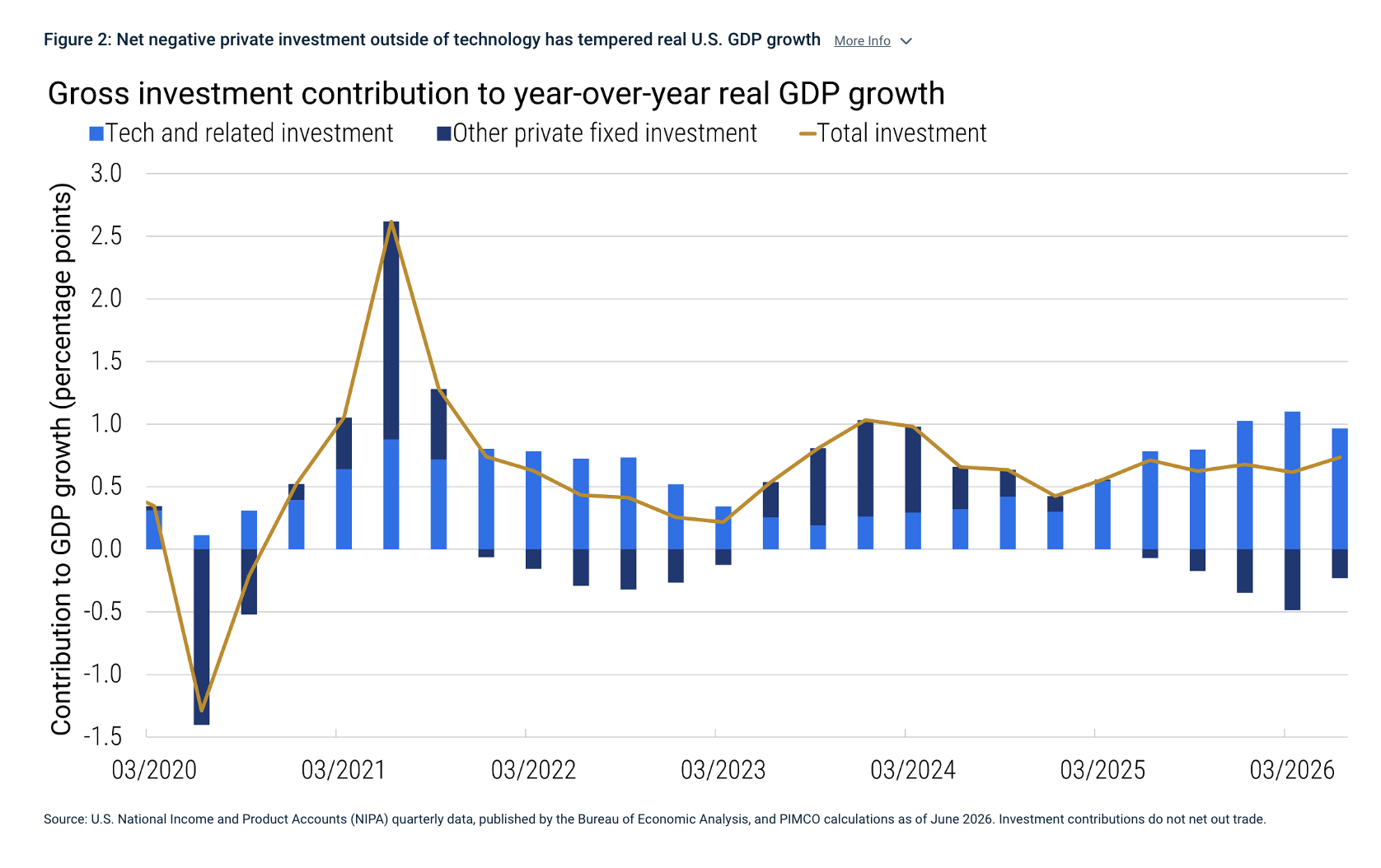
That asymmetry is important because if higher rates do relatively little to slow the AI buildout, then monetary tightening has to work elsewhere. Housing, smaller businesses, leveraged companies, and conventional corporate investment will likely absorb the adjustment. And indeed, other forms of investment are reacting to the rate pressure. Outside the AI complex, private fixed investment has weakened, consistent with a growing divergence between the sectors driving the investment boom and those bearing the adjustment (see Figure 2).
Three other release valves: imports, bottlenecks, and credit
Three other factors affect how much of the economic reallocation must occur through rates and weaker domestic demand elsewhere.
Imports
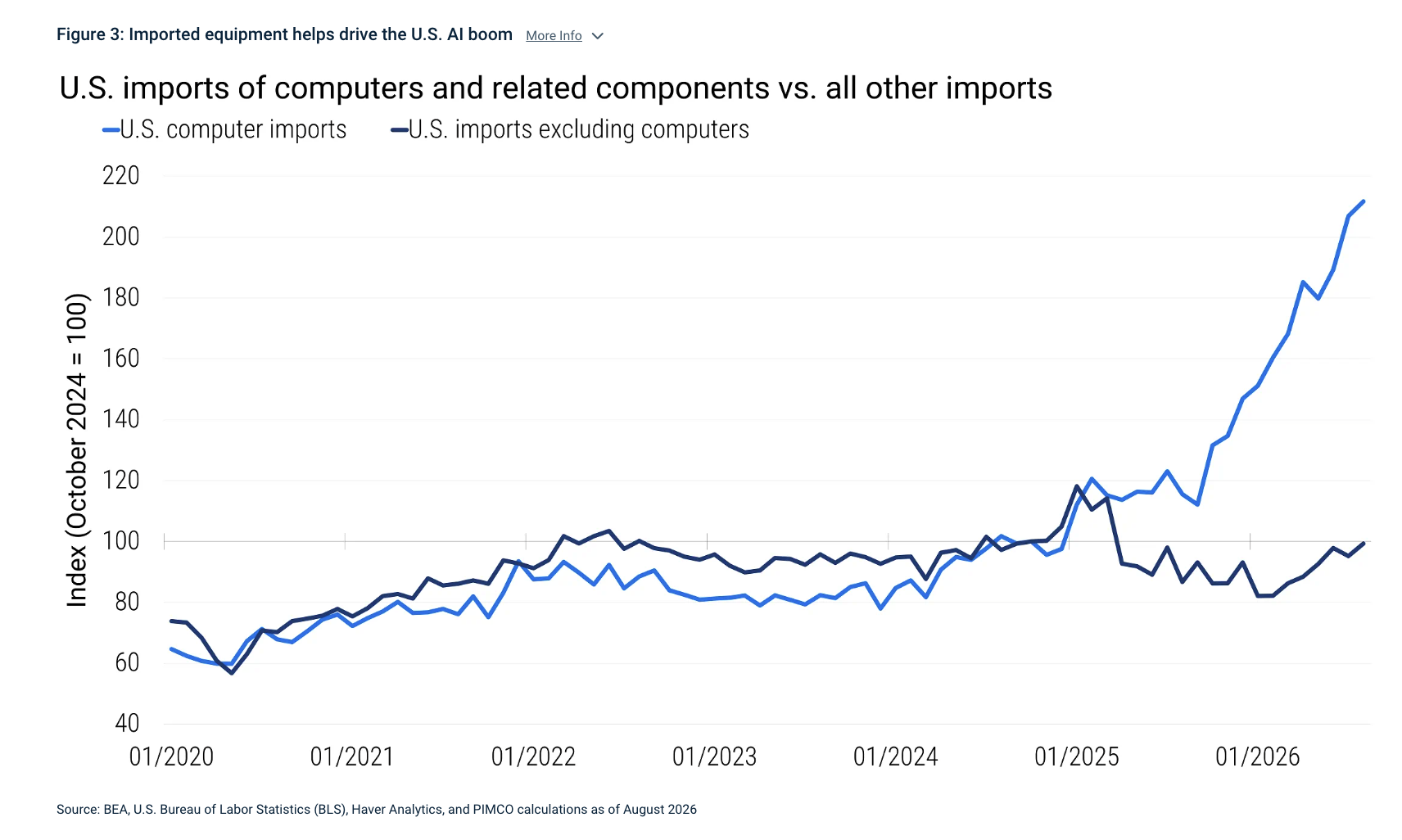
AI investment is import-intensive. Roughly 90% of the equipment used by U.S. high technology sectors originates abroad (see the 15 October 2026 Macro Signposts). The more equipment and components that can be produced abroad, the fewer domestic resources have to be diverted from other uses. Access to foreign production capacity and foreign saving has therefore provided an important release valve, helping the U.S. accommodate some of the AI boom through a wider trade or current account deficit.
This mechanism is not unlimited. Higher prices for chips and other components suggest that global production capacity has itself become a constraint. Nevertheless, imports (see Figure 3) and foreign saving have probably limited U.S. overheating and reduced the required adjustment in domestic rates.
Implementation delays also regulate the speed at which desired AI investment becomes actual spending. Data-center permitting, power generation, grid interconnection, component lead times, and shortages of specialized labor can all prevent investment from reaching its desired level quickly.
The risk of additional state and local regulation in response to popular concern over electricity costs, water consumption, land use, and the local environmental effects of data centers could create further delays. It’s been a major policy discussion ahead of the U.S. election.
These bottlenecks will constrain the supply response and may increase the cost of individual projects. But by slowing the pace at which spending occurs, they also tend to give the economy, supply chains, and energy infrastructure more time to adjust. That can reduce the peak pressure on inflation and rates, even if it stretches the AI investment boom over a longer period.
Credit spreads
Rates aren’t the only market level that is tightening financial conditions. As capital becomes more expensive for the marginal, more leveraged borrower who is vulnerable to higher rates, resources are allocated elsewhere. Recently, credit spreads have widened for lower-quality borrowers (see The Credit Market Lens, 26 October 2026), and high yield issuance slowed sharply in October after strong September volume, according to Goldman Sachs research. Credit markets have become more discriminating among specific companies within the AI supply chain itself, suggesting the market is being more selective in its allocation of resources.
What eventually relieves the resource constraints?
Crowding out need not be permanent. Over time, the economy can grow into the boom, and this can happen in many ways. For example, semiconductor production, power generation, transmission capacity, data center construction, and supplies of specialized labor can expand. Workers and capital can move toward the sectors where returns are highest. Foreign production can provide additional equipment. Households and businesses can increase saving in response to higher returns.
Most importantly, if investment in AI eventually produces the anticipated productivity gains, then potential output will rise. The economy would then be able to sustain higher levels of investment and consumption simultaneously with less pressure on inflation and interest rates.
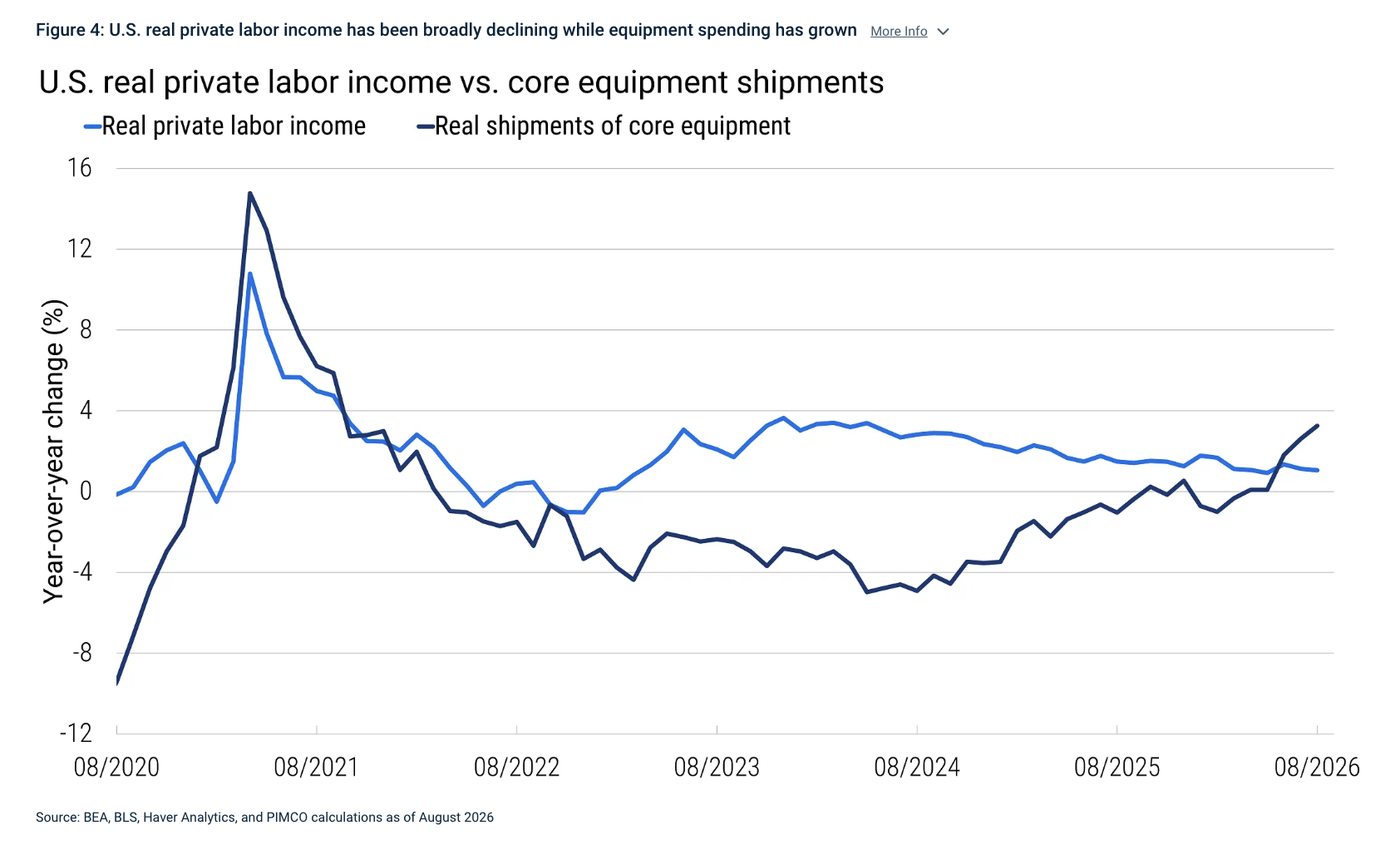
Labor income and consumption are also likely to be part of that adjustment. If higher desired investment in AI is being driven by expectations that the marginal cost of AI investment is lower than the cost of labor for at least some subset of jobs, and that AI adoption therefore will displace workers or reduce demand for some high-skilled occupations, then weaker labor income growth could restrain household spending while freeing more of companies’ resources for investment.
Indeed, recent labor market data show a disproportionate increase in job separations among workers who had previously earned above-median wages, contributing to softer measured wage and aggregate-income growth (see Figure 4 as well as our 19 August 2026 Macro Signposts). That evidence is consistent with labor already taking on some of the adjustment.
Implications
Reallocation is already taking place as higher desired AI-related investment transforms the U.S. economy. The most informative signals about how that reallocation is taking place may be in areas that are largely outside of AI: non-AI equipment and structures investment, housing and other rate-sensitive activity, small business borrowing, leveraged and lower-quality corporate credit, imports of technology equipment, and labor income for higher-skilled white-collar jobs.
So far, the higher-potential-return AI investments have continued even as the financing environment forces lower-potential-return activity elsewhere to slow. AI therefore looks less like an incremental addition to an otherwise unchanged economy and more like a reallocation of the economy itself.
Until greater productivity and supply capacity arrive, the key macro question is not simply whether the AI boom continues – although that is also an important question. It is who makes room for it, through lower investment, weaker consumption, more saving, or greater imports, and whether that adjustment remains orderly.
Footnotes
1 Keith M. Carlson and Roger W. Spencer. “Crowding Out and Its Critics.” Federal Reserve Bank of St. Louis Review (December 1975) Return to content↩
Disclosures
A word about risk: All investments contain risk and may lose value. Investing in the bond market is subject to risks, including market, interest rate, issuer, credit, inflation risk, and liquidity risk. The value of most bonds and bond strategies are impacted by changes in interest rates. Bonds and bond strategies with longer durations tend to be more sensitive and volatile than those with shorter durations; bond prices generally fall as interest rates rise, and low interest rate environments increase this risk. Reductions in bond counterparty capacity may contribute to decreased market liquidity and increased price volatility. Bond investments may be worth more or less than the original cost when redeemed. Investments with exposure to the artificial intelligence sector may involve heightened risks, including rapid technological change, competitive disruption, elevated valuations, regulatory uncertainty, data privacy and cybersecurity concerns, infrastructure dependencies, and reliance on third-party models or platforms. AI-related opportunities may not develop as expected, fail to produce anticipated productivity or revenue benefits, or be concentrated among a limited number of issuers, and could result in increased volatility or loss of capital.
Statements concerning financial market trends or portfolio strategies are based on current market conditions, which will fluctuate. There is no guarantee that these investment strategies will work under all market conditions or are appropriate for all investors and each investor should evaluate their ability to invest for the long term, especially during periods of downturn in the market. Outlook and strategies are subject to change without notice.
PIMCO as a general matter provides services to qualified institutions, financial intermediaries and institutional investors. Individual investors should contact their own financial professional to determine the most appropriate investment options for their financial situation. This material contains the opinions of the manager and such opinions are subject to change without notice. This material has been distributed for informational purposes only and should not be considered as investment advice or a recommendation of any particular security, strategy or investment product. Information contained herein has been obtained from sources believed to be reliable, but not guaranteed. No part of this material may be reproduced in any form, or referred to in any other publication, without express written permission. PIMCO is a trademark of Allianz Asset Management of America LLC in the United States and throughout the world.
CMR2026-1027- 6066020
A message from Advisor Perspectives and VettaFi: Discover something new! Click here to register for our upcoming webcasts.
© PIMCO
More Inflation Topics >