Key takeaways
-
Bonds’ renewed appeal comes with uneven economic costs. Higher starting yields offer income and potential downside mitigation, while exposing borrowers with weak balance sheets and significant refinancing needs.
-
Credit decompression should deepen (i.e., low quality borrowers will likely underperform the broader market). CCC rated companies, fiscally vulnerable sovereign issuers, and leveraged AI borrowers face distinct pressures from higher funding costs, with growing AI debt supply adding competition for capital.
-
Housing faces a prolonged adjustment, not necessarily a new crisis. Higher mortgage rates should extend residential housing weakness in the U.S., but despite higher real yields pressuring commercial property valuations, there hasn’t yet been a broad contraction in credit availability.
We have been arguing that the reset higher in yields has restored the dual role of bonds in multi-asset portfolios: providing attractive income while once again offering the potential for meaningful risk mitigation. This month’s tech market turbulence has provided a clear example: As equities came under pressure, U.S. Treasury yields fell amid a flight to safety, allowing duration to behave like a diversifier again.
One episode does not prove that the stock/bond hedge has been fully restored, but the starting point looks considerably better than it has for years. Investors are once again being paid to hold a potential hedge. (Learn more in our recent article, “Welcome Back, Balanced Portfolio.”)
But the same reset that has made bonds more attractive in portfolios also raises a familiar question for markets and the economy: Where will the higher cost of capital start to bite?
So far, the aggregate picture remains remarkably resilient. But higher borrowing costs are exposing greater differentiation. Rate sensitivity is becoming more visible where leverage is high, refinancing needs are significant, balance sheets are weak, or long-duration assets leave less room for error.
See more: Are Bonds Pricing In a Fed Policy Mistake?
Five areas stand out to us.
1. Pressure on lower-quality credit could persist even without a meaningful deterioration in the macro fundamentals
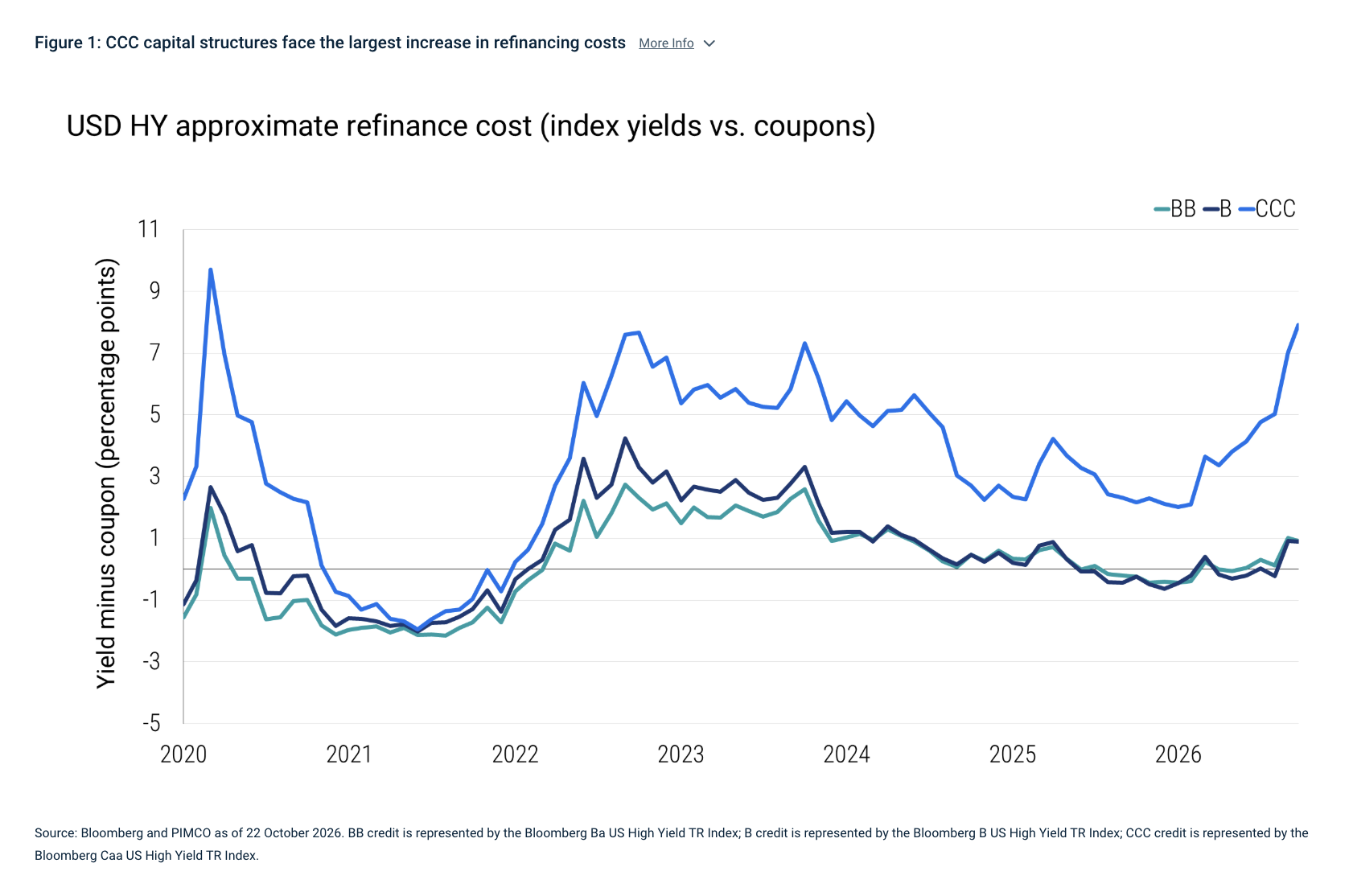
Higher-quality companies can generally absorb a higher risk-free interest rate because leverage remains manageable, interest coverage is healthy, and market access remains available. CCC rated borrowers have far less financial flexibility, and the market has taken notice, as evidenced by the significant recent decompression within the U.S. high yield (HY) market – meaning spreads above Treasuries of lower-rated issues have widened more than those of the broader HY market.
The pressure works from both directions. With attractive all-in yields available higher in the quality spectrum, investors have less incentive to reach for incremental spread in CCCs. At the same time, the weakest borrowers face materially higher costs when they refinance. Figure 1 illustrates this pressure through the gap between secondary market index yields and existing coupons across HY rating buckets – a rough proxy for the increase in borrowing costs upon refinancing, rather than a direct estimate.
2. European fiscal vulnerabilities should remain in focus
We’re closely monitoring developments in Europe, particularly in jurisdictions where weak growth and difficult fiscal arithmetic leave little room to absorb higher borrowing costs.
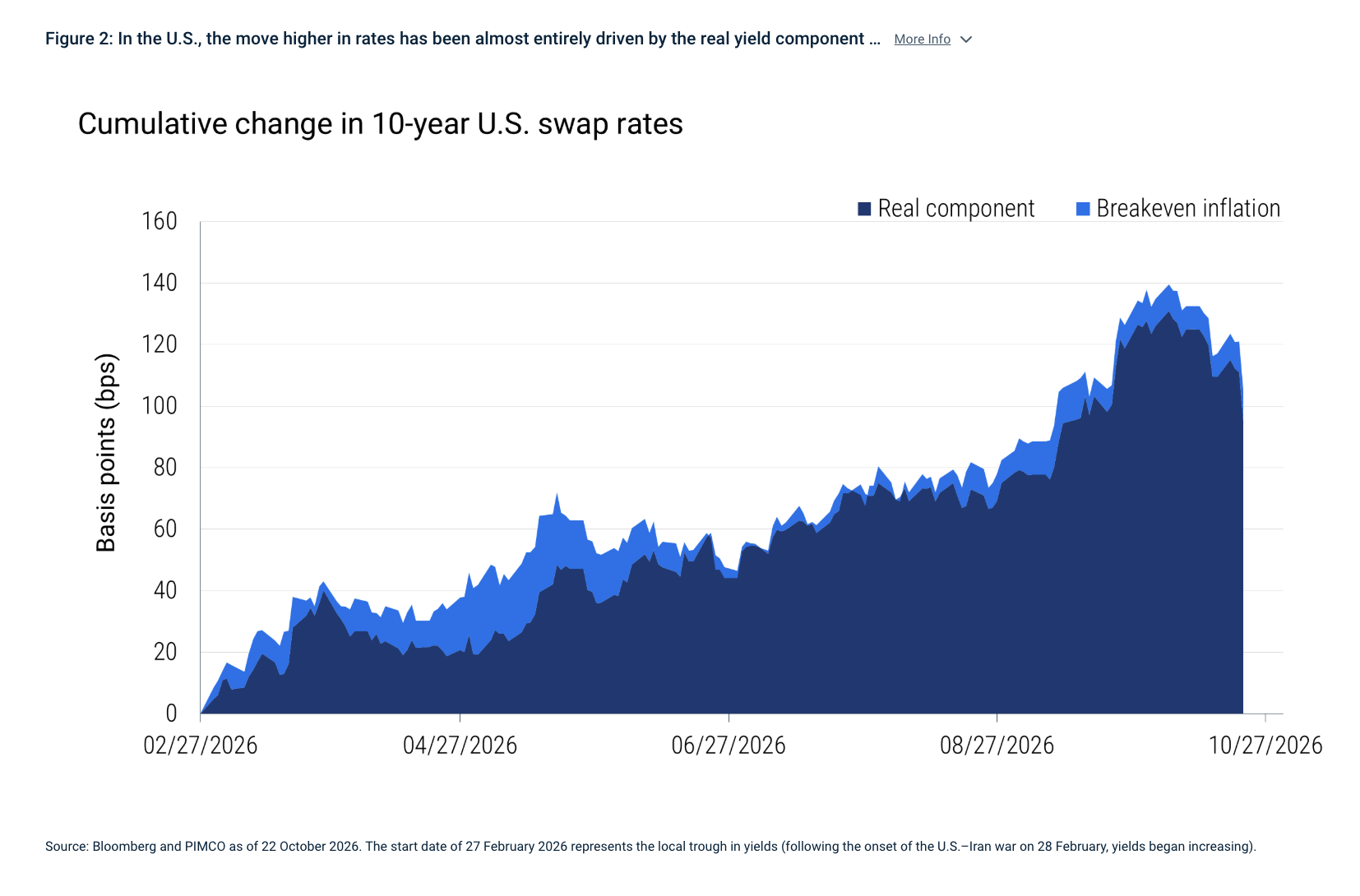
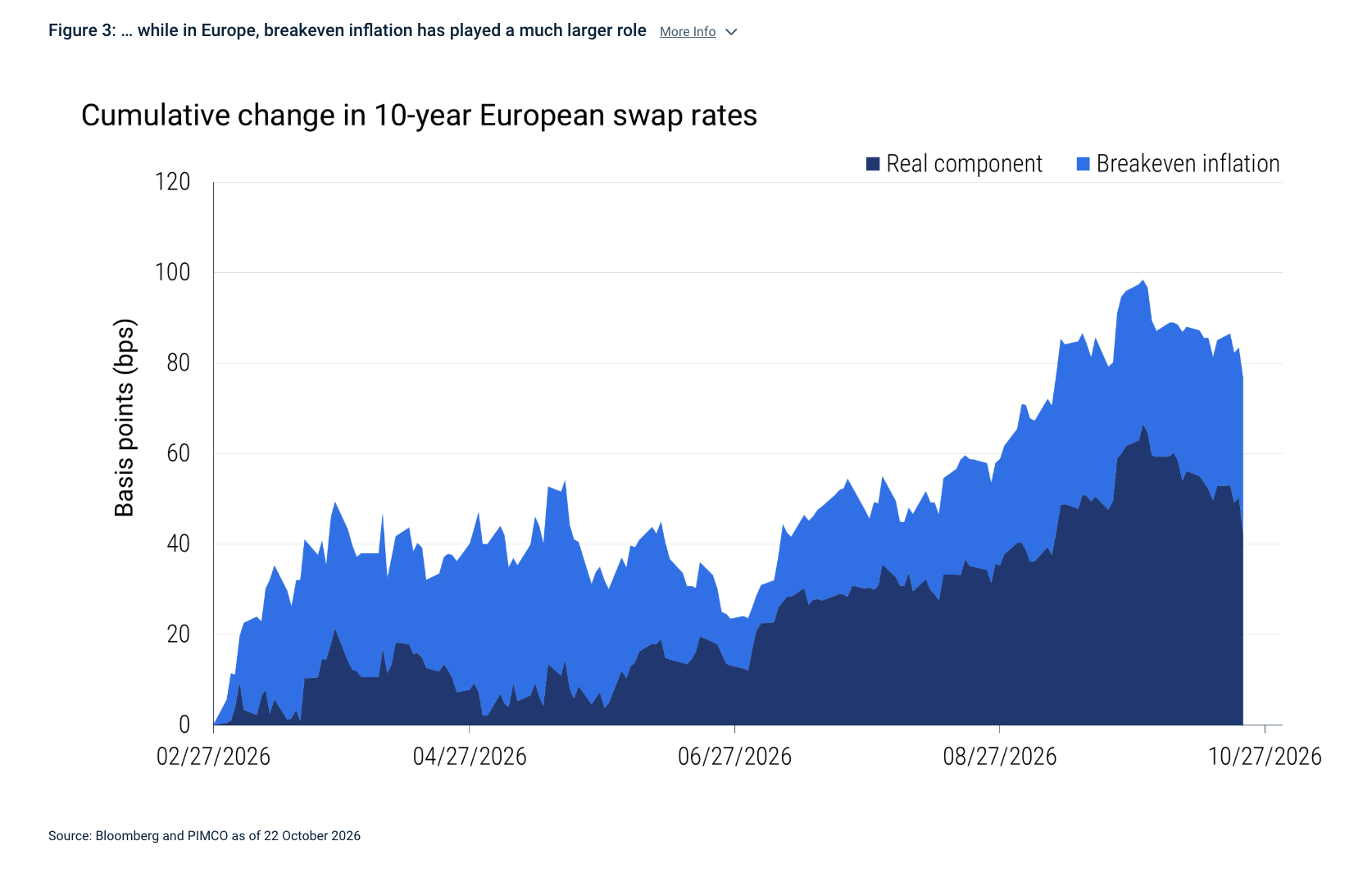
While yields have backed up on both sides of the Atlantic, the drivers have been different. In the U.S., the move has been overwhelmingly a real yield story (see Figure 2). In Europe, breakeven inflation has played a much larger role in the backup in nominal yields (see Figure 3). Put differently, the U.S. bond sell-off has looked like a growth repricing; Europe’s has not.
The composition of the yield move has important implications for how easily it can be absorbed by the economy. Higher real yields are easier to absorb when they come alongside stronger nominal growth and healthier fiscal revenues. Rising borrowing costs driven more by inflation compensation are less helpful, particularly for sovereigns already facing weak growth and challenging fiscal dynamics.
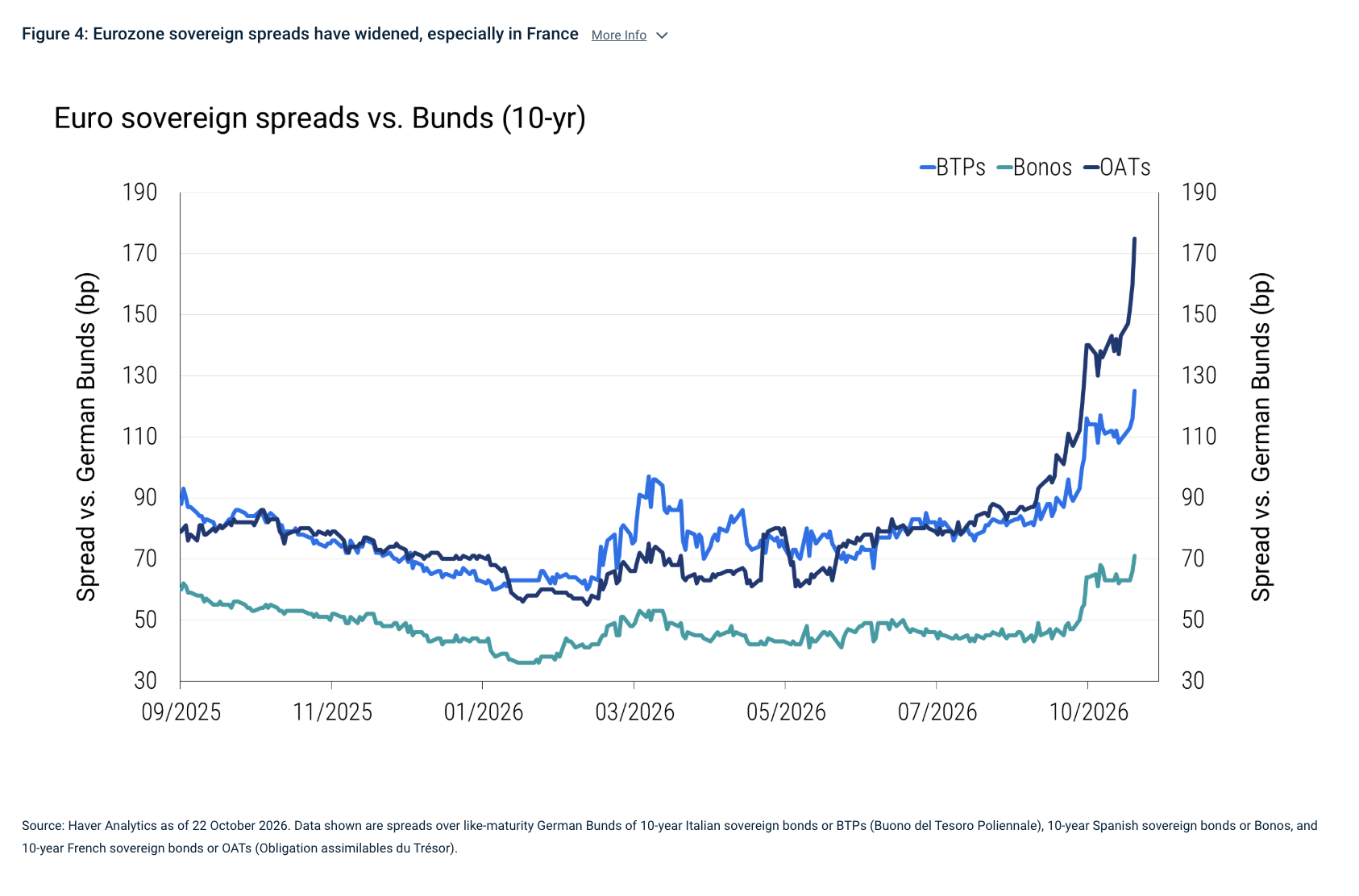
France sits squarely in the latter camp: The global reset higher in yields has compounded an already fragile growth and fiscal backdrop. Spreads of French sovereign bonds (Obligation assimilables du Trésor, or OATs) have widened materially, and the bar for sustained normalization remains high (see Figure 4). A calmer global duration backdrop can help contain the widening, but weak growth, elevated funding costs, and a long political calendar support a more persistent, and elevated, rebuild of risk premium.
3. AI debt: Higher yields and more supply should accelerate decompression
The recent sharp underperformance of low-quality borrowers in the AI financing chain is not a reflection of weak compute fundamentals, in our view. Compute remains scarce and demand strong. What markets are repricing is the sustainability of leveraged financing models amid a higher-yield environment, accelerating debt supply, and increasingly attractive higher-quality alternatives.
The AI financing debate is often framed around whether investors have enough capacity to absorb the coming supply. But the more relevant question surrounds the price at which the debt clears the market. The next financing wave will likely be larger and more varied, forcing lower-quality borrowers to compete with hyperscalers, investment-grade-tenanted data centers, and better-protected asset-level structures. With all-in yields already elevated, investors have less reason to reach for incremental credit risk.
As the capex cycle matures, another challenge will emerge: The debate will shift from building capacity to monetizing it. Returns depend on utilization, compute pricing, technological obsolescence, and whether falling token costs generate enough additional usage.
Even if AI adoption ultimately validates today’s investment, where the value eventually accrues remains uncertain. Newer hardware could capture much of the upside while eroding the utilization, rental income, and residual value of legacy equipment. That wide distribution of outcomes leaves highly leveraged borrowers with little room for error.
4. U.S. housing: Higher rates should prolong rather than deepen the downturn
The latest increase in mortgage rates is unlikely to create a new housing downturn; instead, it should extend the weakness already in place. Housing remains one of the most rate-sensitive parts of the real economy, and conditions today are already deeply impaired.
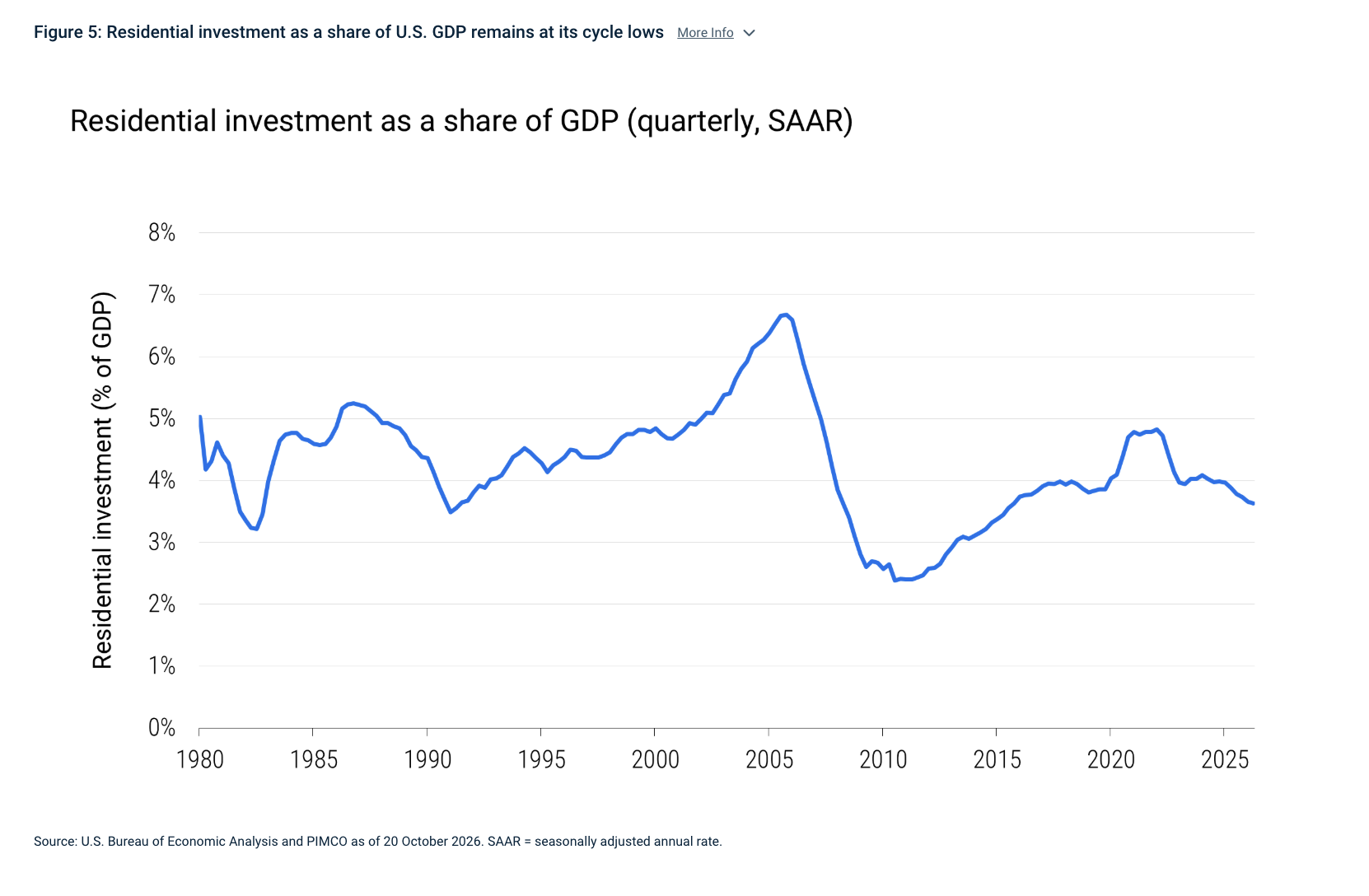
Since 2022, higher home prices, mortgage rates, and insurance costs have pushed housing expenses far ahead of household incomes. Affordability is severely constrained, transaction volumes are depressed, the lock-in effect remains firmly in place, and residential investment remains near rock-bottom levels (see Figure 5).
Therefore, housing is not so much entering a new downturn as extending the existing one. Higher rates keep prospective buyers constrained while giving homeowners with low-rate mortgages little incentive to move, perpetuating weakness in turnover, brokers’ commissions, and transaction-related residential investment.
5. Commercial real estate: valuation pressure without a broad credit event
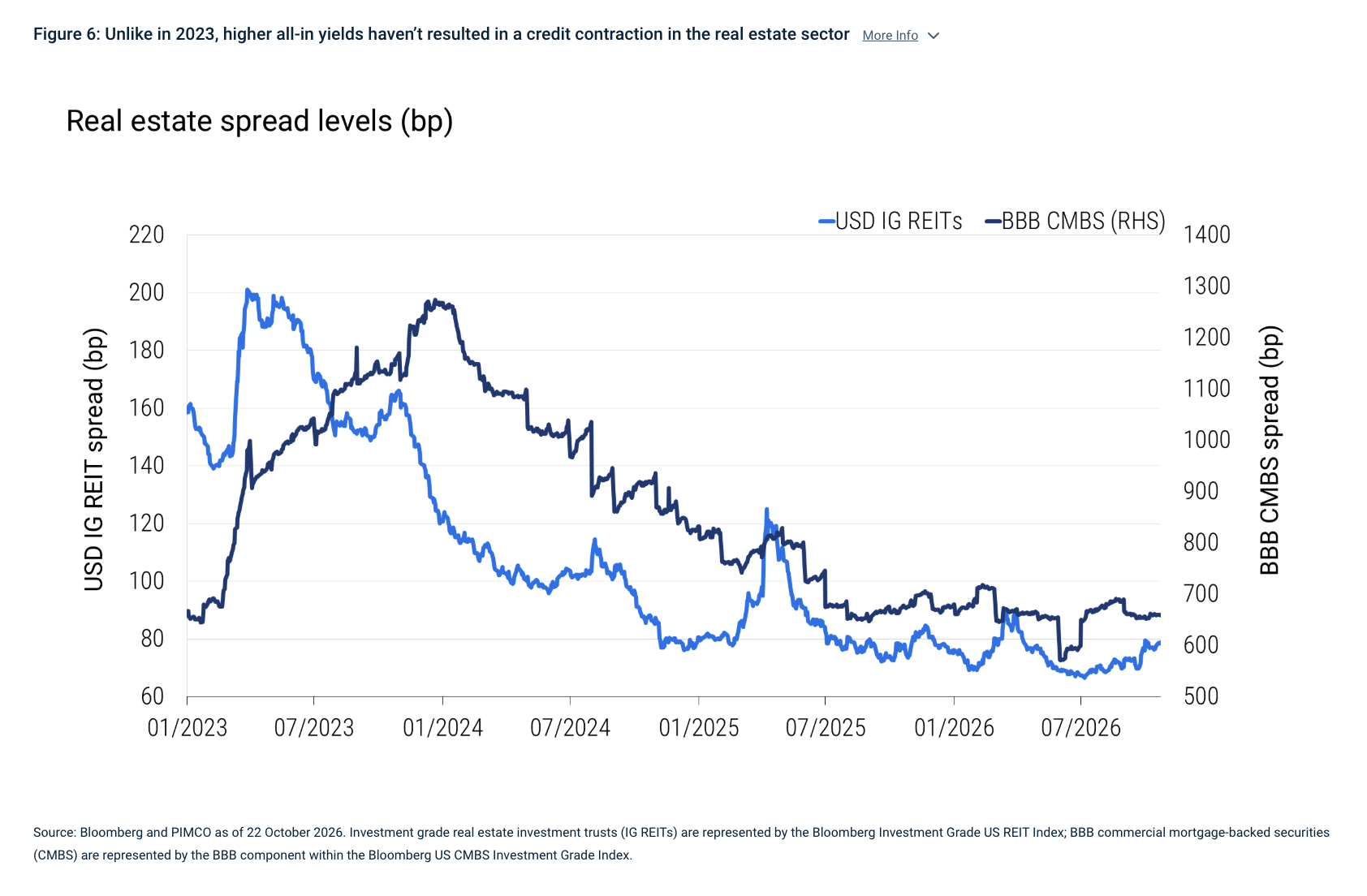
Higher yields leave commercial real estate (CRE) valuations vulnerable, but we do not yet see the ingredients for a repeat of the broad credit stress of 2023. The recent sell-off in public real estate investment trusts (REITs) looks more like a valuation reset than a renewed CRE crisis.
Higher real yields put upward pressure on capitalization rates, or the yield investors require on a property’s operating income. If the required cap rate rises while income is unchanged, then property values must fall, all else equal. With cap-rate spreads over real yields near historical lows (according to Green Street data), valuations therefore remain vulnerable.
Credit markets, however, are sending a more reassuring signal. REIT bond spreads have broadly tracked their benchmarks, commercial mortgage-backed securities (CMBS) spreads remain resilient (see Figure 6), and financing markets remain open despite softer origination volumes. Unlike in 2023, higher yields have not coincided with a comparable contraction in credit availability.
There are also important differences in the starting point. Borrowing costs are already elevated, reducing the incremental debt service shock from another move higher. Transactions completed since 2022 generally reflect lower leverage and stronger debt service coverage. Policy appears to be moving toward easing bank lending constraints, while most property sectors lack the structural demand deterioration that compounded office market stress in 2023.
Michael Puempel and Gabriel Cazaubieilh contributed to this report.
Disclosures
Statements concerning financial market trends or portfolio strategies are based on current market conditions, which will fluctuate. Outlook and strategies are subject to change without notice.
Past performance is not a guarantee or a reliable indicator of future results. Forecasts, estimates and certain information contained herein are based upon proprietary research and should not be considered as investment advice. There is no guarantee that stated results will be achieved.
All Investments contain risk and may lose value. High-yield, lower-rated, securities involve greater risk than higher-rated securities; portfolios that invest in them may be subject to greater levels of credit and liquidity risk than portfolios that do not. Investments in commercial real estate debt are subject to risks that include prepayment, delinquency, foreclosure, risks of loss, servicing risks and adverse regulatory developments, which risks may be heightened in the case of non-performing loans. Mortgage and asset-backed securities may be sensitive to changes in interest rates, subject to early repayment risk, and while generally supported by a government, government-agency or private guarantor there is no assurance that the guarantor will meet its obligations. Bond investments are subject to market, interest rate, issuer, credit, inflation, and liquidity risks. Bond prices generally fall when interest rates rise, with longer-duration bonds typically more sensitive to rate changes. Reduced market liquidity may increase price volatility. Investors may receive more or less than their original investment upon redemption. Equity investments may decline in value due to both real and perceived general market, economic and industry conditions. Investing in foreign denominated and/or domiciled securities may involve heightened risk due to currency fluctuations, and economic and political risks, which may be enhanced in emerging markets. Sovereign securities are generally backed by the issuing government. Investments with exposure to the artificial intelligence sector may involve heightened risks, including rapid technological change, competitive disruption, elevated valuations, regulatory uncertainty, data privacy and cybersecurity concerns, infrastructure dependencies, and reliance on third-party models or platforms. AI-related opportunities may not develop as expected, fail to produce anticipated productivity or revenue benefits, or be concentrated among a limited number of issuers, and could result in increased volatility or loss of capital. REITs are subject to risk, such as poor performance by the manager, adverse changes to tax laws or failure to qualify for tax-free pass-through of income. The value of real estate and portfolios that invest in real estate may fluctuate due to: losses from casualty or condemnation, changes in local and general economic conditions, supply and demand, interest rates, property tax rates, regulatory limitations on rents, zoning laws, and operating expenses.
The credit quality of a particular security or group of securities does not ensure the stability or safety of the overall portfolio. References to specific securities and their issuers are not intended and should not be interpreted as recommendations to purchase, sell or hold such securities. It is not possible to invest directly in an unmanaged index.
PIMCO as a general matter provides services to qualified institutions, financial intermediaries and institutional investors. Individual investors should contact their own financial professional to determine the most appropriate investment options for their financial situation. This material contains the opinions of the author and such opinions are subject to change without notice. This material has been distributed for informational purposes only and should not be considered as investment advice or a recommendation of any particular security, strategy or investment product. Information contained herein has been obtained from sources believed to be reliable, but not guaranteed. No part of this material may be reproduced in any form, or referred to in any other publication, without express written permission. PIMCO is a trademark of Allianz Asset Management of America LLC in the United States and throughout the world.
CMR2026-1023-6054056
A message from Advisor Perspectives and VettaFi: Discover something new! Click here to register for our upcoming webcasts.
© PIMCO
More Tax Planning Topics >