Calm on the Surface, Steady as She Goes?
Membership required
Membership is now required to use this feature. To learn more:
View Membership Benefits
For passive investors, a bird’s-eye view of third quarter equity index returns was likely pretty boring. The S&P 5001 Index rose 2.3%, bringing the year-to-date return to 12.8%. International developed markets fared less well and emerging market equities were slightly negative.2 The small cap Russell 2000 Index3 declined -7.2%. Yields soared as the Iran conflict entered its 8th month and investors demanded higher risk premiums on fixed income securities.
For active equity investors, the quarter likely felt more like a battle scene. July saw one of the most severe momentum reversals in the last four decades. Large moves in individual stocks occurred in both directions, cancelling each other out at the index level, a phenomenon we’ve dubbed The Hidden Momentum Reversal.4
A key driver was the Artificial Intelligence (AI) trade. AI beneficiaries dramatically underperformed in July while those previously perceived as vulnerable to AI disruption outperformed. In retrospect, it seems highly likely that the July episode was precipitated by the unwind of a large AI-focused hedge fund that needed to liquidate levered long and short bets on the AI ecosystem.5
The event, which partially reversed in August, left an indelible mark on thematic AI trades. This is relevant to all investors, not just the technophiles in the audience, because AI and AI-adjacent stocks currently represent about 55% of the U.S. market capitalization.6
Last quarter, we argued that AI was better understood as a capital cycle than a bubble and that elevated dispersion was increasing both the opportunities and risks beneath equity indexes. Three months later, the market provided a real stress test. July exposed how deeply AI has become embedded in market leadership, while corporate fundamentals increasingly show that sustaining the buildout requires more cash and outside capital.
As we move through a large capital expenditure cycle for the AI segment, the investment question for allocators is shifting from whether AI can drive earnings to whether the capital required to sustain those earnings will generate sufficient returns on that capital.
Calm on the Surface, Carnage in Factor Land
The hidden momentum reversal occurred within a minor drawdown at the index level. The carnage under the surface was masked by low correlations between U.S. stocks. Portfolio volatility is driven by two components: 1) the standalone volatility of the underlying holdings and 2) how correlated the holdings are with each other. For index volatility to remain calm while individual stock volatility rises, correlations between stocks must fall. That is exactly what we have observed.
Passive investors only see small ripples on the surface while a strong undertow pushes active investor positions around. This is not a problem per se, but like pressure building at a tectonic fault line, minor shifts can have unexpected and unpredictable consequences. If correlations normalize while single-stock volatility remains elevated, index volatility could rise materially even without an increase in single-stock volatility.
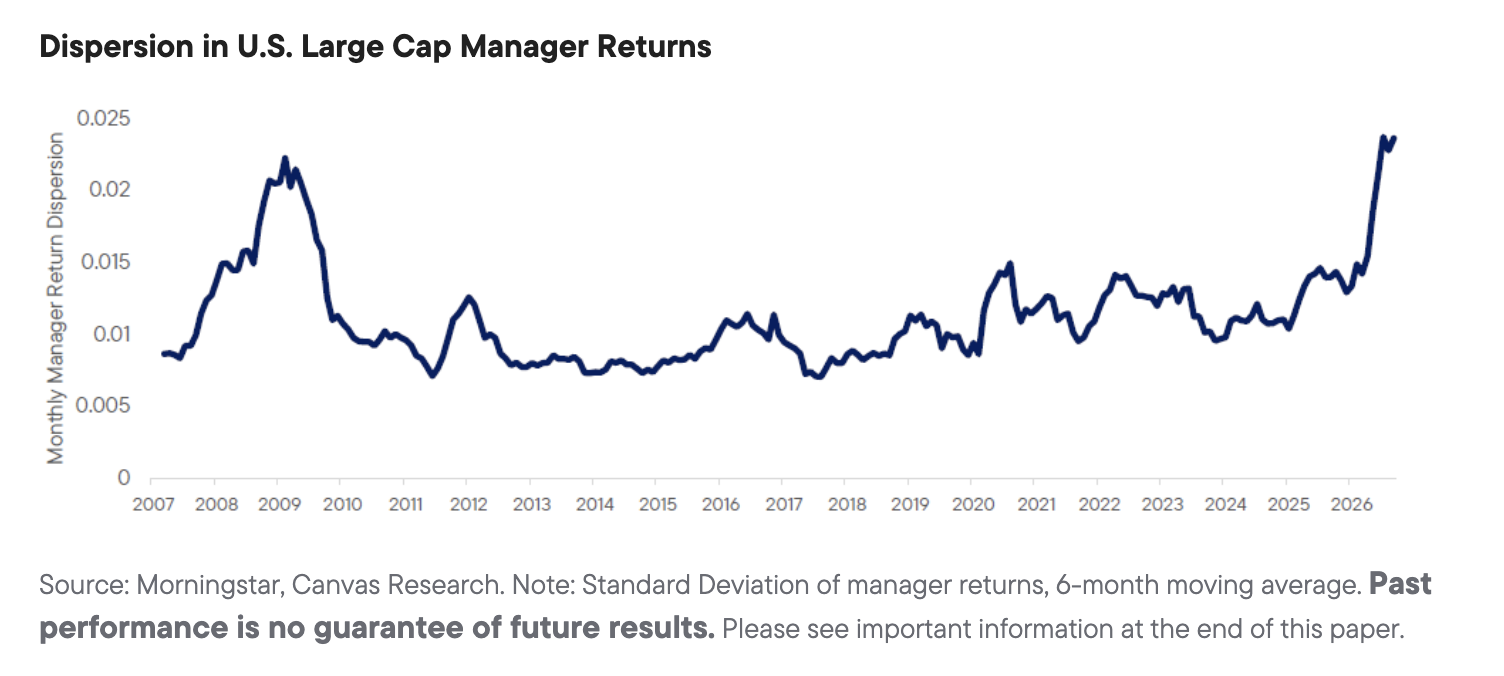
For the quarter, some active investors were likely very happy while others were quite disappointed. The chart below shows U.S. Large Cap active manager return dispersion over the last 20 years. When dispersion is high, the difference between the best and worst manager returns is wide. You can see on the right side that manager dispersion has soared in 2026, largely driven by whether a manager leaned into or away from AI-related names.
With dispersion comes another benefit for tax-aware investors. A wide return spread between winners and losers generally creates ample opportunity for tax loss harvesting, the practice of realizing losses to offset future gains within client-defined tracking error7 budgets. In the third quarter, our trading team realized approximately $300 million in gross losses across the Canvas platform for active and passive equity investors.
AI Was the Fault Line
Not surprisingly, when we drill down into systematic drivers of pre-tax returns for U.S. large cap, a similar theme is evident. Factor spreads were generally wide for the quarter.
Technology is now 38% of the Russell 1000 Index8, and as it goes so goes the broad market and factors. Selection effects within the Information Technology sector contributed -6.8% to Momentum’s performance. Coming into the quarter, high momentum stocks were overweight AI-beneficiaries
(Semiconductors, Hardware & Equipment) and weak momentum was overweight to names subject to AI disruption (Software & Services). During the July reversal, AI beneficiaries dramatically lagged while AI disruption plays soared.
The reversal matters because the stocks sitting at the center of momentum are also sitting at the center of a much larger change in corporate capital allocation.
From Software Economics to Industrial Economics
The calm at the index level is hiding a significant redistribution of capital under the surface, and AI is the driver. The AI trade is evolving from a high margin, asset-light earnings story into a capital-intensive investment cycle right at the moment that the cost of capital is rising.
While AI can easily be classified as a technology, we think a better framework is a “manufacturing of knowledge.” The industrial revolution transformed our ability to manufacture physical goods by combining energy, machines, and labor at scale. AI follows a similar architecture: data is the raw material, semiconductors and datacenters are the machinery, and foundational models orchestrate the production process to generate text, code, images, summaries, and potentially new knowledge.
Today’s models do not literally manufacture knowledge. Knowledge implies some combination of truth, context, and understanding. Current models manufacture outputs that compress, synthesize, and redistribute the accumulated knowledge embedded in training data, the rich history of knowledge that has compounded since the dawn of human existence. But they dramatically expanded access to expertise that was confined to specialists in fields like mathematics, science, and engineering.
The economic distinction from the software era is critical. Once software is developed and distributed, marginal costs can be low and margins very high (i.e. the Microsoft Office suite). AI is not software. AI is forcing a shift in the economics of technology from primarily asset-light software economics toward something resembling industrial economics.
Scaling capability requires enormous recurring investment in compute, data centers, semiconductors, energy, and model development. The estimated cost of training a frontier model has risen dramatically as complexity has increased: GPT-1 contained just 117 million parameters versus 671 billion for DeepSeek-V3.
The last decade rewarded businesses that could scale digital offerings. The AI era increasingly requires investors to ponder whether massive CapEx9 will generate adequate long-run returns.
The Capital Cycle Has Arrived
When we look at the underlying fundamentals, we are starting to see a shift in the earnings and capital structures of the AI ecosystem. To do so, we constructed a universe of large capitalization U.S. stocks and subdivided it into two groups: AI and ex-AI.10
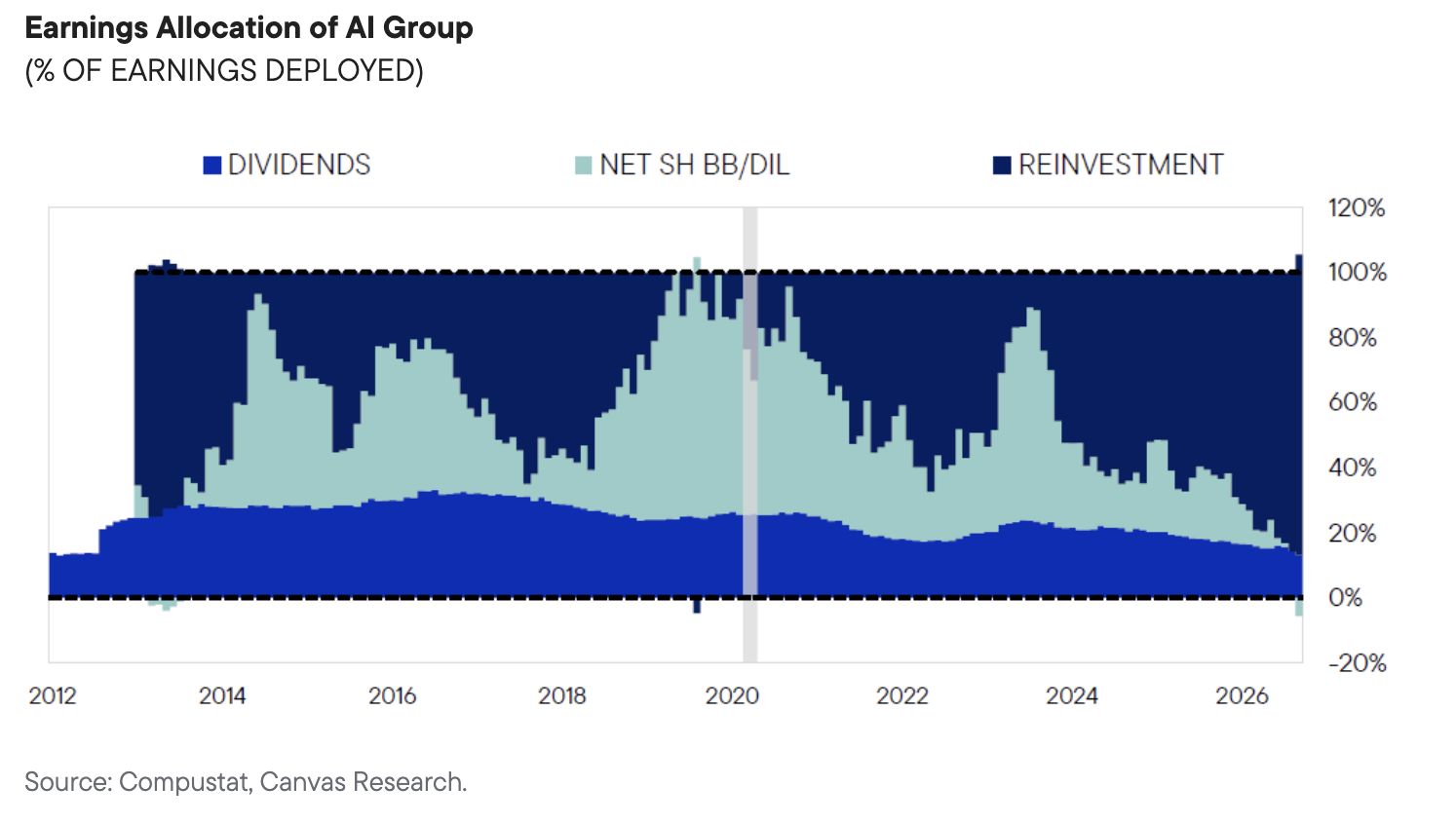
It is no surprise that AI players have massively ramped up capital expenditures. Over the trailing 12 months, 92% of earnings have been reinvested. Reinvestment has gradually replaced share buybacks as the de facto avenue of capital allocation. As of September 2026, the AI ecosystem moved to net share issuance for the first time since 2013.
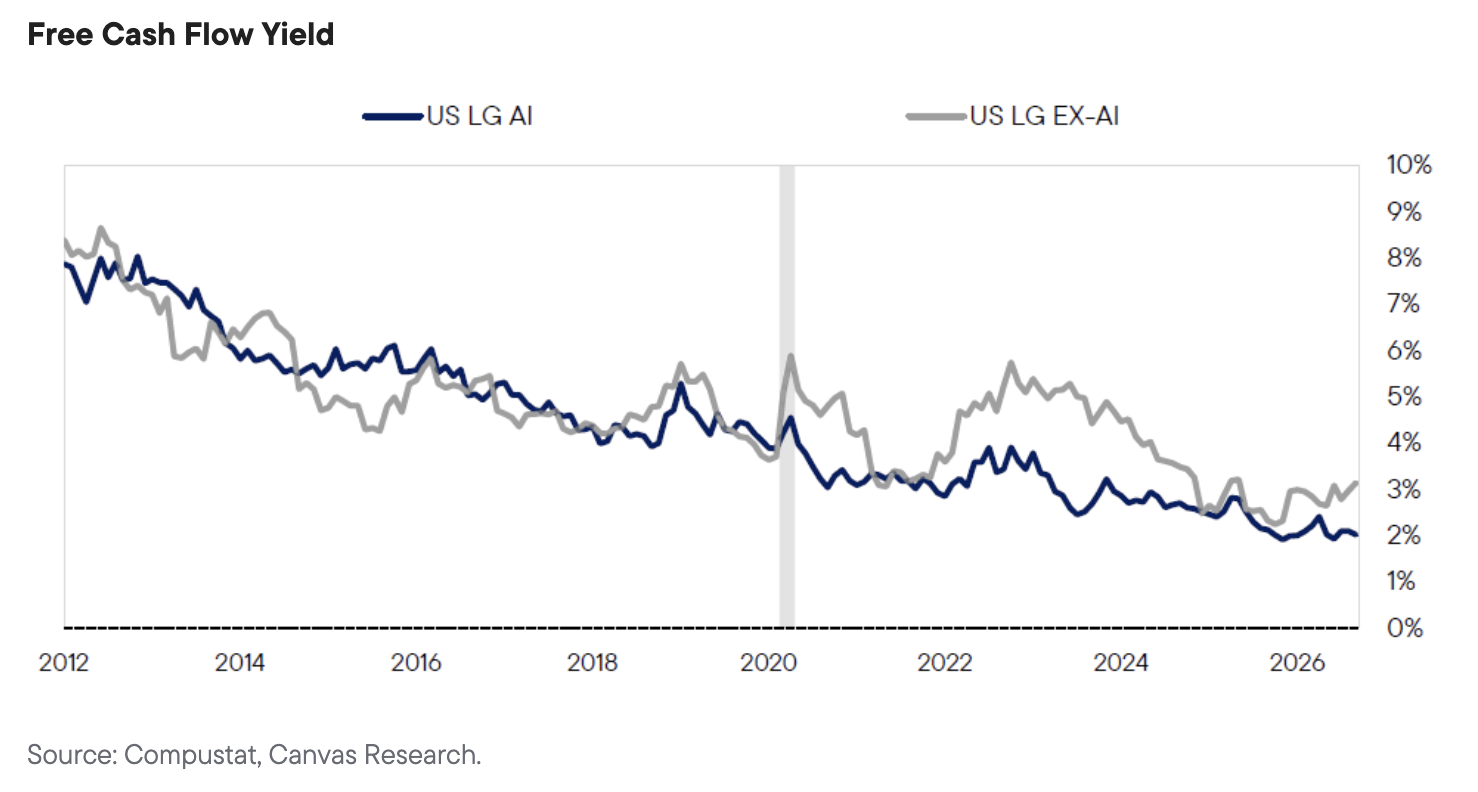
We can see this impact through free cash flow as well. Free cash flow yield has steadily declined in recent years.11 This is not an immediate cause for concern. We view it as a nascent industry starting to mature.
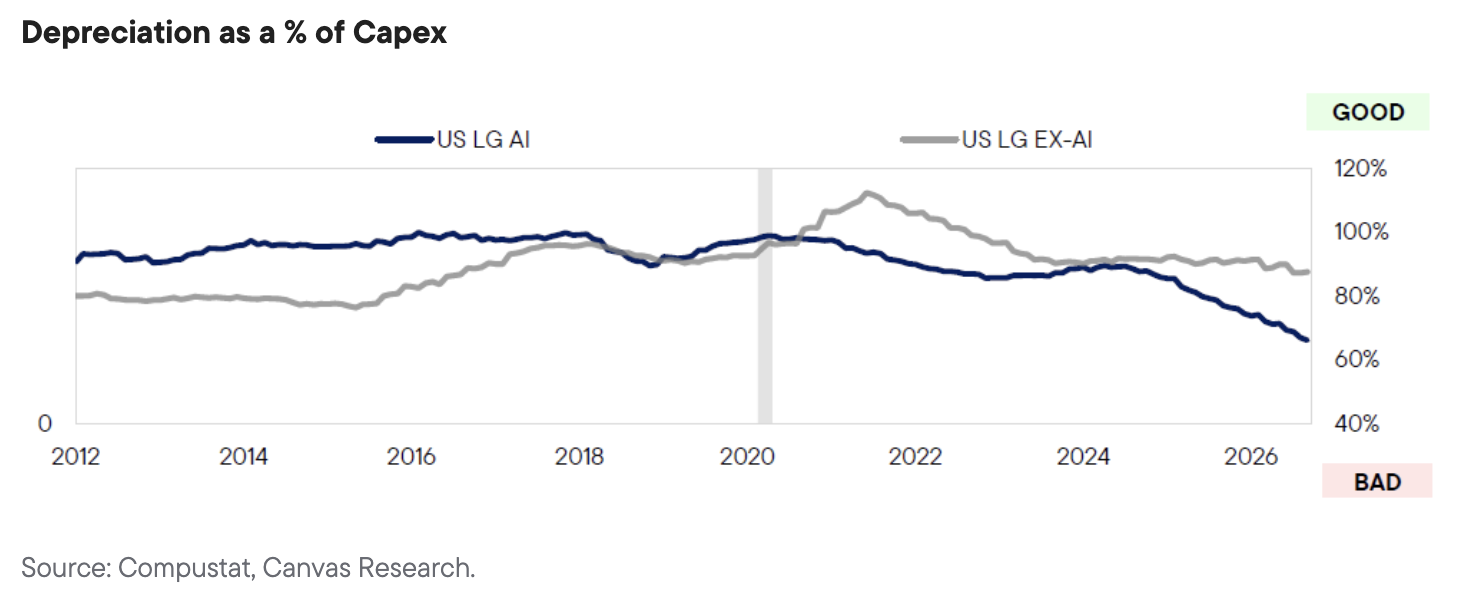
Reinvesting in high return of capital projects is certainly the cornerstone of Finance 101. As investors, we just need to gain comfort that the reinvestment will result in positive economic returns and management teams are not getting too far out over their skis to capture revenues. One data point that gives us pause is the way depreciation, an income statement item, is not keeping pace with capex, a cash flow statement item. Depreciation and/or amortization are accounting concepts that allow businesses to make large up-front investments and spread out the costs of the investment over the useful life of the asset, i.e. a manufacturing plant depreciated over 30 years, so a company can have high expenditures today without the entire cost immediately reducing earnings. However, investors get the true picture of outlays via the statement of cash flows, which reflects the full investment in the period in which it occurs.
For mature firms, a depreciation-to-capex ratio of 1.0 is indicative that cash receipts and outlays match reported earnings. However, rapidly growing firms should have greater CapEx than depreciation if adding productive assets.
CapEx is increasingly running ahead of recognized depreciation for the AI group. That is consistent with a major expansion cycle, but it also means reported earnings are not a complete measure of the cash outlays needed to support rapid growth. Since late 2023, depreciation-to-capex has dipped from 0.91 to 0.66, suggesting the AI ecosystem’s earnings understate the cash required to sustain that growth.
We are not suggesting that the AI ecosystem suddenly has weak fundamentals, but we do need to recognize that growth is consuming a larger share of those fundamentals. As the cycle matures, non-cash depreciation and CapEx will need to be reconciled.
Investors need to think hard about how much of today’s CapEx will be rewarded with attractive returns versus how much is being outlaid simply to maintain competitive position.
The Risk Has Migrated
The growth of the AI ecosystem over the last several years is quite astounding. The idea that such large firms can compound earnings at triple digits for multiple years seems to defy the laws of economics. Meanwhile, analysts continue to underestimate earnings-per-share (EPS)12 growth. Actual EPS reports have beaten estimates 95% of the time for the AI group by an average of 13% over the last five years.
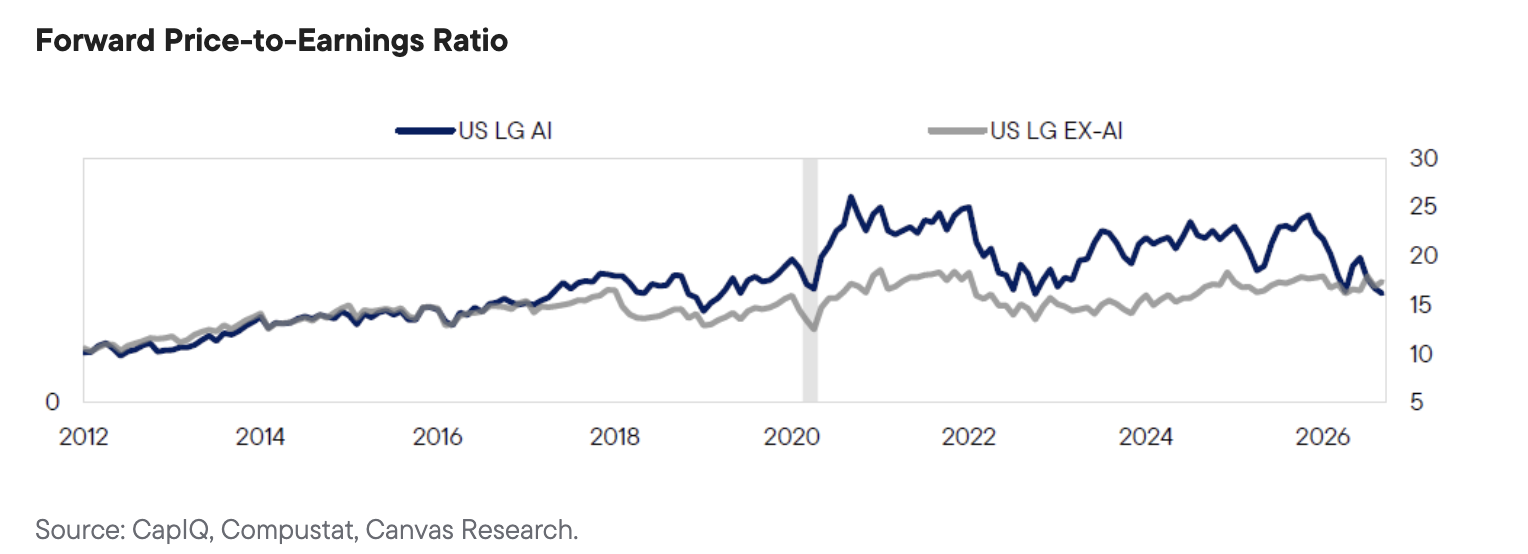
The result of such strong actual earnings growth is that the AI group is now trading at a forward price-to-earnings13 discount compared to the rest of the market for the first time since 2017. Given the open questions as to the capital needs associated with the maturing AI ecosystem, we think this is a healthy development.
We are also in the midst of a strong earnings estimate revision cycle. The chart below shows that analysts have increased their expectations for AI group earnings by 21% in the last 6 months.
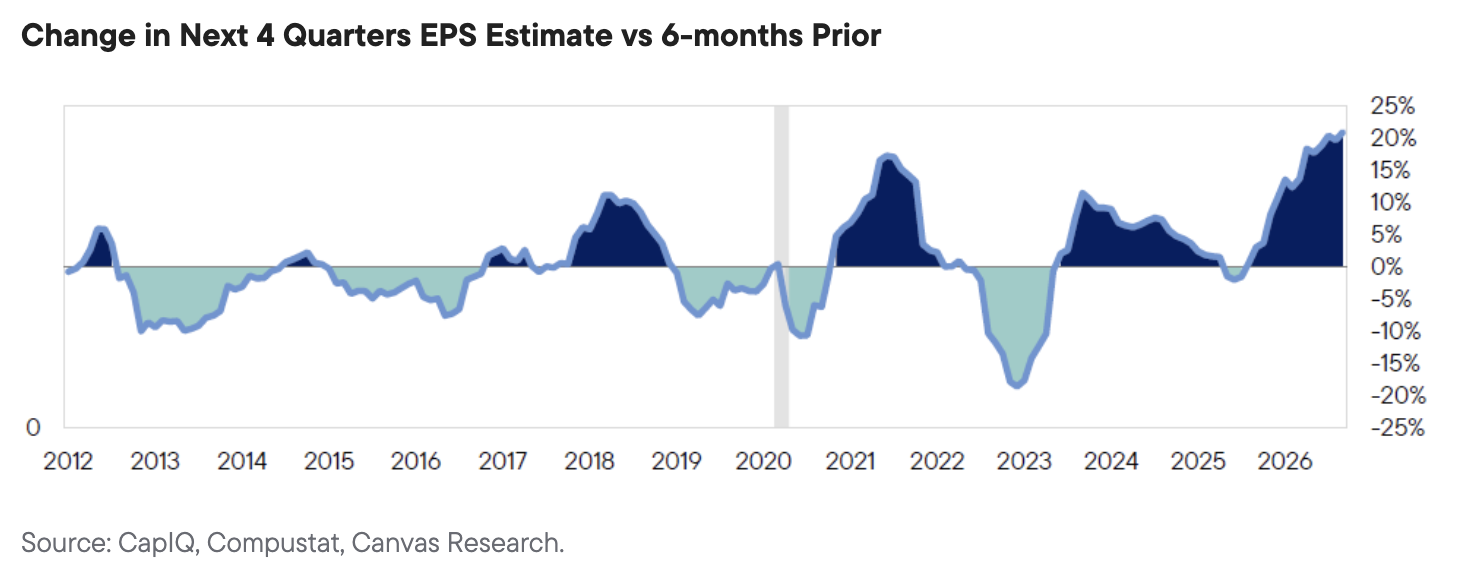
From a top-down perspective, analysts expect U.S. large cap earnings growth of 16% for the next four quarters, of which the AI group is expected to contribute a third of that growth.
The AI complex no longer looks obviously expensive on consensus earnings. However, that does not eliminate risk; it just relocates it. The market is increasingly underwriting the earnings estimates themselves at a time when earnings quality is becoming somewhat more complicated.
One driver of that complication is the cross investments within the ecosystem. Microsoft, for example, holds a 27% stake in OpenAI reportedly worth $135 billion.14 Google and Amazon hold stakes in Anthropic. These large stakes can influence the investing company’s earnings through either proportional results (as through the equity method of accounting used by Microsoft for OpenAI) or through fair value methodologies that require mark ups when new funding rounds occur (as Amazon and Alphabet do with their Anthropic holdings).
As can be seen in the chart below, non-operating income now represents 7.5% of the AI ecosystem’s 30% GAAP15 profit margin, suggesting the headline earnings could become more volatile.
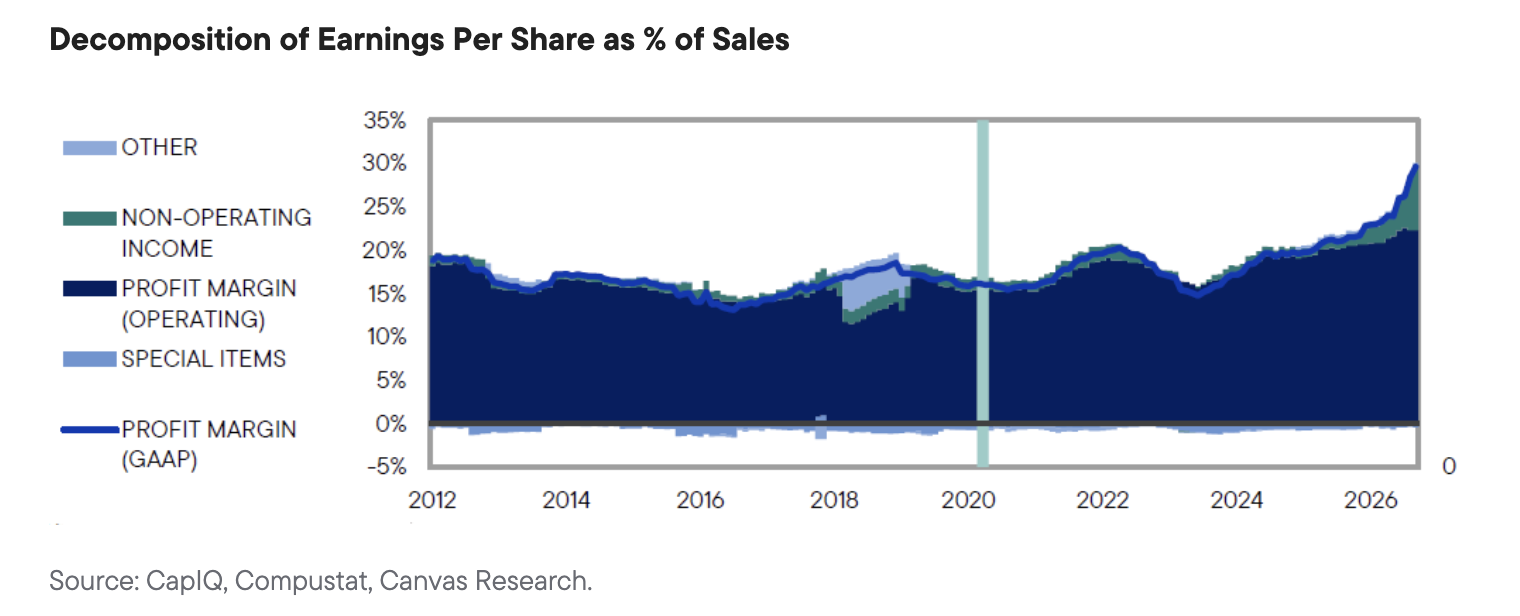
In summary, AI’s influence on broad market valuation, margins, capital allocation policies, expectations, and sentiment is growing at a time when the ecosystem is just beginning to mature. The key conclusion here is that valuation risk has morphed into execution and return-on-capital risk.
While we don’t necessarily share in the AI-bubble thesis at this time, there are some undercurrents to remain attuned to as we head into 2027.
Everyone Wants Capital
The post-GFC16 regime was defined by excess capital in search of assets. The current regime looks to be increasingly defined by competition for capital.
Corporations need capital for the AI infrastructure buildout. For the last 15 years companies increasingly returned excess capital to shareholders through buybacks and dividends. The current regime may increasingly be characterized by greater equity and debt issuance, a request of capital from investors.
The electrical grid and energy system need it to accommodate a step change in power consumption and to address energy supply instability. The defense sector needs capital to accommodate the changing global security landscape. The federal government needs capital to fund deficits. Mega-IPOs and private-to-public transitions want capital to monetize gains.
A greater share of capital that might otherwise have been returned to shareholders is being redirected toward investment in the real economy. The new transmission channel is likely an underappreciated driver of resilient economic growth and inflation. As of the third quarter, non-residential fixed investment (one of the avenues by which the AI buildout flows through to GDP17) increased 9.6% year-over-year. Nominal GDP is growing at relatively high persistent rates not seen since the 1990s.18
Given the above, it should not be a surprise that the price of capital is rising. The U.S. 10-year Treasury yield surged 0.81% on the quarter, building on gains earlier in the year. While the impetus seemed to be continued energy supply disruptions from the Iran conflict, 10-year breakeven rates (the market’s implied compensation for long-run inflation) “only” rose 0.14%.
The larger change came from a 0.67% rise in real yields to 2.91%, the highest level since 2008. That increase breaks down to a 0.29% rise in expectations for the short-term Fed Funds rate19 over the next 10 years and a 0.38% increase in the 10-year term premium. Term premium is compensation for bearing the risk of policy rate changes, the level of future rates, as well as unexpected inflation and duration risk.
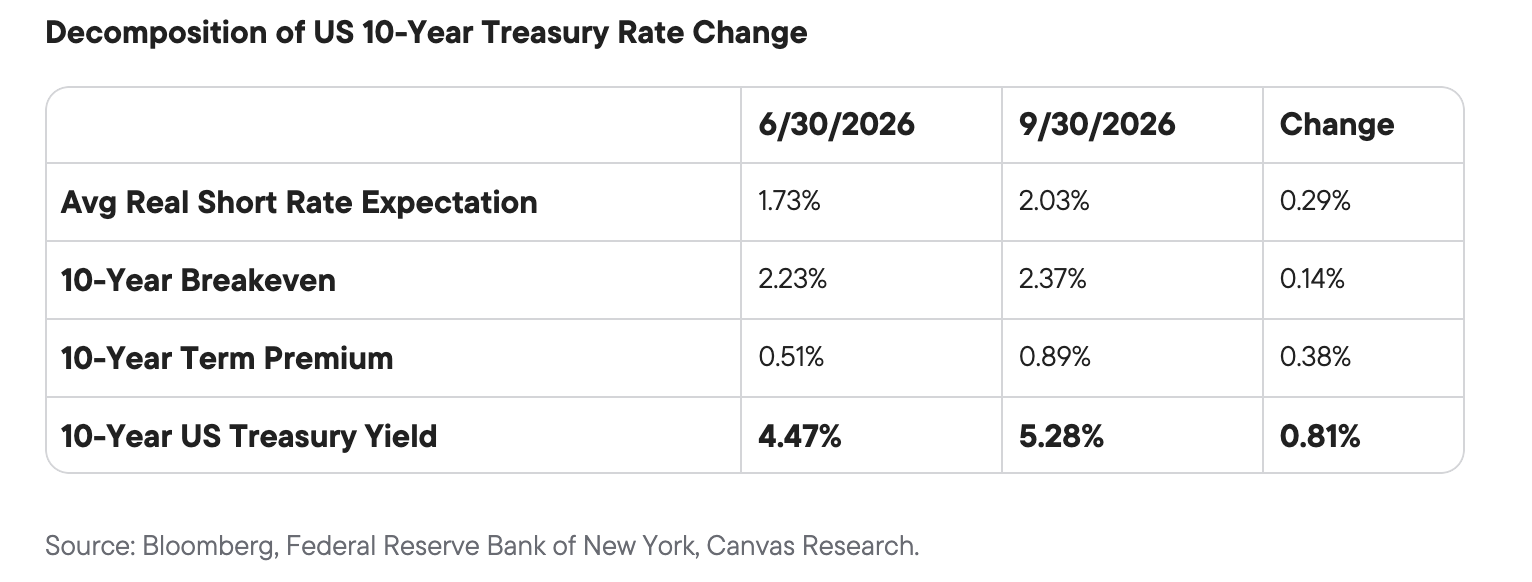
The move was not driven by a rise in inflation expectations beyond the short-term. Investors instead demanded a higher policy rate path and greater compensation for holding duration. This is consistent with a structurally higher rate regime.
Policymaker Purgatory
At this point policymakers are somewhat stuck. The lean towards deglobalization, geopolitical conflict, and the decline of energy stability are trends which monetary policy cannot address. The recent rise in oil, other commodities, and global bond yields is emblematic of this paradox.
Easing to support growth and asset values risks inflation, a weaker dollar, and potential capital misallocation. Tightening would restrain demand but do nothing to increase oil supply, electric capacity, or advanced semiconductor production. Doing nothing leaves the market to its own devices in determining the cost of capital.
The problem is that many of today’s economic constraints are real-economy constraints (energy, compute, infrastructure, and industrial capacity) that monetary policy cannot manufacture. These structural issues fall to fiscal authorities; however, they are constrained by the albatross of exorbitant and growing fiscal deficits.
One avenue where we do expect to see some activity in the coming years is on the regulatory front. The Fed and Treasury have macroprudential20 powers that could be used to relax the regulatory environment, a structural de facto easing that does not require congressional approval.
What It Means for Portfolios
Index calm does not equal low risk. Low correlations are suppressing index volatility while stock and manager dispersion remains elevated. That increases manager selection risk but also stock-selection and tax-management opportunity.
AI risk is shifting from valuation to execution. Investors should increasingly discriminate based on differences in balance sheets, cash generation, capital intensity, and returns on incremental investment rather than simply asking whether or not the AI trade is “expensive.”
Capital has a price again. Higher yields and greater competition for savings raise the hurdle rate21 for corporate projects and risky financial assets. That should favor disciplined capital allocation, broaden the opportunity set beyond mega-cap growth, and increase the value of diversification.
None of this requires investors to predict the next correction. Climbing the wall of worry is what equity markets do best and that has certainly rung true in 2026 thus far. Equity indexes may remain steady as the tectonic plates shift below the surface. But the combination of greater dispersion, a more capital-intensive AI ecosystem, and a higher cost of capital raises the importance of diversification, security selection, tax management, and disciplined capital allocation. In that sense, steady as she goes does not mean standing still.
Ehren Stanhope, Co-Head of Investment Management
Endnotes
1. S&P 500 Index: An index of 500 leading U.S. companies widely used as a measure of large-cap U.S. equity market performance.
2. MSCI World ex USA Index 0.89% and MSCI Emerging Markets Index -0.37%. These indexes measure large- and mid-cap stocks in developed markets outside the U.S. and in emerging markets, respectively.
3. Russell 2000® Index: An index of approximately 2,000 U.S. small-cap stocks designed to represent the small-cap segment of the U.S. equity market.
4. See our recent paper “The Hidden Momentum Reversal” for a deep dive.
5. It was widely reported that Leopold Aschenbrenner’s Situational Awareness hedge fund faced large drawdowns and collateral calls in July 2026.
6. Canvas Research as of 9/30/2026.
7. Tracking error: A measure of how closely a portfolio’s returns follow its benchmark, expressed as the standard deviation of the return differences.
8. Russell 1000® Index: An index of approximately 1,000 of the largest U.S. stocks designed to represent the large-cap segment of the U.S. equity market. Investors cannot invest directly in an index, and unmanaged index returns do not reflect any fees, expenses or sales charges.
9. Capital Expenditures (CapEx): Spending by a company to acquire, build or improve long-term assets such as property, equipment and infrastructure.
10. Our AI ecosystem classification includes companies with material exposure to compute infrastructure, AI enablement, automation or AI-driven disruption; the ten largest constituents, weighted by market capitalization, are Nvidia, Apple, Alphabet, Microsoft, Amazon, Broadcom, Meta Platforms, Micron Technology, Advanced Micro Devices, and Intel. The ex-AI group are all U.S. large capitalization stocks not in the AI group. It should be noted that this group was established with the benefit of hindsight and does not represent an investable index.
11. Free cash flow yield is defined as operating cash flow minus capital expenditures divided by price.
12. Earnings Per Share (EPS): A company’s earnings available to common shareholders divided by its number of shares outstanding.
13. Forward price-to-earnings (P/E) ratio: Share price divided by analysts’ estimated earnings per share for the next 12 months.
14. Microsoft and OpenAI joint announcement, October 28, 2025.
15. Generally Accepted Accounting Principles (GAAP): The standard accounting rules U.S. companies use for financial reporting.
16. Global Financial Crisis (GFC): The period of severe financial market stress and economic contraction from 2007 to 2009.
17. Gross Domestic Product (GDP): The value of final goods and services produced within a country over a specified period.
18. The obvious exception being the inflationary spike of 2021-2022 during the pandemic.
19. Federal funds rate: The overnight rate at which U.S. banks lend reserves to one another; the Federal Reserve sets its target range.
20. Macroprudential powers: Regulatory tools, such as bank capital and liquidity requirements, aimed at risks to the financial system as a whole.
21. Hurdle rate: The minimum rate of return a company or investor requires before committing capital to a project or investment.
WHAT ARE THE RISKS?
All investments involve risks, including possible loss of principal.
Tax management practices may impact performance, portfolio characteristics and holdings; and may not result in favorable outcomes.
Small- and mid-cap stocks involve greater risks and volatility than large-cap stocks.
Important Information
This material is intended to be of general interest only and should not be construed as individual investment advice or a recommendation or solicitation to buy, sell or hold any security or to adopt any investment strategy. It does not constitute legal or tax advice. This material may not be reproduced, distributed or published without prior written permission from Franklin Templeton.
The views expressed are those of the investment manager and the comments, opinions and analyses are rendered as at publication date and may change without notice. The underlying assumptions and these views are subject to change based on market and other conditions and may differ from other portfolio managers or of the firm as a whole. The information provided in this material is not intended as a complete analysis of every material fact regarding any country, region or market. There is no assurance that any prediction, projection or forecast on the economy, stock market, bond market or the economic trends of the markets will be realized. The value of investments and the income from them can go down as well as up and you may not get back the full amount that you invested. Past performance is not necessarily indicative nor a guarantee of future performance. All investments involve risks, including possible loss of principal.
Any research and analysis contained in this material has been procured by Franklin Templeton for its own purposes and may be acted upon in that connection and, as such, is provided to you incidentally. Data from third party sources may have been used in the preparation of this material and Franklin Templeton ("FT") has not independently verified, validated or audited such data. Although information has been obtained from sources that Franklin Templeton believes to be reliable, no guarantee can be given as to its accuracy and such information may be incomplete or condensed and may be subject to change at any time without notice. The mention of any individual securities should neither constitute nor be construed as a recommendation to purchase, hold or sell any securities, and the information provided regarding such individual securities (if any) is not a sufficient basis upon which to make an investment decision. FT accepts no liability whatsoever for any loss arising from use of this information and reliance upon the comments, opinions and analyses in the material is at the sole discretion of the user.
Franklin Templeton has environmental, social and governance (ESG) capabilities; however, not all strategies or products for a strategy consider “ESG” as part of their investment process.
Products, services and information may not be available in all jurisdictions and are offered outside the U.S. by other FT affiliates and/or their distributors as local laws and regulation permits. Please consult your own financial professional or Franklin Templeton institutional contact for further information on availability of products and services in your jurisdiction.
Issued in the U.S. by Franklin Templeton, One Franklin Parkway, San Mateo, California 94403-1906, (800) DIAL BEN/342-5236, franklintempleton.com. Investments are not FDIC insured; may lose value; and are not bank guaranteed.
You need Adobe Acrobat Reader to view and print PDF documents. Download a free version from Adobe's website.
CFA® and Chartered Financial Analyst® are trademarks owned by CFA Institute.
A message from Advisor Perspectives and VettaFi: Discover something new! Click here to register for our upcoming webcasts.
Membership required
Membership is now required to use this feature. To learn more:
View Membership Benefits