Last week saw a further deterioration in the inflation outlook, while the Federal Reserve (Fed) appears increasingly reluctant to tighten again immediately. The September headline Consumer Price Index (CPI) rose 0.6% month/month (m/m) and 3.7% year/year (y/y), while core inflation increased 0.3% m/m and accelerated to 2.6% y/y from 2.4%. Energy accounted for more than half the headline increase, but the underlying picture was not particularly reassuring: Shelter inflation accelerated to 0.4% m/m, while several services and goods categories also recorded increases. The more concerning signal came from the Producer Price Index (PPI), which surged 1.3% m/m and 6.3% y/y, its strongest monthly increase since March 2022. Although energy was the main driver, prices excluding food, energy and trade services rose 0.5%, while import prices increased another 1.1%. The risk is increasingly that elevated energy and input costs feed through into broader consumer inflation, rather than remaining a temporary headline shock.
The growth picture remains resilient, but the divergence between nominal spending and underlying consumer purchasing power is becoming more pronounced. September retail sales increased a stronger-than-expected 0.8% m/m, but excluding gasoline stations, sales rose only 0.2%. Higher prices are therefore accounting for a meaningful portion of the increase in spending. The latest Federal Reserve’s “Beige Book” report reinforced this divergence: Most districts reported little change in consumer spending, with growth increasingly concentrated among higher-income households. Meanwhile, real average hourly earnings are now down 0.7% y/y and stagnant for the past six months. This is worth watching because it suggests household purchasing power is weakening despite relatively healthy aggregate consumption. However, initial jobless claims remained exceptionally low at 199,000, indicating that the labor market continues to suffer more from weak hiring than rising layoffs.
See more: Consumer Price Index: Inflation at 3.7% in September
The industrial sector remains an important source of strength. September industrial production rose 0.7% m/m, exceeding expectations, although manufacturing output increased by a more modest 0.3%. Utilities production jumped 3.5%, consistent with continued strong electricity demand associated with artificial intelligence (AI) infrastructure investment. This reinforces the theme that AI-related investment continues to support economic activity, even as higher energy prices and interest rates weigh on other sectors. The expansion is therefore becoming more dependent on a relatively narrow set of growth drivers.
The Fed is facing a more difficult policy trade-off, but an October pause remains the most likely outcome. The latest inflation reports strengthen the argument for additional tightening, while softer payroll growth, weaker real earnings and uncertainty around the consumer argue against moving too quickly. Fed Chair Kevin Warsh offered little indication of the Fed's intentions during his October 16 remarks, reiterating his reluctance to provide forward guidance ahead of policy decisions. Markets ended the week assigning roughly an 85% probability to rates remaining unchanged on October 28, despite the upside inflation surprises. We retain our view that the Fed will pause later this month, while a December hike remains firmly in play. The more important question is whether the Fed can afford to remain patient if higher input costs continue passing through into consumer prices. The September Beige Book offered little reassurance on that front, with four districts reporting an acceleration in price increases and firms anticipating further increases as existing contracts expire.
Despite the upside inflation surprises and another deterioration in the fiscal outlook, the sharp selloff in AI-related equities triggered substantial safe-haven demand for Treasuries. The Financial Times reported that America's unprecedented AI infrastructure expansion is encountering increasingly serious financial and operational constraints. At least 47 major projects have been delayed, withdrawn or blocked in 2026, while Bernstein research analysts estimate that only 35% of the announced US data-center pipeline should be treated as credible. Higher interest rates and weakening investor confidence are making financing more difficult for AI infrastructure developers, while electricity constraints, construction delays and local opposition are creating additional obstacles. While this does not yet imply that the AI investment cycle is reversing, it does introduce a new risk to both growth and financial markets. The same investment boom supporting US economic outperformance could become a source of vulnerability if financing conditions tighten further.
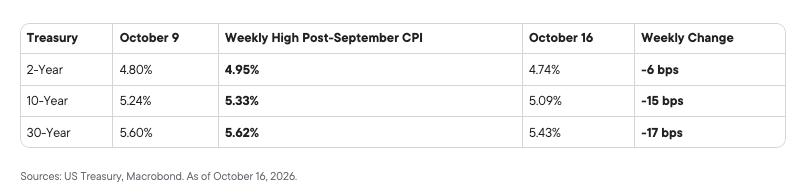
Growing concerns about the sustainability of AI-related investment sparked demand for duration (table below), with the 2-year and 10-year curves flattening by 9 basis points (bps). The rally was driven predominantly by declining real yields (10-year real yields fell 17 bps to 2.74%) rather than a significant reassessment of inflation expectations. The rally was particularly notable given that the fiscal year 2026 deficit widened to US$1.99 trillion from US$1.78 trillion, with debt-service costs reaching a record US$1.36 trillion. While investors became more comfortable owning duration at elevated yields, particularly following the improvement in auction demand the week of October 5 and weaker risk sentiment last week, we remain cautious about extrapolating the rally given persistent inflation, heavy Treasury financing requirements and still-elevated term-premium risks.
The US dollar weakened modestly despite renewed risk aversion, with the US Dollar Index (DXY) declining from 102.21 on October 9 to approximately 101.84 on October 16. The dollar remains supported by elevated yields and relative US growth outperformance, although further declines in Treasury yields and weaker risk sentiment could limit the upside. Tactical rallies may occur around inflation data releases or additional Fed tightening.
WHAT ARE THE RISKS?
All investments involve risks, including possible loss of principal.
Fixed income securities involve interest rate, credit, inflation and reinvestment risks and possible loss of principal. As interest rates rise, the value of fixed income securities falls. Low-rated, high-yield bonds are subject to greater price volatility, illiquidity and possibility of default.
Equity securities are subject to price fluctuation and possible loss of principal.
There is no assurance that any estimate, forecast or projection will be realized.
A message from Advisor Perspectives and VettaFi: Discover something new! Click here to register for our upcoming webcasts.
Important Information
This material is intended to be of general interest only and should not be construed as individual investment advice or a recommendation or solicitation to buy, sell or hold any security or to adopt any investment strategy. It does not constitute legal or tax advice. This material may not be reproduced, distributed or published without prior written permission from Franklin Templeton.
The views expressed are those of the investment manager and the comments, opinions and analyses are rendered as at publication date and may change without notice. The underlying assumptions and these views are subject to change based on market and other conditions and may differ from other portfolio managers or of the firm as a whole. The information provided in this material is not intended as a complete analysis of every material fact regarding any country, region or market. There is no assurance that any prediction, projection or forecast on the economy, stock market, bond market or the economic trends of the markets will be realized. The value of investments and the income from them can go down as well as up and you may not get back the full amount that you invested. Past performance is not necessarily indicative nor a guarantee of future performance. All investments involve risks, including possible loss of principal.
Any research and analysis contained in this material has been procured by Franklin Templeton for its own purposes and may be acted upon in that connection and, as such, is provided to you incidentally. Data from third party sources may have been used in the preparation of this material and Franklin Templeton ("FT") has not independently verified, validated or audited such data. Although information has been obtained from sources that Franklin Templeton believes to be reliable, no guarantee can be given as to its accuracy and such information may be incomplete or condensed and may be subject to change at any time without notice. The mention of any individual securities should neither constitute nor be construed as a recommendation to purchase, hold or sell any securities, and the information provided regarding such individual securities (if any) is not a sufficient basis upon which to make an investment decision. FT accepts no liability whatsoever for any loss arising from use of this information and reliance upon the comments, opinions and analyses in the material is at the sole discretion of the user.
Franklin Templeton has environmental, social and governance (ESG) capabilities; however, not all strategies or products for a strategy consider “ESG” as part of their investment process.
Products, services and information may not be available in all jurisdictions and are offered outside the U.S. by other FT affiliates and/or their distributors as local laws and regulation permits. Please consult your own financial professional or Franklin Templeton institutional contact for further information on availability of products and services in your jurisdiction.
Issued in the U.S. by Franklin Templeton, One Franklin Parkway, San Mateo, California 94403-1906, (800) DIAL BEN/342-5236, franklintempleton.com. Investments are not FDIC insured; may lose value; and are not bank guaranteed.
You need Adobe Acrobat Reader to view and print PDF documents. Download a free version from Adobe's website.
CFA® and Chartered Financial Analyst® are trademarks owned by CFA Institute.
© Franklin Templeton
More Fintech Topics >