Key takeaways
-
After tightening over the summer, software loan spreads have widened again recently, underscoring that clear risks remain. And while spreads are off their year-to-date wides, the valuation gap versus the broader loan market remains significant.
-
The impact of AI hangs over the sector. The AI disruption narrative that catalyzed this year’s sell-off in software loans remains unchanged. While a small group of issuers does appear well-positioned to benefit from AI, many still face uncertain competitive situations, and a growing share contend with business model and execution risks.
-
Maturity relief is available, but not always at favorable prices. For many issuers, refinancing costs remain prohibitively expensive given wide spread levels and a still-elevated base rate.
-
Dispersion will likely remain elevated, as the narrative behind the sector’s relative underperformance has not materially changed. A small group of issuers does appear well-positioned to benefit from the democratization of AI, while a much larger group of issuers continues to face uncertain competitive implications.
This year, the software sector has been one of the worst-performing pockets of the leveraged loan market amid fears that AI would severely disrupt existing business models. The sector’s underperformance has also weighed on the leveraged loan asset class as a whole, given its more than 10% weight in the overall Morningstar LSTA US Leveraged Loan Index.
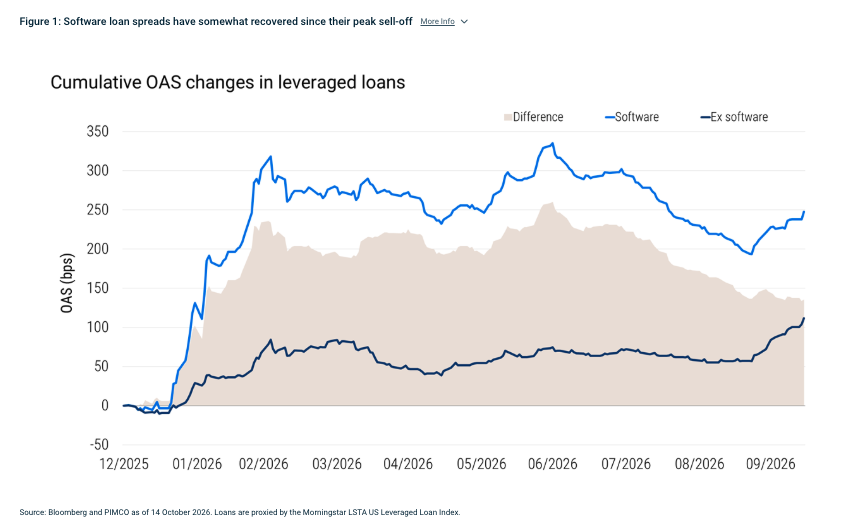
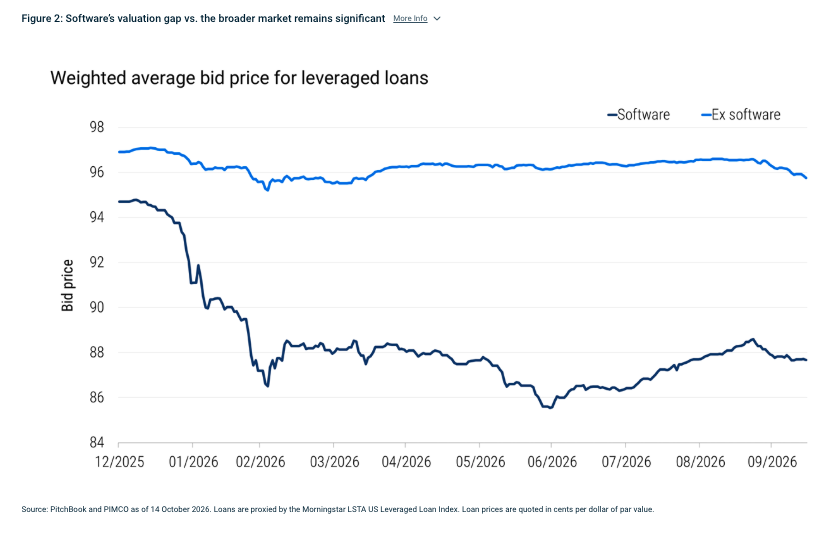
Software loan spreads tightened over the summer, retracing about one-third of this year’s widening and moving roughly 100 basis points (bps) inside their June wides (see Figure 1). That improvement has partially reversed, however, with spreads widening again since early September. The recovery therefore remains incomplete. The average bid price for software loans is still about 8 points (i.e., 8 cents on the dollar) below that of non-software peers, compared with roughly 10 points in June (see Figure 2).
-
After tightening over the summer, software loan spreads have widened again recently, underscoring that clear risks remain. And while spreads are off their year-to-date wides, the valuation gap versus the broader loan market remains significant.
-
The impact of AI hangs over the sector. The AI disruption narrative that catalyzed this year’s sell-off in software loans remains unchanged. While a small group of issuers does appear well-positioned to benefit from AI, many still face uncertain competitive situations, and a growing share contend with business model and execution risks.
-
Maturity relief is available, but not always at favorable prices. For many issuers, refinancing costs remain prohibitively expensive given wide spread levels and a still-elevated base rate.
-
Dispersion will likely remain elevated, as the narrative behind the sector’s relative underperformance has not materially changed. A small group of issuers does appear well-positioned to benefit from the democratization of AI, while a much larger group of issuers continues to face uncertain competitive implications.
This year, the software sector has been one of the worst-performing pockets of the leveraged loan market amid fears that AI would severely disrupt existing business models. The sector’s underperformance has also weighed on the leveraged loan asset class as a whole, given its more than 10% weight in the overall Morningstar LSTA US Leveraged Loan Index.
Software loan spreads tightened over the summer, retracing about one-third of this year’s widening and moving roughly 100 basis points (bps) inside their June wides (see Figure 1). That improvement has partially reversed, however, with spreads widening again since early September. The recovery therefore remains incomplete. The average bid price for software loans is still about 8 points (i.e., 8 cents on the dollar) below that of non-software peers, compared with roughly 10 points in June (see Figure 2).
Looking ahead, AI disruption risk and elevated refinancing costs are likely to keep the software sector’s valuation gap versus the broader loan market material. Uneven exposure to these pressures should also sustain elevated dispersion across issuers.
See more: Who Owns Your Marketing Process?
Software equity, software loans: two very different stories
While the spread tightening in software-related loan spreads over the summer appears to be correlated with the broader recovery in software equities, we believe there’s no real causal relationship between the two, and investors shouldn’t take any further recovery in equities as a sign of relief for software loan issuers more broadly.
The reason is that the two universes are vastly different. Some of the largest software firms in the equity market are not only direct AI-related investments, but also investment grade firms with much broader access to public capital markets and other forms of financing, at much lower rates than their leveraged loan peers who don’t enjoy the same kind of financial flexibility.
Key risks still challenge software lending
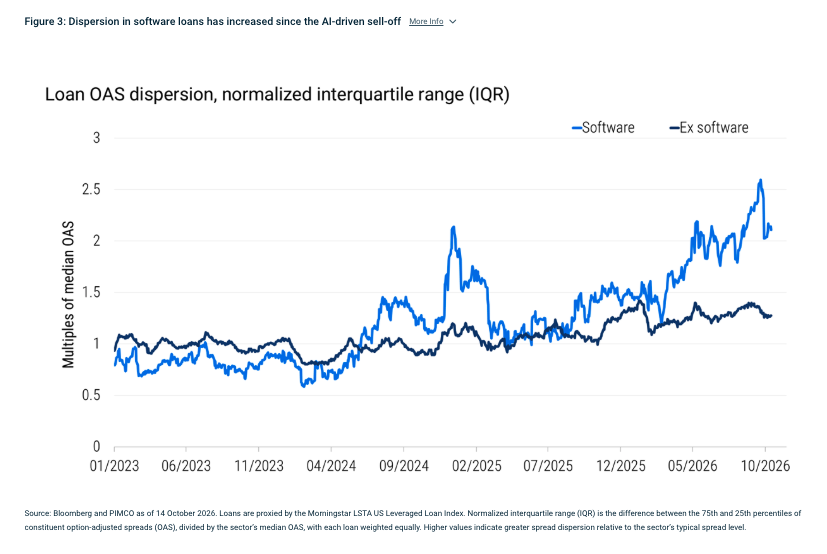
Loan investors watching this year’s trends are naturally wondering where spreads could go from here. The underlying narrative that catalyzed the sector’s relative underperformance hasn’t materially changed. A small group of issuers does appear well-positioned to benefit from the democratization of AI, as the technology’s rapid expansion rewards some software innovation. However, a much larger group of issuers faces uncertain competitive implications. Dispersion within the sector is therefore likely to remain elevated relative to last year – and also higher than in the broader loan market (see Figure 3).
Some issuers turn to refinancing, but at what cost?
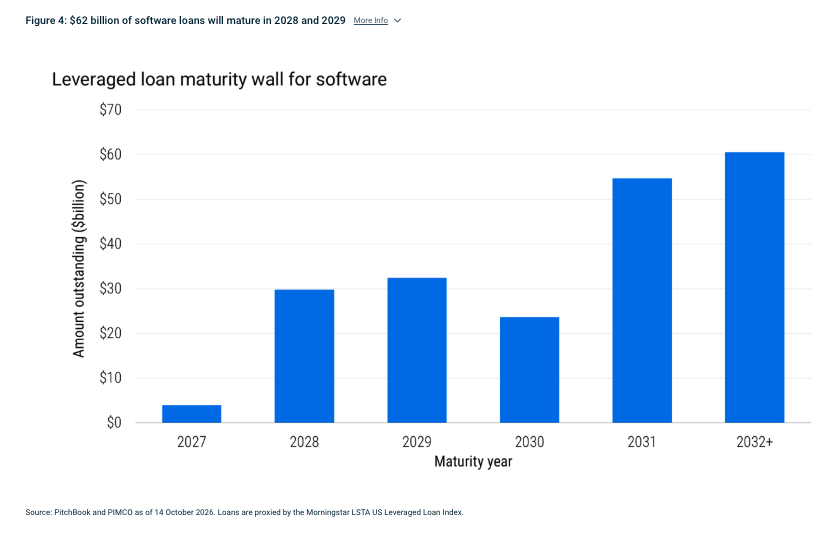
Against that backdrop, the path of least resistance remains liability management exercises (LMEs). LMEs are agreements that let issuers restructure debt in various ways, such as extending maturities or refinancing. About $62 billion of software loans are maturing in 2028 and 2029 (see Figure 4). Gaining access to attractive refinancing could matter almost as much to these issuers as navigating AI-related risks to their business models.
Recent amend-and-extend transactions show that financing options are available, but at sharply different costs depending on the issuer and situation. Some issuers that recently extended maturities were able to tap the market for just a 25-bp increase in their spread over the overnight (baseline) rate, according to PitchBook reports. Others, however, faced a spread increase of 150 bps over previous levels and had to accept a discount on their issue price, placing it below par. That range highlights how differently the market is pricing issuers based on perceived quality and resilience to AI disruption.
The takeaway is that maturity relief is available, but not always cheaply. Even after the recent rally, refinancing costs remain prohibitively expensive for many issuers relative to the borrowing costs put in place during the low-rate era.
We believe that for weaker credits, spread compression has improved the optics more than the economics. The software loan market appears to be increasingly defined by winners, losers, and wider dispersion. Until the disruptive effects of AI on software-related loan issuers become clearer, choices made during the low-interest-rate regime of yesterday are likely to drive further differentiation within the sector tomorrow.
Michael Puempel and Gabriel Cazaubieilh contributed to this report.
Disclosures
Statements concerning financial market trends or portfolio strategies are based on current market conditions, which will fluctuate. Outlook and strategies are subject to change without notice.
Past performance is not a guarantee or a reliable indicator of future results. Forecasts, estimates and certain information contained herein are based upon proprietary research and should not be considered as investment advice. There is no guarantee that stated results will be achieved.
All Investments contain risk and may lose value. Investments with exposure to the artificial intelligence sector may involve heightened risks, including rapid technological change, competitive disruption, elevated valuations, regulatory uncertainty, data privacy and cybersecurity concerns, infrastructure dependencies, and reliance on third-party models or platforms. AI-related opportunities may not develop as expected, fail to produce anticipated productivity or revenue benefits, or be concentrated among a limited number of issuers, and could result in increased volatility or loss of capital. Broadly syndicated loans involve interest rate and market risk, credit risk, default risk, liquidity, structural and legal risks. The current regulatory climate is uncertain and rapidly evolving, and future developments could adversely affect the technology and AI sector.
References to specific securities and their issuers are not intended and should not be interpreted as recommendations to purchase, sell or hold such securities. It is not possible to invest directly in an unmanaged index.
PIMCO as a general matter provides services to qualified institutions, financial intermediaries and institutional investors. Individual investors should contact their own financial professional to determine the most appropriate investment options for their financial situation. This material contains the opinions of the author and such opinions are subject to change without notice. This material has been distributed for informational purposes only and should not be considered as investment advice or a recommendation of any particular security, strategy or investment product. Information contained herein has been obtained from sources believed to be reliable, but not guaranteed. No part of this material may be reproduced in any form, or referred to in any other publication, without express written permission. PIMCO is a trademark of Allianz Asset Management of America LLC in the United States and throughout the world.
CMR2026-1016-6030635
A message from Advisor Perspectives and VettaFi: Discover something new! Click here to register for our upcoming webcasts.
© PIMCO
More Alternative Investments Topics >