While don’t think of myself as being old, I can’t call myself young anymore. When I go to the gym, it takes me longer to stretch than to work out. People my age debate the best vitamin supplements, not the best burger joints. When I am asked for identification at the market, it isn’t to confirm I am old enough to buy beer; it’s to see whether I am eligible for a senior discount.
Signs of aging aren’t confined to my personal life. We see them everywhere: populations in many of the world’s largest markets are collectively getting older, a trend that will have a tremendous influence on economic performance in the years ahead.
It’s not as if the challenges of collective aging are just now becoming apparent. Even as the baby boomers were entering their peak productive years in the 1980s, demographers were warning about the challenges that such a large generation would present decades later. Of the many variables that bear on the outlook, demographic factors are among the most predictable.
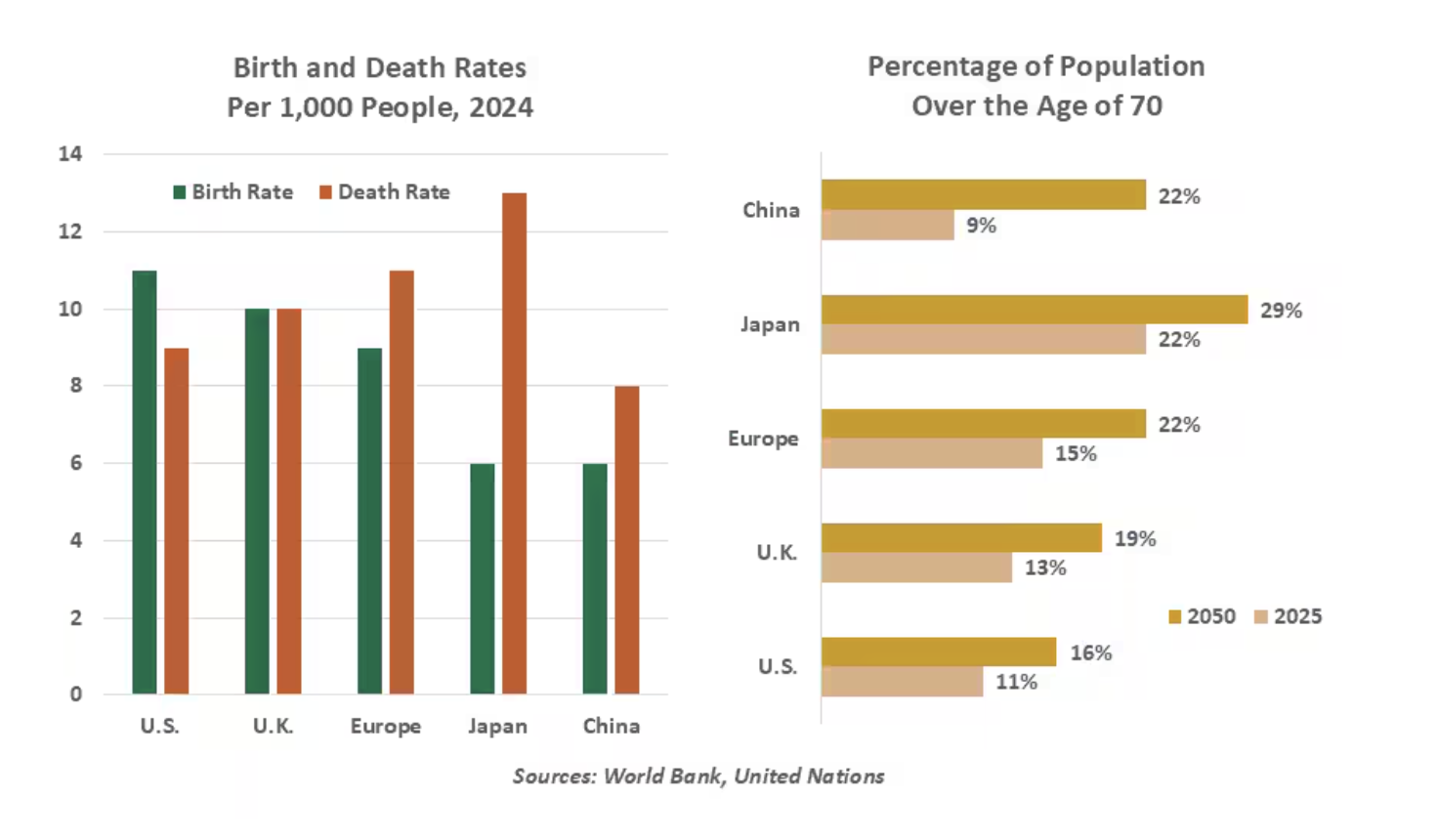
The emerging demographic deficit in America, Europe, and Asia is the product of basic economics. Studies of international data across time and place reveal that richer countries have lower birth rates. This might initially seem counter-intuitive, as wealthier families can theoretically afford to have more children. But the opportunity cost of caring for kids (time taken away from work or leisure time) can be substantial, more so for parents with higher incomes and two-earner families.
In societies where children are expected to care for the elderly, fertility tends to be lower. The capacity for care is fixed, and must be split between generations. Studies have demonstrated slight increases in fertility for countries that have better systems for care-giving, but the availability of these programs is still very uneven.
Declines in fertility have coincided with rising fractions of populations which are above customary retirement ages. Labor forces in many countries are shrinking. Beyond the numbers, older populations are more risk averse, they are less entrepreneurial and innovative, and they adopt technology more slowly. All of these elements make it more difficult to sustain growth.
Newcomers have historically helped to fill in demographic gaps, but immigration has become a controversial topic in many parts of the world. Offshoring allows countries to tap into labor pools beyond their borders, but logistics and politics place limits on this practice.
Unable to sustain population numbers, countries have become desperate for productivity gains. This explains why much of the world is all in on artificial intelligence.
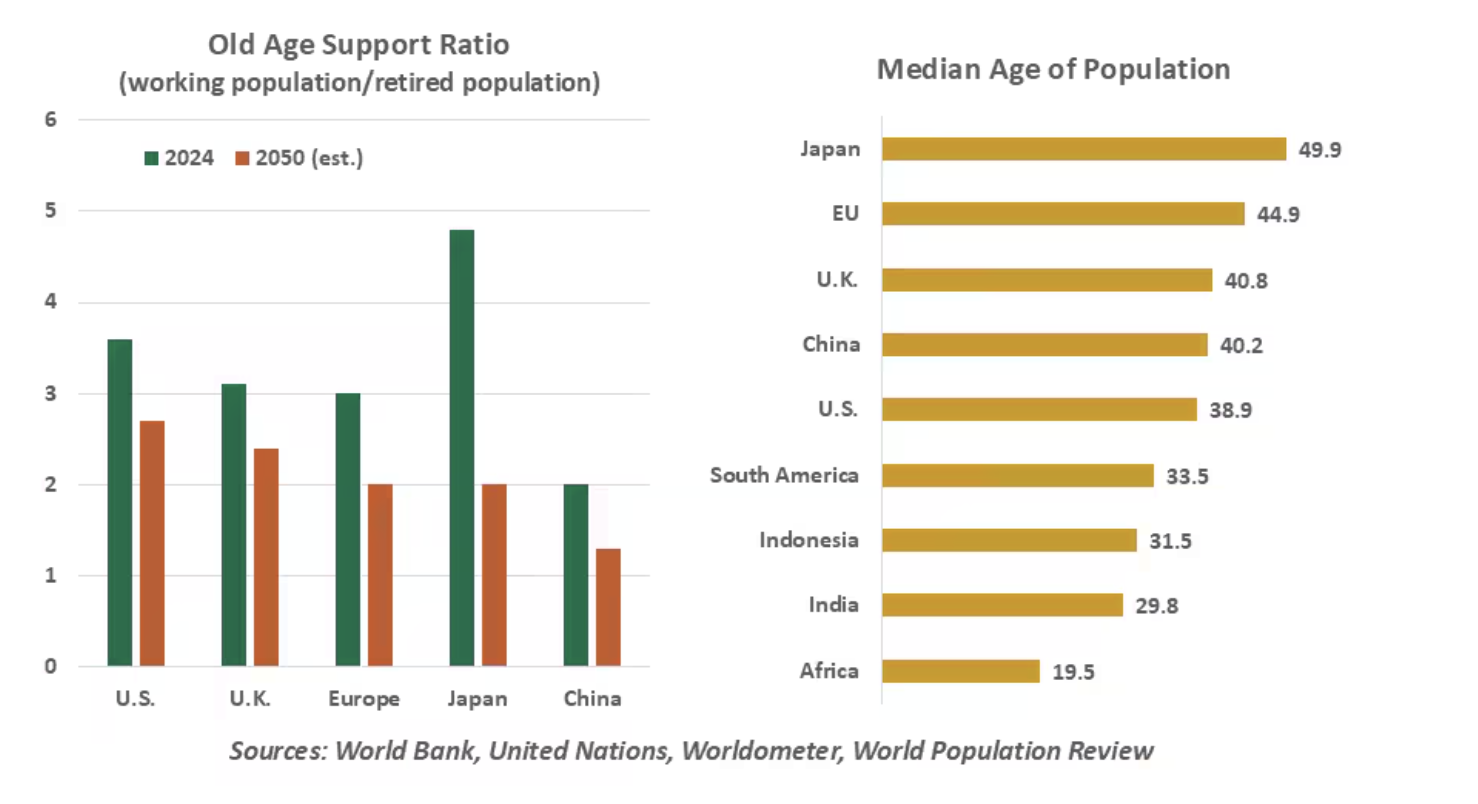
Aging populations are also placing heavier burdens on public finances. The ratio between those working and those retired is falling, meaning that “pay as you go” retirement systems like America’s Social Security program are facing prospective shortfalls. Increasing longevity means that pension payments will continue longer than previously, adding to future burdens. And public costs for retiree medical care are expected to rise rapidly in the years ahead.
Official retirement ages have risen in recent decades, but they have not kept pace with life expectancy. Proposals to extend working lifetimes meet with substantial political resistance, but failing to raise pension ages have been among the factors alarming bond investors. Europe is facing particular challenges on this front, with France an illustrative case study.
Addressing retirement system shortfalls will require new taxes, reductions in benefits or diversion of funds intended for other uses. None of these will be favorable for economic growth. A significant fraction of citizens will be heavily reliant on government benefits in retirement, which will make reform even more challenging. Older populations living on fixed incomes are more sensitive to tax increases, and they vote in far higher concentrations than younger cohorts. This will make fiscal policy debate more difficult at a time when government indebtedness is rising rapidly.
One clear solution to all of this would be for workers to remain in the labor force longer. And in fact, a trend in this direction has been underway for some time. As people are healthier at advanced ages and more commonly work with their minds than their backs, longer careers are within reach. This development could be extended with a stick (raising retirement ages) or a carrot (offering incentives to keep older workers in place).
In one sense, the population problem in developed markets is temporary. In the United States, the millennial generation is already larger than that of the baby boom, and projections suggest labor force growth will begin increasing again within the next ten years. The ratio of those working to those retired should eventually begin to recover, to the benefit of pension and health systems.
On a global basis, demographics don’t look as bad. There are a number of countries and regions that are younger, but they tend to be in areas of the world that are less well-developed. Without adequate investment in economic infrastructure, they will not realize their full potential. The global mismatch of population and opportunity will become more acute in the years ahead, potentially prompting the kind of disorderly migration that has been already been experienced episodically in Europe and the United States. The need for international coordination on population flows will be rising, just as the level of global collaboration declines.
The march of demographics may be slow, but it is sure. Unless we develop strategies to deal with the situation now, it will become much less manageable later. And now, if you will excuse me, it is time for my vitamins.
Carl Tannenbaum is the Chief Economist for Northern Trust.
Information is not intended to be and should not be construed as an offer, solicitation or recommendation with respect to any transaction and should not be treated as legal advice, investment advice or tax advice. Under no circumstances should you rely upon this information as a substitute for obtaining specific legal or tax advice from your own professional legal or tax advisors. Information is subject to change based on market or other conditions and is not intended to influence your investment decisions.
© 2026 Northern Trust Corporation. Head Office: 50 South La Salle Street, Chicago, Illinois 60603 U.S.A. Incorporated with limited liability in the U.S. Products and services provided by subsidiaries of Northern Trust Corporation may vary in different markets and are offered in accordance with local regulation. For legal and regulatory information about individual market offices, visit northerntrust.com/terms-and-conditions.
A message from Advisor Perspectives and VettaFi: Discover something new! Click here to register for our upcoming webcasts.
© Northern Trust
More Alternative Investments Topics >