Key takeaways
- Seven months into the U.S.–Iran conflict, few historical analogues have held. The trajectory of oil prices has been consistent with previous geopolitical shocks, but the market response elsewhere has looked strikingly different. U.S. Treasury yields have moved notably higher, for example, while credit spreads have remained remarkably resilient.
- Two factors help explain why this time is different. First, the U.S. economy is far less oil-intensive than it was during earlier energy shocks, reducing the macroeconomic drag from higher energy prices. Second, the AI capex cycle is helping stabilize growth expectations and support risk appetite.
- There are tentative signs of supply normalization. Recent reports suggest Persian Gulf crude oil exports may have recovered to roughly 80%–90% of pre-conflict levels. U.S. rig counts have also begun to rise, albeit gradually, as producers remain disciplined after the boom-and-bust cycles of prior decades.
- Nevertheless, we are not out of the woods. The recovery in crude exports is encouraging, but it only tells part of the story. Bottlenecks in refining and product markets remain challenging. More importantly, the geopolitical situation remains highly fluid, and a renewed disruption to energy markets could leave policymakers confronting slower growth alongside renewed inflation pressures.
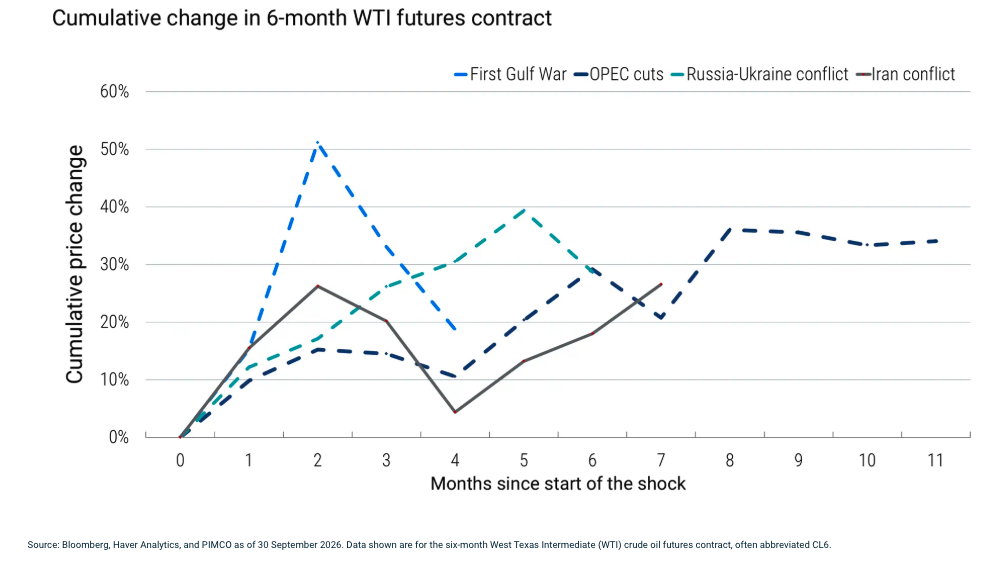
A full seven months into the conflict with Iran that catalyzed a global energy supply shock, energy markets remain the clearest source of uncertainty for risk assets. As shown in Figure 1, the six-month WTI contract is roughly 25% higher than it was at the end of February, following a trajectory broadly consistent with previous geopolitical oil shocks.
See more: What’s Behind the Move?
Figure 1: The oil market is behaving similarly to past supply shocks
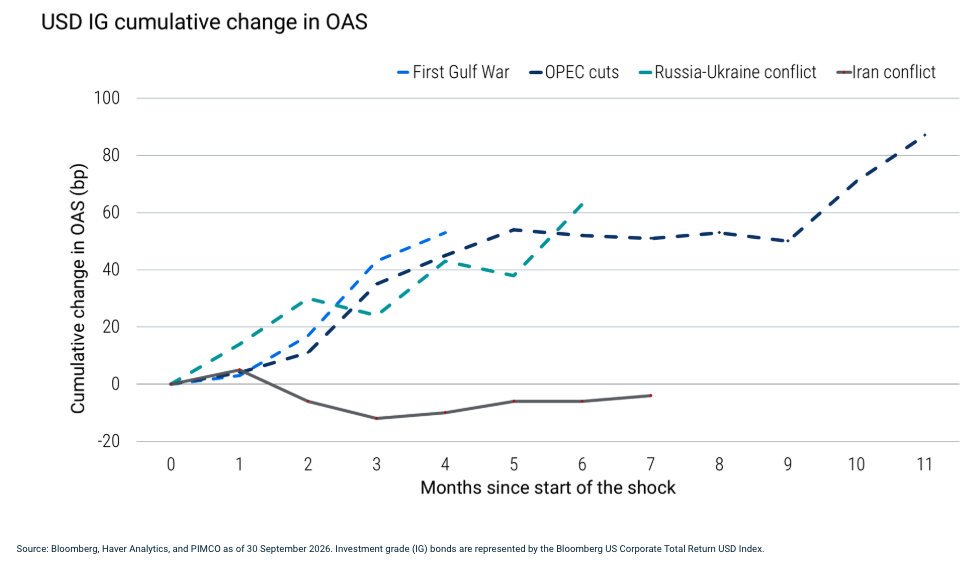
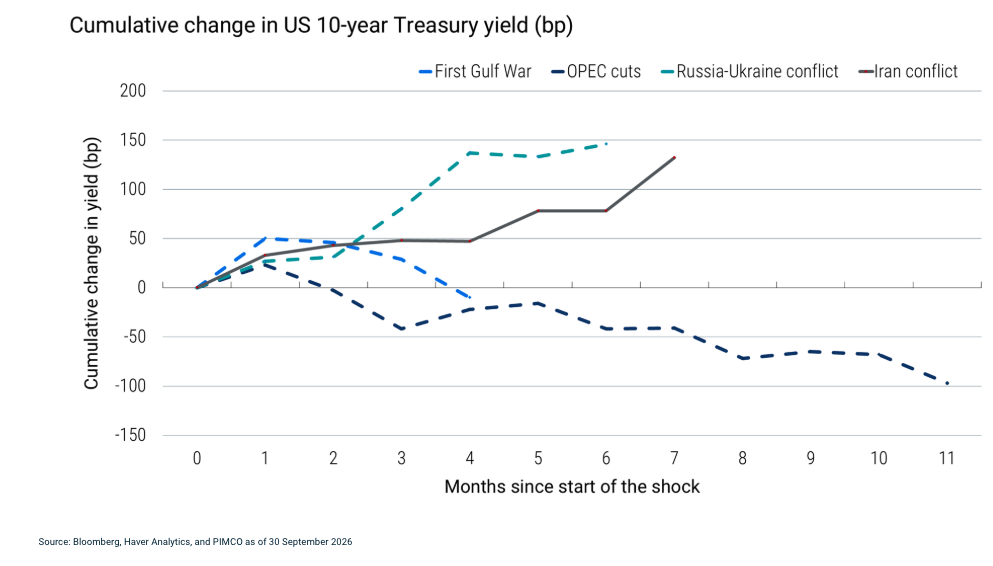
However, the performance of other asset classes has not followed the standard playbook of past supply shocks. Figure 2 shows that investment grade (IG) credit spreads remain effectively flat versus February levels. Figure 3 shows how U.S. Treasury yields have moved markedly higher in 2026, more closely tracking the 2022 Russia-Ukraine pattern than the one observed during the first Gulf War in 1991. Higher energy prices have led many investors to expect more central bank rate hikes – a key force behind higher real yields. For credit investors specifically, elevated Treasury yields are likely helping support demand via higher all-in yields despite tight spread levels.
Figure 2: U.S. investment grade credit spreads remain effectively flat versus levels prior to the Iran conflict
Figure 3: U.S. Treasury yields have been rising since the start of the Iran conflict
Although the move in rates during the onset of the Russia-Ukraine conflict in 2022 may seem like a useful prism through which to frame the current conflict, conventional macroeconomic thinking would suggest otherwise. Historically, energy supply shocks have tended to morph from inflation scares into growth scares, with investors ultimately seeking perceived safety and pushing yields lower (again, Figure 3).
The reason 2022 is an exception is its unique starting point. During the 2020 pandemic, policy rates in most countries were effectively cut to zero, central banks embarked on large-scale asset purchases that pushed down long-dated yields to multi-decade lows, and large fiscal packages to support aggregate demand ultimately met constrained supply chains and led to spiking inflation.
None of these conditions were the same at the outset of the current Iran conflict.
Why has this episode been different?
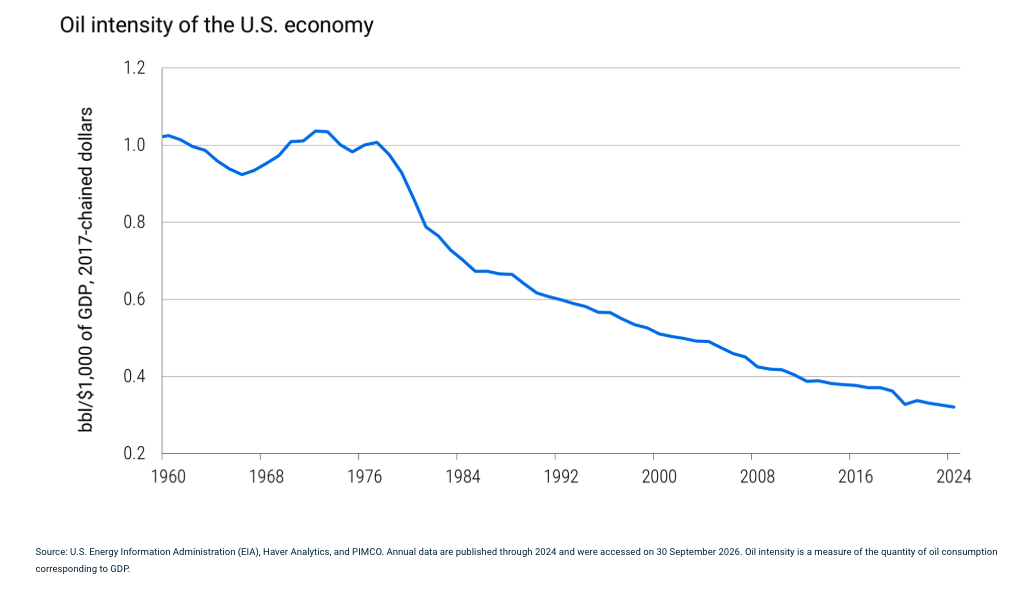
We see two main factors contributing to the resilience of the U.S. economy (thus far) in the face of this year’s energy shock. The first is the oil intensity of the economy. Figure 4 shows that since the 1980s, there has been a structural and persistent decline in the number of barrels of oil consumed for a given level of real U.S. GDP.
Figure 4: The oil intensity of the U.S. economy has been drifting structurally lower since the 1980s
For context, during the first Gulf War in 1991, the U.S. economy needed to use roughly twice the amount of oil compared with today for a commensurate level of GDP.
One way to conceptualize this is that over the past 50 years, the U.S. has transitioned from a manufacturing-based economy to a services-based one, which is mechanically less sensitive to oil as an input.
That isn’t to say the U.S. is impervious to energy price spikes. Rather, it implies that it would likely take a larger and more sustained energy shock for growth to deteriorate the way it did during episodes such as the first Gulf War.
The second factor is the AI investment cycle. Over the past several months, capex spending expectations linked to the AI ecosystem have consistently increased. AI hyperscaler capex alone will likely surpass $1 trillion in 2027, according to consensus analyst estimates compiled by Bloomberg.
This level of spending has helped stabilize growth expectations and also helps support risk appetite while potentially limiting the spillover from higher energy prices into broader risk assets.
Early signs suggest supply-side pressure may be easing somewhat
We also see some encouraging signs that oil flows from the Persian Gulf are starting to approach 2025 averages. According to commodities analysts, news reports, and data from satellite tracking services, exports in recent weeks may have reached 80%–90% of pre-Iran-conflict levels. That’s a striking estimate given the disruptions through the Straits of Hormuz and Bab al-Mandab. That said, inventories are still under pressure and risks to supply normalization remain elevated.
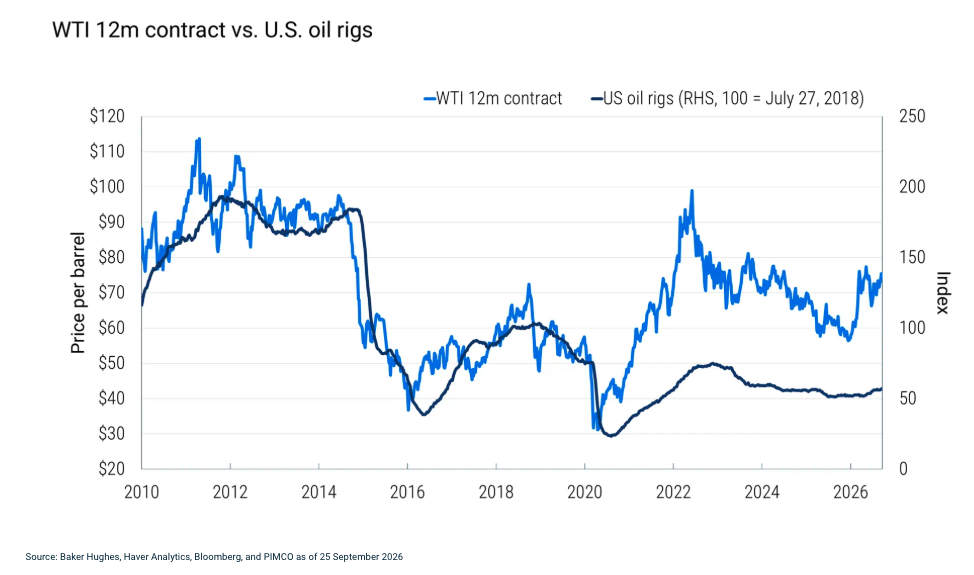
Moreover, increasing rig counts suggest U.S. oil production may be ramping up, albeit gradually: Data compiled by Baker Hughes shows that active U.S. rig counts have increased 10% so far this year and stand at around 600, similar to levels at the start of 2025 (see Figure 5). However, given the history of booms and busts in U.S. energy production, U.S.-based exploration and production (E&P) firms appear to be expanding more cautiously this time – they seem less reactive to the price of oil than in the years prior to the 2020 pandemic.
Figure 5: Active U.S. oil rig counts have increased slightly in 2026 year to date
Risks to monitor
Despite the economic resilience so far, the encouraging signs in Gulf oil transits, and our baseline forecast that energy prices could gradually decline in line with what’s priced into futures markets, the path forward has clear risks. Bottlenecks in refining and product markets remain real, and the transmission to the real economy occurs through diesel, jet fuel, and gasoline prices rather than crude alone. The near-normalization in crude flows has not eliminated the risk that higher energy costs weigh on consumer spending and broader economic activity.
More importantly, the geopolitical situation remains highly fluid. A renewed disruption to crude or refined product markets could push the growth-inflation mix in an unfriendly direction, leaving policymakers confronting slower growth alongside renewed inflation pressures.
Simply put, if the disruption to the oil and refined product supply chain persists, then growth expectations and risk assets will likely be increasingly exposed to the shock; this adjustment may simply take longer than in previous cycles. The current divergence from historical cross-asset relationships may not persist indefinitely.
Michael Puempel and Gabriel Cazaubieilh contributed to this report.
A message from Advisor Perspectives and VettaFi: Discover something new! Click here to register for our upcoming webcasts.
Disclosures
Past performance is not a guarantee or a reliable indicator of future results. Charts are provided for illustrative purposes and are not indicative of the past or future performance of any PIMCO product. References to specific securities and their issuers are not intended and should not be interpreted as recommendations to purchase, sell or hold such securities. It is not possible to invest directly in an unmanaged index.
Statements concerning financial market trends and portfolio strategies are based on current market conditions, which will fluctuate. Outlook and strategies are subject to change without notice. There can be no assurance that the trends mentioned will continue.
Energy sector and pipeline companies are subject to the risk of changes in the demand for and availability of products for gathering, transportation, processing or sale due to natural declines in reserves, sharp decreases in crude oil or natural gas prices that curtail production, and environmental regulation. Gathering and processing companies are subject to natural declines in the production of oil and natural gas fields, prolonged declines in the price of natural gas or crude oil, and declines in the prices of natural gas liquids and refined petroleum products. Commodities contain heightened risk, including market, political, regulatory and natural conditions, and may not be appropriate for all investors. Investing in the bond market is subject to risks, including market, interest rate, issuer, credit, inflation risk, and liquidity risk. Sovereign securities are generally backed by the issuing government.
Pacific Investment Management Company LLC (“PIMCO”) is an investment adviser registered with the U.S. Securities and Exchange Commission (“SEC”). PIMCO Investments LLC (“PIMCO Investments”) is a broker-dealer registered with the SEC and member of the Financial Industry Regulatory Authority, Inc. (“FINRA”). PIMCO and PIMCO Investments is solely responsible for its content. PIMCO Investments is the distributor of PIMCO investment products, and any PIMCO Content relating to those investment products is the sole responsibility of PIMCO Investments.
The information provided herein is not directed at any investor or category of investors and is provided solely as general information about our products and services and to otherwise provide general investment education. No information contained herein should be regarded as a suggestion to engage in or refrain from any investment-related course of action as none of PIMCO nor any of its affiliates is undertaking to provide investment advice, act as an adviser to any plan or entity subject to the Employee Retirement Income Security Act of 1974, as amended, individual retirement account or individual retirement annuity, or give advice in a fiduciary capacity with respect to the materials presented herein. If you are an individual retirement investor, contact your financial advisor or other fiduciary unrelated to PIMCO about whether any given investment idea, strategy, product or service described herein may be appropriate for your circumstances.
Check the background of this firm on FINRA's BrokerCheck.
Account Managers Compensation
PIMCO is a trademark of Allianz Asset Management of America LLC in the United States and throughout the world. ©2026 PIMCO. All Rights Reserved. Investment Products: NOT FDIC INSURED | MAY LOSE VALUE | NOT BANK GUARANTEED.
© PIMCO
More Factor-Based Investing Topics >