Summary
In this article, Russ Koesterich looks at the strong second-quarter earnings season and discusses why positioning mattered as much as fundamentals.
Key takeaways
- Second-quarter earnings were strong, particularly in technology, but crowded ownership often determined whether good news was rewarded.
- The selloff in semiconductors arguably reflected crowded positioning and concerns surrounding the sustainability of the earnings boom. The net result: multiples compressed while earnings revisions held up.
- AI is broadening into power, equipment, software and credit, creating more ways to invest and more ways for financing or infrastructure constraints to matter.
Markets rarely move in a straight line. Neither do earnings seasons.
On the numbers, the second quarter was strong, particularly for technology. But strong results were not always enough. Across global markets, many companies beat expectations, raised guidance and still sold off. In my view, this was mostly about positioning. Investors already owned a lot of the winners, and when selling pressure arrived, good earnings were not enough to protect crowded trades.
See more: World Markets Watchlist: September 21, 2026
A season in three parts
The season had three distinct phases.
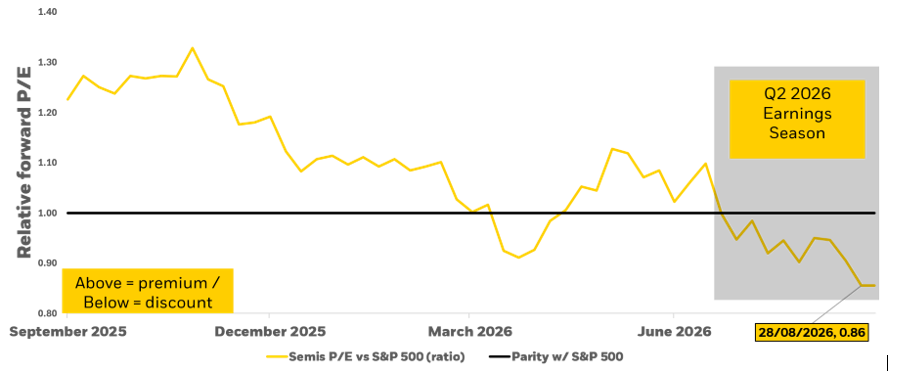
- First came the July selloff. The pressure was clearest in semiconductors, which briefly entered a technical bear market just as technology was posting the strongest earnings-estimate revisions of any sector (see Chart 1).
- Second came the early-August rebound. The biggest moves were not necessarily in the companies with the best earnings or cash-flow momentum. They were in the stocks that had been sold hardest, including out-of-favour software names.
- Then the market shifted again. After the early-August payroll report, investors paid more attention to rates and the health of the U.S. consumer. Rate-sensitive and consumer-facing stocks de-rated, even as the broader market held up.
That sequence matters. July was about crowded positioning and forced selling. Early August was about mean reversion. Later in the month, macro risk started to matter more.
Chart 1
Semiconductors: From Premium to Discount vs the S&P 500
AI broadens out
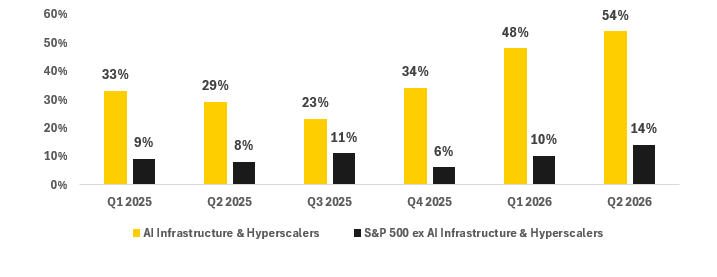
AI was still the season's strongest earnings engine. AI infrastructure and hyperscaler earnings grew 54% in the second quarter, versus 14% for the rest of the S&P 500, excluding energy. (See Chart 2)
But the story is no longer only about the biggest technology companies. Earnings momentum is spreading to the equipment, power and interconnect businesses needed to build and connect AI systems.
Further up the stack, the questions are getting tougher. Cloud demand and hyperscaler spending remain strong, but investors are now asking how the models will produce economic returns.
The application layer was better than feared. Software companies with proprietary data and products embedded in corporate workflows held up better, and cybersecurity continued to take a larger share of technology budgets.
The result is a more complicated AI trade. It now touches power, supply chains and credit, not just chips. Credit is becoming part of the story. AI compute is being financed through supplier balance sheets, revenue guarantees, borrowing by cloud providers and other forms of credit support. As chips become more available, the bottleneck is shifting toward electricity generation, grid capacity, interconnection and permitting.
Chart 2
S&P 500 ex Energy YoY EPS Growth
Looking beyond AI
AI dominated the headlines, but there were several signals outside technology. In Europe, the improvement was broader than one sector. Banks delivered better profitability, while defense companies benefited from full backlogs.
The consumer picture was mixed. Lower-income demand softened as fuel and essential spending took more of household budgets. Travel, housing-adjacent spending and premium experiences held up better.
Healthcare was also uneven. Patent-protected pharmaceutical companies continued to produce durable earnings, while medical technology depended more on execution and product cycles. GLP-1 drugs remain a long-term growth area, but they are also raising costs for managed-care companies and changing demand for some procedures.
The lesson: the right market or theme is not enough. Investors still need the right companies within it.
When bonds do not diversify
One other lesson from the quarter: portfolio construction is different.
The AI buildout is starting to impact fixed income. The debt required to finance it is arriving alongside heavy government borrowing, adding to bond supply. The result: investors are focused more on supply, both government and corporate. With both stock and bond investors increasingly focused on the AI buildout, stock-bond correlations are near 20-year highs, meaning government bonds are compounding rather than mitigating portfolio risk.
Energy has looked different, and has proved one of the few reliable hedges in the current environment. The sector has delivered genuine earnings momentum this season tied to higher commodity prices. At the same time, with markets responding negatively to rising prices, energy stocks have often bucked the broader market. As long as geopolitical risk constrains supply, energy can play a role that looks different from the broader equity cycle.
Price vs fundamentals
The second-quarter earnings season reinforced a simple point: price and fundamentals do not always move together. A strong company can fall because investors own too much of it. A weaker company can rebound because positioning has become too depressed. And a compelling long-term opportunity can become vulnerable when financing conditions tighten.
For investors, the message is constructive but selective. Earnings remain supportive, but the market is less willing to reward every beat. The opportunity is to respect short-term rotations without losing sight of the underlying earnings trend.
To obtain more information on the fund(s) including the Morningstar time period ratings and standardized average annual total returns as of the most recent calendar quarter and current month end, please click on the fund tile.
The Morningstar RatingTM for funds, or "star rating", is calculated for managed products (including mutual funds, variable annuity and variable life subaccounts, exchange-traded funds, closed-end funds, and separate accounts) with at least a three-year history. Exchange-traded funds and open-ended mutual funds are considered a single population for comparative purposes. It is calculated based on a Morningstar Risk-Adjusted Return measure (excluding any applicable sales charges) that accounts for variation in a managed product's monthly excess performance, placing more emphasis on downward variations and rewarding consistent performance. The top 10% of products in each product category receive 5 stars, the next 22.5% receive 4 stars, the next 35% receive 3 stars, the next 22.5% receive 2 stars, and the bottom 10% receive 1 star. The Overall Morningstar Rating for a managed product is derived from a weighted average of the performance figures associated with its three-, five-, and 10-year 60-119 months of total returns, and 50% 10-year rating/30% five-year rating/20% three-year rating for 120 or more months of total returns. While the 10-year overall star rating formula seems to give the most weight to the 10-year period, the most recent three-year period actually has the greatest impact because it is included in all three rating periods.
A message from Advisor Perspectives and VettaFi: Discover something new! Click here to register for our upcoming webcasts.
© BlackRock
More Retirement Income Topics >