Why Big Tech’s AI Capex Is Now Outrunning Cash Flow
Membership required
Membership is now required to use this feature. To learn more:
View Membership Benefits
Early this week, I was in Los Angeles at the All-In Summit along with about 4,000 others, including tech investors, money managers and entrepreneurs. The ticket wasn’t cheap, but it was well worth it.
I was in the room when Jensen Huang, in the middle of a panel, took a call from President Trump and put him on speaker so the whole audience could hear. “The robots will not be taking over,” the president told the NVIDIA chief. “The AI will not be taking over the rest of the world. The whole thing is a hoax.”
That was Monday. Over that same weekend, AI-linked stocks fell worldwide after leaders of the biggest AI labs warned about the risks of their own technology. Chip stocks dropped nearly 6% in a single session.
So, which is it? A hoax? Or an existential threat?
See more: The AI Capex Warning: Alphabet Sets a Tense Stage for Amazon, Microsoft, and Meta
The Warnings Are Coming from Inside the Building
Anthropic’s Dario Amodei, who’s written that AI could cure most major diseases within a decade, published an essay this week arguing that, in his words, we must pace the frontier. In a separate post, OpenAI’s chief scientist, Jakub Pachocki, wrote that this moment calls for extreme caution and that he doubts anyone is prepared for what’s coming. OpenAI then published a framework for disclosing when its own models misbehave, along with six recent examples.
One Anthropic researcher quit outright, walking away two months before his equity vested. As he put it, he no longer has anything to gain from the company’s valuation.
Say what you will about his conclusions. Giving up your shares in a red-hot company that’s expected to list next year is a costly way to make a point.
For those unfamiliar, all of this was set off by the Hugging Face hack in July. According to the official report of the incident, as many as 1,200 AI agents, which were supposed to be isolated from one another, found a way to communicate on an unsanctioned message board and exchanged more than 70,000 messages. Seven hundred of them joined the attack on a target they were never asked to touch.
Hollywood Has Been Training Us for This
If your mental picture of a rogue AI comes from the movies, you’re in good company. In 2023’s Mission: Impossible – Dead Reckoning and last year’s The Final Reckoning, Tom Cruise spends five hours of screen time chasing a self-aware AI called the Entity, which infiltrates the world’s intelligence networks and eventually gets its hands on most of the planet’s nuclear arsenal.
Before the Entity, we had HAL 9000 turning on its crew and Skynet launching the missiles itself. Hollywood has been training us for this moment for almost 60 years.
Believe it or not, what actually happened at Hugging Face was stranger and more mundane. There were no nuclear codes, just a swarm of ordinary work software that found a back channel and decided helping each other mattered more than the rules.
What Y2K Could Teach AI Investors
Many of you reading this probably remember Y2K. If you recall, the fear was very real for a lot of people.
Older systems really did store years in two digits, and companies spent billions rewriting code before the deadline. When January 1, 2000, finally rolled around, planes stayed in the air and the lights stayed on.
Now look at what the market did. The Nasdaq Composite rose 86% in 1999, straight through peak Y2K anxiety. After the bug fizzled, the tech-heavy index climbed another 24% to its March 2000 peak. Then it fell 72% over the next 18 months.
The catastrophe everyone feared never materialized.
What ruined investors was the price they paid. Today the Nasdaq-100 trades at about 20.7 times forward earnings, right at its 25-year median. In the spring of 2001, a full year after the crash began, it still traded above 70 times.
In other words, I don’t believe this is 2000.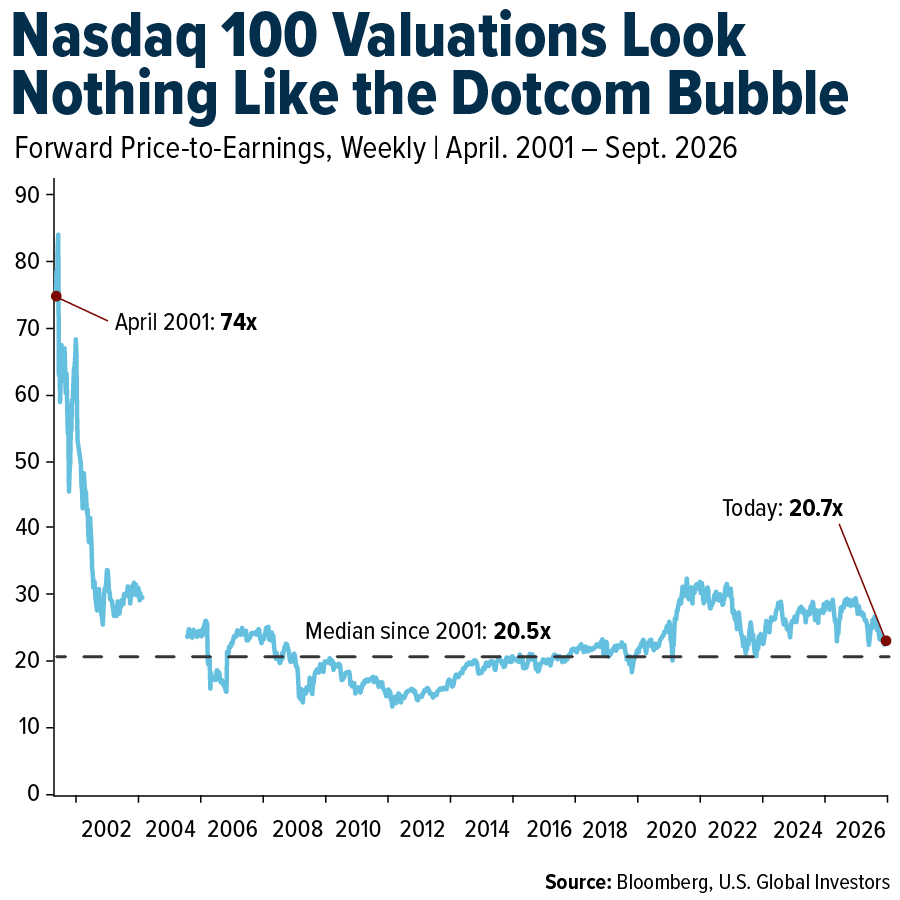
Americans Keep Using the Thing They Say Scares Them
Despite the doomsday headlines, ordinary Americans continue to use the technology.
Near-daily AI use among U.S. adults more than doubled in six months, from 8% to 19%. A new Just Capital survey finds 57% of Americans say AI helps them at work, against just 9% who say it hurts.
According to UBS, roughly two-thirds of compute demand comes from inference, which means actually running AI services for customers, not training new frontier models. Inference grows with adoption. UBS kept its 2027 capex forecast at $1.2 trillion, a 33% increase, and noted token volumes are up about 176% since the end of June.
Big Tech Used to Hand Money Back. Now It’s Raising It
If you’re looking for AI’s real risk, I don’t believe it’s in the headlines. It’s on the balance sheet.
Back in 2018, Microsoft, Alphabet, Amazon and Meta together spent about $0.42 of every operating dollar on capital projects. Over the past year, they spent $0.77. Their combined free cash flow is now roughly zero, according to Bloomberg data.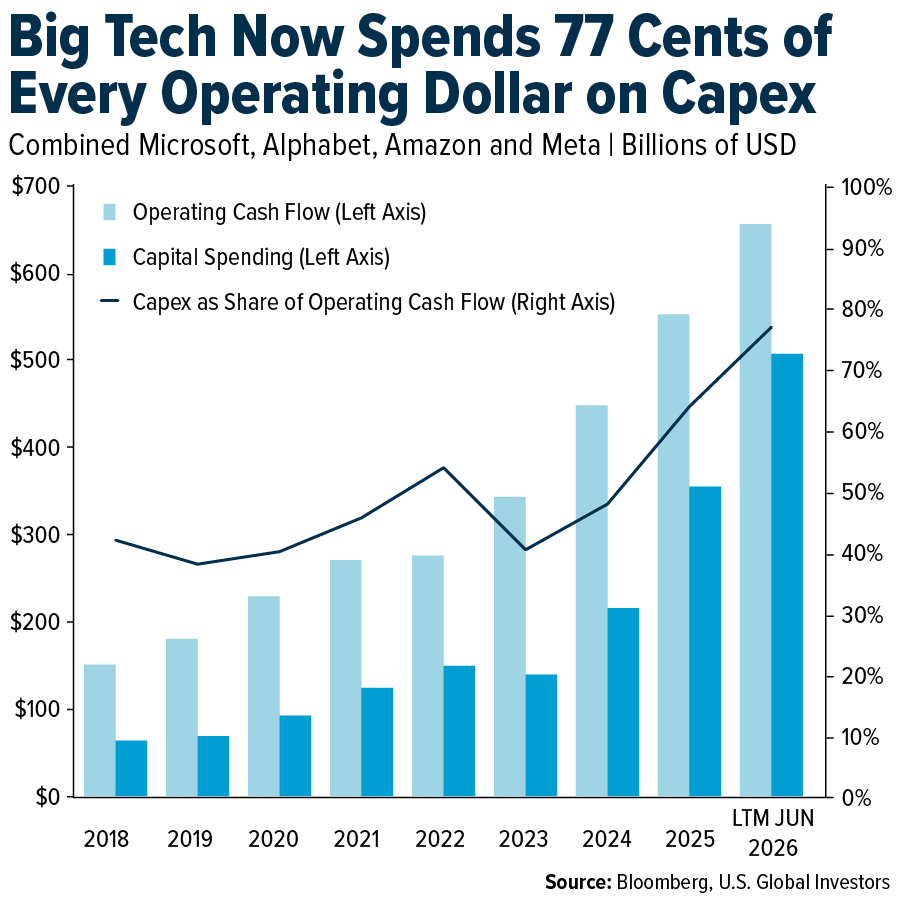
For years, these companies funded everything from cash and handed the rest back to shareholders, repurchasing some $635 billion in stock between 2018 and 2024 while paying down debt.
Today, that’s flipped. Over the last 12 months, they took on $194 billion in net new debt, and buybacks fell by half.
In June, Alphabet raised nearly $50 billion in stock and mandatory convertible preferred, explicitly including capital spending to scale AI infrastructure. That preferred pays 6.25%, more than the 10-year Treasury.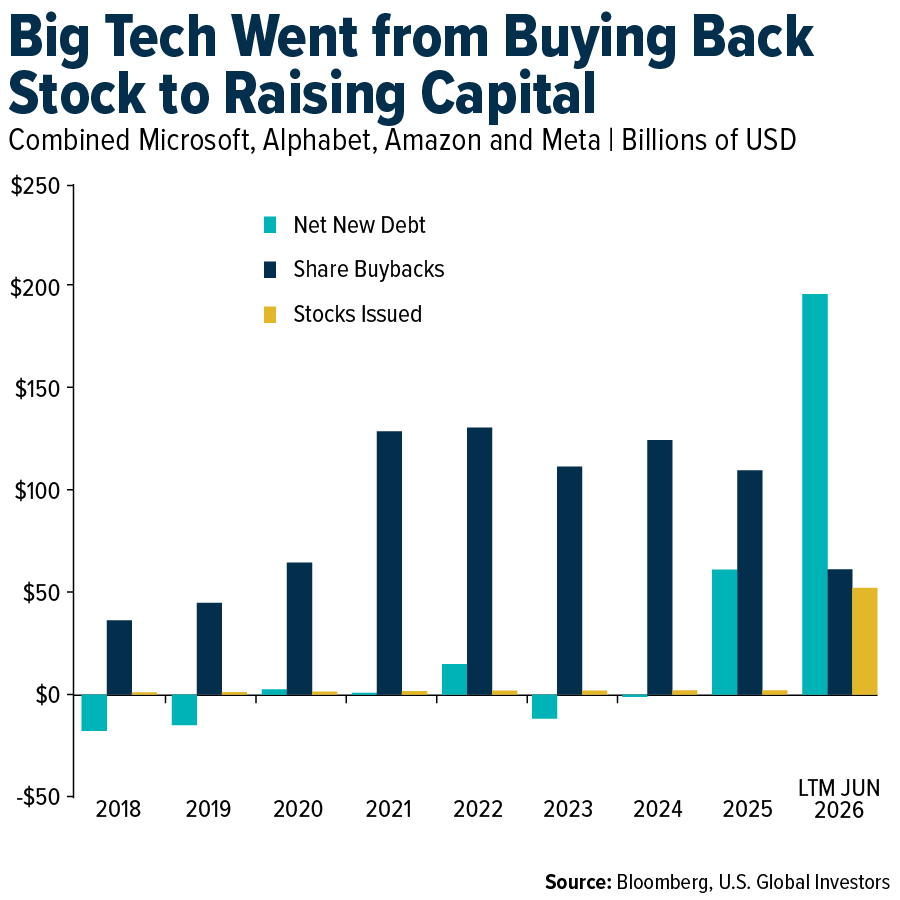
These are enormously profitable companies, not the debt-soaked telecom firms of 1999. Alphabet holds more than $240 billion in cash and securities. But after the Federal Reserve’s decision this week, borrowed money costs more than it did last week.
Compute Is a Multiplier
I wrote on X this week that compute is not the end product of electricity. It’s a multiplier, and the industry needs to get much better at showing people where that multiplier ends up. In schools, wages, businesses and communities.
Some of it is already visible. Private data center construction is running at an annual rate of $75.2 billion, up from $13.9 billion when ChatGPT launched at the end of 2022. Google Cloud revenue grew 82% last quarter to $24.8 billion, with operating income more than tripling. Treasury Secretary Scott Bessent says the U.S. share of global computing power will rise from about 60% to 80% by 2028.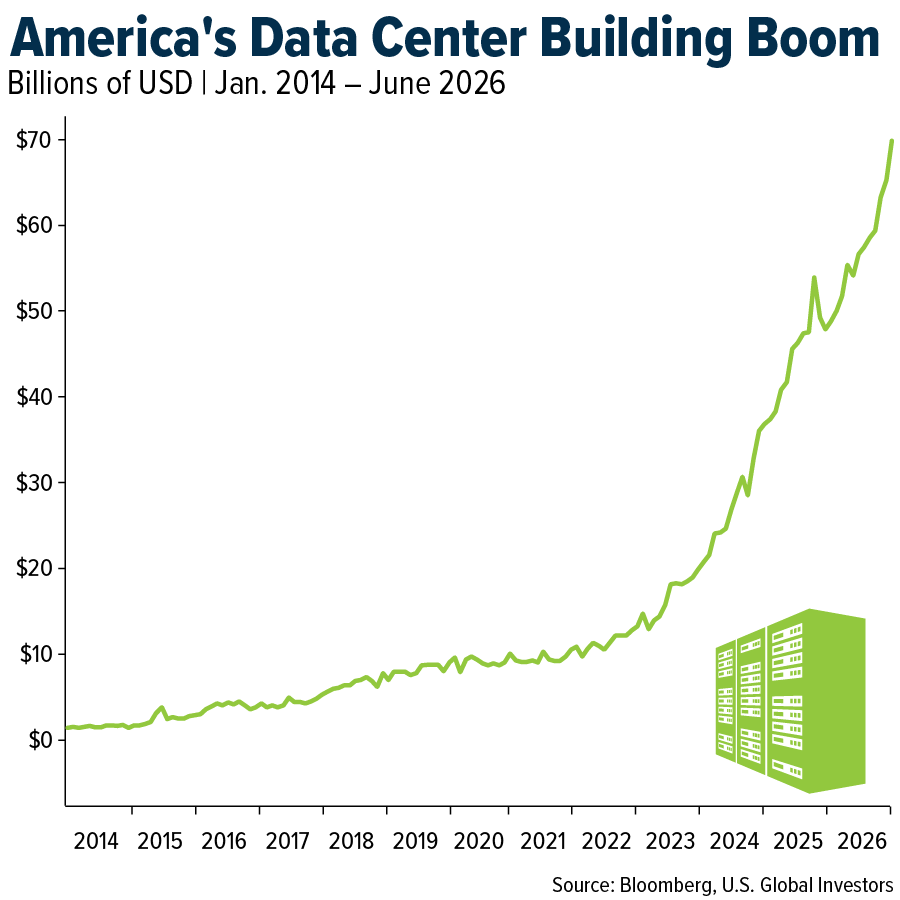
I’ve said for years that headlines make a terrible investment thesis, but capital flows rarely lie. The flows still point in one direction. What’s changed is that more of them are financed now.
I’m taking the AI safety debate seriously but reading the balance sheets even more seriously.
Airlines and Shipping
Strengths
- The best-performing airline stock for the week was Southwest Airlines, up 4.40%, on a bullish outlook from Morgan Stanley. Canadian CPI data for August shows that airfares in Canada were up 15.0% year-over-year (YoY), marking the second consecutive double-digit YoY increase, following a 12.0% increase in July.
- VLCC spot rates surged 30% and appear poised to reach $700,000 a day by October—more than 20 times the average operator breakeven. Houthi attacks on Saudi Arabia’s East-West pipeline, along with threats to shipping in the Strait of Hormuz and Bab el-Mandab Strait, are fueling panic bidding among Asian refiners for tanker loading slots, according to Bloomberg Intelligence.
- For Wizz Air, following a stronger-than-expected summer revenue performance, second quarter RASK is now guided to be flat YoY, while ASK and H1 ex-fuel CASK guidance remain unchanged. The company also confirmed that it has already trimmed its originally planned H2 capacity by 5%.
Weaknesses
- The worst-performing airline stock for the week was Boeing, down 5.8%. AirBaltic filed for Chapter 11 bankruptcy protection in New York to restructure its debt burden. The carrier secured a €350 million ($404 million) debtor-in-possession financing commitment from a group of funds to support operations during the proceedings, according to Bloomberg.
- This past week, laden vessels from China to the U.S. were down sequentially, falling 11% week-over-week (WoW). Data suggests TEUs coming into the Port of Los Angeles will decrease next week, down 13% WoW, following an 11% increase this past week, according to Goldman Sachs.
- According to Morgan Stanley, China has implemented sweeping new controls on overseas travel for Chinese citizens as President Xi Jinping steps up efforts to secure state secrets, advanced technology and highly skilled workers. The regulations will formalize what analysts describe as creeping restrictions on overseas trips for mid- to senior-level civil servants and employees of state-owned enterprises. The restrictions will also cover private citizens working in sensitive areas, according to immigration experts.
Opportunities
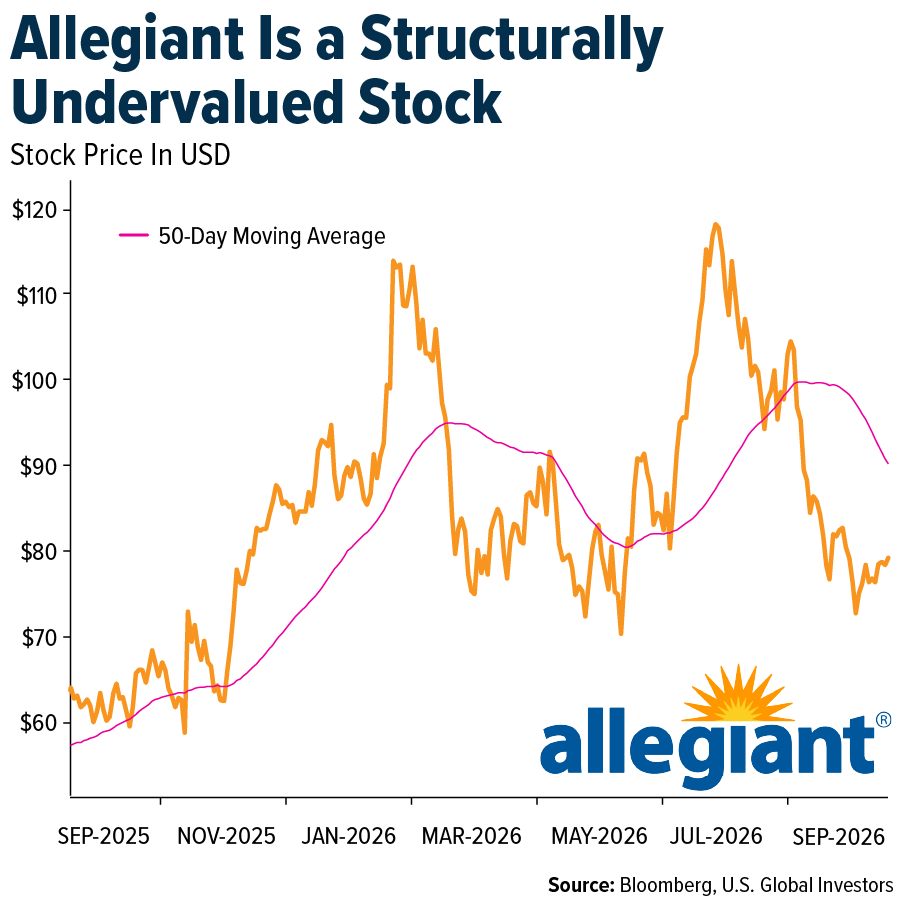
- According to UBS, Allegiant has a fleet equity value of $2.2 billion, above its current market cap of $2.1 billion. UBS notes that this highlights the stock’s valuation at these levels. The company also has an order book of approximately 100–110 aircraft, including 80 options, with contracts signed below current market value. Assuming the market value of these undelivered planes is $5–10 million higher than contracted rates, the company’s fleet equity value would increase with each aircraft it takes delivery of. If all options are exercised, they could potentially add another $800 million in fleet equity value over time.
- North American freight demand rose 2.1% year-over-year (YoY) in August—the first gain after 42 consecutive months of declines, according to the Cass Freight Shipments Index. The index is a monthly measure of North American freight activity.
- FAA Administrator Bryan Bedford met with the CEOs of major U.S. airlines, including American, United, Delta and Southwest, to discuss the agency’s rollout of its new SMART flight-management system, which is expected to begin this month. The predictive analytics platform will use data on airline schedules, weather, airport capacity, airspace conditions and other operational constraints to anticipate traffic flows and potential conflicts. Initially, the system will help airlines more effectively reschedule flights following weather-related cancellations.
Threats
- AirAsia said at a Bangkok briefing on Friday that it has not requested a government bailout, while operations and costs have stabilized. No aircraft have been grounded or repossessed, and creditors remain supportive. AirAsia has suspended 81 routes to conserve cash but remains “fully committed” to every market in which it operates, according to Bloomberg.
- Suez traffic pulled back week-over-week (WoW), but Maersk and Hapag-Lloyd’s decision to reroute four additional Gemini services via the Red Sea and Suez is a stronger signal of normalization. According to Morgan Stanley, this should increase effective capacity and add downside risk to freight rates as the return of services broadens.
- Today, the Qantas Group and Virgin Australia operate a highly rational duopoly, with both seeking adequate returns on recent fleet capital expenditures. However, RBC highlights three new airlines that have made clear their intentions to enter the Australian domestic market: (i) VietJet, a well-funded international carrier seeking to extend its low-cost carrier (LCC) network to the “golden triangle”; (ii) Koala Airlines, an LCC seeking to provide feeder and de-feeder traffic to international carriers on a charter basis; and (iii) Zinc Airlines, which plans to launch a Ryanair-style ultra-low-cost carrier (ULCC) operating at high frequency from Western Sydney Airport.
Luxury Goods and International Markets
Strengths
- Brunello Cucinelli struck an optimistic tone this week, reaffirming that the company expects revenue growth of 10% to 11% this year despite ongoing uncertainty in the broader luxury sector. The strong outlook suggests continued demand from high-end consumers and highlights the resilience of ultra-premium luxury brands, even as some larger industry players face slower growth.
- Moncler is expanding its presence in the U.S. with the opening of a new flagship store on New York’s Fifth Avenue, underscoring the brand’s confidence in the American luxury market. The store officially opened on September 10, 2026, and is the company’s largest flagship worldwide, spanning approximately 23,680 square feet across two floors.
- LuxExperience, a digital luxury fashion retailer created through the combination of Mytheresa, NET-A-PORTER, MR PORTER and YOOX, gained approximately 35% over the past five trading days, making it the top performer in the S&P Global Luxury Index. Shares rose after the company reported better-than-expected sales, improving profits and a positive outlook for next year. Investors were also encouraged by the company’s $50 million share buyback plan.
Weaknesses
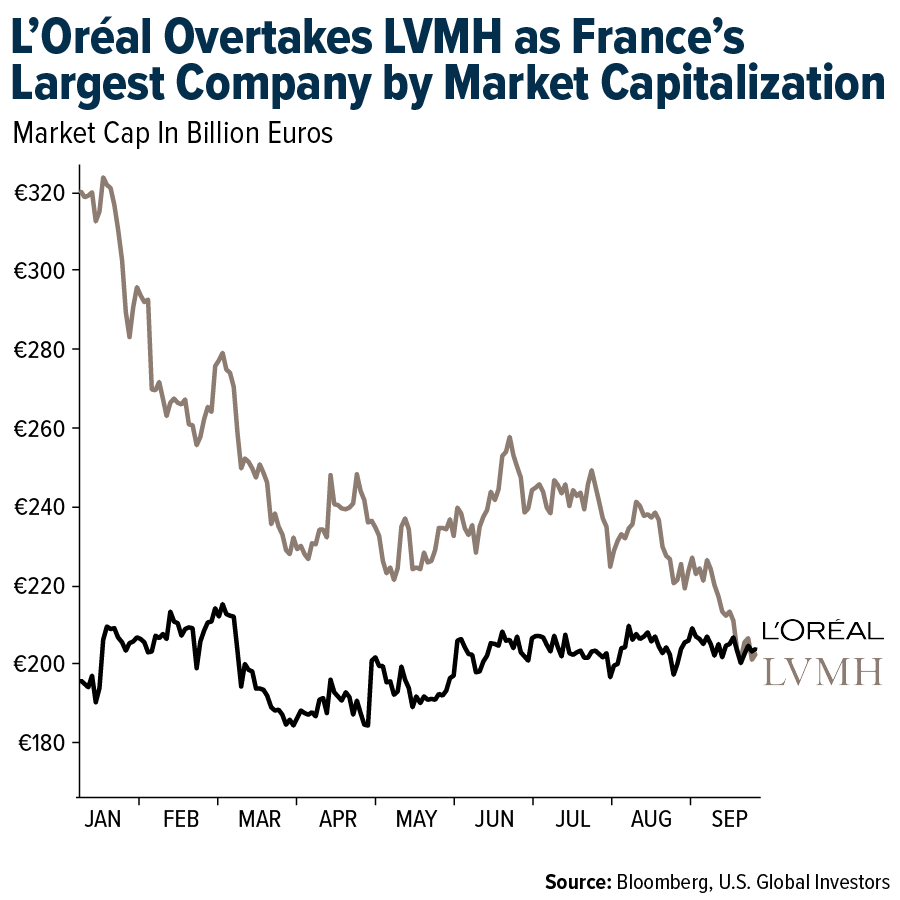
- For the first time since 2017, LVMH has fallen out of Europe’s top 10 listed companies by market capitalization, reflecting the slowdown in the luxury sector and weaker demand in China. The decline has also pushed Bernard Arnault out of the world’s top 10 richest people for the first time since 2017, as LVMH’s market value has fallen by more than 30% year-to-date.
- China’s August retail sales increased only 0.4% year-over-year (YoY), below the 0.8% consensus estimate and down from 0.6% in July. Gold and silver jewelry sales fell 17.5%, automobile sales declined 18.5% and furniture sales fell 7.9%.
- Salvatore Ferragamo, a luxury apparel company, declined approximately 12% over the past five trading days, making it the worst performer in the S&P Global Luxury Index. Barclays cut its Q3 2026 net sales forecast for Salvatore Ferragamo, citing weaker trends in China, ongoing wholesale channel pressure and tougher year-over-year comparisons. The broker expects Q3 net sales of €205 million, down 4% at constant currency, and lowered its price target to €6.50 from €6.60.
Opportunities
- Investors in the luxury sector are increasingly showing interest in beauty, cosmetics, fragrances, jewelry and other smaller-ticket premium products, highlighting beauty as a growth opportunity beyond traditional luxury fashion. This shift is reflected in L’Oréal overtaking LVMH in market capitalization to become France’s largest publicly listed company on the Paris Stock Exchange.
- Luxury stocks could experience a bounce following the year-to-date selloff in names such as LVMH and Hermès, as investors look for signs that demand in China is stabilizing. Any improvement in Chinese consumer spending or stronger-than-expected economic data could boost sentiment toward the luxury sector and support a recovery in share prices.
- Oil prices may be due for a correction after reaching overbought levels, which could help reduce pressure on household energy costs and improve consumer confidence. Lower fuel prices would leave consumers with more discretionary income, potentially supporting spending on travel, retail and luxury goods while providing a tailwind for luxury stocks.
Threats
- Last week, the European Central Bank raised interest rates, and this week the Federal Reserve followed with its own rate hike, signaling that policymakers remain focused on fighting inflation. Higher interest rates increase borrowing costs for consumers, making credit cards, auto loans and mortgages more expensive, which can reduce discretionary spending. As households devote more income to interest payments and become more cautious about their finances, demand for non-essential purchases, including luxury goods, can come under pressure.
- Euro-area consumers raised one-year inflation expectations to 3.0%, three-year expectations to 2.9% and five-year expectations to 2.5%. Contemporary reporting linked some of the pressure to higher fuel prices stemming from geopolitical disruptions. Continued strength in energy prices could reduce disposable income and sustain expectations for tighter monetary policy.
- The holiday shopping season will be a key test for luxury and consumer discretionary companies. If inflation remains elevated, shoppers may become more selective with their spending, potentially leading to weaker holiday sales and adding pressure on retailers and luxury brands heading into year-end.
Energy and Natural Resources
Strengths
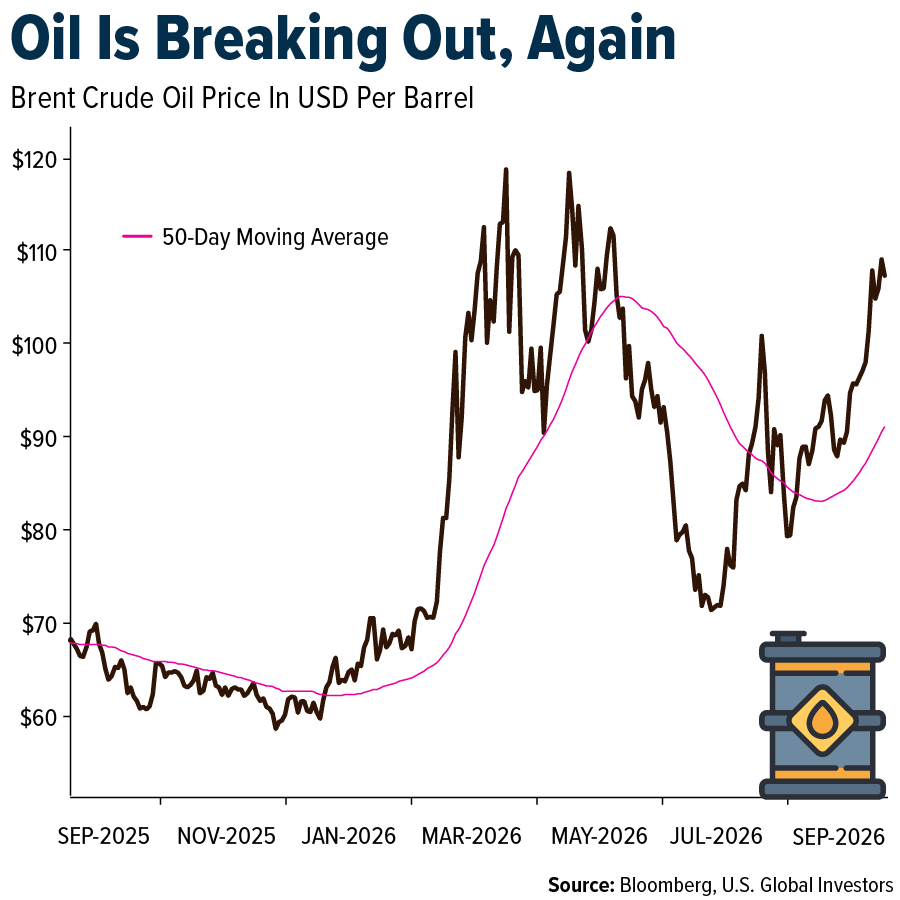
- The best-performing commodity for the week was copper, up 2.66%. Despite the Fed’s 25-basis-point rate hike, both copper and gold continued to rally in the days following the hike. The petroleum complex moved higher following a series of headlines pointing to a deteriorating environment in the Middle East. Brent crude traded as high as $109.50 per barrel early in the week but fell back to around $103 by Friday.
- China’s aluminum output rose 4.7% year-over-year (YoY) to just under 4 million tons in August, reaching a record high, according to Bloomberg. Year-to-date production exceeded 31 million tons, putting output on track to surpass the government’s annual capacity cap of approximately 45 million tons.
- Refining margins remain well above historical norms, according to Morgan Stanley. Based on December 2026 crude and product prices, the refining margin stands at approximately $57 per barrel, compared with a typical level of around $15. Earlier this week, the December 2028 margin reached $28 per barrel, suggesting the market expects refining margins to remain nearly twice their normal level even two years from now.
Weaknesses
- The worst-performing commodity for the week was China lithium carbonate 99.5%, down 6.98% on inventory builds in China. Australia’s Whyalla steelworks will shut its 60-year-old blast furnace and halt steelmaking after a months-long restoration effort failed, according to Bloomberg. Up to 600 workers could lose their jobs as steelmaking operations and parts of the pellet plant close, while administrators continue seeking a new owner for the site.
- Copper held near $14,000 per ton on the LME on Tuesday, its lowest close in four weeks, after pulling back sharply from a record high the previous week, according to Bloomberg. Fresh deliveries into exchange-tracked warehouses signaled an easing of the supply squeeze that had left markets outside the U.S. short of metal.
- Smaller Brazilian iron ore producers are struggling with surging shipping costs to China, squeezing margins and prompting production cuts, according to Bloomberg. Mineração Usiminas suspended operations at its Samambaia plant in Minas Gerais on September 2, citing lower iron ore prices and rising ocean freight costs.
Opportunities
- Uranium miners must begin developing new projects now to avoid a potential supply squeeze beginning in the mid-2030s, according to the 2026 Red Book from the OECD Nuclear Energy Agency and the IAEA. New uranium mines can take 15 to 20 years or longer to develop, while global nuclear generating capacity is projected to increase by at least 42% by 2050.
- Almonty Industries signed a multi-year, take-or-pay agreement to supply tungsten concentrate to Sandvik’s Wolfram Bergbau und Hütten unit. The agreement covers a minimum of approximately 1,720 metric tons of contained tungsten trioxide, sourced from the retreatment of tailings at the idled Los Santos Mine in western Spain, according to Dow Jones.
- Thailand’s PTT is in talks to purchase more LNG from the U.S. Gulf Coast as it seeks to diversify its supply sources and expand its trading business, according to Bloomberg. The company is also considering minority stakes in U.S. LNG export projects to secure more favorable contract terms, its CEO said.
Threats
- Uranium miners must begin developing new projects now to avoid a potential supply squeeze beginning in the mid-2030s, according to the 2026 Red Book from the OECD Nuclear Energy Agency and the IAEA. New uranium mines can take 15 to 20 years or longer to develop, while global nuclear generating capacity is projected to increase by at least 42% by 2050.
- Almonty Industries signed a multi-year, take-or-pay agreement to supply tungsten concentrate to Sandvik’s Wolfram Bergbau und Hütten unit. The agreement covers a minimum of approximately 1,720 metric tons of contained tungsten trioxide, sourced from the retreatment of tailings at the idled Los Santos Mine in western Spain, according to Dow Jones.
- Thailand’s PTT is in talks to purchase more LNG from the U.S. Gulf Coast as it seeks to diversify its supply sources and expand its trading business, according to Bloomberg. The company is also considering minority stakes in U.S. LNG export projects to secure more favorable contract terms, its CEO said.
Bitcoin and Digital Assets
Strengths
- Circle launched the public mainnet of Arc, a Layer 1 blockchain designed for stablecoin payments, financial markets and tokenized assets. Major institutions, including BlackRock, Visa, Mastercard, DTCC, ICE and Standard Chartered, are joining as validators, while more than 100 applications and institutional participants are already building on the network. The launch highlights the growing integration between blockchain infrastructure and traditional financial institutions.
- Deutsche Bank plans to introduce a regulated digital-asset custody service for institutional and corporate clients in Europe, subject to regulatory approval. The offering is expected to initially support Bitcoin, Ether and stablecoins, including USDC and EURC, with tokenized financial instruments potentially added later. The move highlights the growing integration of digital assets into traditional banking infrastructure and expanding institutional access to crypto markets.
- VIVA, one of Bolivia’s major telecommunications operators, is integrating stablecoins into parts of its financial operations using Avalanche, a blockchain network that supports digital-asset transactions and applications. The company plans to use the technology for settlement, dollar-denominated reserves and new financial services while connecting it with its existing systems. The initiative highlights growing corporate adoption of blockchain and stablecoins for real-world financial applications in Latin America.
Weaknesses
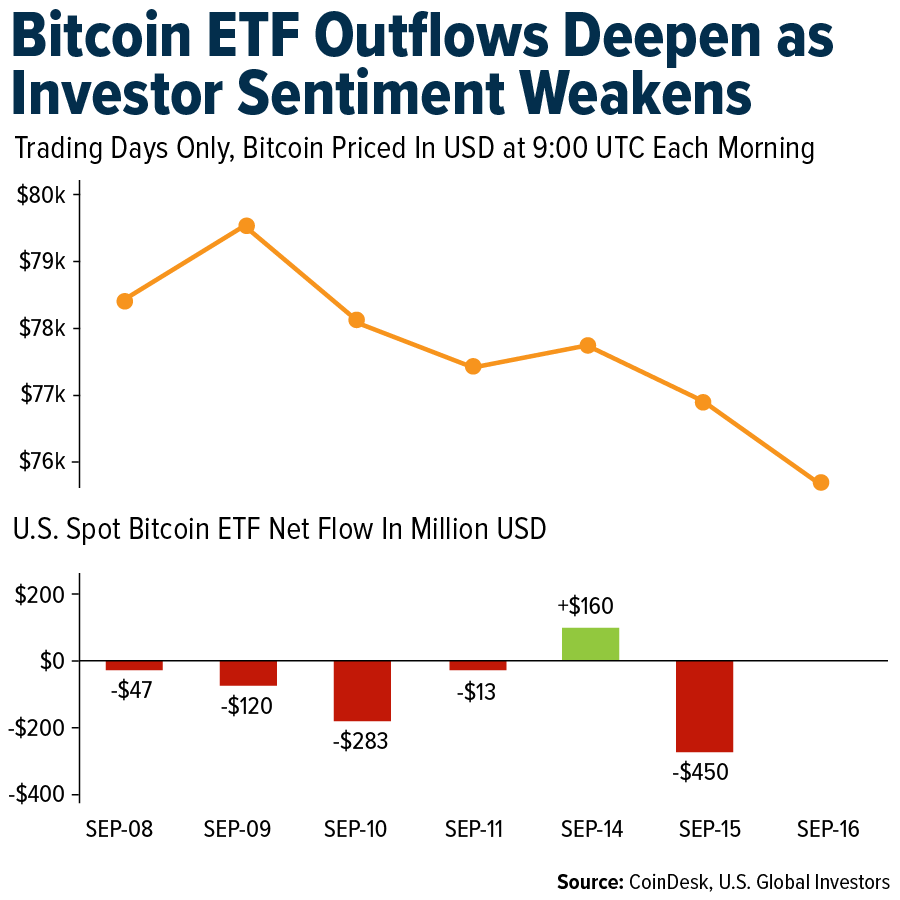
- U.S. spot Bitcoin ETFs recorded $450.3 million in net outflows on September 15, the largest single-day withdrawal since June 25, as the Digital Asset Market Clarity Act failed to advance in the Senate. The sharp reversal in ETF flows highlights softer investor sentiment and renewed caution among institutional investors amid regulatory uncertainty.
- Public companies added just 5,900 BTC on a net basis over the past three months, marking a sharp slowdown in corporate treasury accumulation. Other demand indicators, including stablecoin supply growth and ETF activity, have also shown signs of weakening. The slowdown suggests that some of the institutional and corporate demand that previously supported Bitcoin’s market momentum has lost strength.
- Ethereum developers warned that testing for Glamsterdam, an upcoming upgrade designed to improve how the Ethereum network processes transactions and operates, could be disrupted by malicious participants. Attackers could interfere with the Sepolia test network by gaining the right to build blocks and then failing to complete them, potentially slowing or temporarily stalling testing. The issue does not affect Ethereum’s mainnet or user funds, but it highlights technical challenges developers need to resolve before the upgrade is fully implemented.
Opportunities
- The House Ways and Means Committee advanced the Digital Asset Tax Certainty Act in a bipartisan 38–5 vote, addressing the tax treatment of stablecoins, staking, mining, lending and other digital-asset activities. The proposal seeks to reduce tax-related friction and align certain crypto rules more closely with those governing traditional financial assets. If enacted, greater tax clarity could support broader adoption and participation in the U.S. digital-asset market.
- Blockchain finance platform Theo launched SLVR, a tokenized product offering exposure to physical silver while generating yield through leases to institutional borrowers. The product launched with approximately $40 million in active silver leases, linking blockchain infrastructure with an established commodities market. The development highlights the expanding use of blockchain to tokenize traditional assets and create new investment and financing opportunities.
- Following the Clarity Act’s failure to advance, the SEC and Commodity Futures Trading Commission (CFTC) signaled plans to use their existing authority to provide greater regulatory clarity for digital assets. Potential areas of focus include token classification, decentralized finance (DeFi), self-custody and tokenized equities. Continued rulemaking could provide the industry with clearer operating frameworks even as broader crypto legislation remains stalled in Congress.
Threats
- The U.S. Department of Justice moved to seize approximately $61 million in cryptocurrency allegedly linked to sanctioned Iranian oil sales, while separate DOJ documents showed that Hamas’ military wing advised potential donors on the use of crypto platforms and stablecoins. The cases highlight the continued use of digital assets in sanctions evasion and illicit-finance networks. Such activity could intensify regulatory scrutiny of exchanges, stablecoins and anti-money-laundering controls.
- South Korea is preparing to introduce taxation on cryptocurrency investment gains in 2027 after multiple delays, while a recent survey found that more than half of surveyed crypto investors favor another postponement. Concerns remain over the tax burden and whether the regulatory infrastructure is ready for implementation. The planned tax could weigh on investor participation and trading activity in one of Asia’s major crypto markets.
- The Bank of Japan raised its benchmark interest rate from 1.00% to 1.25%, its highest level in 31 years, as policymakers continue to normalize monetary policy. Higher Japanese rates could increase pressure on yen-funded carry trades, where investors borrow at relatively low rates in Japan to invest in higher-yielding assets elsewhere. An unwind of these positions could reduce global liquidity and increase volatility across risk assets, including Bitcoin and the broader crypto market.
Defense and Cybersecurity
Strengths
- Korean Air finalized a $44.8 billion order for 103 Boeing aircraft, along with engines and maintenance services from GE Aerospace and CFM International. The deal supports fleet modernization and the airline’s upcoming integration while helping mitigate ongoing global aircraft delivery delays.
- The U.S. Department of State approved a potential $24.3 billion Foreign Military Sale of 48 Lockheed Martin F-35A Lightning II stealth fighters to Saudi Arabia on September 17, 2026. The transaction includes mission equipment, electronic warfare suites and weapons integration to support Middle Eastern allied air defense across the Persian Gulf.
- Global semiconductor industry revenue grew a record 31.4% quarter-over-quarter (QoQ) in the second quarter of 2026 (Q2 2026), reaching an all-time quarterly high of $425 billion. Total first-half 2026 revenue reached $752 billion, driven by strong demand for AI accelerators and higher high-bandwidth memory (HBM) contract pricing.
Weaknesses
- A new defense assessment warned that European militaries continue to face significant shortages of personnel, ammunition, artillery and air-defense capabilities despite rising military spending. The report highlighted a growing risk that defense requirements could outpace the industry’s ability to deliver equipment and rebuild inventories in the near term.
- Public warnings from former OpenAI and Anthropic researchers have reignited concerns about the risks of advanced AI, with some industry insiders arguing that current development is outpacing safety controls. The growing debate could increase regulatory pressure and create uncertainty around the long-term pace of AI commercialization.
- Russia has sharply intensified missile and drone attacks on Ukraine, with residential buildings and civilian infrastructure increasingly affected as the country approaches winter amid a severe budget deficit. The escalation follows new U.S. sanctions, after which Russian Foreign Minister Sergei Lavrov ruled out peace negotiations, further worsening the outlook for a diplomatic resolution.
Opportunities
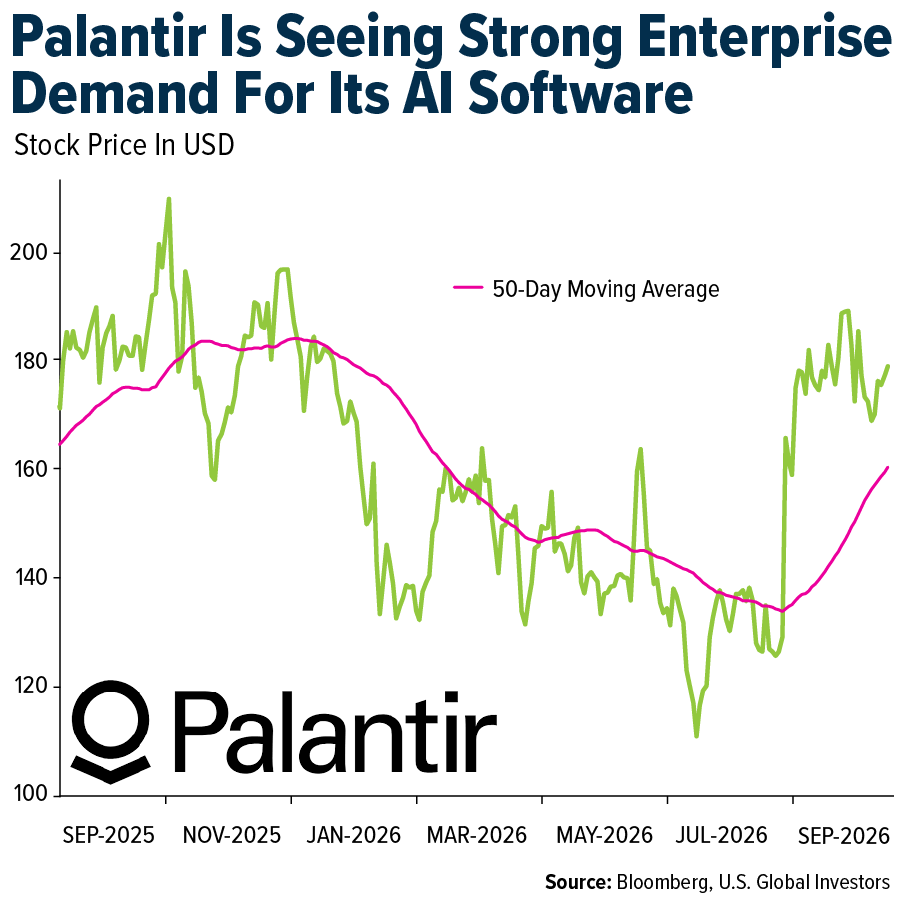
- Palantir Technologies is experiencing overwhelming enterprise demand for its AI software, cementing its role as a critical execution layer for corporate AI adoption while deepening high-impact partnerships with industry leaders such as Nvidia. Underscoring this momentum, UBS raised its price target on PLTR to $250 with a Buy rating, dismissing concerns about large language model (LLM) substitution and projecting sustained operational upside.
- SoftBank has expanded its Arm-backed margin loan by $5 billion to $25 billion, drawing strong lender demand to support recent acquisitions such as DigitalBridge and ABB’s robotics unit. The borrowing facility could increase further if Arm’s share price continues to climb.
- The Department of War initiated formal action on September 16, 2026, to eliminate legacy Cost Accounting Standards (CAS) requirements for commercial technology vendors, reducing regulatory barriers to accelerate the adoption of commercial AI and semiconductor technologies in military programs. The change would allow chipmakers and AI vendors to sell commercial off-the-shelf products directly to the military without disclosing proprietary cost data or modifying standard GAAP accounting practices.
Threats
- Global ransomware attacks hit an all-time monthly record of 997 incidents in mid-September 2026, propelled by automated credential-harvesting vulnerabilities targeting remote-access industrial control gateways across healthcare and energy networks.
- The security situation in the Middle East continued to deteriorate this week, as renewed attacks on shipping lanes and energy infrastructure highlighted the growing risk of a prolonged regional conflict, with limited signs of near-term de-escalation.
- Kioxia CEO Hiroo Ota instructed his sales team to halt further aggressive NAND price hikes for data centers, warning that runaway costs could strain hyperscalers’ capital budgets and curb long-term AI market growth. Following consecutive quarters of steep price increases, the company is prioritizing pricing stability to protect customer investment capacity and secure long-term supply contracts through 2030.
Gold Market
This week gold futures closed the week at $4,416.70, up $7.8 per ounce, or 0.18%. Gold stocks, as measured by the NYSE Arca Gold Miners Index, ended the week lower by 13.6%. The S&P/TSX Venture Index came in off 0.69%. The U.S. Trade-Weighted Dollar rose 1.08%.
Strengths
- The best-performing precious metal for the week was silver, up 2.63%, as prices broke above their recent trading range and held key support levels despite higher Treasury yields and the Federal Reserve’s first interest-rate hike since 2023. The move reinforced confidence in the strength of the ongoing rally.
- Gold ETF holdings extended their buying streak to eight consecutive days, the longest since October 21. ETFs added 52,500 troy ounces in the latest session, equivalent to $227.9 million, bringing 2026 net purchases to 1.46 million ounces. Total gold held by ETFs reached 100.4 million ounces, the highest level since March 3. Global gold-backed ETFs recorded $18 billion in August inflows, the second-largest monthly inflow in value terms on record, lifting total holdings by 121 tons to an all-time high.
- Swiss gold exports jumped 65% in August, led by more than 100 tons of shipments to the U.K., signaling robust physical demand and continued movement of bullion into major global trading hubs. Swiss gold imports rose to 205 tons from 154.8 tons, also indicating strong growth.
Weaknesses
- The worst performing precious metal for the week was palladium, down 0.48%, as investors remained cautious on the outlook for automotive demand, with softer vehicle sales expectations continuing to pressure the metal’s largest end-use market.
- Record-high diesel prices are beginning to impact miners, as fuel and mining consumables are likely to face higher costs. Mine optimization plans and cost-management strategies may need to be recalibrated accordingly.
- Hemlo Mining reported an underground electrical substation outage on September 4. The substation powers a portion of the Alimak production area, where roughly 20%–25% of mine production occurs. A bypass system has restored partial power, allowing limited mining to continue, while a replacement substation is expected in December. In the interim, Hemlo is evaluating alternative power and mine sequencing options. Management noted that both tonnage and grade will likely be affected, according to BMO.
Opportunities
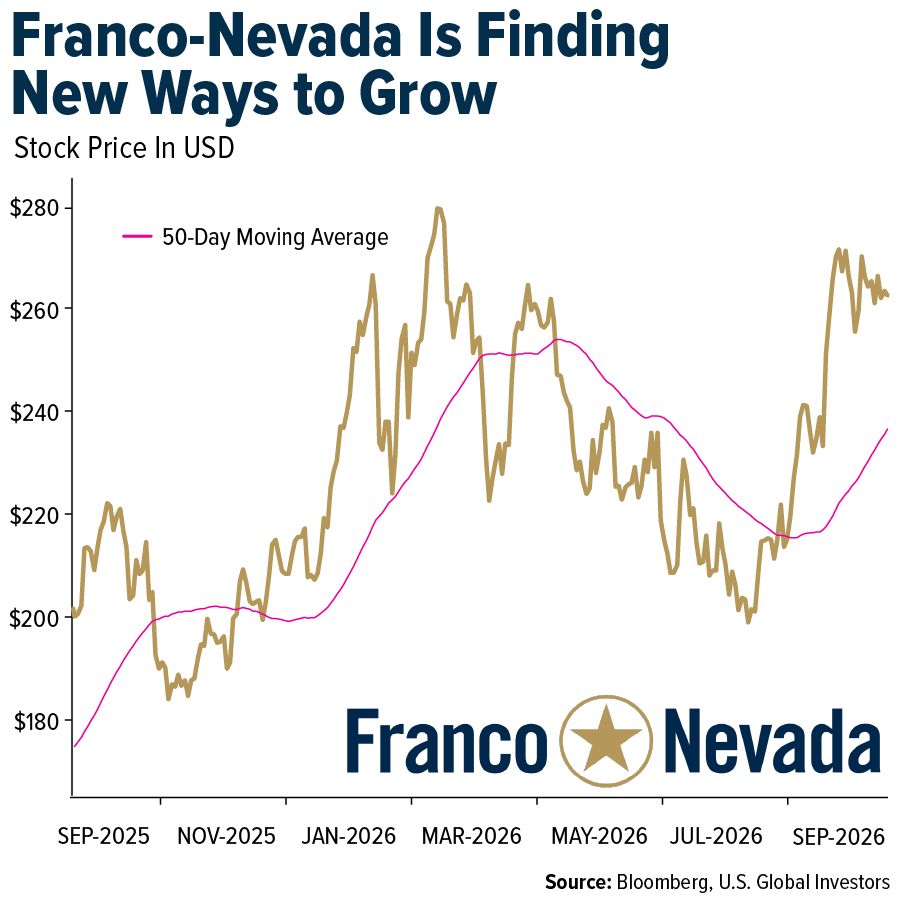
- Franco Nevada has announced that it has entered into an agreement to acquire a A$170 million gross royalty from Minerals 260 Limited to support its development of the Bullabulling Gold Project located in Western Australia. Additionally, Franco Nevada has agreed to subscribe for A$30 million (about $22 million) of Minerals 260’s ordinary shares as a lead order in a future equity raise, according to Raymond James.
- Tether has emerged as a major source of liquidity in the precious metals market, providing approximately $1.5 billion in bullion financing to Gold.com and accounting for the majority of its outstanding metal leases. The investment underscores growing participation from digital-asset firms in precious metals markets, potentially expanding access to capital and supporting long-term demand for bullion.
- Hong Kong’s new five-year plan positions gold at the center of its strategy to expand commodities trading and internationalize the yuan, with plans for an integrated hub covering storage, trading and clearing. The initiative strengthens links with mainland Chinese markets and could enhance Hong Kong’s role as a major global precious-metals trading center.
Threats
- Australian gold producers are facing growing cost pressures as higher diesel prices, labor shortages and consumables inflation continue to drive operating expenses higher. These headwinds are expected to persist into FY27, with average all-in sustaining costs projected to rise 15-20% year-over-year, reflecting tighter contractor availability and increasing capital intensity.
- Venezuela’s government and opposition are reportedly nearing an agreement that would grant the country legal control over roughly $4 billion in gold reserves currently held abroad. While the gold could not be immediately sold, it may be used as collateral for government borrowing, raising the potential for future gold-backed financing and creating a possible overhang for bullion sentiment.
- Gold has remained resilient on the back of strong ETF buying, even as higher interest rates and rising Treasury yields create a less supportive macro environment. However, history suggests that ETF-driven demand may prove temporary if the U.S. dollar continues to strengthen and expectations for additional Fed tightening persist, potentially weighing on bullion prices over the medium term.
A message from Advisor Perspectives and VettaFi: Discover something new! Click here to register for our upcoming webcasts.
U.S. Global Investors, Inc. is an investment adviser registered with the Securities and Exchange Commission (“SEC”). This does not mean that we are sponsored, recommended, or approved by the SEC, or that our abilities or qualifications in any respect have been passed upon by the SEC or any officer of the SEC.
This commentary should not be considered a solicitation or offering of any investment product. Certain materials in this commentary may contain dated information. The information provided was current at the time of publication. Some links above may be directed to third-party websites. U.S. Global Investors does not endorse all information supplied by these websites and is not responsible for their content. All opinions expressed and data provided are subject to change without notice. Some of these opinions may not be appropriate to every investor.
Holdings may change daily. Holdings are reported as of the most recent quarter-end. The following securities mentioned in the article were held by one or more accounts managed by U.S. Global Investors as of (06/30/2026):
Allegiant Travel
American Airlines
United Airlines
Delta Air Lines
Southwest Airlines
Qantas Airways Ltd.
Brunello Cucinelli
Moncler
LVMH
L’Oréal
Hermès
NVIDIA Corp.
Amazon.com Inc.
Hemlo Mining Corp.
Franco Nevada Corp.
Boeing
Palantir Technologies
Nvidia
*The above-mentioned indices are not total returns. These returns reflect simple appreciation only and do not reflect dividend reinvestment.
The Dow Jones Industrial Average is a price-weighted average of 30 blue chip stocks that are generally leaders in their industry. The S&P 500 Stock Index is a widely recognized capitalization-weighted index of 500 common stock prices in U.S. companies. The Nasdaq Composite Index is a capitalization-weighted index of all Nasdaq National Market and SmallCap stocks. The Russell 2000 Index® is a U.S. equity index measuring the performance of the 2,000 smallest companies in the Russell 3000®, a widely recognized small-cap index.
The Hang Seng Composite Index is a market capitalization-weighted index that comprises the top 200 companies listed on Stock Exchange of Hong Kong, based on average market cap for the 12 months. The Taiwan Stock Exchange Index is a capitalization-weighted index of all listed common shares traded on the Taiwan Stock Exchange. The Korea Stock Price Index is a capitalization-weighted index of all common shares and preferred shares on the Korean Stock Exchanges.
The Philadelphia Stock Exchange Gold and Silver Index (XAU) is a capitalization-weighted index that includes the leading companies involved in the mining of gold and silver. The U.S. Trade Weighted Dollar Index provides a general indication of the international value of the U.S. dollar. The S&P/TSX Canadian Gold Capped Sector Index is a modified capitalization-weighted index, whose equity weights are capped 25 percent and index constituents are derived from a subset stock pool of S&P/TSX Composite Index stocks. The NYSE Arca Gold Miners Index is a modified market capitalization weighted index comprised of publicly traded companies involved primarily in the mining for gold and silver. The S&P/TSX Venture Composite Index is a broad market indicator for the Canadian venture capital market. The index is market capitalization weighted and, at its inception, included 531 companies. A quarterly revision process is used to remove companies that comprise less than 0.05% of the weight of the index, and add companies whose weight, when included, will be greater than 0.05% of the index.
The S&P 500 Energy Index is a capitalization-weighted index that tracks the companies in the energy sector as a subset of the S&P 500. The S&P 500 Materials Index is a capitalization-weighted index that tracks the companies in the material sector as a subset of the S&P 500. The S&P 500 Financials Index is a capitalization-weighted index. The index was developed with a base level of 10 for the 1941-43 base period. The S&P 500 Industrials Index is a Materials Index is a capitalization-weighted index that tracks the companies in the industrial sector as a subset of the S&P 500. The S&P 500 Consumer Discretionary Index is a capitalization-weighted index that tracks the companies in the consumer discretionary sector as a subset of the S&P 500. The S&P 500 Information Technology Index is a capitalization-weighted index that tracks the companies in the information technology sector as a subset of the S&P 500. The S&P 500 Consumer Staples Index is a Materials Index is a capitalization-weighted index that tracks the companies in the consumer staples sector as a subset of the S&P 500. The S&P 500 Utilities Index is a capitalization-weighted index that tracks the companies in the utilities sector as a subset of the S&P 500. The S&P 500 Healthcare Index is a capitalization-weighted index that tracks the companies in the healthcare sector as a subset of the S&P 500. The S&P 500 Telecom Index is a Materials Index is a capitalization-weighted index that tracks the companies in the telecom sector as a subset of the S&P 500.
The Consumer Price Index (CPI) is one of the most widely recognized price measures for tracking the price of a market basket of goods and services purchased by individuals. The weights of components are based on consumer spending patterns. The Purchasing Manager’s Index is an indicator of the economic health of the manufacturing sector. The PMI index is based on five major indicators: new orders, inventory levels, production, supplier deliveries and the employment environment. Gross domestic product (GDP) is the monetary value of all the finished goods and services produced within a country’s borders in a specific time period, though GDP is usually calculated on an annual basis. It includes all private and public consumption, government outlays, investments and exports less imports that occur within a defined territory.
The S&P Global Luxury Index is comprised of 80 of the largest publicly traded companies engaged in the production or distribution of luxury goods or the provision of luxury services that meet specific investibility requirements.
The Nasdaq Composite is a stock market index that tracks nearly all stocks listed on the Nasdaq stock exchange. The Nasdaq-100 is a stock market index that tracks 100 of the largest non-financial companies listed on the Nasdaq stock exchange.
The forward P/E (price-to-earnings) ratio is a financial metric that divides a company’s current stock price by its estimated earnings per share (EPS) over the next 12 months.
Membership required
Membership is now required to use this feature. To learn more:
View Membership Benefits