Key Takeaways
-
All eyes turn to big tech names this week: Apple, Amazon, Meta and Microsoft
-
Q2 S&P 500® profit growth currently stands at 37.9% with 27% of companies having reported
-
Potential earnings surprises this week: Illinois Tool Works, Xylem, Vulcan Materials, GoDaddy and more
Capex Cracks and Mainframe Slumps: What Early Q2 Reports Tell Us About the AI Trade
As the Q2 earnings season kicks into high gear, market sentiment around the AI trade is undergoing a critical sanity check. Alphabet’s second quarter results last week served as a barometer for how Wall Street is weighing artificial intelligence investments against current profitability. While top-line growth remained healthy, investors recoiled at Alphabet’s jaw-dropping $195 billion to $205 billion capex estimate for 2026, triggering immediate post-earnings selling. This backlash sets a tense backdrop for fellow hyperscalers, Amazon, Microsoft, and Meta, who report next week. The market’s message to Big Tech is rapidly shifting from "spend whatever it takes" to "show us the returns," leaving these upcoming reports on high alert for any similar capex-driven margin pressure.1
Tesla presented a different side of the AI equation, beating revenue expectations on the back of record Q2 deliveries that topped 480,000 vehicles (up 25% year-over-year). However, aggressive promotional discounting and surging capital expenditures crushed the bottom line, resulting in a notable profit miss. Historically, Tesla was criticized by analysts for not pouring enough capital into its AI infrastructure compared to tech peers, a narrative that CEO Elon Musk addressed head-on by outlining $25 billion in AI capex for this year. Adding another intriguing layer to the Tesla earnings call, Musk also stoked Wall Street's imagination by teasing the possibility of a future merger between Tesla and SpaceX.2
Rounding out the group, IBM confirmed a grueling quarter that followed last week’s rare preliminary earnings release, an unprecedented move designed to soften the market's initial blow. Beyond soft headline numbers, the real pain came from its core infrastructure division, where high-margin Z mainframe sales plummeted 42% year-over-year. Unlike cloud software names (such as Workday, Snowflake, or Salesforce) where AI tools are directly displacing seat-based models, IBM’s headache is rooted in enterprise capital allocation. Large corporate clients are treating legacy hardware refreshes as discretionary, deliberately pushing off mainframe upgrades to channel cash toward their own AI buildouts. This trend has fueled growing speculation that IBM may start to diversify its focus beyond mega-corporations and target mid-sized enterprises to cushion the blow.3
With those tech reports, and results from 83 other S&P 500 constituents, the blended EPS growth rate moved higher to 37.9% last week, from 24.7% the week prior. Revenue growth also saw a bump to 13.2% from 12.8% in the week prior.4
See more: Big Tech Needs to Justify AI Spending as Investors Dump Stocks
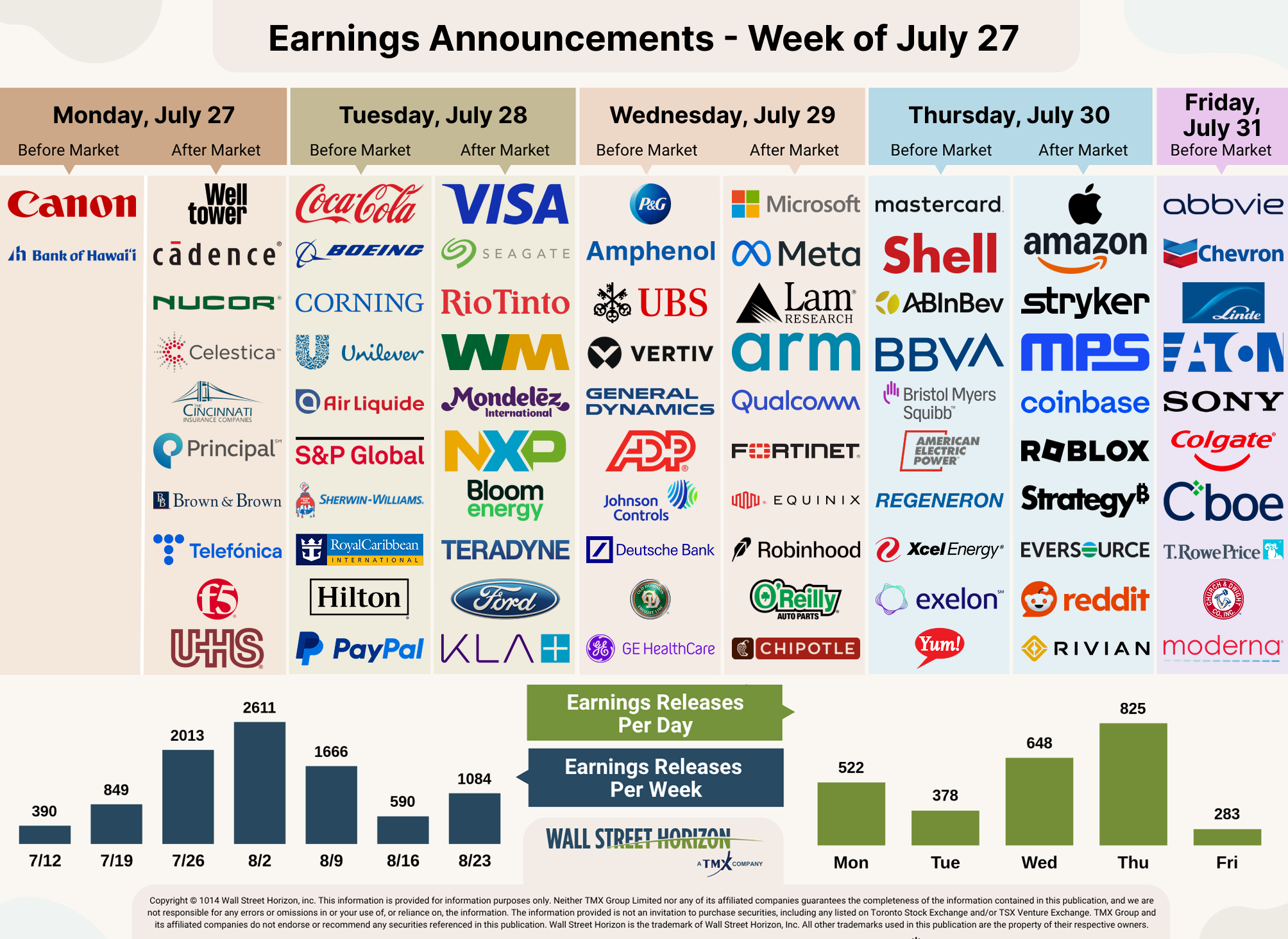
Earnings On Deck: AMZN, AAPL, MSFT, META
This week the focus remains on big tech when four Mag 7 constituents, Amazon, Apple, Microsoft and Meta, report earnings.
Source: Wall Street Horizon
Outlier Earnings Dates This Week
Academic research shows that when a company confirms a quarterly earnings date that is later than when they have historically reported, it’s typically a sign that the company will share bad news on their upcoming call, while moving a release date earlier suggests the opposite.5
This week we get results from a number of large companies on major indexes that have pushed their Q2 2026 earnings dates outside of their historical norms. Six companies within the S&P 500 confirmed outlier earnings dates for this week, Illinois Tool Works (ITW), Xylem (XYL), Vulcan Materials (VMC), Alliant Energy Corp (LNT), GoDaddy Inc. (GDDY) and Corteva, Inc. (CTVA). All six are reporting earlier than usual and therefore have positive DateBreaks Factors*
* Wall Street Horizon DateBreaks Factor: statistical measurement of how an earnings date (confirmed or revised) compares to the reporting company's 5-year trend for the same quarter. Negative means the earnings date is confirmed to be later than historical average while Positive is earlier.
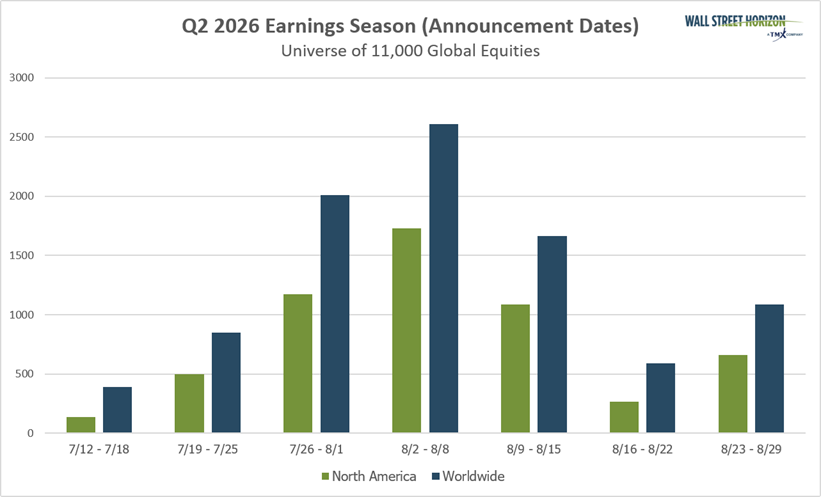
Q2 2026 Earnings Wave
The peak weeks of the Q2 earnings season are expected to fall between July 27 - August 14, with each week expected to see over 2,000 reports. Currently, August 6 is predicted to be the most active day with 1,225 companies anticipated to report. Thus far, 69% of companies have confirmed their earnings date and 12% have reported (out of our universe of 11,000+ global names). The remaining dates are estimated based on historical reporting data.
Source: Wall Street Horizon
1 Alphabet Second Quarter 2026 Earnings Results, July 22, 2026, https://s206.q4cdn.com
2 Tesla Second Quarter 2026 Earnings Results, July 22, 2026, https://assets-ir.tesla.com
3 IBM Second Quarter 2026 Earnings Results, July 22, 2026, https://www.ibm.com
4 FactSet Earnings Insight, John Butters, July 24, 2026, https://advantage.factset.com
5 Time Will Tell: Information in the Timing of Scheduled Earnings News, Journal of Financial and Quantitative Analysis, Eric C. So, Travis L. Johnson, Dec, 2018, https://papers.ssrn.com
Copyright © 2026 Wall Street Horizon, Inc. All rights reserved. Do not copy, distribute, sell or modify this document without Wall Street Horizon's prior written consent. This information is provided for information purposes only. Neither TMX Group Limited nor any of its affiliated companies guarantees the completeness of the information contained in this publication, and we are not responsible for any errors or omissions in or your use of, or reliance on, the information. This publication is not intended to provide legal, accounting, tax, investment, financial or other advice and should not be relied upon for such advice. The information provided is not an invitation to purchase securities, including any listed on Toronto Stock Exchange and/or TSX Venture Exchange. TMX Group and its affiliated companies do not endorse or recommend any securities referenced in this publication. This publication shall not constitute an offer to sell or the solicitation of an offer to buy, nor may there be any sale of any securities in any state or jurisdiction in which such offer, solicitation or sale would be unlawful prior to registration or qualification under the securities laws of any such state or jurisdiction. TMX, the TMX design, TMX Group, Toronto Stock Exchange, TSX, and TSX Venture Exchange are the trademarks of TSX Inc. and are used under license. Wall Street Horizon is the trademark of Wall Street Horizon, Inc. All other trademarks used in this publication are the property of their respective owners.
A message from Advisor Perspectives and VettaFi: Discover something new! Click here to register for our upcoming webcasts.
© Wall Street Horizon
Read more commentaries by Wall Street Horizon