Key takeaways:
-
The AI bond boom has created a simple but potentially misleading market narrative that corporate issuance is crowding out Treasuries. With hyperscalers borrowing heavily and Treasury supply still elevated, it is tempting to blame higher yields on too much duration chasing too little debt-buying capacity.
-
That story gets the mechanism wrong. AI capex can lift real rates, but through the saving-investment channel: A large investment boom absorbs labor, power, equipment, and construction capacity unless saving rises enough to offset it.
-
The data do not support direct Treasury crowding out. Unanticipated AI debt deals leave little statistically significant footprint in 10-year yields, term premia, or swap spreads, pointing instead to policy expectations and broader macro forces as the cleaner explanation for the rate move.
A popular narrative for the rise in bond yields over the past few months is that the debt-funded AI capital expenditure cycle is crowding out the Treasury market. The crowding-out argument can appear compelling: AI companies are expected to continue to issue unprecedented amounts of debt at a time when Treasury supply remains elevated. Because both ultimately draw from the same pool of investor capital, yields must rise to clear the market.
The problem with this argument is that this is not how crowding out conventionally works. The textbook mechanism runs in the opposite direction: Government borrowing absorbs a finite pool of savings, pushes up interest rates, and crowds out interest-rate sensitive private investment.
So, is this time different? Can private-sector financing, however large, crowd out a $32 trillion Treasury market? As we argue below, AI capex just like any other large capex cycle, can and likely will exert upward pressure on real (inflation-adjusted) yields. But that is not evidence of crowding out via portfolio rebalancing, which is a frequently encountered view among market participants.
See more: Magnificent 7 Companies Buoyed by Circular Investing Phenomenon
Higher real yields and the savings-investment identity
Equilibrium real yields are the price that equilibrates desired saving and desired investment. As hyperscalers ramp up spending and compete for labor, power, and construction capacity, the AI capex boom shifts desired investment upward. Unless desired saving rises commensurately, equilibrium real rates must increase until desired saving rises, some investment is crowded out, or both.
Of course, the U.S. is the world's largest open economy, so higher investment does not need to be matched one-for-one by higher domestic saving. Part of the adjustment can occur through greater capital imports. Exchange-rate adjustment provides another margin. A weaker U.S. dollar can improve the trade balance over time, reducing the amount of foreign capital required to finance higher investment.
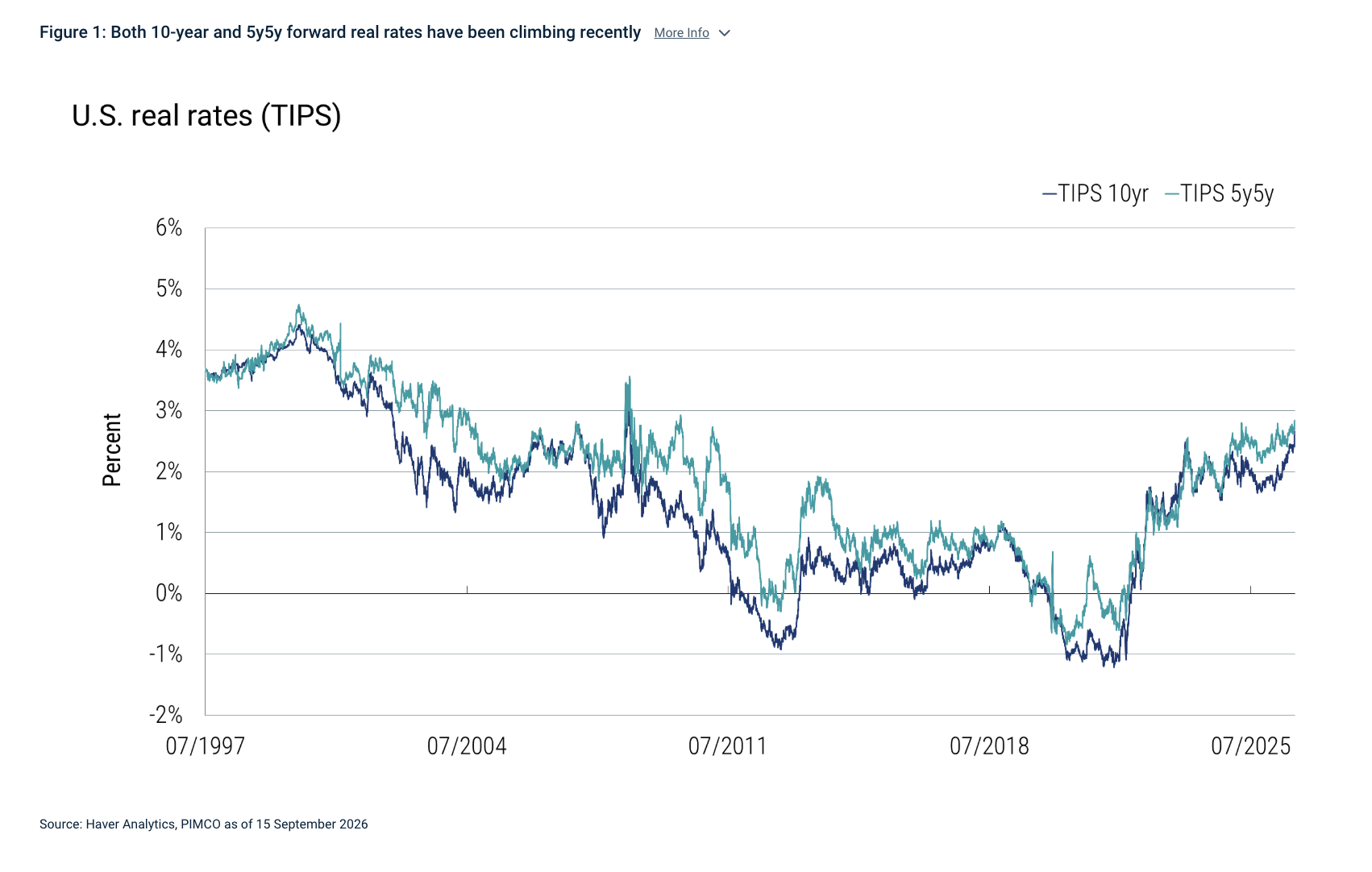
But that margin is not unlimited. The U.S. already runs a large current account deficit and absorbs substantial foreign savings. At the same time, the prospect of unusually high returns on AI-related investment could itself attract foreign capital, limiting the extent to which exchange-rate adjustment bears the burden of rebalancing. In practice, the adjustment is likely to occur through some combination of higher equilibrium real yields, capital inflows, and exchange-rate movements. Still, higher real yields are likely to be an important margin of adjustment: While AI investments have gathered momentum, real rates have been rising (see Figure 1).
One important nuance, and one that is often overlooked in the AI capex debate, is that this upward pressure on real rates is largely independent of how the AI capex cycle is financed. The roughly $1 trillion in hyperscaler capex expected this year consumes the same real resources whether it is funded with debt, retained earnings, or equity issuance. What matters for equilibrium real rates is the underlying gap between desired investment and desired saving, not the liability used to finance it.
This nuance is particularly important in the case of retained earnings. The fact that a firm uses cash already on its balance sheet does not mean the investment is somehow "pre-funded" from a macroeconomic perspective. Deploying retained earnings into AI infrastructure simply converts saving into investment and consumes the same labor, power, and construction resources as any other form of financing. The financing source changes the ownership of claims and the allocation of risk, but not the economy's consumption of real resources.
To be clear, financing choices still matter for asset prices, risk allocation, and market technicals, which is the second channel we discuss next. But for the macroeconomic arithmetic linking desired saving, desired investment, and equilibrium real rates, a dollar of debt-financed capex is no different from a dollar financed through retained earnings or equity issuance.
The empirical evidence for crowding out via portfolio rebalancing is weak
In the portfolio rebalancing channel, financing matters. In theory, a surge in AI bond issuance could force investors to trim other holdings, including Treasuries, to make room. Identifying the effect of AI issuance on Treasury yields is difficult, so we take a narrower approach: an event study around large AI-related debt deals over the past 12 months. The goal is not to estimate the full impact of AI financing on rates, but rather to test whether unexpectedly large deals leave a detectable footprint in Treasuries.
The first challenge is distinguishing anticipated issuance from genuine surprises. Our proxy is the performance of an issuer's outstanding bonds around a new deal announcement. When those bonds generate abnormal (larger than a 1 standard deviation move) negative returns relative to the broader index, we treat that as evidence that the size or timing of the offering was not fully priced in. Using this approach, we identify six surprise deals over the past year.
Of course, the proxy is imperfect as bonds can underperform for fundamental reasons unrelated to supply. However, we think that concern is limited. For example, bad news on another issuer in the same sector can sometimes cause a deal to underperform, but this wasn’t the case in our sample.
Test #1: Nominal yields
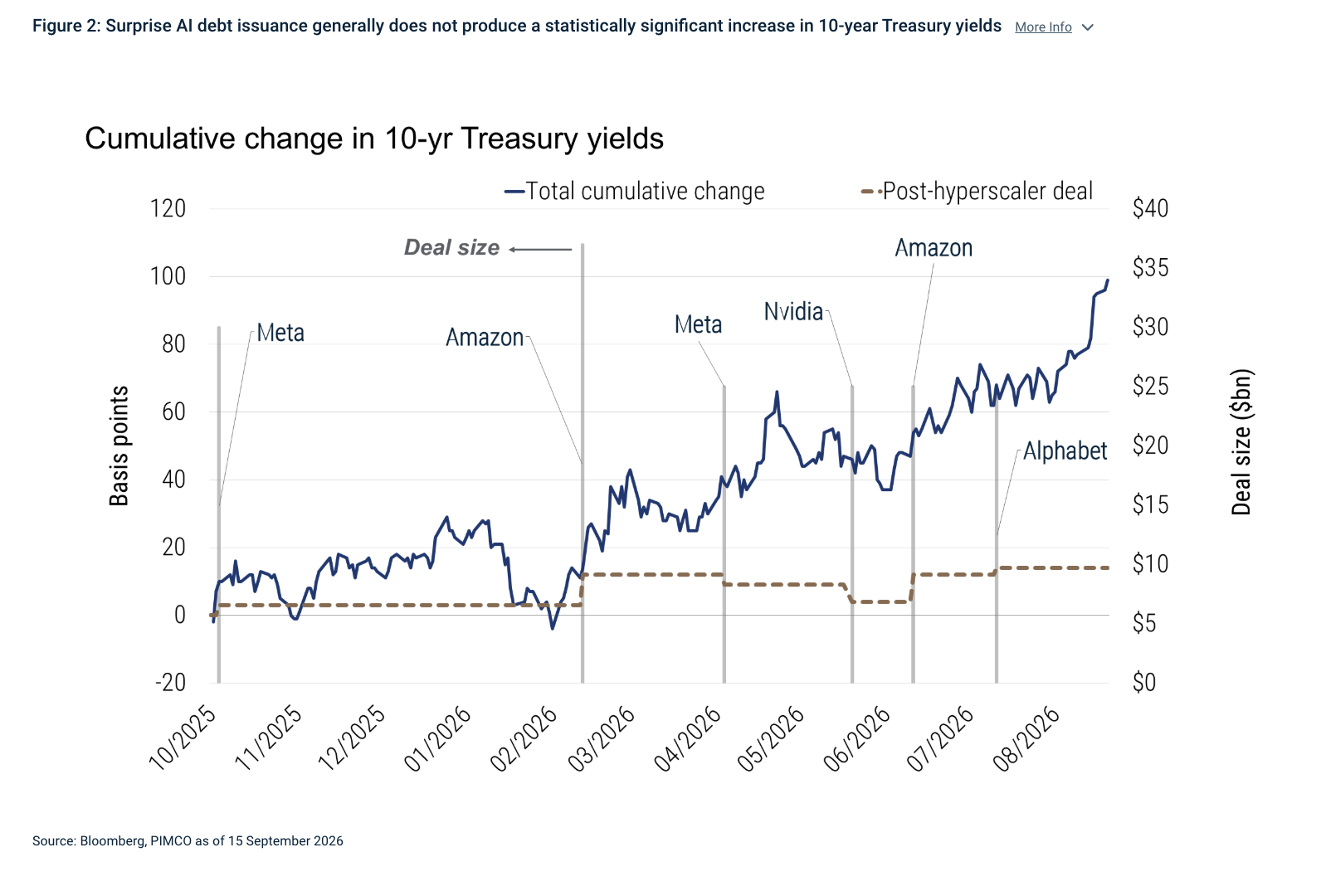
Using the sample of surprise AI issuance deals, we then measure the two-day change in 10-year Treasury yields around each event, from the close before the announcement to the close the day after. The window is short by design but long enough for a large transaction to be priced, allocated, and absorbed.
The data show surprise AI debt issuance does not produce a statistically significant increase in Treasury yields (see Figure 2). The main outlier is Amazon's 10 March deal, which coincided with a meaningful backup in nominal yields. But that move appears more consistent with shifting policy expectations than portfolio crowding. Two-year Treasury yields, a proxy for policy rate expectations, rose roughly 22 basis points over the same window.
Test #2: The term premium
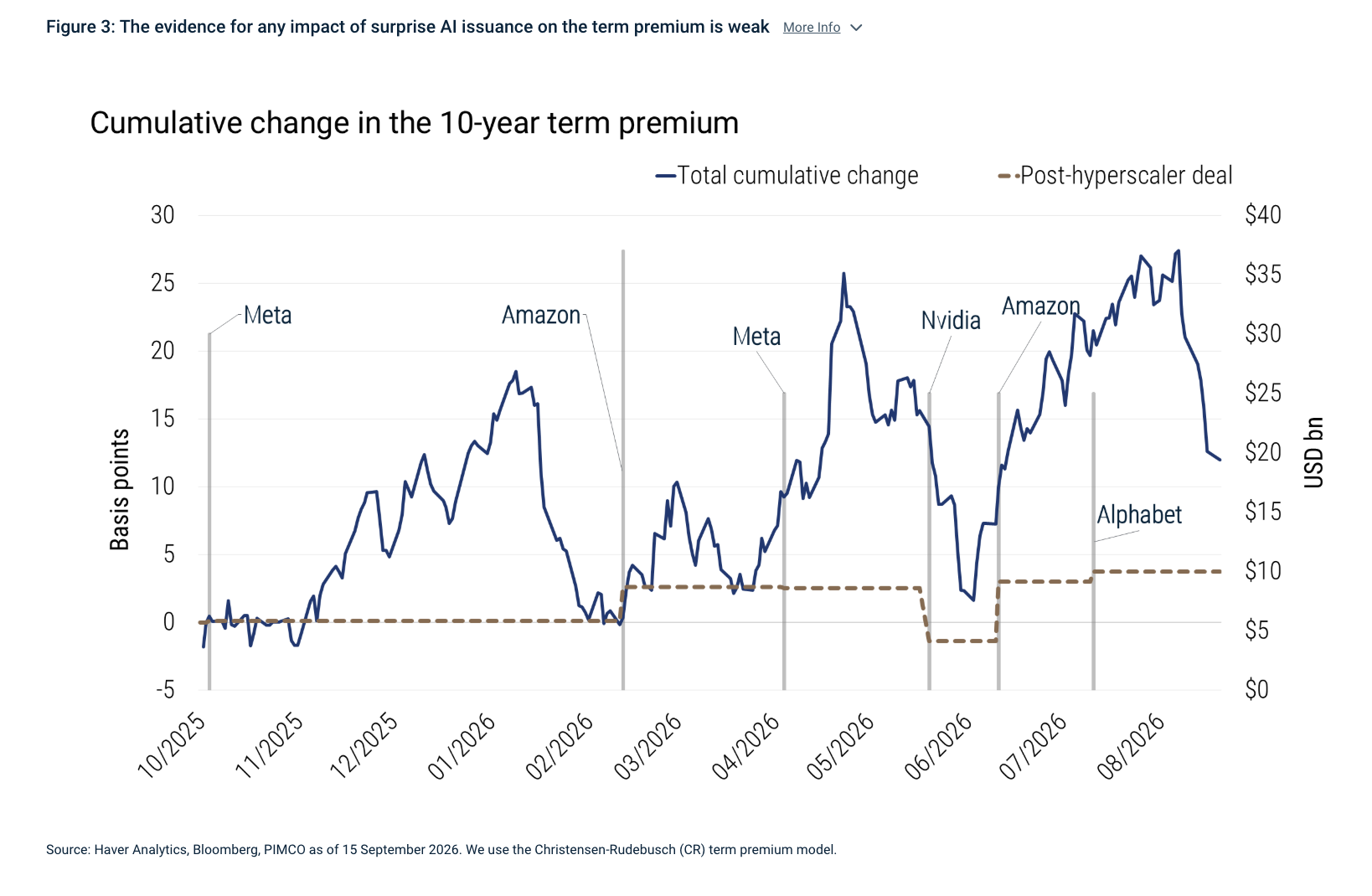
We repeat the exercise using changes in the estimated 10-year Treasury term premium. The conclusion remains unchanged: Surprise AI issuance does not produce a statistically significant increase in term premia (see Figure 3). That result is also consistent with the broader pattern since the third quarter of last year. Most of the rise in yields has reflected higher expected policy rates, although term premia have moved up more noticeably since Fed Chair Kevin Warsh's first FOMC meeting.
Test #3: Swap spreads
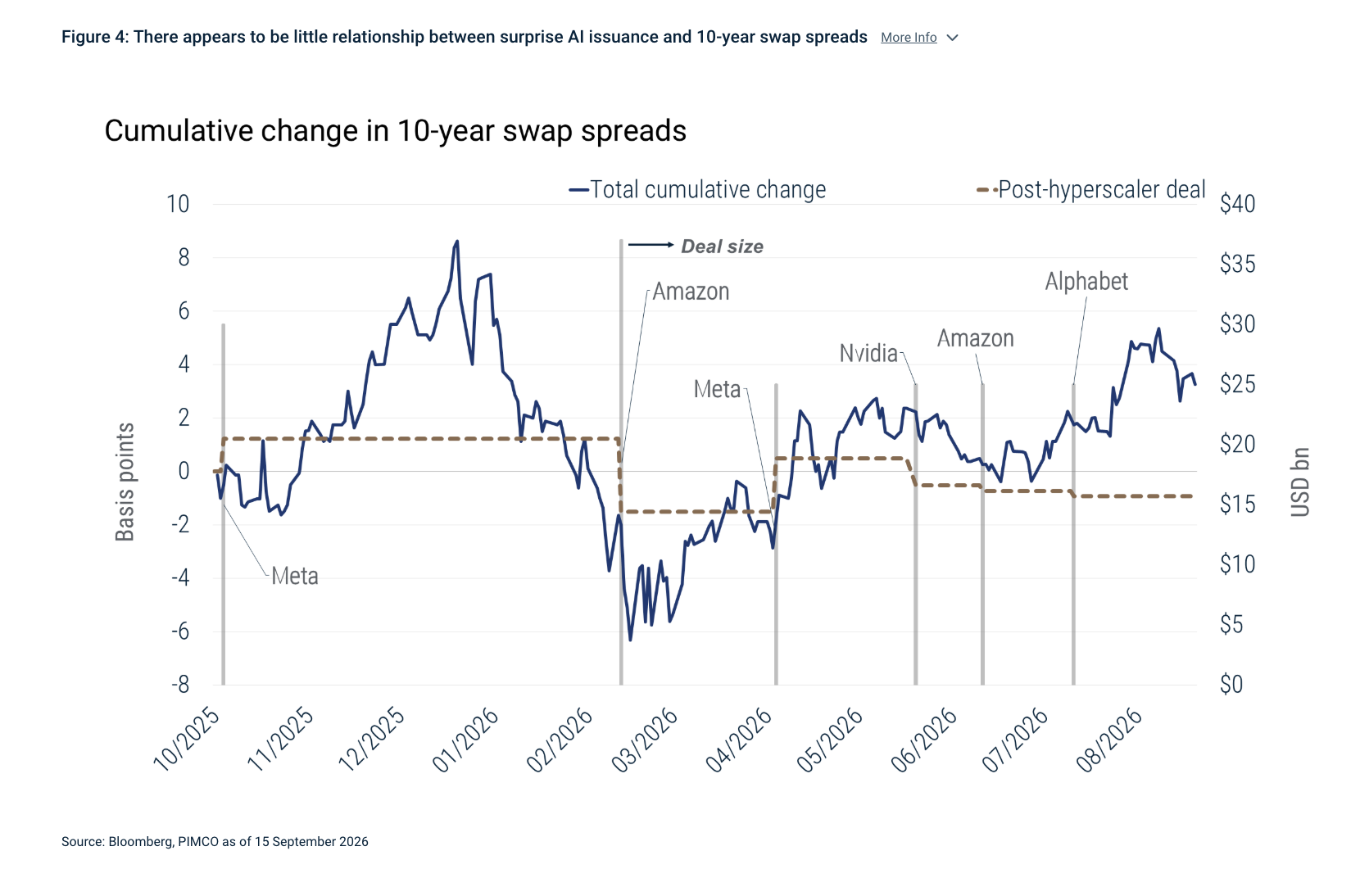
As a final robustness check, we examine swap spreads, which (unlike term premia) are directly observable. If investors were selling Treasuries to absorb unexpected fixed-rate AI bond supply, Treasuries should cheapen relative to swaps even if the signal in outright yields is noisy. Once again, we find little systematic response around surprise issuance (see Figure 4).
Bottom line: Across nominal yields, term premia, and swap spreads, the evidence that surprise AI debt issuance is pushing Treasury yields higher is weak. The AI capex boom may well lift equilibrium real rates through the saving-investment channel, but the narrower claim that AI bond supply is directly crowding out Treasuries is hard to find in the data.
Michael Puempel and Gabriel Cazaubieilh contributed to this report.
Disclosures
Statements concerning financial market trends or portfolio strategies are based on current market conditions, which will fluctuate. Outlook and strategies are subject to change without notice.
Past performance is not a guarantee or a reliable indicator of future results. Forecasts, estimates and certain information contained herein are based upon proprietary research and should not be considered as investment advice. There is no guarantee that stated results will be achieved.
Investments with exposure to the artificial intelligence sector may involve heightened risks, including rapid technological change, competitive disruption, elevated valuations, regulatory uncertainty, data privacy and cybersecurity concerns, infrastructure dependencies, and reliance on third-party models or platforms. AI-related opportunities may not develop as expected, fail to produce anticipated productivity or revenue benefits, or be concentrated among a limited number of issuers, and could result in increased volatility or loss of capital. U.S. government securities such as Treasury bills are backed by the full faith of the government. Corporate debt securities are subject to the risk of the issuer’s inability to meet principal and interest payments and may also be subject to price volatility due to interest rate sensitivity, market perception of the creditworthiness of the issuer and general market liquidity. Swaps are a type of derivative; swaps are increasingly subject to central clearing and exchange-trading.
PIMCO as a general matter provides services to qualified institutions, financial intermediaries and institutional investors. Individual investors should contact their own financial professional to determine the most appropriate investment options for their financial situation. This material contains the opinions of the author and such opinions are subject to change without notice. This material has been distributed for informational purposes only and should not be considered as investment advice or a recommendation of any particular security, strategy or investment product. Information contained herein has been obtained from sources believed to be reliable, but not guaranteed. No part of this material may be reproduced in any form, or referred to in any other publication, without express written permission. PIMCO is a trademark of Allianz Asset Management of America LLC in the United States and throughout the world.
CMR2026-0918-5942074
A message from Advisor Perspectives and VettaFi: Discover something new! Click here to register for our upcoming webcasts.
© PIMCO
More Smart Beta Topics >