“If you bought it, a trucker brought it.” —Ancient Trucking Proverb
“I don’t care about the facts, Domino, I care about how I feel.” —from The Passion by Jeanette Winterson
The Federal Reserve raised interest rates this week, in part to reset consumer expectations on inflation. Their work is likely not done, as there is a negative surprise coming for many consumers, especially in rural America. Winter is coming, and that means the return of home heating bills. Depending on how you heat your home, your bills could be much higher this winter.
Even as the Fed acknowledges that inflation has been running higher than their 2% target for several years, some economists argue that the rate of inflation is coming down. While the data might indicate improvement, it is somewhat irrelevant if consumers do not believe it. Right now, many don’t. They would argue that the way inflation is calculated does not reflect their reality.
This week we look at the most pervasive expense in the economy. It is an input to nearly everything we buy, eat, and touch.
Unless you own a trucking company, run a farm, operate heavy equipment, or drive a really big pickup truck, you may not have noticed how expensive diesel has become.
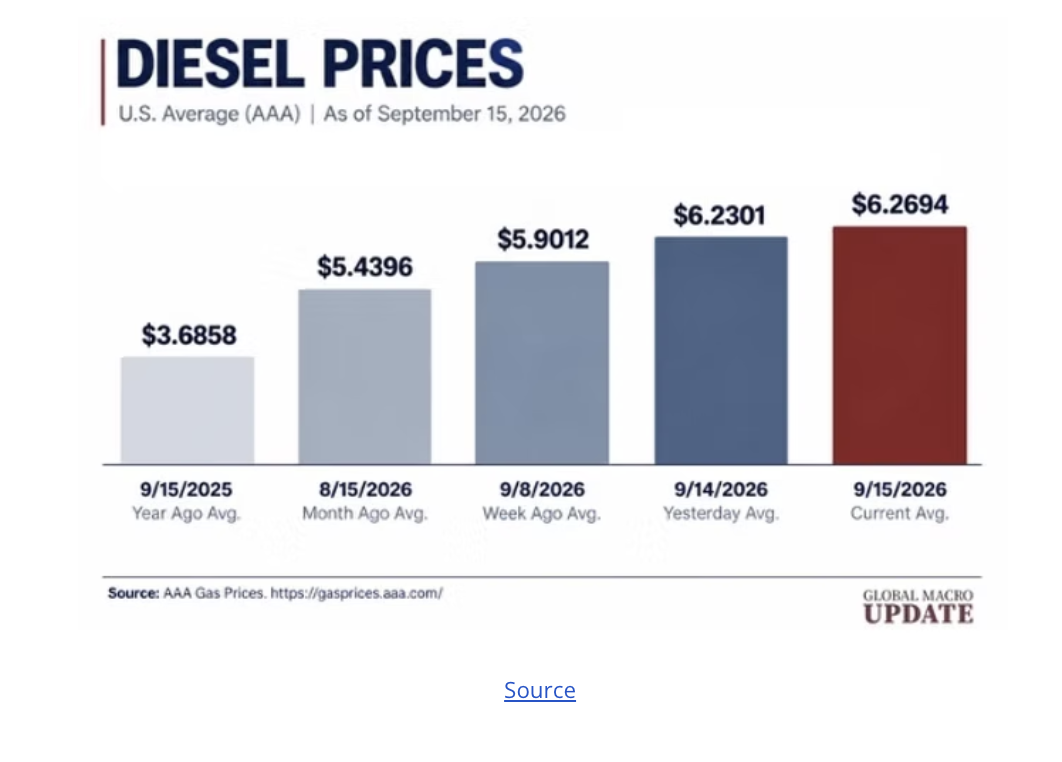
On September 15, AAA’s national average diesel price was $6.27 a gallon, compared with about $3.69 a year ago— a roughly 70% increase. Today’s price is the highest on record, but it is not the most expensive diesel has ever been. In 2008, AAA’s national diesel average peaked near $4.76 a gallon. Adjusted for inflation, that’s more than $7 a gallon in today's dollars.
Either way, a 70% increase in a single year is an enormous shock to the economy.
Even if diesel prices were to fall from here, the shock will be working its way into grocery bills, freight charges, construction costs and home heating bills for many months.
See more: Financial Markets Still Grappling with High Oil Prices and Higher Interest Rates
What’s Up with Diesel?
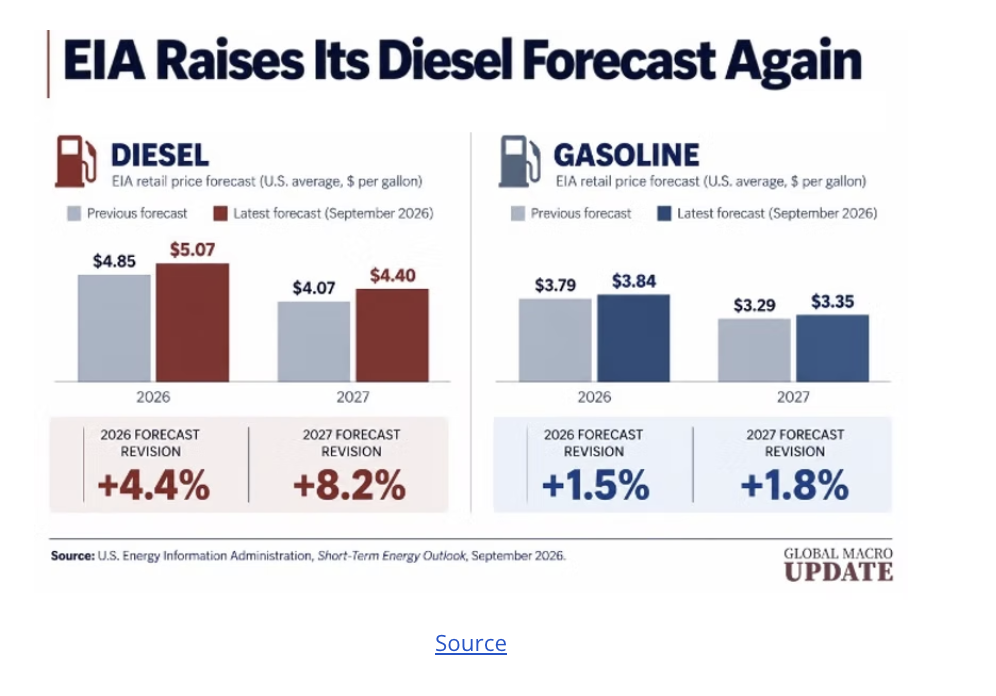
In its September forecast, the Energy Information Administration raised its outlook for diesel prices. It now expects diesel to average $5.55 a gallon in the fourth quarter, up from $4.86 in its August forecast.
EIA also raised its 2026 and 2027 diesel forecasts by 4.4% and 8.2%, respectively, far more than its 1.5% and 1.8% increases for gasoline. That’s well below today’s $6.27 national average, so EIA expects prices to ease from here, not stay at record levels. [1]
What is unique about diesel, and why is its price outpacing oil and gasoline?
EIA expects U.S. distillate inventories (the category that includes diesel and heating oil) to fall below 100 million barrels in October, for the first time since 2003, and remain below the five-year range through the first quarter of 2027.
At the same time, refiners were already running at about 98% of capacity in late August, the highest utilization rate since 2018. In one sense that’s good news: refineries are responding to high prices by making more fuel.
The problem is they are already running near full capacity. That leaves less room to offset another supply disruption: an outage, a hurricane, a refinery accident or a further escalation of conflicts in the Middle East and Russia/Ukraine.
There may not be much relief coming. Several refiners have delayed planned maintenance to keep their refineries operating. At some point, they have to do the maintenance or risk an unplanned failure. Industry executives warn that diesel and heating-oil markets could remain tight well into next year, even if the Iran conflict ends.
This is not simply a U.S. problem. Diesel trades in a global market. When barrels are scarce abroad, foreign buyers compete with American truckers, farmers, construction firms and oil-heated households for fuel. The American Petroleum Institute reports that global refining capacity is down approximately 10%. This is due to missile and drone strikes on refineries in Russia and the Middle East. Further adding to the global shortage is China, which has been limiting diesel exports to the rest of Asia to preserve domestic supply.
This brings us back to inflation. The effect of a tight diesel market does not end at the pump. Higher fuel costs work their way through the economy and eventually into household budgets.
And that is what concerns me about diesel. Its price has already risen dramatically, but some of its effect on the economy may still be ahead of us, either in higher prices or lower profit margins if companies cannot pass the cost on to consumers.
Winter Is Coming
For millions of households, winter means heating oil bills. Heating oil and diesel come from the same distillate pool. The differences are minimal, coming down to dyes for color and additives to help with either engine combustion or tank storage. You can run a diesel engine on heating oil, and you can fire your oil furnace with diesel.
The timing of this shortage is not ideal. Refineries typically reduce diesel and heating-oil production during the fall for planned annual facility maintenance. Inventories are built up in advance to ensure farmers have the extra diesel needed for harvest. Then winter adds heating-oil demand. But as we know, inventories are quite low this fall.
In late August, the National Energy Assistance Directors Association estimated that a representative household using 450 gallons of heating oil could spend about $2,497 this winter, roughly $707 more than during the 2025–26 heating season.
NEADA based that estimate on a heating-oil price of about $5.55 a gallon. It said the figure was an estimate, not an official August residential-heating-oil quote, derived from the relationship between retail heating-oil and diesel prices during the prior heating season. [2]
Since that analysis was published, diesel has become still more expensive. AAA’s national average reached $6.27 a gallon on September 15, compared with about $3.69 a year earlier. That does not tell us precisely what every household will pay for heating oil this winter. But it is a reminder that NEADA’s late-August estimate was made before the latest increase in price. [3]
Let me try to put this into real dollar terms. Last winter, I relied primarily on oil to heat my New England home. It was a cold winter. On many days the electric heat pump did not make economic sense. Oil was the cheaper option. A typical monthly oil delivery was about 150 gallons and cost around $550.
A 60% increase would put a delivery to my home at roughly $900. Ouch! Thankfully, I can pay it. It won’t change my lifestyle. But for many, it will force hard decisions and uncomfortable compromises. If you are on a fixed income or living paycheck-to-paycheck, an increase like that is a serious problem.
For them, from their very real perspective, inflation will be sky high.
Diesel may be telling us we’re not quite out of the woods yet when it comes to inflation. Based on the Fed’s rate hike this week, they seem to agree. We are all diesel buyers, whether we realize it or not.
Let me know what you think—reply to this note or drop a comment.
Thanks for reading.
Ed D’Agostino
Partner & COO
[1] https://www.eia.gov/outlooks/steo/pdf/steo_full.pdf
[2] https://neada.org/wp-content/uploads/2026/08/Iran-War-Family-Energy-Prices-Press-Release-Aug-28-2026.pdf
[3] gasprices.aaa
A message from Advisor Perspectives and VettaFi: Discover something new! Click here to register for our upcoming webcasts.
© Mauldin Economics
More Inflation Topics >