Trump Accounts for Business Owners: Two Decisions, Not One
Membership required
Membership is now required to use this feature. To learn more:
View Membership Benefits
Key Takeaways
- The account arrives twice: A founder decides once as a parent, choosing where a child’s capital belongs, and again as an employer, weighing whether to fund contributions as a benefit.
- Some business owners cannot participate: Under the proposed regulations, partners, sole proprietors, and more than 2% S corporation shareholders are excluded from Section 128 participation, even though their businesses can establish programs for eligible employees.
- December 31 is a real deadline: Unlike an IRA, a Trump Account has no prior year contribution window, so a contribution made in January counts against the new year.
Most coverage of Trump Accounts treats them as a parenting question, or a discussion comparing them to 529s. For founders and business owners the analysis of them is slightly more nuanced.
That’s because the discussion and use of Trump accounts shows up twice for the family:
- The first is at the kitchen table, where the question is whether a child’s education savings belongs here or in a 529
- And the second at the family’s business, where the question is whether the company should fund contributions, and whether the owner can participate at all.
These accounts have different rules, different benefits, and different trade-offs vs. 529s, which often results in different answers for their usage. Both are easier to settle when the purpose of the capital drives account selection.
Below is an overview of how this plays out for business owners.
What a Trump Account Actually Is
First some quick background: A Trump Account under IRC Section 530A is a traditional IRA for a child with a valid Social Security number who has not reached age 18 by the end of the calendar year of the election. The child owns it and an adult serves as responsible party during minority. Special rules apply through December 31 of the year before the child turns 18, which the statute calls the growth period.
Specifically:
- Contribution limit: Family and employer contributions combined are generally capped at $5,000 per child per year, indexed after 2027, with the one time $1,000 federal pilot contribution sitting outside that limit.
- Investments and access: Holdings are generally limited to broad U.S. equity index funds with expenses capped at 0.1% under proposed regulations, and distributions are generally prohibited during the growth period.
- After the growth period: Traditional IRA rules generally take over. Family contributions generally create basis, while the federal pilot contribution and qualifying Section 128 employer contributions do not, so money the company puts in eventually comes back to the child as ordinary income in full.
The December 31 Deadline That Does Not Work Like an IRA
Only contributions made by the last day of the calendar year count for that year. There is no prior year window running to the tax filing deadline, so a contribution funded in January 2027 is a 2027 contribution and the 2026 limit is gone. For a payroll-based program, the last pay period is the last real chance.
The Parent Decision: Where a Child’s Capital Belongs
Set the company aside. As a parent, the account competes with tools you already use for education savings. So the discussion is really about a Trump account vs each of the following:
- 529: For education money the 529 is cleaner, because qualified distributions can come out free of federal income tax while Trump Account earnings come out as ordinary income. Many states offer a state income tax deduction for 529 contributions, and Pennsylvania allows up to $19,000 per beneficiary in 2026.
- UTMA or taxable account: Both allow unlimited contributions and an open investment menu, while the Trump Account trades that flexibility for tax deferral and restricted access.
Where a Trump Account wins: As long-term capital for a child with no defined purpose, and as the only way to capture the $1,000 federal contribution and employer money that would not otherwise exist.
Using an early IRA distribution for education may avoid the 10% additional tax, but avoiding a penalty is not the same as receiving tax free money. Families funding education at scale should look at 529 superfunding before adding here.
The Employer Decision: How Section 128 Programs Work
Basic use case aside, for founders and business owners the question of using a Trump account diverges from the parent question entirely.
Section 128 establishes the basic program, while proposed Treasury regulations issued in August 2026 fill in many of the operational details described below. Those regulations are not final, with comments due September 25, 2026, so an employer implementing a program should confirm the rules in effect at the time.
And as of this writing, they are as follows:
- The cap: Up to $2,500 per employee per year, indexed after 2027, applied across all of an employee’s employers rather than per job or per child.
- The tax treatment: Income tax exclusion only. Contributions generally remain wages for FICA and FUTA, and in Pennsylvania can be taxable compensation for state purposes.
- The written plan: A separate written document is contemplated, covering eligible classes of employees, how contributions work, how employees designate an account, the plan year, and error correction.
- Notice and reporting: Employees would receive notice of the terms, annual statements are due by January 31, and contributions are reported on Form W-2 in box 12 using code TA.
- Nondiscrimination: The program cannot favor highly compensated employees, and average benefits for employees who are not highly compensated must generally reach at least 55% of the average for those who are.
- ERISA: Under Department of Labor Technical Release 2026-02, these programs generally fall outside ERISA Title I where participation is voluntary and the employer does not influence investments, restrict use of funds, or present the accounts as employer sponsored.
Bottom Line: An employer that matches the government’s $1,000 pilot contribution uniformly across eligible employees gets relief from two of the three nondiscrimination tests.
The Catch for Owners: Who Can Actually Participate
This is the part that changes the decision for most of our clients. The proposed regulations define “employee” using the common law standard and exclude self-employed individuals, drawing that list from Section 1372(b).
So the actual ability for a business owner to participate depends on how the business is organized. And that breaks down as follows:
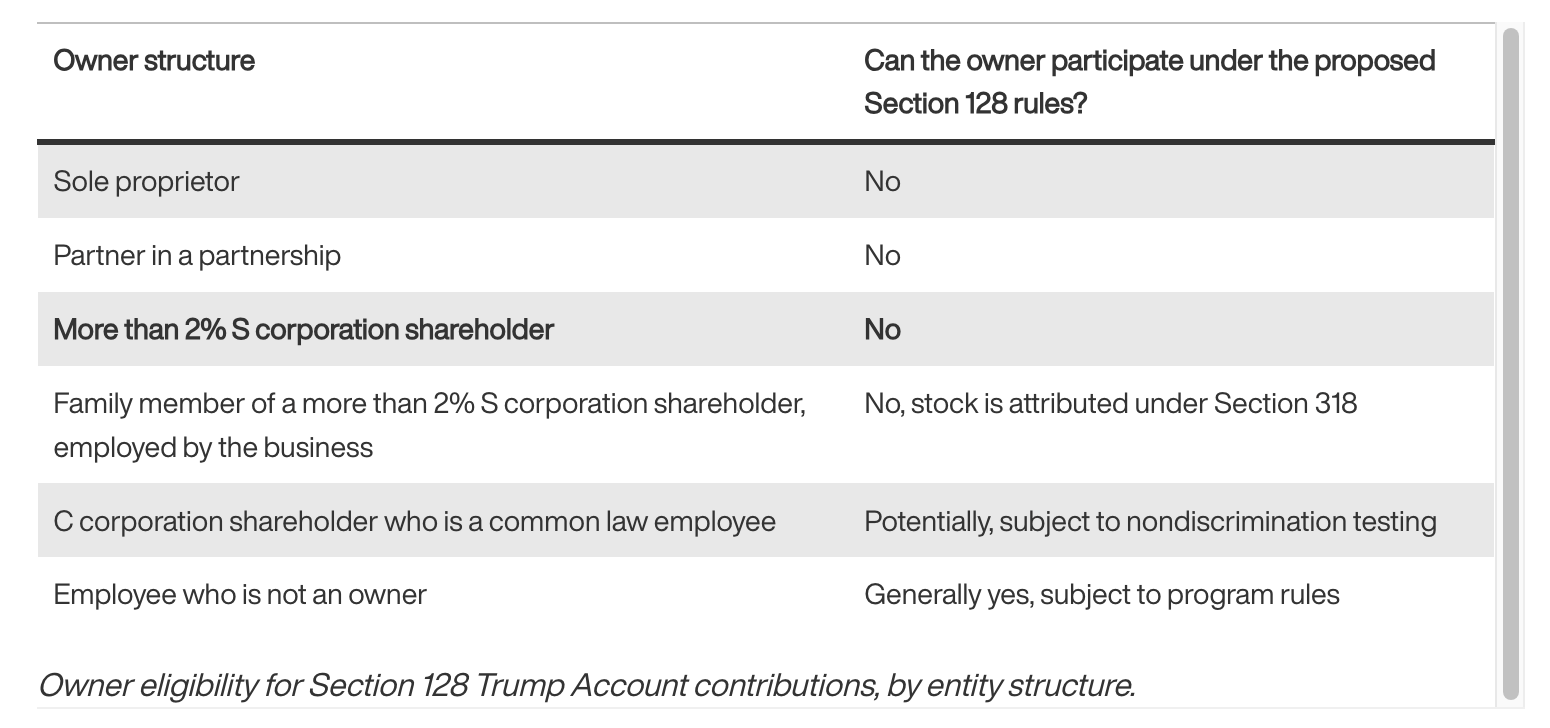
The attribution row (bolded) is the one most owners miss. Section 1372(b) counts someone as a more than 2% shareholder if they own, or are considered as owning under Section 318, more than 2% of the stock, and Section 318 attributes stock among spouses, children, grandchildren, and parents. In an S corporation, a spouse or child on payroll is generally excluded as well. This works as a family rule, not an individual one.
Bottom line: A C corporation shareholder who is a genuine common law employee is not categorically excluded, but being eligible is not the same as unconstrained. A founder in that position is almost certainly a highly compensated employee, and the nondiscrimination tests exist precisely to limit how much benefit flows to that group.
Example: Two Founders, Two Answers
Assume a founder owns 100% of an S corporation with 20 employees and two young children. She reads that employers can contribute $2,500 and assumes the company can fund her children’s accounts.
It generally cannot, at least not on a tax favored Section 128 basis, because she is a more than 2% S corporation shareholder. Adding her spouse to payroll does not solve it either, since Section 318 attributes her stock to him. The company can still run a qualifying program for its other employees and generally deduct those contributions.
Now change one fact. If the same business were a C corporation and she received wages as a genuine common law employee, she is not categorically excluded, though the answer still turns on employee status and nondiscrimination testing she will face as a highly compensated employee.
Same $2,500, same intent, different answer, and the difference is an entity election made years earlier.
Is $2,500 Per Employee the Best Use of the Same Benefit Dollar?
Even when the program works, it competes for the same dollar as everything else on the benefits menu.
- Against a retirement match: A retirement contribution generally receives more favorable payroll tax treatment and reaches employees whether or not they have young children.
- Against an HSA contribution: An HSA avoids income and payroll taxes and can be used now, and unlike a Section 128 contribution it is not fully taxable to the recipient later.
Where does it work best? In our view, as a recruiting signal in a workforce with young families, particularly for a company competing against larger employers on something other than salary.
Ultimately this is a culture decision with a modest tax benefit attached, not a tax strategy with a culture benefit attached. It belongs in the same conversation as every other decision where the business and the personal balance sheet meet.
What We Are Telling Clients
The decision to open the account is easy, especially for parents with children born within the $1,000 bonus qualifying period. The decision after it is where the discussion happens.
Here is how we’re talking with our clients about it, although each situation is different:
- Claim the $1,000 when the child qualifies: Declining free investment capital rarely improves a plan, and the election takes minutes.
- Keep education money in the 529: The tax treatment is better for its stated purpose, and in Pennsylvania the deduction widens the gap.
- Check your entity first: Whether you can participate turns on how the business is organized and, in an S corporation, on attribution to family members.
- Evaluate the program as a benefit, and watch the calendar: Run it against a match increase or an HSA contribution using the same dollar, and fund anything intended for this year by December 31.
For a family with a meaningful balance sheet, $5,000 a year into a child owned account is a savings tool, not a comprehensive wealth transfer strategy. Choose the structure based on what the capital is meant to accomplish, and in the employer’s case on what the benefit is meant to accomplish. The employer regulations are still proposed, so confirm anything here against current guidance and your own tax counsel.
If you are weighing both decisions at once, this is where business advisory and family wealth planning meet.
Frequently Asked Questions
Can an S corporation owner receive employer Trump Account contributions for their own children?
Generally no. The proposed regulations exclude more than 2% S corporation shareholders, and Section 1372(b) applies Section 318 attribution, so a spouse or child on payroll is generally excluded too. The company can still fund contributions for employees who are not owners and generally deduct them.
Can a C corporation owner participate?
A C corporation shareholder who is a genuine common law employee is not categorically excluded the way partners, sole proprietors, and more than 2% S corporation shareholders are. Eligibility still depends on common law employee status and on nondiscrimination testing, which a founder will face as a highly compensated employee.
Are employer Trump Account contributions taxable to the employee?
Qualifying Section 128 contributions are excluded from the employee’s federal income tax but generally remain wages for FICA and FUTA. They also do not create basis, so the full amount eventually comes out of the child’s account as ordinary income. Pennsylvania may treat them as taxable compensation.
When is the Trump Account contribution deadline?
Only contributions made by the last day of the calendar year count for that year. Unlike an IRA, there is no prior year window extending to the tax filing deadline, so a contribution funded in January applies to the new year and the prior year’s limit goes permanently unused.
Please read important disclaimers here.
A message from Advisor Perspectives and VettaFi: Discover something new! Click here to register for our upcoming webcasts.
Membership required
Membership is now required to use this feature. To learn more:
View Membership Benefits