One AI Trade for Now, Many Trades Later
Membership required
Membership is now required to use this feature. To learn more:
View Membership Benefits
Key takeaways
- Moving in unison, for now. The AI financing chain spans a spectrum from more generalist hyperscalers to more specialized neoclouds, yet, in contrast to the equity market, dispersion in credit performance remains limited.
- A more varied outlook ahead. Given that the current funding gap for AI capex will likely persist, debt issuance will likely continue to expand, bringing a wider variety of issuers, structures, and risk exposures to market. That variety should create more room for differentiation.
- Focus on downside mitigation. Credit investors finance the AI buildout but capture relatively little of its upside, making risk mitigation more important than winner selection. Even if adoption, monetization, and capex reinforce one another, debt investors still need to ask whether spreads adequately compensate them for obsolescence, re-contracting, and refinancing risk.
Is the AI infrastructure buildout one big trade in credit? So far, the market seems to think so. Spread dispersion – differences in borrowing costs among issuers – across the financing chain remains limited despite sharp differences in underlying risk. This contrasts with equities, where performance has become increasingly differentiated. In both investment grade (IG) and high yield (HY) credit, AI-related debt has underperformed broader indices quarter-to-date, according to Bloomberg index data.
For debt investors, the proposition is fundamentally asymmetric: They finance the AI buildout without directly participating in much of its economic upside. Returns are largely contractual, driven by coupon, principal, and, at most, some spread compression. On the other hand, the risks span leverage, execution, utilization, technological obsolescence, and refinancing.
As shown in Figures 1 and 2, AI capex is still poised to absorb enormous amounts of capital, while the funding gap is likely to persist. As a result, debt supply should continue to grow, bringing a wider variety of issuers, structures, and risk exposures to market. That variety should create more room for differentiation. And with time, investors should gain greater clarity on where the economic value of the AI buildout ultimately accrues.
See more: Strengths & Weaknesses of Advisor Fee–Only Models from the Client Perspective
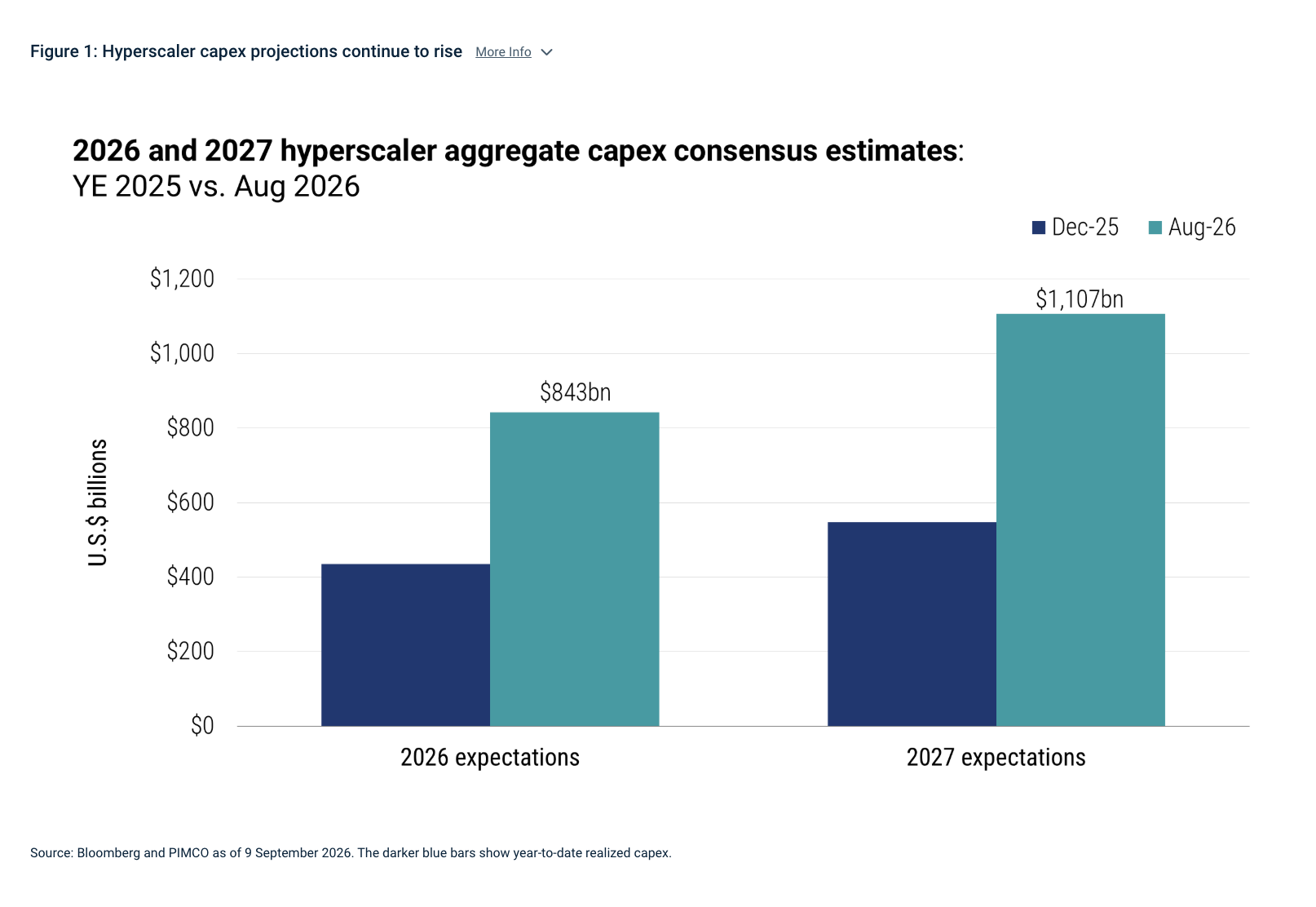
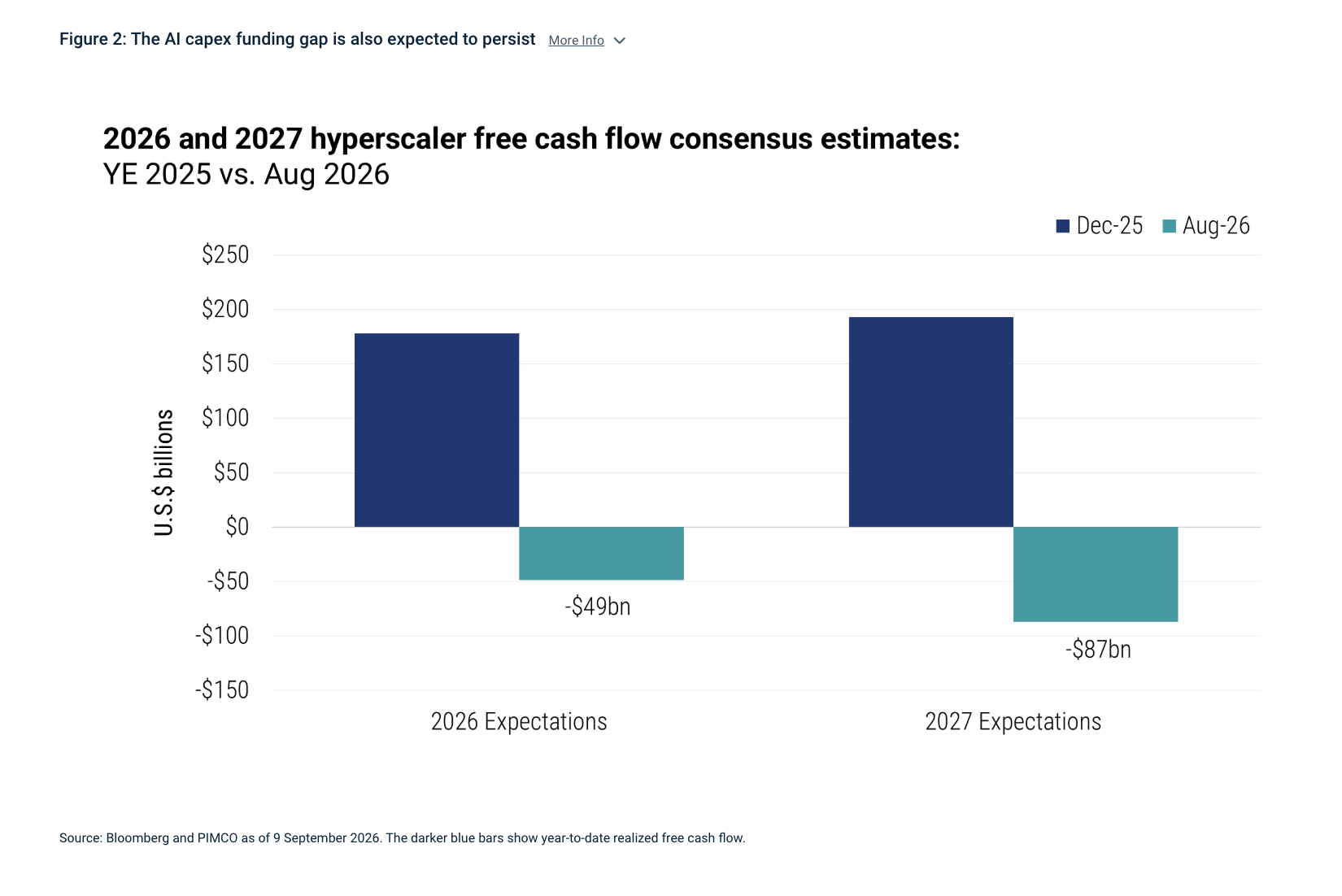
Revisiting the taxonomy of the AI financing supply chain
For credit investors, the AI question is not simply who wins the race, but who is left holding the risk. The financing chain spans a spectrum: hyperscaler corporate debt, hyperscaler-tenanted data centers, neocloud-tenanted data centers, and, finally, neocloud debt.
- Debt issued by hyperscalers. Diversified businesses, strong cash flows, and large balance sheets largely insulate creditors from the economics of any single data center, model, or GPU cluster. Utilization and technology risk remain inside the enterprise rather than passing to lenders.
- Debt issued by hyperscaler-tenanted data centers. These assets typically serve one internal customer: the hyperscaler, which uses the capacity across its broader cloud and AI ecosystem. Creditors primarily underwrite the tenant’s balance sheet and lease, not utilization at a specific site. Construction risk depends on completion obligations; lease protections depend on guarantees, termination rights, and delay remedies. Once operational, utilization and technology risk largely remain with the tenant, which can replace obsolete GPUs while continuing to use the same shell and power infrastructure. The main trade-off is single-tenant concentration and remarketing risk at lease expiry.
- Debt issued by neocloud-tenanted data centers. These assets may look similar physically, but they are more exposed economically to end-user demand. Creditors indirectly underwrite the neocloud’s ability to resell compute capacity profitably, which depends on utilization, pricing, customer retention, and access to capital. Diversified customers and contracted backlog help, but the duration mismatch is hard to ignore: Leases can outlast GPUs, GPUs can outlast customer contracts, and debt can outlast both. As contracts roll and hardware ages, the neocloud must re-contract capacity at attractive economics while funding continuous reinvestment, making execution and refinancing risk more central.
- Neocloud debt. This is the furthest point on the spectrum: direct exposure to utilization, pricing, customer concentration, technology-refresh, and refinancing risk, with the fewest contractual protections and the least asset coverage.
These categories are not hermetically sealed. Vendor financing, hyperscaler equity stakes in neoclouds, and residual-value backstops create linkages, while a hyperscaler guarantee can be softer than it appears. Still, the direction of travel is clear: Moving from hyperscaler debt toward neocloud debt, utilization and residual-value risk migrate steadily from the hyperscaler balance sheet to the creditor.
That migration is most visible at the extremes, and hyperscaler credits may offer the cleanest risk/return profile at the tails, meaning the best- and worst-case scenarios. In the good scenario, spread upside is limited because successful monetization is likely to prolong the capex cycle and keep issuance elevated, but the credit story is reinforced by scale, cash flow, and strategic control. In the bad scenario, balance sheet flexibility and rapid capital discipline provide meaningful protection, provided that discipline arrives quickly enough.
The left tail: What happens in an AI-sector bust?
For hyperscaler creditors, the first-order effect is disappointing returns on AI investment. Paradoxically, the second-order effect could be credit-positive: Capex falls, free cash flow recovers, and the issuance pipeline shrinks. The same shock that undermines the AI investment case could improve hyperscaler credit metrics. The catch is speed: Competitive dynamics, sunk power costs, lease commitments, and contracted equipment purchases could keep capex sticky even in a downturn, so the paradox only holds if capital discipline follows quickly.
It is also worth separating improving credit metrics from improving technical conditions for spreads. Hyperscaler capex is increasingly debt-funded rather than cash-funded, so a pullback that strengthens leverage and coverage ratios could still coincide with elevated net issuance if near-term maturities need refinancing.
Hyperscaler-tenanted data centers should remain relatively resilient, provided contractual protections hold. Neocloud-tenanted facilities face a harder question: Can the tenant keep honoring a 10- to 15-year lease if utilization and compute economics deteriorate? If not, and if lease rejection in bankruptcy caps landlord claims well below remaining contract value, recovery hinges on re-leasing the facility and on the value of its power access in a market likely facing excess capacity in a downturn scenario. In other words, contractual protection is weakest exactly when it is needed most. Neocloud debt would absorb the largest share of the downside, as falling utilization weakens profitability while faster obsolescence erodes GPU asset values.
Revisiting the taxonomy of the AI financing supply chain
For credit investors, the AI question is not simply who wins the race, but who is left holding the risk. The financing chain spans a spectrum: hyperscaler corporate debt, hyperscaler-tenanted data centers, neocloud-tenanted data centers, and, finally, neocloud debt.
- Debt issued by hyperscalers. Diversified businesses, strong cash flows, and large balance sheets largely insulate creditors from the economics of any single data center, model, or GPU cluster. Utilization and technology risk remain inside the enterprise rather than passing to lenders.
- Debt issued by hyperscaler-tenanted data centers. These assets typically serve one internal customer: the hyperscaler, which uses the capacity across its broader cloud and AI ecosystem. Creditors primarily underwrite the tenant’s balance sheet and lease, not utilization at a specific site. Construction risk depends on completion obligations; lease protections depend on guarantees, termination rights, and delay remedies. Once operational, utilization and technology risk largely remain with the tenant, which can replace obsolete GPUs while continuing to use the same shell and power infrastructure. The main trade-off is single-tenant concentration and remarketing risk at lease expiry.
- Debt issued by neocloud-tenanted data centers. These assets may look similar physically, but they are more exposed economically to end-user demand. Creditors indirectly underwrite the neocloud’s ability to resell compute capacity profitably, which depends on utilization, pricing, customer retention, and access to capital. Diversified customers and contracted backlog help, but the duration mismatch is hard to ignore: Leases can outlast GPUs, GPUs can outlast customer contracts, and debt can outlast both. As contracts roll and hardware ages, the neocloud must re-contract capacity at attractive economics while funding continuous reinvestment, making execution and refinancing risk more central.
- Neocloud debt. This is the furthest point on the spectrum: direct exposure to utilization, pricing, customer concentration, technology-refresh, and refinancing risk, with the fewest contractual protections and the least asset coverage.
These categories are not hermetically sealed. Vendor financing, hyperscaler equity stakes in neoclouds, and residual-value backstops create linkages, while a hyperscaler guarantee can be softer than it appears. Still, the direction of travel is clear: Moving from hyperscaler debt toward neocloud debt, utilization and residual-value risk migrate steadily from the hyperscaler balance sheet to the creditor.
That migration is most visible at the extremes, and hyperscaler credits may offer the cleanest risk/return profile at the tails, meaning the best- and worst-case scenarios. In the good scenario, spread upside is limited because successful monetization is likely to prolong the capex cycle and keep issuance elevated, but the credit story is reinforced by scale, cash flow, and strategic control. In the bad scenario, balance sheet flexibility and rapid capital discipline provide meaningful protection, provided that discipline arrives quickly enough.
The left tail: What happens in an AI-sector bust?
For hyperscaler creditors, the first-order effect is disappointing returns on AI investment. Paradoxically, the second-order effect could be credit-positive: Capex falls, free cash flow recovers, and the issuance pipeline shrinks. The same shock that undermines the AI investment case could improve hyperscaler credit metrics. The catch is speed: Competitive dynamics, sunk power costs, lease commitments, and contracted equipment purchases could keep capex sticky even in a downturn, so the paradox only holds if capital discipline follows quickly.
It is also worth separating improving credit metrics from improving technical conditions for spreads. Hyperscaler capex is increasingly debt-funded rather than cash-funded, so a pullback that strengthens leverage and coverage ratios could still coincide with elevated net issuance if near-term maturities need refinancing.
Hyperscaler-tenanted data centers should remain relatively resilient, provided contractual protections hold. Neocloud-tenanted facilities face a harder question: Can the tenant keep honoring a 10- to 15-year lease if utilization and compute economics deteriorate? If not, and if lease rejection in bankruptcy caps landlord claims well below remaining contract value, recovery hinges on re-leasing the facility and on the value of its power access in a market likely facing excess capacity in a downturn scenario. In other words, contractual protection is weakest exactly when it is needed most. Neocloud debt would absorb the largest share of the downside, as falling utilization weakens profitability while faster obsolescence erodes GPU asset values.
The right tail: A virtuous circle of adoption, monetization, and capex
The upside case is almost, but not exactly, the opposite of the bust scenario. Suppose adoption accelerates, monetization becomes tangible, and infrastructure supply stays broadly aligned with demand. Neocloud credits would see the greatest cyclical improvement: Higher utilization supports pricing and cash flow, leverage declines passively, and refinancing gets easier. Neocloud-tenanted data centers benefit too, as leases that once looked like leveraged bets on future demand begin to resemble durable contracted cash flows.
Even so, much of the upside is concentrated in equity investments. Strong demand does not turn neocloud infrastructure into hyperscaler credit: GPUs can become obsolete before leases mature, contracts can roll before the lease or debt, capacity may re-contract on weaker terms, and the debt must still be refinanced. Strong demand mitigates utilization risk; it does not eliminate obsolescence, re-contracting, or refinancing risk.
Hyperscaler-tenanted data centers would also benefit, though with less upside from a credit standpoint because much of the favorable outcome is already embedded in their contractual protections. Hyperscaler corporate debt could even lag: Successful monetization validates further investment, prolongs the capex cycle, and keeps issuance elevated. Shareholders capture the economic upside; bondholders mostly face another round of supply.
Michael Puempel and Gabriel Cazaubieilh contributed to this report.
The upside case is almost, but not exactly, the opposite of the bust scenario. Suppose adoption accelerates, monetization becomes tangible, and infrastructure supply stays broadly aligned with demand. Neocloud credits would see the greatest cyclical improvement: Higher utilization supports pricing and cash flow, leverage declines passively, and refinancing gets easier. Neocloud-tenanted data centers benefit too, as leases that once looked like leveraged bets on future demand begin to resemble durable contracted cash flows.
Even so, much of the upside is concentrated in equity investments. Strong demand does not turn neocloud infrastructure into hyperscaler credit: GPUs can become obsolete before leases mature, contracts can roll before the lease or debt, capacity may re-contract on weaker terms, and the debt must still be refinanced. Strong demand mitigates utilization risk; it does not eliminate obsolescence, re-contracting, or refinancing risk.
Hyperscaler-tenanted data centers would also benefit, though with less upside from a credit standpoint because much of the favorable outcome is already embedded in their contractual protections. Hyperscaler corporate debt could even lag: Successful monetization validates further investment, prolongs the capex cycle, and keeps issuance elevated. Shareholders capture the economic upside; bondholders mostly face another round of supply.
Michael Puempel and Gabriel Cazaubieilh contributed to this report.
Disclosures:
Statements concerning financial market trends or portfolio strategies are based on current market conditions, which will fluctuate. Outlook and strategies are subject to change without notice.
Past performance is not a guarantee or a reliable indicator of future results. Forecasts, estimates and certain information contained herein are based upon proprietary research and should not be considered as investment advice. There is no guarantee that stated results will be achieved.
Equity investments may decline in value due to both real and perceived general market, economic and industry conditions, while debt investments are subject to credit, interest rate and other risks. Investments with exposure to the artificial intelligence sector may involve heightened risks, including rapid technological change, competitive disruption, elevated valuations, regulatory uncertainty, data privacy and cybersecurity concerns, infrastructure dependencies, and reliance on third-party models or platforms. AI-related opportunities may not develop as expected, fail to produce anticipated productivity or revenue benefits, or be concentrated among a limited number of issuers, and could result in increased volatility or loss of capital. Real asset investments including data centers are subject to a variety of inherent risks such as economic and market risk, rental rates, location and physical condition of the properties, financial condition of tenants, buyers and sellers, operating costs, interest rates, energy prices, environmental laws and other regulatory liability, natural catastrophes, civil unrest and illiquidity. Corporate debt securities are subject to the risk of the issuer’s inability to meet principal and interest payments on the obligation and may also be subject to price volatility due to factors such as interest rate sensitivity, market perception of the creditworthiness of the issuer and general market liquidity.
PIMCO as a general matter provides services to qualified institutions, financial intermediaries and institutional investors. Individual investors should contact their own financial professional to determine the most appropriate investment options for their financial situation. This material contains the opinions of the author and such opinions are subject to change without notice. This material has been distributed for informational purposes only and should not be considered as investment advice or a recommendation of any particular security, strategy or investment product. Information contained herein has been obtained from sources believed to be reliable, but not guaranteed. No part of this material may be reproduced in any form, or referred to in any other publication, without express written permission. PIMCO is a trademark of Allianz Asset Management of America LLC in the United States and throughout the world.
CMR2026-0911-5919584
A message from Advisor Perspectives and VettaFi: Discover something new! Click here to register for our upcoming webcasts.
© PIMCO
Membership required
Membership is now required to use this feature. To learn more:
View Membership Benefits