The recent employment report provided reassurance that the US labor market remains resilient. The economy added 162,000 jobs in August; the previous two months’ gains were revised higher by a combined 55,000, and the unemployment rate held steady at 4.1%. Through the first eight months of 2026, payroll growth has averaged approximately 80,000 jobs per month, compared with our forecast of roughly 70,000 per month for the full year.
Although that forecast is well below the hiring pace recorded during the earlier post-pandemic expansion, comparing today’s job gains with yesterday’s standards can be misleading. The economy’s ability to maintain a stable unemployment rate depends not simply on how many jobs employers create, but also on how quickly the pool of available workers expands. That second part of the equation has changed considerably.
See more: Employment Report: 162K Jobs Added in August, Better Than Expected
A lower breakeven point
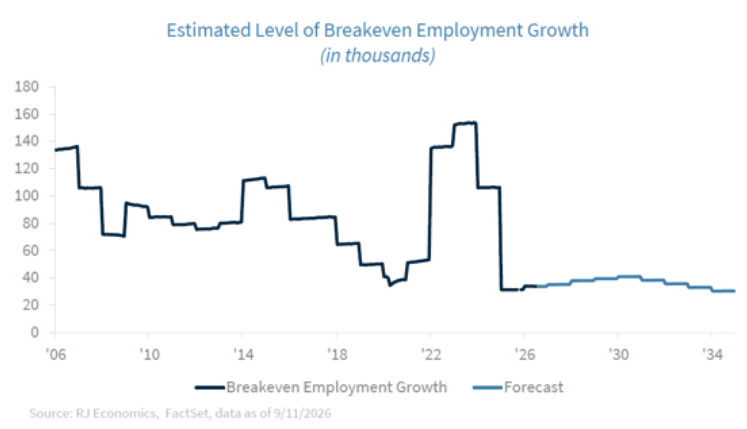
The breakeven rate of employment growth is the pace of job creation needed to keep the unemployment rate broadly unchanged. During the immigration-driven population surge earlier in the post-pandemic expansion, our estimates suggest that the monthly breakeven level of employment growth reached approximately 150,000 in 2023 and still over approximately 100,000 in 2024.
Today, our estimate places that breakeven level closer to 40,000 jobs per month. Against that benchmark, our forecast of approximately 70,000 monthly job gains looks considerably different: modest by historical standards, but still sufficient to absorb the expected increase in available workers without a sustained rise in the rate of unemployment.
This is an estimate, not a fixed threshold or a month-by-month rule. Nevertheless, the distinction is important. A payroll number that might previously have signaled insufficient hiring can now be consistent with a relatively balanced labor market. Two developments help explain the change: downward pressure on labor force participation and substantially slower population growth.
Labor force participation and population growth
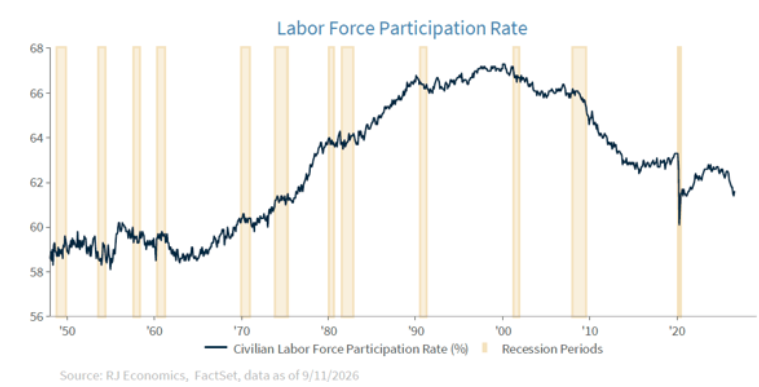
The labor force participation rate measures the share of the civilian, non-institutional population age 16 and older that is working or actively looking for work. Although participation edged higher to 61.6% in August, it remains 0.5 percentage points below its January level. More importantly, the recent decline is part of a longer trend, as labor force participation has generally moved lower since peaking at 67.3% around the turn of the century, as female participation in the labor force peaked, and reflects structural forces such as an aging population and the retirement of the baby boom generation.
Population aging is an important structural force behind the longer-term trend. As more people move into retirement, the pool of available workers decreases. The economy therefore needs fewer new jobs to keep unemployment stable, even though employers may still need to hire replacements for retiring employees.
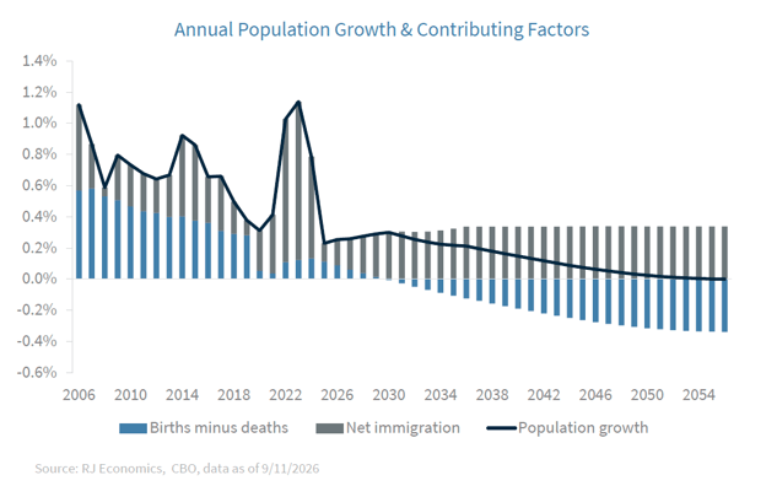
Immigration is the other major component. The Congressional Budget Office’s (CBO) estimates and projections show annual population growth slowing from more than 1% during the earlier immigration surge to roughly 0.25% around the start of its forecast period. Recent immigration policy changes account for much of the downward revision to projected population growth, alongside changes in fertility assumptions. CBO projects population growth averaging only about 0.3% annually over the next decade.
That outlook is not immutable. Different immigration policies under a future White House administration could change the trajectory, but the CBO’s baseline reflects existing policy assumptions rather than a presumed future reversal. However, currently, the CBO projects that annual deaths will exceed births beginning in 2030, making net immigration the sole source of population growth thereafter, and estimates population growth turning negative just past the middle of the century.
What this means for the Federal Reserve
The Federal Reserve’s (Fed) dual mandate is to promote maximum employment and stable prices and not to deliver a particular number of new jobs each month. The Fed explicitly recognizes that maximum employment changes over time as the structure of the labor market evolves. Its assessment must therefore extend beyond the headline payroll number.
In our view, the combination of a stable unemployment rate and job growth slightly above our estimated breakeven pace suggests that the employment side of the mandate remains in relatively good shape. This does not mean that slower labor force growth is an economic advantage. It means that a smaller monthly payroll gain is not, by itself, compelling evidence that the Fed needs to lower interest rates.
That leaves inflation as the more important driver of our near-term policy outlook. We believe policymakers have room to prioritize restoring price stability as long as employment conditions remain broadly balanced. This morning’s inflation report helps determine whether that means maintaining a patient stance or considering additional tightening.
A September hike in sight
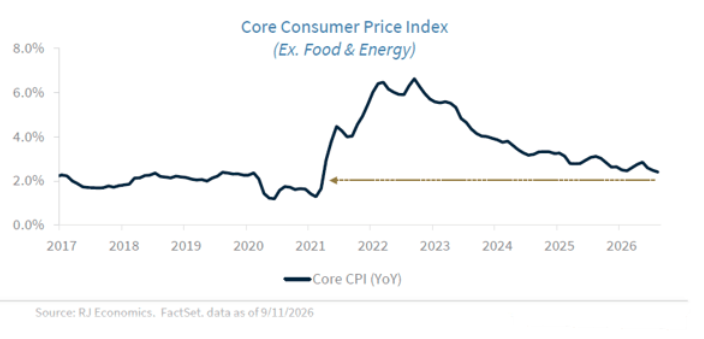
August’s Consumer Price Index (CPI) report delivered a mixed message on inflation. Headline prices rose 0.4% month over month and 3.4% from a year ago, while core inflation continued to move in the right direction on a year-over-year basis, easing to 2.4% from 2.5% in July. The monthly core reading was somewhat firmer than expected, but a closer look at the components suggests the upside surprise was not as troubling as the headline number might suggest.
Shelter was an important contributor to the stronger monthly reading, but even here there are reasons for caution when interpreting the acceleration. Shelter inflation had increased just 0.1% in each of the prior two months, partly because lodging away from home declined sharply. We had previously argued that World Cup-related distortions were likely complicating normal seasonal patterns in this category. That dynamic reversed in August, with lodging away from home rebounding and adding approximately 0.093 percentage point to shelter inflation after subtracting 0.113 and 0.098 percentage points, respectively, during the previous two months. Moreover, the reported 0.3% monthly increase in shelter was only 0.264% before rounding. In other words, some of August’s apparent acceleration represents a normalization of an unusually weak component rather than a meaningful resurgence in underlying shelter inflation.
The implications for next week’s Federal Reserve meeting are less straightforward. Markets are now assigning an 87% probability to another rate increase, and the combination of today’s CPI report, yesterday’s producer price data and the recent surge in gasoline and diesel prices has clearly strengthened the argument for additional tightening. Unless energy prices retreat quickly, headline inflation is also likely to face renewed upward pressure in the coming months, potentially interrupting the recent improvement in the inflation data.
We continue to believe the underlying inflation trends give policymakers a reasonable case for remaining patient. Core inflation is still moderating on a year-over-year basis and some of August’s monthly strength appears attributable to temporary or reversing factors. Nevertheless, the opportunity to wait may be narrowing. With the subsequent meeting occurring close to the midterm elections, when policymakers may be particularly sensitive to perceptions of political influence, September could represent a more natural window to act if the Committee believes another hike will ultimately be necessary.
While we believe the underlying details still provide the Fed with enough room to maintain its wait-and-see approach, market pressures are likely to push Federal Open Market Committee members to increase rates next week.
1Animal spirits refers to “the instinctive, emotional, and non-rational factors – such as confidence, hope, fear, and spontaneous optimism – that drive human financial decisions and business investments under conditions of deep uncertainty, rather than purely mathematical or rational calculations.” Source: tutor2u
Economic and market conditions are subject to change.
Opinions are those of Investment Strategy and not necessarily those of Raymond James and are subject to change without notice. The information has been obtained from sources considered to be reliable, but we do not guarantee that the foregoing material is accurate or complete. There is no assurance any of the trends mentioned will continue or forecasts will occur. Past performance may not be indicative of future results.
A message from Advisor Perspectives and VettaFi: Discover something new! Click here to register for our upcoming webcasts.
Links are being provided for information purposes only. Raymond James is not affiliated with and does not endorse, authorize or sponsor any of the listed websites or their respective sponsors. Raymond James is not responsible for the content of any website or the collection or use of information regarding any website's users and/or members.
Raymond James & Associates, Inc., member New York Stock Exchange / SIPC, and Raymond James Financial Services, Inc., member FINRA / SIPC, are subsidiaries of Raymond James Financial, Inc.
Raymond James® and Raymond James Financial® and power of personal® are registered trademarks of Raymond James Financial, Inc.
© Raymond James
Read more commentaries by Raymond James