I haven’t always taken the most conventional approach to economics. In a world where many practitioners construct elaborate models to arrive at conclusions, I often find more value in simply following my instincts. During stressful times and paradigm changes, thinking outside of the equations is essential.
There are times, however, when conventional approaches are the best ones. After almost two decades of unconventional policy, the Federal Reserve seems intent on turning back the clock.
During his recent speech to the Federal Reserve’s conference at Jackson Hole, Chairman Kevin Warsh asserted that “short-term interest rates are the predominant tool to achieve the [Fed’s] dual mandate. Unconventional policies to spur economic activity may suit genuine crises but should otherwise be used sparingly, if at all.”
This statement was a succinct critique of monetary policy since 2008. As the global financial crisis took hold, central banks reduced interest rates to very low (or, in some cases, negative) levels. It was clear, however, that those actions alone were not going to reverse the contraction of credit that threatened to produce a second Great Depression.
See more: A Little Now, or a Lot Later
Drawing on his study of the Depression, then-Fed Chair Ben Bernanke initiated a series of novel strategies. The central bank began quantitative easing, purchasing government bonds to bring down long-term interest rates and encourage investors stay in the markets. Other central banks followed suit, going to much greater lengths in their quests to restore financial stability.
Slowly but steadily, conditions improved. Debate continues over which components of the program were most effective, but that may miss the point. The Fed’s commitment to pursue a range of remedies over a long period of time steered sentiment in a manner that was conducive to recovery.
When the worst of the crisis had passed, there were questions as to whether unconventional policy should be unwound. The Fed chose to press on, expanding its balance sheet well into the following decade. Warsh, a member of the Board of Governors at the time, pushed back. In 2010, he expressed: “I am concerned that we are assuming too much efficacy from further securities purchases and too little risk from the expansion of our balance sheet.”
The Federal Reserve essentially prints money to pay for the securities it holds on its balance sheet. This adds reserves to the financial system, easing credit. While the links between reserves, the money supply and inflation are not as clear as they were forty years ago, it is still fair to say that more reserves can tend to put upward pressure on the price level.
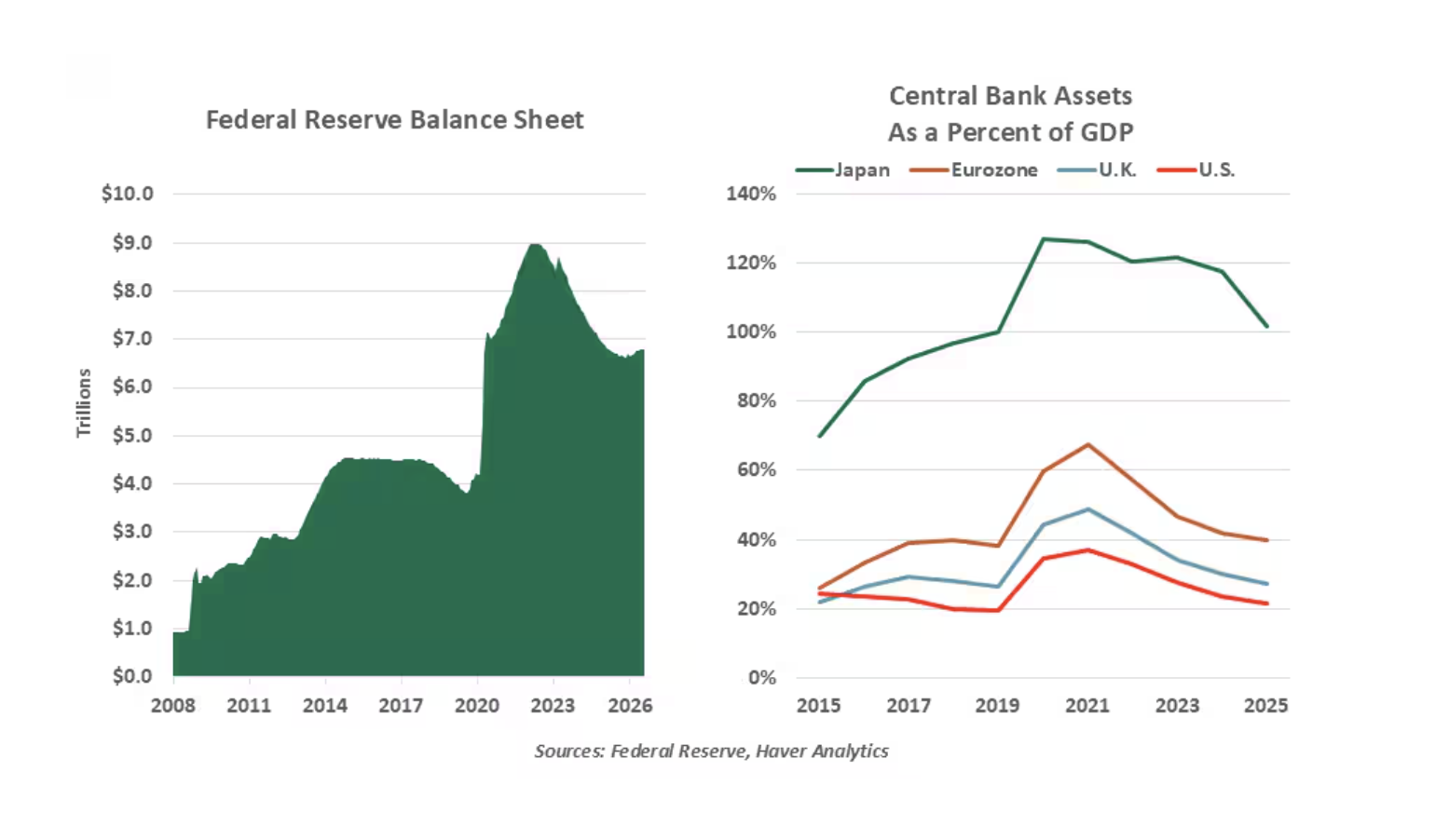
The Fed finally began reducing its balance sheet in 2018, but paused the effort the following year when financial conditions tightened. After expanding its asset purchases during the pandemic, the Fed initiated a second round of “quantitative tightening” in 2022. At present, the Fed’s total assets are about $2 trillion lower than their peak. The process hasn’t been entirely smooth; market liquidity has become thin at times during the last four years, leading to questions about how low the Fed’s balance sheet can go.
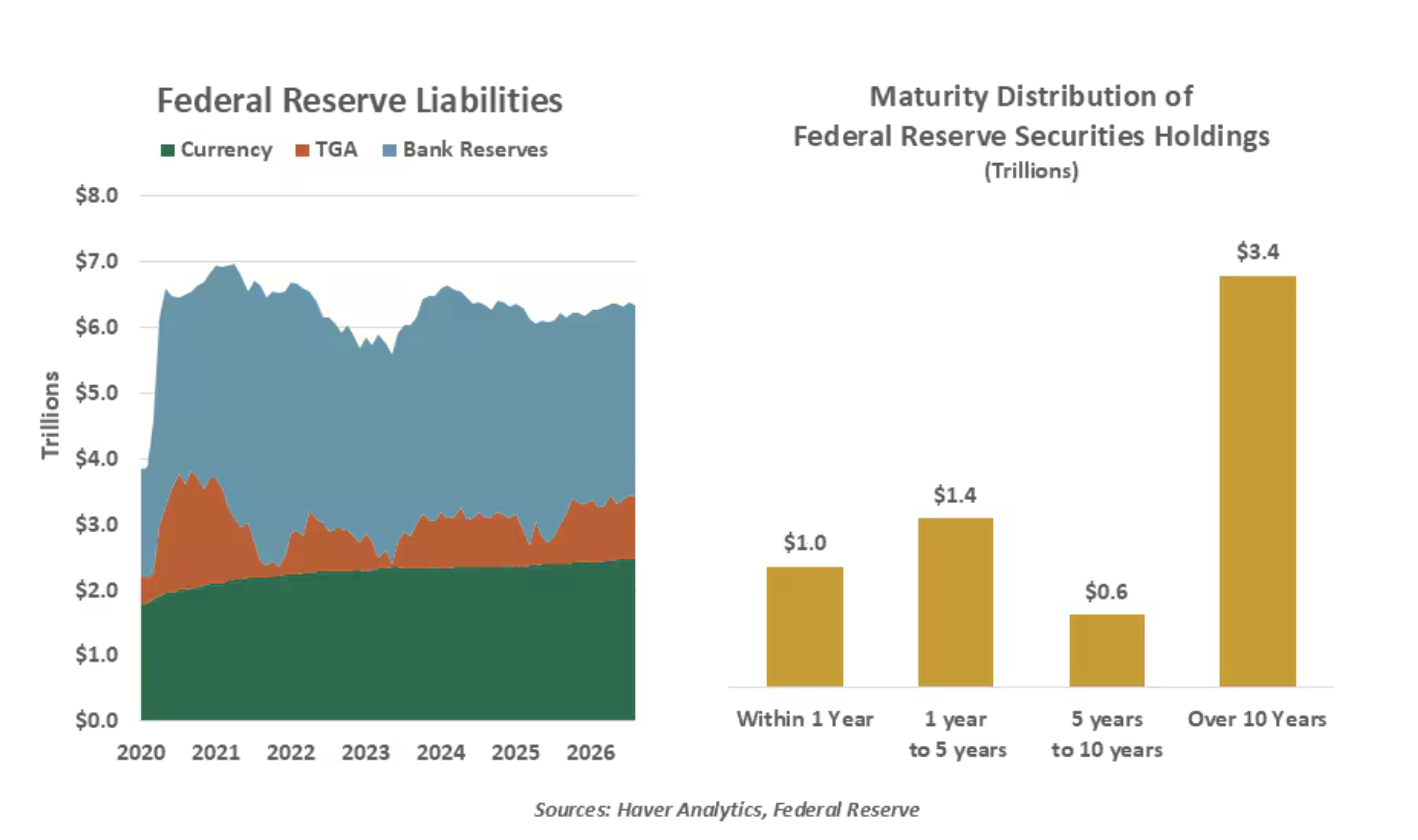
There has been a lot of research devoted to the neutral level of interest rates, which has informed the Fed’s thinking about whether policy is tight or easy. But there has been relatively little done to determine what an equilibrium level is for the Fed’s balance sheet. That answer depends, in part, on the Fed’s liabilities. These consist primarily of currency in circulation, reserves held by banks with the Fed, and the Treasury General Account (essentially, the government’s checking account). To reduce the balance sheet, the Fed would have to find a way to reduce one of these line items.
Currency seems an unlikely candidate, despite the broad shift to cashless forms of payments. Currency demand rises with the size of the economy; in addition, it is estimated that about half of all U.S. currency is held outside of the country. The Treasury must keep a buffer against seasonal swings in tax revenue, and holding less cash wouldn’t yield much balance sheet relief for the Fed. And so the focus is on bank reserves.
Banks hold twice as much money with the Federal Reserve system as they did prior to the COVID-19 pandemic. This has been prompted, in part, by a generous rate paid by the Fed on those balances: the interest rate on reserve balances (IOR) is currently 3.65%. They are fully liquid, carry no counterparty risk, and are treated favorably in measures of bank liquidity.
Fed officials are contemplating systems that would change bank demand for reserves. As described in a paper from the Federal Reserve Bank of Dallas, updating bank liquidity guidelines and increasing access to the Fed’s discount window would be means to this end. A reduction in the IOR, potentially achieved through a tiering system, would incent banks to purchase market-based liquid assets like Treasury bills. Increased demand from banks for government debt could therefore offset a large fraction of the Fed’s reduced holdings and keep yields stable.
The Fed has about $1 trillion in securities maturing within the next year. That will serve to bound the size of balance sheet reduction. The Fed will want to proceed with caution in any event, to remain attuned to any changes in market dynamics.
It is not immediately clear what effect this strategy will have on reserves, credit, or financial conditions. But it will be a form of monetary restraint that could reduce the need to raise interest rates if inflation persists.
The Fed may never get back to its conventions of 20 years ago, and it shouldn’t try. The economy and the financial system have changed a lot since then. But a return to some basic principles may be wise.
I’d sure like to return to the conventions of 20 years ago, when we didn’t face requests to post 30 second economic blasts on social media. I know we have to change with the times, but I am drawing the line on dancing while forecasting.
Carl Tannenbaum is the Chief Economist for Northern Trust.
Information is not intended to be and should not be construed as an offer, solicitation or recommendation with respect to any transaction and should not be treated as legal advice, investment advice or tax advice. Under no circumstances should you rely upon this information as a substitute for obtaining specific legal or tax advice from your own professional legal or tax advisors. Information is subject to change based on market or other conditions and is not intended to influence your investment decisions.
© 2026 Northern Trust Corporation. Head Office: 50 South La Salle Street, Chicago, Illinois 60603 U.S.A. Incorporated with limited liability in the U.S. Products and services provided by subsidiaries of Northern Trust Corporation may vary in different markets and are offered in accordance with local regulation. For legal and regulatory information about individual market offices, visit northerntrust.com/terms-and-conditions.
A message from Advisor Perspectives and VettaFi: Discover something new! Click here to register for our upcoming webcasts.
© Northern Trust
Read more commentaries by Northern Trust