In Part I of Indexing Redefined, the foundational strategies comprising Research Affiliates’ fundamental indexing methodology (RAFI) were introduced. More specifically, the article explained how fundamental indexing differentiates itself from a traditional market-cap-weighted approach, and the risks involved in tying portfolio weights directly to stock prices. By decoupling weight from price and selecting/sizing/rebalancing holdings by real-world economic scale, RAFI establishes a disciplined framework that systematically trims overextended stocks and buys underappreciated businesses.
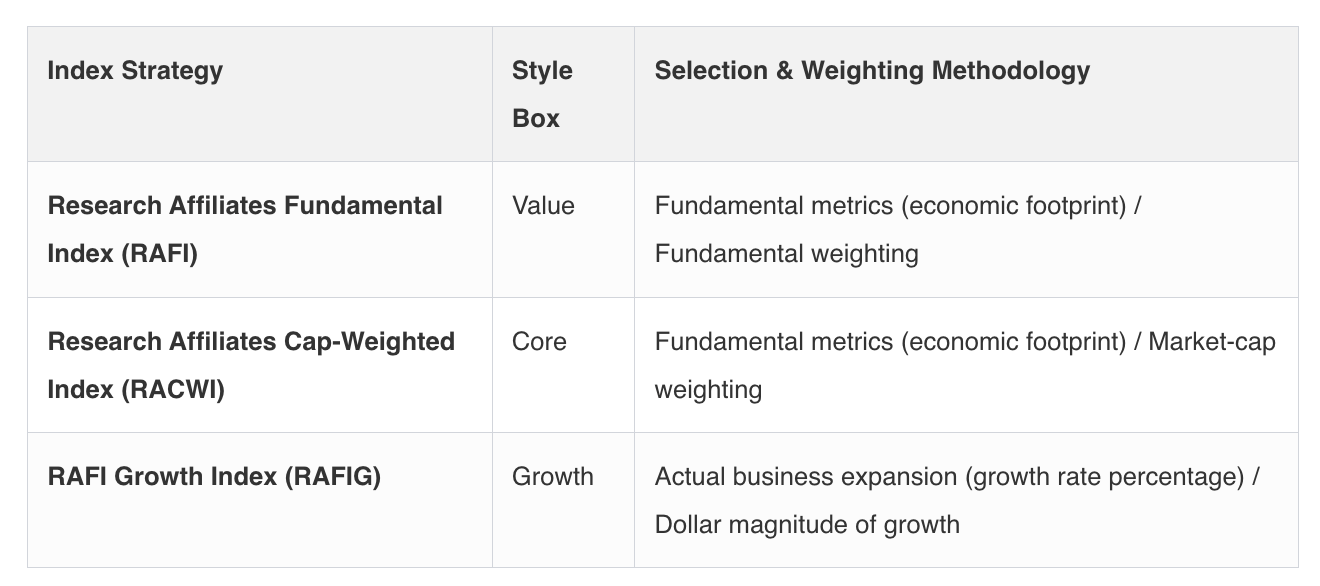
With the baseline premise established, there is one myth to debunk: Some detractors may assume that RAFI is merely a niche value strategy. In reality, anchoring portfolio weights to economic reality redefines how portfolio allocations are constructed across the style box spectrum. This includes not only value through RAFI, but also core and growth strategies through the Research Affiliates Cap-Weighted Index (RACWI) and RAFI Growth Index (RAFIG).
Key Takeaways:
- Research Affiliates’ fundamental methodology moves beyond traditional style-box constraints by decoupling portfolio weights from stock prices across value, core, and growth strategies.
- The approach redefines core allocations through the Research Affiliates Cap-Weighted Index (RACWI) by selecting companies based on economic scale to prevent costly buy-high, sell-low index additions.
- For growth (RAFIG) and value (RAFI) strategies, the framework avoids speculative bubbles by measuring observable corporate expansion rather than rising price multiples.
See More: Indexing Redefined, Part I: The RAFI Approach
Moving Beyond the Style Box
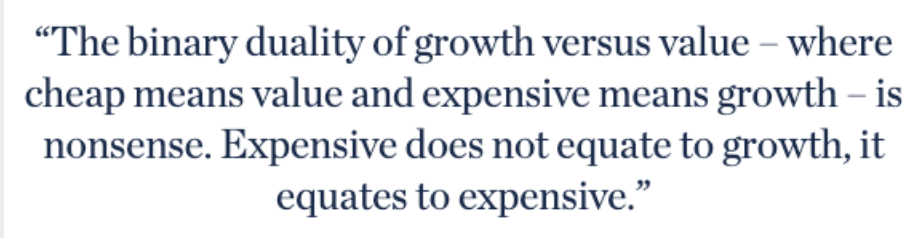
For many years, the financial industry has been categorizing equity investments according to “style box,” which was a concept developed by Morningstar. This categorization distinguishes portfolios according to the aforementioned value style box along with core/blend and growth. Following this concept, style box indexing separates companies into these categories by using price multiples (such as price-to-earnings or price-to-book) and momentum metrics.
One contention with this traditional style-box methodology is that, again, it remains bound to market prices. For example, a traditional growth index simply aggregates companies with high price-to-earnings ratios and recent price appreciation, while a traditional value index selects stocks trading at low price multiples. Again, this occurs regardless of whether those low multiples reflect true bargains or severe operational distress when it comes to value.
A Different Core, Cap-Weighted Approach
With regard to core exposure, traditional cap-weighted indexes suffer from an inherent flaw where stocks are added after substantial price run-ups and deleted after steep drops during rebalances. This can create performance drag since additions frequently underperform and nixed stocks often rebound after their deletion. As noted in a Research Affiliates article, RACWI “aims to minimize buy-high and sell-low flip-flops—companies added during a frothy fad and dropped a few short years later—a brutally costly structural flaw of traditional cap-weighted benchmarks.” Additionally, their research revealed that additions to the S&P 500 have already outpaced the market prior to their inclusion in an index, and then underperform in the subsequent year. Conversely, stocks will often experience a rebound once they are dropped from an index.
RACWI solves this dilemma by selecting constituents based on economic scale rather than volatile market prices. It uses the fundamental indexing process for selecting stocks, but retains the cap-weighted approach to build the portfolio. Because fundamental weighting evaluates a firm’s true economic footprint, it applies the same principle across all equity allocations. When applied to a broad market universe, fundamental indexing creates a robust core portfolio predicated on economic scale rather than market hype.
“We’re not cap-weighting a portfolio biased to favor the most expensive stocks; we’re cap-weighting the biggest businesses,” Research Affiliates noted.
See More: RACWI: Reinventing Cap-Weighted Indexing
Avoiding Speculative Bubbles Through Rebalancing
One of the more common pitfalls of value investing is succumbing to “value traps,” or investing in businesses that may appear to be inexpensive, but have unstable underlying fundamentals. It’s akin to contemplating the purchase of a house with a pristine exterior and curb appeal at a below-market price, only to discover that it has a cracked foundation. Another issue is when momentum reaches fever pitch, and continues to push a stock’s price well past its underlying value, which may create speculative bubbles. Applying the RAFI framework across style allocations establishes an automated defense against value traps and speculative bubbles.
In a traditional cap-weighted value index, as a company’s price plunges, it may still maintain a heavy weight if its backward-looking book value or low earnings multiple allows it to retain its place within the index. RAFI solves this by evaluating a company’s economic footprint. That includes its sales, cash flow, dividends, and book value. If a firm’s underlying fundamentals reveal weakness, its economic weight automatically contracts, preventing the index from over-allocating capital to these businesses.
Additionally, traditional cap-weighted indexes frequently are prone to absorbing speculative bubbles. It hearkens back to the classic adage by value investing pioneer Benjamin Graham where “in the short term, the market is a voting machine, but in the long term, it is a weighing machine.” When momentum pushes unprofitable companies with minimal revenue to astronomical market valuations, cap-weighted funds are mechanically forced to purchase more of their shares. Fundamental indexing naturally avoids bubbles since a company with zero profits and sales receives a negligible fundamental weight regardless of how high its stock price surges.
Measuring Real Corporate Growth
In market-cap-weighted indexes, growth is typically synonymous with rising valuation multiples and expanding stock prices. When a mega-cap tech company’s stock price doubles due to market enthusiasm, its weight in a cap-weighted growth index doubles alongside it, regardless of whether its actual revenue or earnings support this growth. This design conflates market narrative with true business expansion.
RAFIG addresses growth by measuring real corporate growth. This refers to the observable, fundamental expansion of a firm’s economic contribution. Under a fundamental framework, a company is recognized as a growth business when it demonstrably expands its underlying economic engine. This includes increasing its top-line sales, growing its operating cash flows, expanding its physical asset base, and returning more cash to shareholders through dividends and buybacks. Again, the premise is grounded on real economic growth and not price growth.
See More: Trifecta: A Fundamental Revolution in Indexing
Grounding Equity Exposure in Business Reality
By anchoring portfolio weights to tangible economic metrics rather than inflated share prices, fundamental indexing allows investors to capture true corporate expansion without overpaying for market enthusiasm. This disciplined framework ensures that portfolio allocations reflect a company’s actual business capacity as opposed to short-term price momentum.
Ultimately, fundamental indexing mutes speculative noise from growth strategies while protecting value-focused portfolios from speculative bubbles. The result is an indexing approach that enforces a disciplined link between portfolio weighting and economic output for core, value, and growth investing. In Part III, the implementation of RAFI in a portfolio will be the topic of discussion.
Originally posted on ETF Trends
For more news, information, and strategy, visit the Smart Beta Content Hub.
A message from Advisor Perspectives and VettaFi: Discover something new! Click here to register for our upcoming webcasts.
Read more commentaries by VettaFi