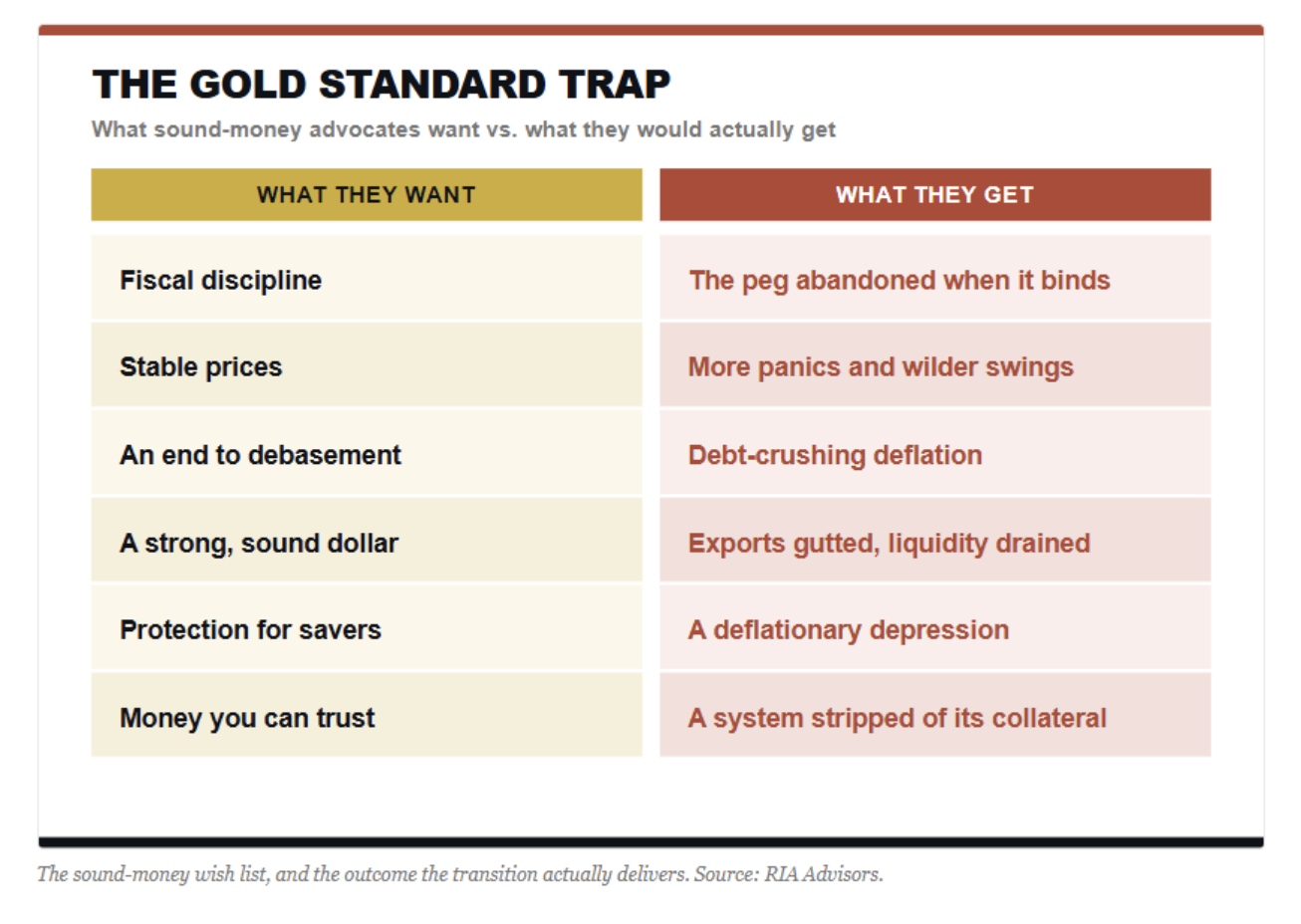
A return to sound money has become the rallying cry for a growing crowd of investors, politicians, and commentators who are, understandably, fed up. Fed up with deficits that never shrink, with a national debt north of $39 trillion, with a dollar that buys a little less every year. The pitch is elegant. Back the dollar with gold again, and you force Washington to live within its means. I get the appeal. I’ve spent years in these pages warning about the debt and deficit trajectory myself. But there’s a problem with the prescription, and it’s a big one.
The problem is NOT the diagnosis, which is largely correct. The problem is the medicine: applied to a $30 trillion economy wired the way ours is, it would likely trigger the very collapse it claims to prevent. Let me walk through why.
What “Sound Money” Really Means
“Sound money,” in its purest form, is money whose supply a government cannot expand at will. Under a gold standard, every dollar is a claim on a fixed weight of gold. You can’t print gold. So the government can’t monetize its deficits, and the money supply grows only as fast as miners pull metal out of the ground, historically around 1.5% a year.
That constraint is the whole point. As Michael Bordo of the NBER puts it, the gold standard worked by “regulating the quantity and growth rate of a country’s money supply.” Spend more than you tax, and gold flows out, forcing austerity. There’s no hiding the bill in a slow inflation tax that voters barely notice for years.
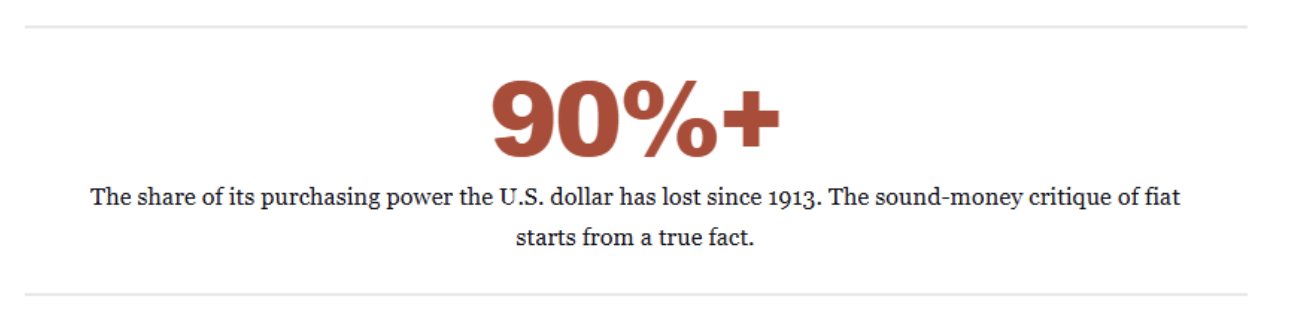
The intellectual heart of the argument is about trust. Fiat money asks you to trust that the people who benefit from printing will restrain themselves. History says they mostly don’t. Ludwig von Mises and Friedrich Hayek built careers on this insight, and today’s Bitcoin advocates have inherited it wholesale. The dollar has lost the better part of its value since the Federal Reserve was created in 1913. Savers, retirees, and anyone on a fixed income paid that tax quietly for over a century. When a gold bug calls fiat a slow-motion confiscation of purchasing power, they aren’t wrong, and that steady erosion of savings is very real.
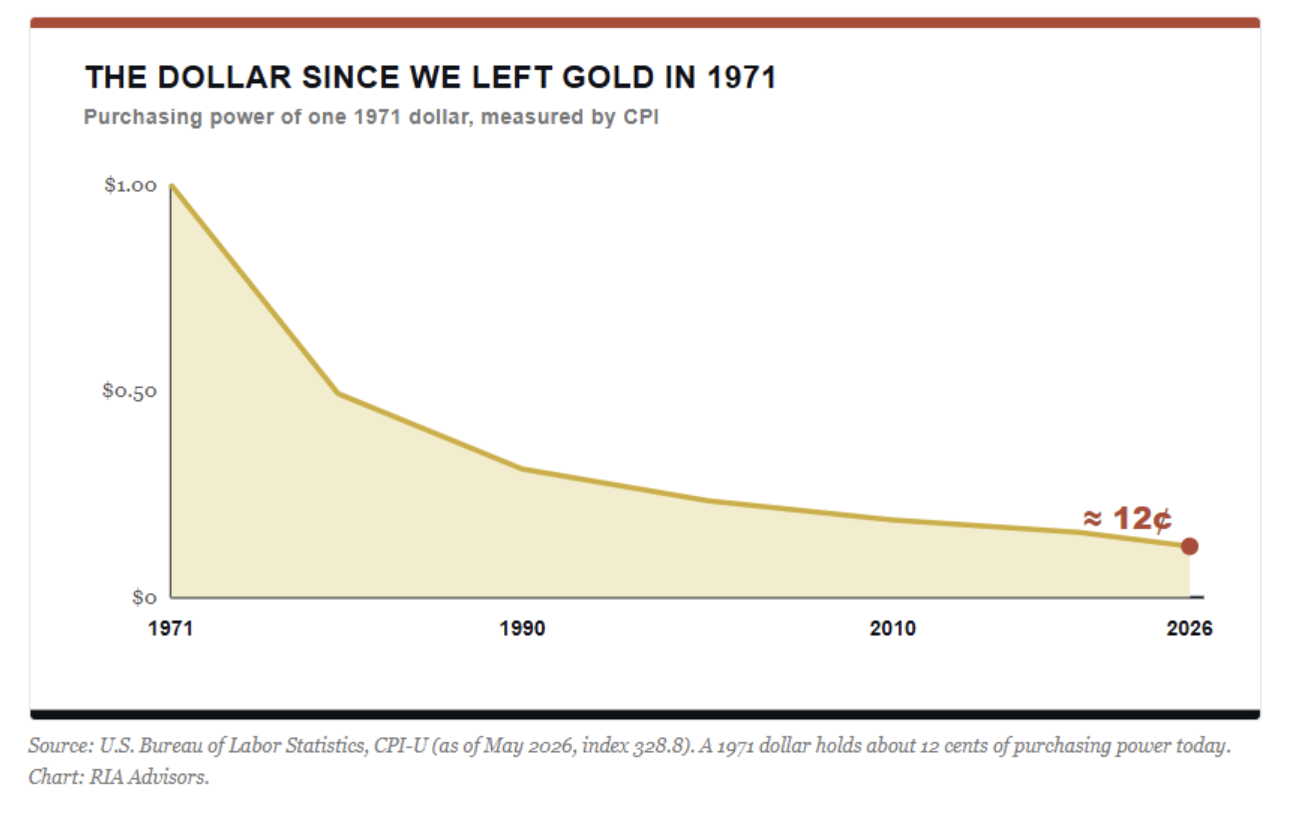
The erosion shows up most clearly after 1971, the year we cut the last tie to gold. A dollar back then buys roughly 12 cents’ worth of goods today. We’ve dug into this before in our work on what dollar debasement really is and isn’t. That slope is the gold camp’s whole case in one line.
The Gold Standard’s Real Record
Here’s where the story gets complicated for the gold advocates. The classical gold standard, running roughly from 1870 to 1914, is remembered as an age of stability. It wasn’t. It delivered stable prices over decades while inflicting violent year-to-year instability.
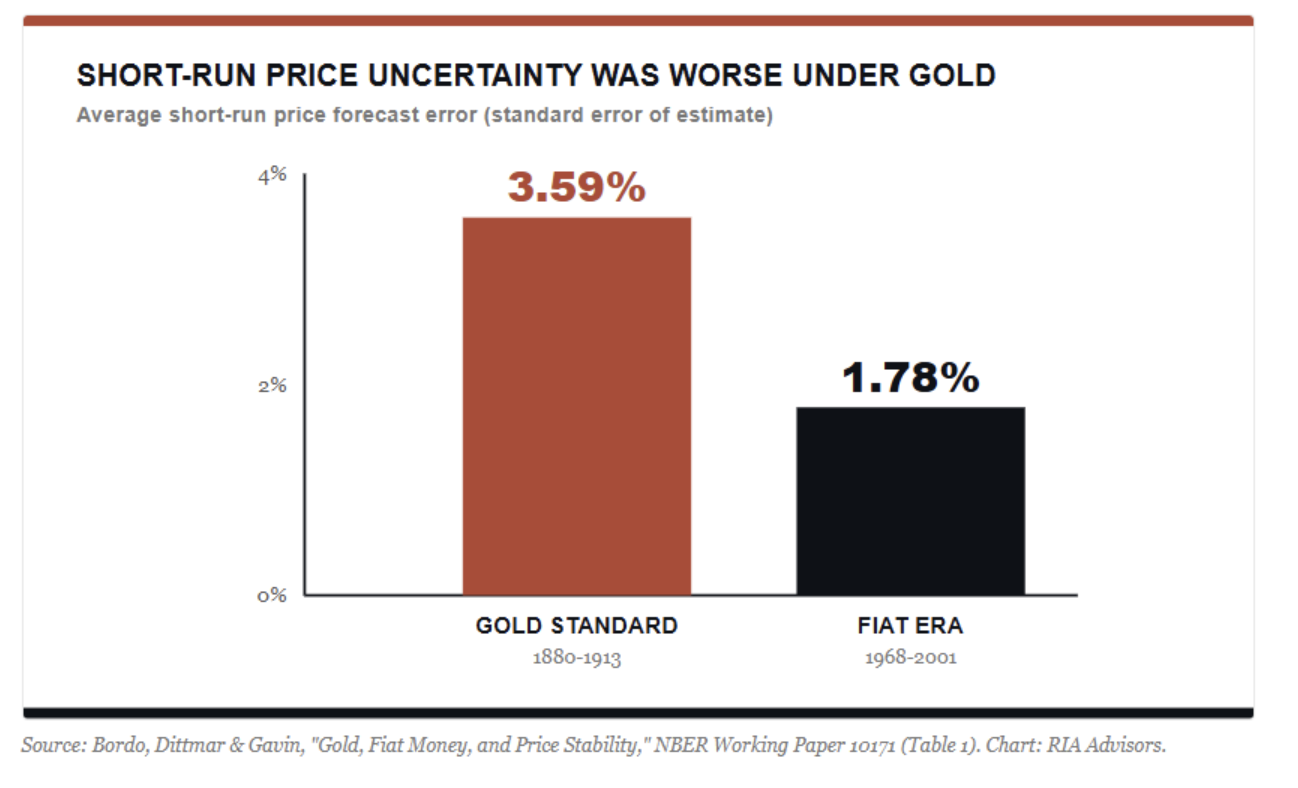
The numbers are unambiguous. Economists Bordo, Dittmar, and Gavin measured short-run price uncertainty under the gold standard against the modern fiat era. Under gold, the average short-run forecast error was 3.59%. Under the 1968 to 2001 fiat regime, it was 1.78%, roughly half. Their conclusion: “the gold standard actually produced less short-run price stability than did the fiat regime.” Long-run stability bought at the cost of worse short-run swings is the trade you’re actually making.
See more: Gold Jumps as Weak US Jobs Data Adds Fuel to Bullion’s Rebound
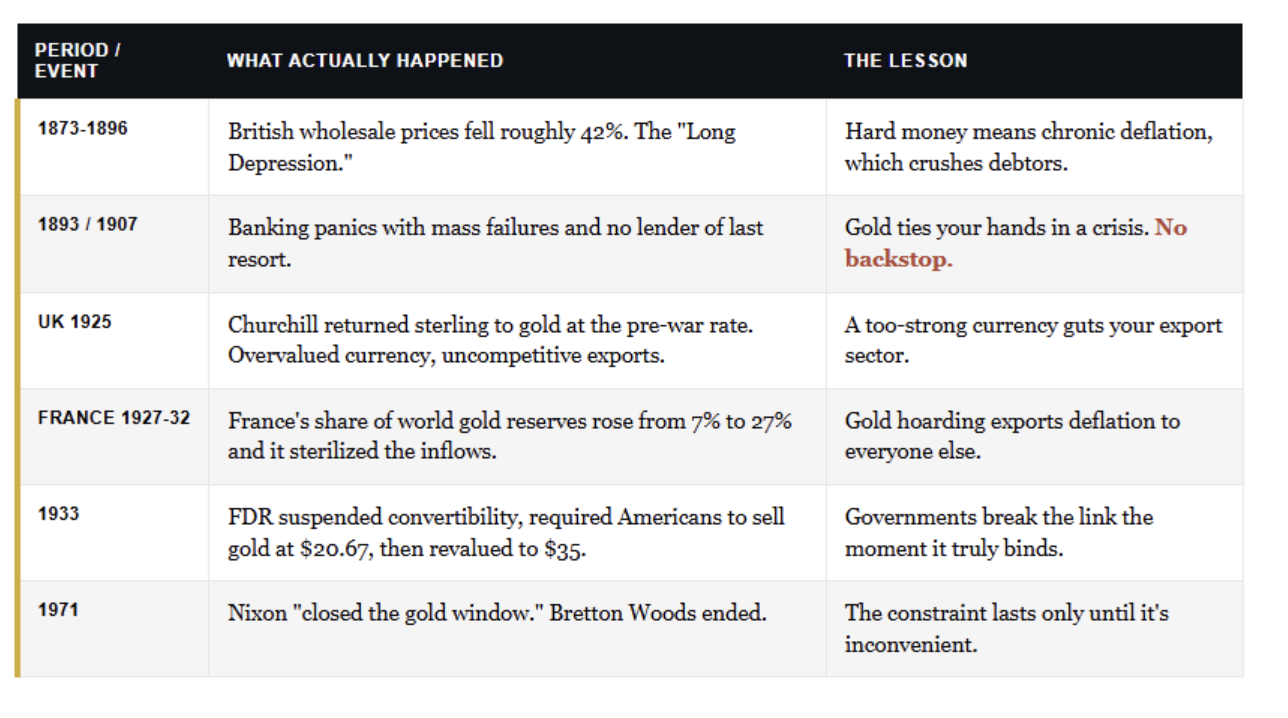
The instability wasn’t just in prices. The gold-standard decades gave us the Panic of 1873, the Panic of 1893, and the Panic of 1907. In 1893 alone, roughly 500 banks failed. When a crisis hit, the gold standard tied policymakers’ hands. There was no lender of last resort because stopping a run meant creating money that wasn’t backed by gold.
Then there’s deflation, the gold standard’s quiet companion. British wholesale prices fell about 42% between 1873 and 1896. Falling prices sound great until you owe money. As Irving Fisher explained in 1933, deflation raises the real burden of every nominal debt, so debtors cut spending, and output falls. American farmers lived this. Their mortgages stayed fixed while crop prices collapsed. That’s what William Jennings Bryan’s “Cross of Gold” speech was about in 1896, a debtor revolt against hard money.
Look at the last two rows. Every gold-standard government that faced the discipline actually biting chose to break the link rather than take the pain. In other words, that tells you how durable any new gold standard would be.
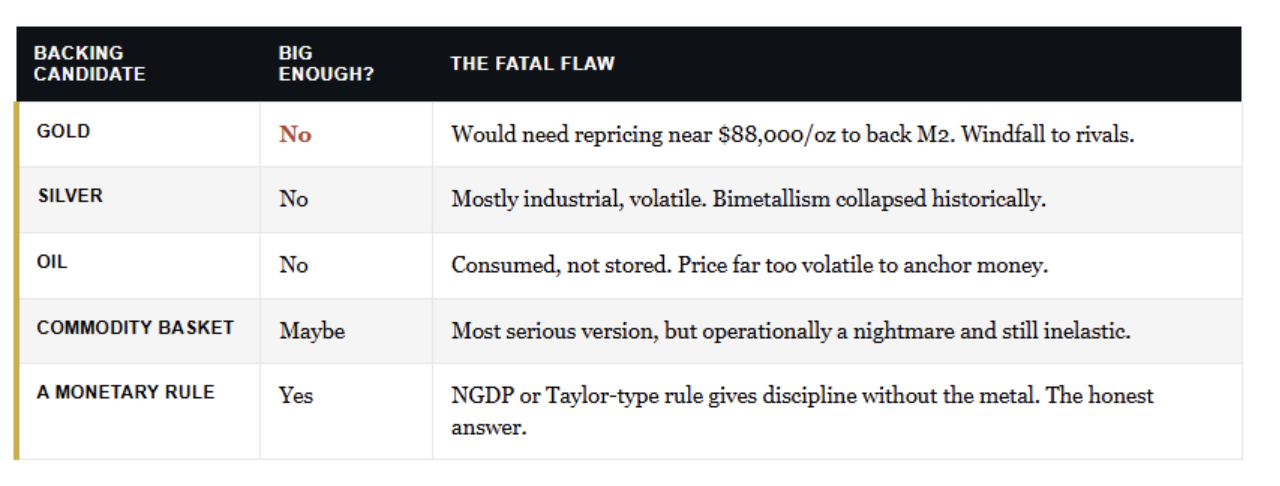
That repricing would be the largest one-time wealth transfer in modern history, and much of it would flow to America’s rivals. Russia and China have accumulated gold for years as a hedge against the dollar. A twenty-fold revaluation hands them the windfall.
Consider what a hard dollar does to trade. If the U.S. pegged to gold while the world stayed fiat, capital would flood into the hardest currency on earth, and the dollar would surge. A soaring dollar makes U.S. exports expensive and imports cheap, which widens the trade deficit rather than closing it. When Churchill put Britain back on the gold standard at an overvalued rate in 1925, British exports became uncompetitive, unemployment rose, and the pain helped trigger the 1926 general strike. Keynes wrote a whole pamphlet about the damage.
A purist will object that a true gold standard corrects itself. Gold drains out, prices fall, and exports get cheap again. That’s true on paper. In practice, it runs through wage cuts, layoffs, and years of deflation, and only if every major economy plays by the same rules. Go hard while the rest of the world stays on fiat, and the capital just keeps coming.
How Money Actually Works Now
This is the part the sound-money pitch skips, and it matters most. Modern growth doesn’t come from factories and workers alone. It comes from credit, and that credit system sits on an expanding pile of government debt.
U.S. Treasuries are the collateral that underpins nearly everything. They’re the safe asset in repo, the ballast in money market funds, the foundation of the global dollar system. Yale’s Gary Gorton has shown that the economy runs on a stable and growing supply of these “information-insensitive” safe assets. His research found the safe-asset share of total U.S. assets has held near 33% every year since 1952. That’s structural demand, not an accident.
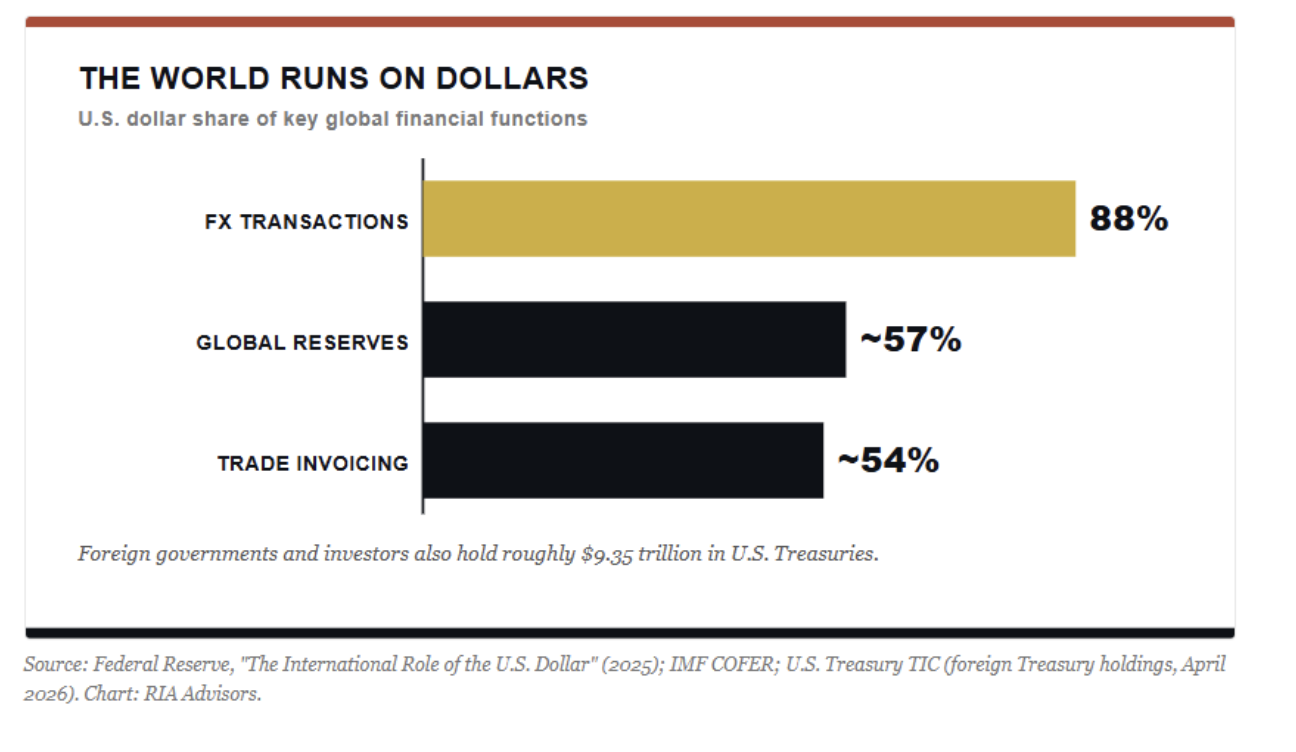
And that demand doesn’t stop at our borders. The dollar is the world’s money, as the chart below lays out. Cap the supply of dollars and Treasuries, and you don’t just squeeze the U.S. economy. You starve the whole system of the collateral it runs on.
Here’s the second-order effect nobody mentions. Gorton’s work shows that when the supply of public safe assets runs short, the private sector manufactures substitutes, and those substitutes are fragile. The AAA-rated mortgage securities that blew up in 2008 were exactly that, private-label “safe” assets created to fill a Treasury shortage. As Gorton puts it, “the likelihood of a financial crisis is increasing in the ratio of private safe assets to public safe assets.” Cap Treasury issuance under a gold standard, and you don’t get discipline. You get a scramble for collateral and a deleveraging spiral.
The Money-Printing Fear Meets The Data
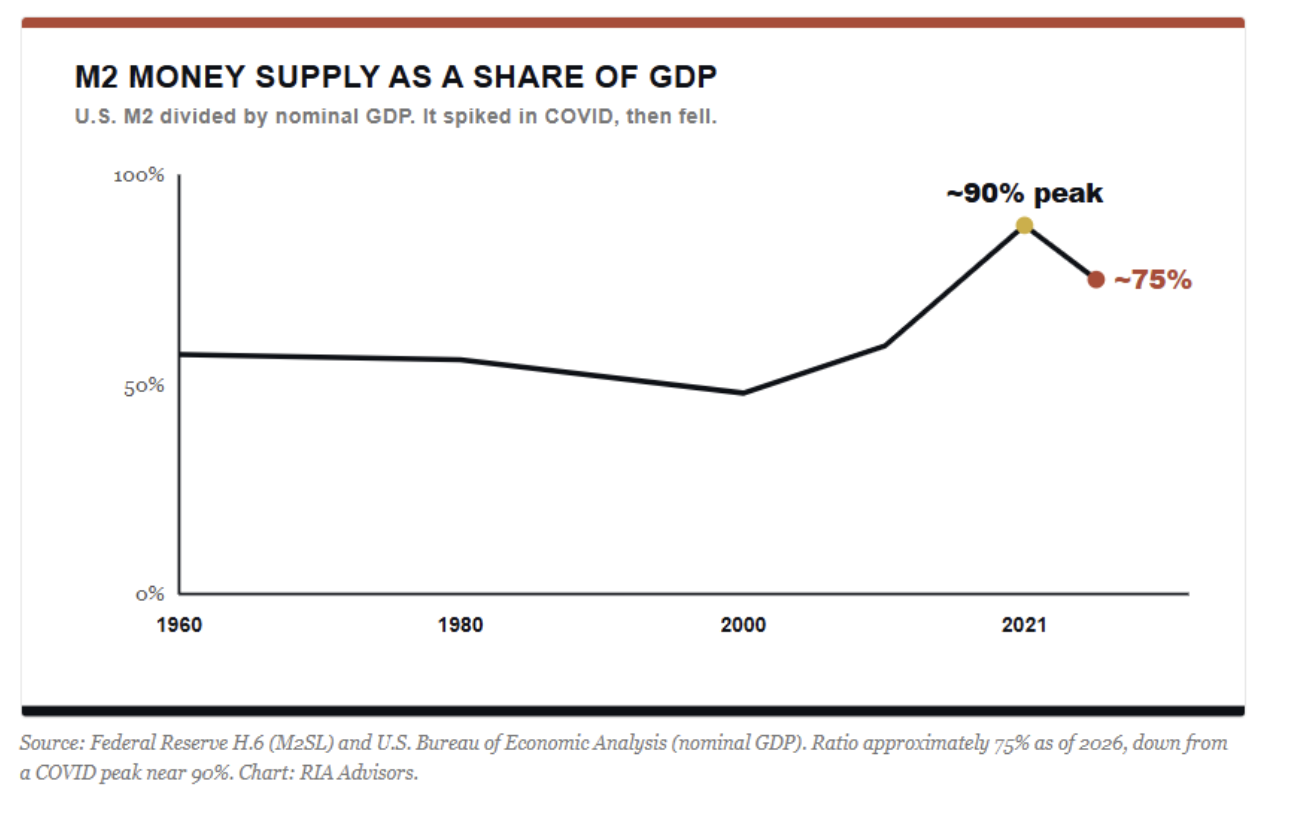
The sharpest sound-money fear is that fiat means endless printing and eventual hyperinflation. The reality is more boring. Money gets lent into existence, tracking the economy. Our M2 money supply sits near $23 trillion against a $30.8 trillion economy, so M2 runs about three-quarters of GDP. That ratio spiked during COVID and has been FALLING ever since. As we showed in “Why the Money-Supply-Growth Thesis has a Fatal Flaw” and the “Gold Bugs’ Faulty Thesis on M2 and Inflation“, money supply grows with the economy over time.
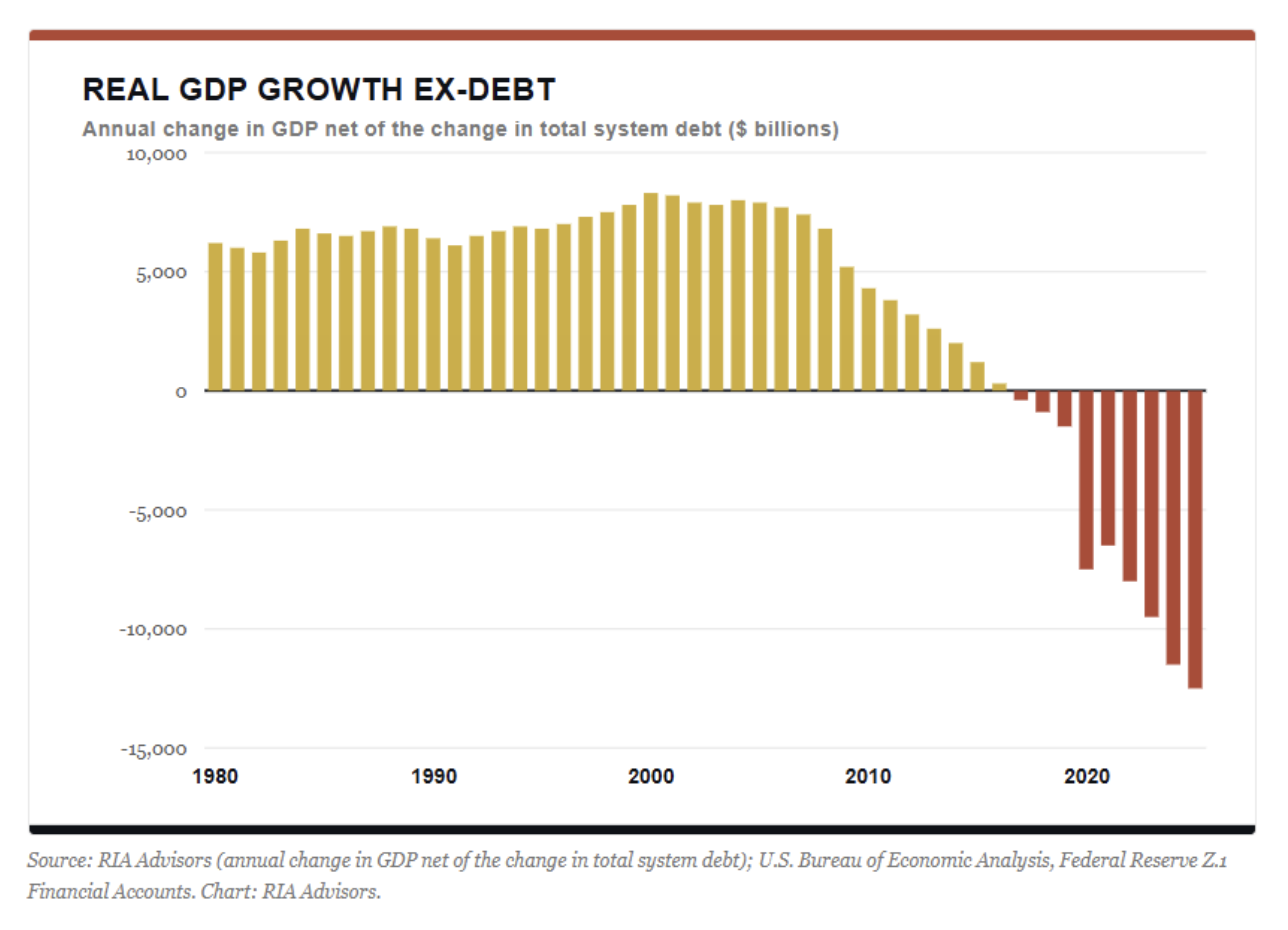
That doesn’t let Washington off the hook. It now takes more than a dollar of new debt to buy a dollar of GDP, a point we detailed in our work on the debt and deficit problem. Strip that borrowed money out, and the picture turns brutal. Real growth net of debt ran solidly positive for decades, then collapsed into deeply negative territory. That’s what the word deflation hides, because it sounds mild, like prices drifting lower, when the reality is that cutting off the debt doesn’t just soften the economy, it shrinks it. You don’t get deflation. You get a depression.
The Great Depression is the clearest evidence we have. Barry Eichengreen’s landmark study “Golden Fetters” established the pattern that’s now the mainstream consensus. The countries that abandoned gold earliest recovered fastest. Britain left in September 1931. The United States left in 1933. The “Gold Bloc” nations that clung on, led by France, stayed mired in deflation for years. Gold didn’t cushion the Depression. It transmitted and deepened it.
France proves the mechanism. Douglas Irwin’s research shows that France increased its share of world gold reserves from 7% to 27% between 1927 and 1932, then sterilized the inflows so it never expanded its money supply. That “gold hoarding created an artificial shortage of reserves and put other countries under enormous deflationary pressure.” Irwin’s counterfactual is stunning. World prices should have risen about 15% over that stretch. Instead, they fell 42%. Hard money didn’t prevent the catastrophe; it was what manufactured it.
Why does no government run a gold standard today? The honest answer is revealed preference. Every country that ever had one abandoned it in a crisis and never went back voluntarily.
This isn’t a conspiracy of central bankers who love to print. It’s a near-universal judgment that a government facing a war, a bank run, or a pandemic cannot afford to have its hands tied to a mining constraint. The 2008 and 2020 rescues would have been flatly impossible under gold. Here, the reverse holds. When every government on earth quietly makes the same choice, it’s worth asking what they see that the pamphlets miss.
Where Sound Money Advocates Have A Point
I don’t want to strawman this. The gold camp is right about more than they’re given credit for, and the strongest version of their case deserves a real answer.
They’re right that fiat has enabled debasement. They’re right that discretionary central banking has fueled boom-bust cycles, the dot-com bubble and the housing bubble being exhibits A and B. And the most serious academic version of their argument, made by economists George Selgin and Lawrence White, is that the gold standard’s historical failures were caused mostly by central banks and bad regulation, not by gold itself. A gold standard paired with competitive free banking, they argue, could have supplied money far more elastically. That’s a legitimate position, not a gold-bug tweet.
But here’s the honest reframe that both sides usually miss. The real debate was never gold versus fiat. It’s rules versus discretion. Gold is just one rule, and a rigid, deflation-prone one. There are better-designed rules on the menu. Milton Friedman proposed a fixed money-growth rule. John Taylor gave us the Taylor rule. Scott Sumner and the market monetarists argue for targeting nominal GDP. Each strips out central-bank whim without chaining the economy to the output of a gold mine.
One caution on the way there. Be skeptical of the claim that “real” inflation is secretly running 7% or more. That figure usually traces to ShadowStats, which isn’t credible. It applies a fixed fudge factor rather than recomputing anything. The serious critique runs the other way. Back in 1996, the Boskin Commission found the CPI overstated inflation. The defensible point isn’t a hidden inflation cover-up. It’s that official indices miss asset-price inflation in homes and stocks, which is real and does widen the gap between the haves and have-nots.
No commodity is big enough because a reserve currency must be elastic. It has to expand and contract with a $100 trillion economy and backstop crises. Any commodity anchor sacrifices that. The gold bugs chase discipline. What they need is a rule.
The Smarter Bull Case: Remonetization, Not A Standard
The strongest version of the gold argument has quietly dropped the peg. It doesn’t ask for a gold standard at all. It argues for “remonetization,” a slow, evolutionary process in which gold regains monetary relevance as the neutral reserve and settlement asset, pushed along by fiscal strain, sanctions risk, and eroding trust.
That’s a more serious thesis, and parts of it are simply true. Since the 2022 freeze of Russia’s reserves, gold’s appeal as the one reserve asset with no issuer and no counterparty risk is real. The dollar’s share of global reserves has drifted from about 71% in 1999 to roughly 57%, while gold’s share has climbed. At the margin, gold is remonetizing, and pretending otherwise would be dishonest.
Here’s the flaw that runs through the whole case. Almost every argument in it proves that gold could go UP, not that gold becomes money. Rising reserve demand, a thin market meeting large flows, central banks diversifying, those are price arguments wearing a monetary-regime costume. A higher gold price and a gold-anchored system are different claims, and the case quietly swaps one for the other.
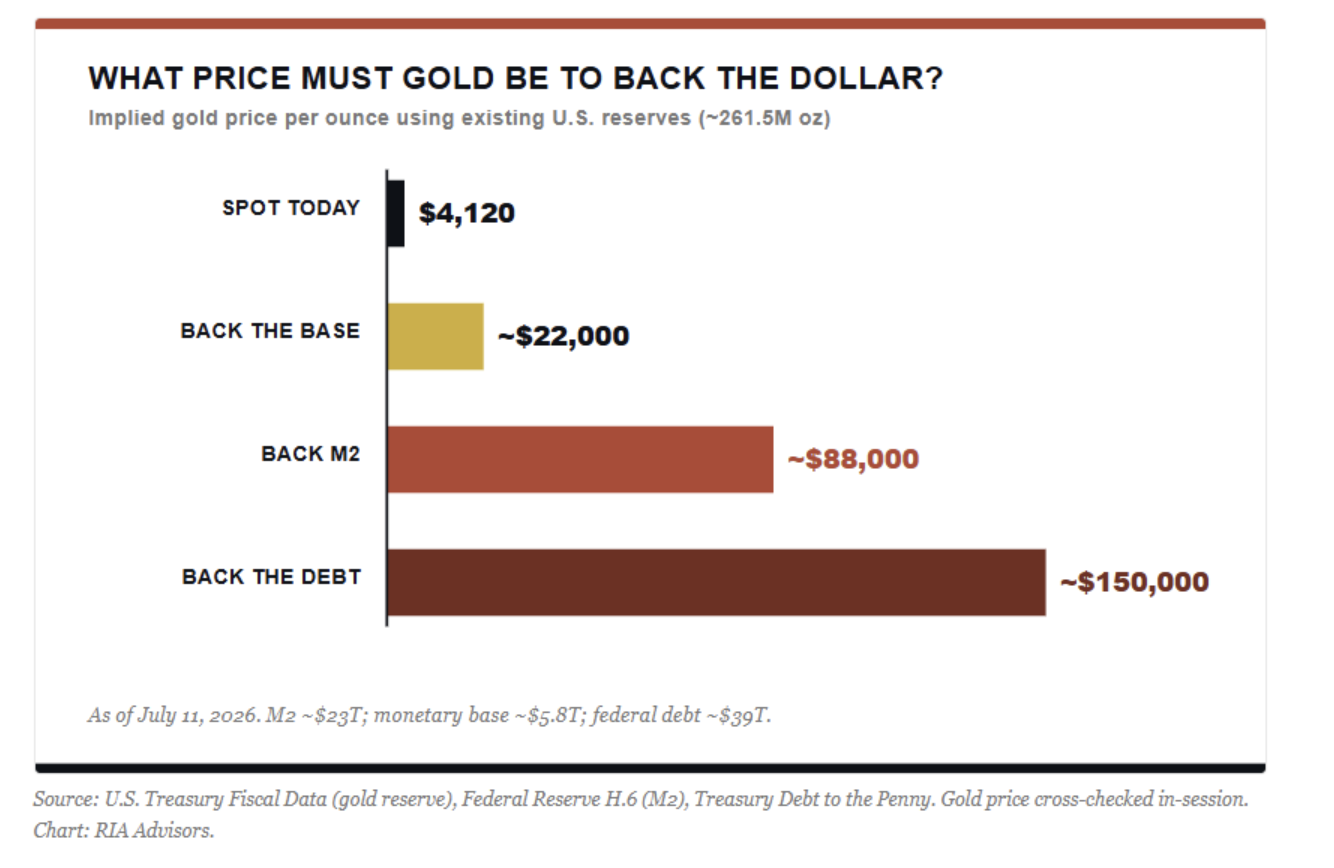
You see the sleight most clearly in the “shadow gold price” this camp loves to cite. Fully back the money supply with existing gold, and you get numbers from $20,000 to a quarter-million an ounce, depending on which measure of money you choose. We ran that same arithmetic earlier and landed in the same place. But that price only exists if someone actually imposes the backing, the very gold standard this camp swears will never come. You can’t disown the peg and then bank the price target that only a peg produces. Pick one.
The clever workarounds don’t escape it either. Revaluing gold on the books to “recapitalize” the state is an accounting entry, and the moment you spend it, you’re monetizing an asset, which is money printing by another name.
Gold-backed bonds relocate the credibility problem rather than solve it, since a gold-indexed debt explodes in real terms if gold soars. Tokenized gold hands back the counterparty risk that bullion was supposed to remove. And the sweeping claim that fiat is a 54-year anomaly against 5,000 years of history skips an awkward fact: the real coordinated gold standard ran barely from 1870 to 1914, shorter than the fiat era it is meant to indict.
What A Gold Standard Would Do To Your Portfolio
Suppose Washington actually tried to return to a “sound money” regime. What happens to your money? The transition, not the steady state, is where the damage lives.
Gold is the obvious winner on paper, since the exercise revalues it many times over. Everything else gets harder because:
-
A deflationary deleveraging would hammer equities and corporate credit as the debt superstructure shrinks to fit the metal.
- The surging dollar would punish U.S. multinationals and anything tied to exports.
-
Long-dated Treasuries would benefit from deflation in yield terms, which is the debt-deflation dynamic Lacy Hunt has argued for years, but only if the government’s solvency held through the transition, and that’s a large “if” when you’ve just capped its ability to fund itself.
Here’s the twist most gold bugs miss. That paper win assumes you can calmly hold the metal, and in a real dollar shortage, you can’t. When everyone scrambles for dollars at once, gold is what gets sold to raise them, because it yields nothing and trades in a deep, liquid market. We saw a preview during the Iran shock: as oil spiked and emerging-market currencies buckled, central banks turned net sellers of gold, and Turkey swapped bullion for dollars to defend the lira. What people reach for in that moment is the dollar and short Treasuries, not the metal that supposedly protects them.
So what do you actually do with this? You don’t position for a “sound money” gold standard that isn’t coming. You position for the real trend. The debasement the gold camp warns about is a genuine long-run risk, which is why a sensible allocation carries some exposure to:
- Real assets and gold as insurance
- Favors quality balance sheets that survive a credit squeeze, and
- Respects duration as a hedge against deflation.
I’m reasonably confident in that framework over a full cycle. I’m far less confident about the timing of any given year, and I’d rather own the insurance before the fire than chase it during one.
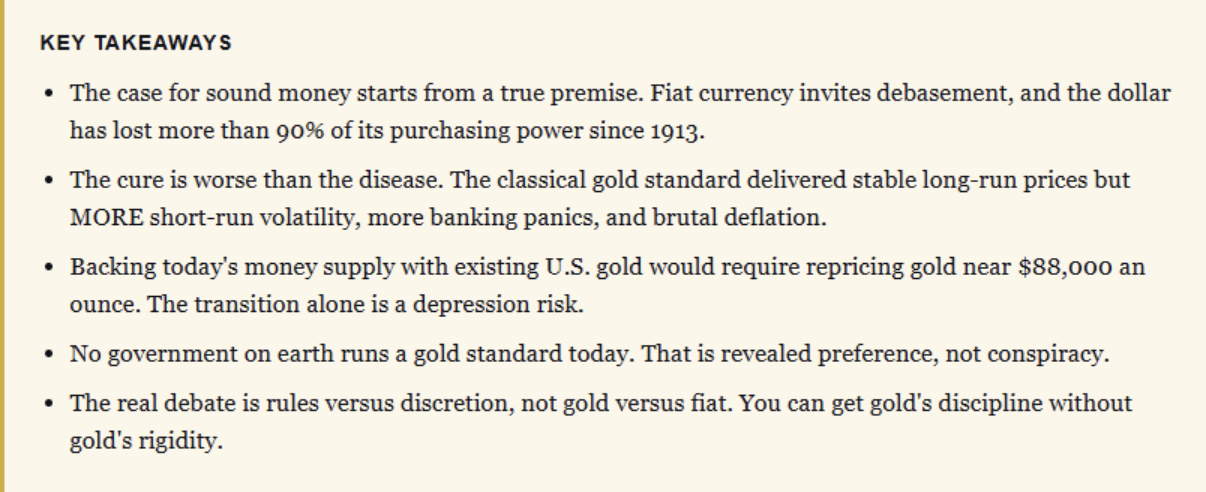
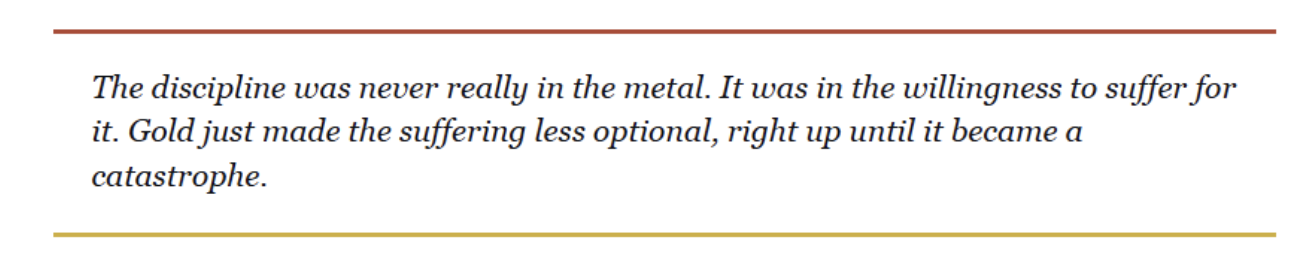
The bottom line is this. The sound-money camp has diagnosed a real disease. Yes, the dollar does lose value. Deficits are real, and I’ll keep saying so. But the gold standard is a nineteenth-century cure that has repeatedly failed at exactly the moments when a modern economy needs flexibility most. The discipline they want doesn’t live in a metal bar. It lives in the political will to pursue responsible policy, and if we had that will, we wouldn’t need gold to enforce it.
That’s the harder conversation. It’s also the only one that leads anywhere.
Sources
- Bordo, Dittmar & Gavin, “Gold, Fiat Money, and Price Stability,” NBER Working Paper 10171 (2003). nber.org/papers/w10171
- Bordo, “Gold Standard,” Concise Encyclopedia of Economics (Econlib). econlib.org/library/Enc/GoldStandard.html
-
Eichengreen, “Golden Fetters: The Gold Standard and the Great Depression, 1919-1939,” NBER / Oxford University Press (1992).
- Irwin, “Did France Cause the Great Depression?” NBER Working Paper 16350 (2010). nber.org/papers/w16350
- Gorton & Ordonez, “The Supply and Demand for Safe Assets,” NBER Working Paper 18732 (2013). nber.org/papers/w18732
- Gorton, Lewellen & Metrick, “The Safe-Asset Share,” NBER Working Paper 17777 (2012). nber.org/papers/w17777
- Federal Reserve History, “Roosevelt’s Gold Program” and “Nixon Ends Convertibility of U.S. Dollars to Gold.” federalreservehistory.org
- U.S. Treasury Fiscal Data, “Status Report of U.S. Government Gold Reserve.” fiscaldata.treasury.gov
- Federal Reserve H.6 Money Stock Measures; U.S. Bureau of Economic Analysis (nominal GDP); U.S. Treasury “Debt to the Penny.”
- U.S. Bureau of Labor Statistics, Consumer Price Index (CPI-U). bls.gov/cpi
- World Gold Council, “How Much Gold Has Been Mined?” gold.org/goldhub/data/how-much-gold
- White, “A Gold Standard with Free Banking Would Have Restrained the Boom and Bust” (SSRN); Selgin, “The Theory of Free Banking.”
- Boskin Commission, “Toward a More Accurate Measure of the Cost of Living” (1996). ssa.gov/history/reports/boskinrpt.html
Lance Roberts is a Chief Portfolio Strategist/Economist for RIA Advisors. He is also the host of “The Lance Roberts Podcast” and Chief Editor of the “Real Investment Advice” website and author of “Real Investment Daily” blog and “Real Investment Report“. Follow Lance on Facebook, Twitter, Linked-In and YouTube Customer Relationship Summary (Form CRS)
Join RIA Advisors and elevate your career within a deeply experienced team focused on innovation. Our collaborative environment is built on a foundation of advanced technology and effective investment models, designed to enhance your ability to serve clients and grow your practice. Benefit from a supportive culture that encourages professional development and fosters a forward-thinking approach. By joining our team, you’ll be part of a group dedicated to excellence and continuous improvement, empowering you to focus on building meaningful client relationships and pursuing your business ambitions. Discover the advantages of working with our accomplished advisory team by starting your conversation today.
A message from Advisor Perspectives and VettaFi: Discover something new! Click here to register for our upcoming webcasts.
© Real Investment Advice
More Tax Planning Topics >