The S&P 500 was flat in July 2026 as semiconductors fell 29%, energy gained nearly 13% on higher oil, and long-term Treasury yields reached their highest levels since 2007.
MONTHLY MARKET UPDATE
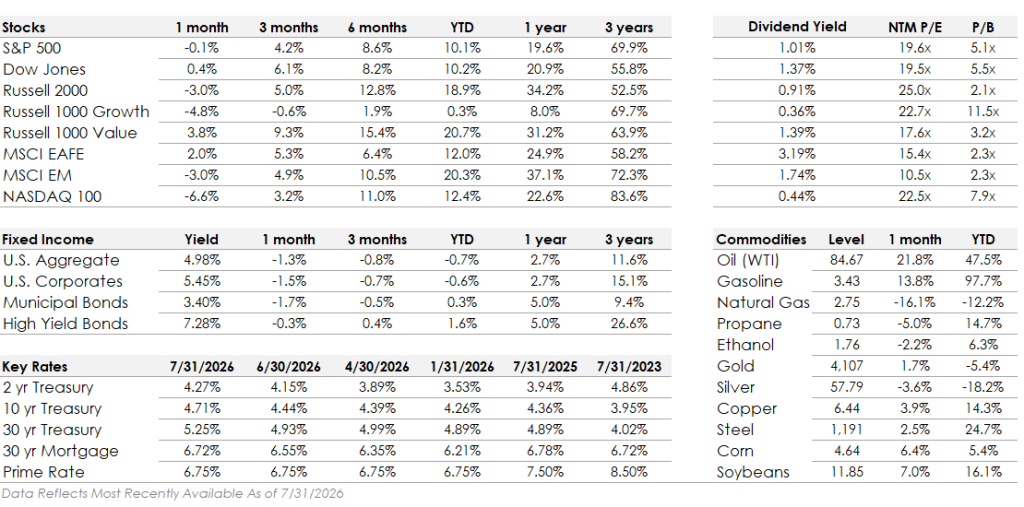
- The S&P 500 declined 0.1%, and the flat headline hid a wide gap underneath. Energy led all sectors with a 12.6% gain, followed by Financials (up 6.2%), and Real Estate (up 2.5%). Technology fell 3.4% and the NASDAQ 100 lost 6.6%. Seven of eleven sectors finished higher, and the equal-weight S&P 500 set a new all-time high.
- Value beat growth by a wide margin. Large-cap value gained 3.8% while large-cap growth fell 4.8%. Year to date, value has returned 20.7% and growth just 0.3%.
- Bonds fell as the long end sold off. The U.S. Bond Aggregate declined 1.3% and investment-grade corporates lost 1.5%, while high yield held up better at a 0.3% decline. The 30-year Treasury yield rose 0.32% to 5.25%, its highest level since 2007; the 2-year moved just 0.12% to 4.27%.
- The Fed held for a fifth straight meeting, with three dissents favoring a hike. Second quarter GDP came in at an annualized 1.5% against a 2.1% consensus, though consumer spending grew 3.2%. June PCE inflation moderated to 3.7% from 4.1%.
- Oil drove sector returns. West Texas Intermediate crude climbed 21.8% to $84.67 as renewed U.S.-Iran conflict put the Strait of Hormuz back in play. Developed international markets gained 2.0% while emerging markets fell 3.0%.
See more: Oil Rebounds as Global Supply Risks Intensify
The AI Question Is Now About Returns
Our 2026 theme of “Returns must be Earned” was on full display in July as companies announced 2Q26 results. Specifically for AI, the question of having an AI strategy, how much you are spending on it, and how fast you are building is over; markets expect every company to have an AI strategy. Instead, investor focus has shifted to the actual benefits of this strategy. Markets are rewarding companies that have a creditable, EPS accretive strategy. Or said another, markets want to see real returns for companies spending billions in AI capex.
And investors pushed back hard this quarter, especially in large-cap tech. Microsoft’s cloud business showed the investment converting into growth, and the stock got credit for it. Companies where spending outran cash flow or ate into margins traded lower. In our view this is a natural progression of the AI narrative, and also represents a maturation of the theme. Stocks can’t keep trading on expectations, and 2Q26 was the quarter where this became entirely apparent. That said, we remain constructive on AI infrastructure (our positioning hasn’t changed) and continue to see opportunity for long-term investment.
Leverage Amplified the Semiconductor Selloff
The broad S&P 500 return disguises how volatile parts of July actually were. The Philadelphia Semiconductor Index fell 29% between June 22 and July 29. South Korea’s Kospi, heavy with Samsung and SK Hynix, dropped 38% in local currency terms over the same stretch, which is most of the reason emerging markets fell 3% for the month while developed markets gained 2%. Separately, the AI-focused hedge fund Situational Awareness, reportedly levered up to 400% and concentrated in technology, sold part of its public book to Citadel. The forced selling only compounded the negative momentum, dragging the stocks lower.
More interestingly, the equal-weight S&P 500 set a record highin July. Seven of eleven sectors rose, Energy gained over 12% (on oil’s 22% jump), and Financials added over 6%. In our view this was a positioning unwind in a crowded, levered trade rather than a verdict on the underlying businesses, and a diversified portfolio had a very different July than a concentrated one did.
The Fed Held Rates Steady as Long-Term Yields Climbed
The Fed held rates for a fifth straight meeting, but three officials dissented in favor of a hike, and Chair Warsh spent the press conference declining to say anything about what comes next. The post-meeting statement was roughly half its former word count. He reiterated there’s “no soft inflation target,” only 2%, and told investors they should be “playing the ball, not the referee.”
While Warsh’s comments came across as opaque, the bond market’s moves were very clear. The 30yr Treasury yield rose to 5.25% (its highest since 2007), the 10yr climbed to 4.71%, and the 2yr barely moved at 4.27%. What that says is that investors aren’t demanding much more for near-term rate risk; they’re demanding it for holding duration against heavy Treasury issuance, unprecedented AI capital spending, and energy supply that keeps getting interrupted.
What Matters Now
Three things to carry into the rest of the year. First, the AI trade has entered a stage where results matter more than ambition, which is a better environment for selective exposure than one where everything touching the theme rose together. We remain bullish on the space. Second, July was a reminder that leverage, not fundamentals, usually determines how bad a drawdown feels. Nothing about Samsung’s business justified a 38% move. Third, the value-versus-growth gap is a 20-point, full-year phenomenon rather than a monthly quirk, and portfolios that haven’t been rebalanced since January are almost certainly carrying different exposures than intended.
The S&P 500 is still up over 10% this year (and even more in August), which is worth acknowledging after a month with a 29% semiconductor drawdown and a hedge fund unwind in it. It’s also worth remembering that the index return says very little about what any individual portfolio actually did in 2026.
If you’d like to talk through how your allocation lines up with what’s been working, we’re happy to do that
Please see important disclosures here.
A message from Advisor Perspectives and VettaFi: Discover something new! Click here to register for our upcoming webcasts.
© Defiant Capital Group
Read more commentaries by Defiant Capital Group