When I became a homeowner, I resolved to put plenty of sweat equity into the house. That was both a desire and a necessity: we had no financial equity left after making the down payment.
I painted, did some basic carpentry, and became adept at fixing plumbing problems. But I reached the limits of handywork when I attempted electrical projects. I once failed to turn off the proper circuit breaker prior to installing a new light switch, and received quite a shock. From there forward, I left that discipline to trained professionals.
Electricity has become a major global focus. It essential to powering the modern economy: regions with capacity will generate growth, while those without adequate supplies may be vulnerable to shocks.
Technology, even within basic industries, is becoming ever more dominant. Factories are using more robotics; farmers and miners rely on increasingly sophisticated equipment; and service businesses rely on advanced decision systems. Many consumer products include features that are driven by leading-edge circuitry, and an increasing number of vehicles around the world are powered by batteries.
And then there is the advance of artificial intelligence (AI), which is an industry unto itself and an influence on all others. The appetite for computation is driving an investment boom in data centers. McKinsey projects that the number of these facilities could triple by 2030.
See more: The War in Iran
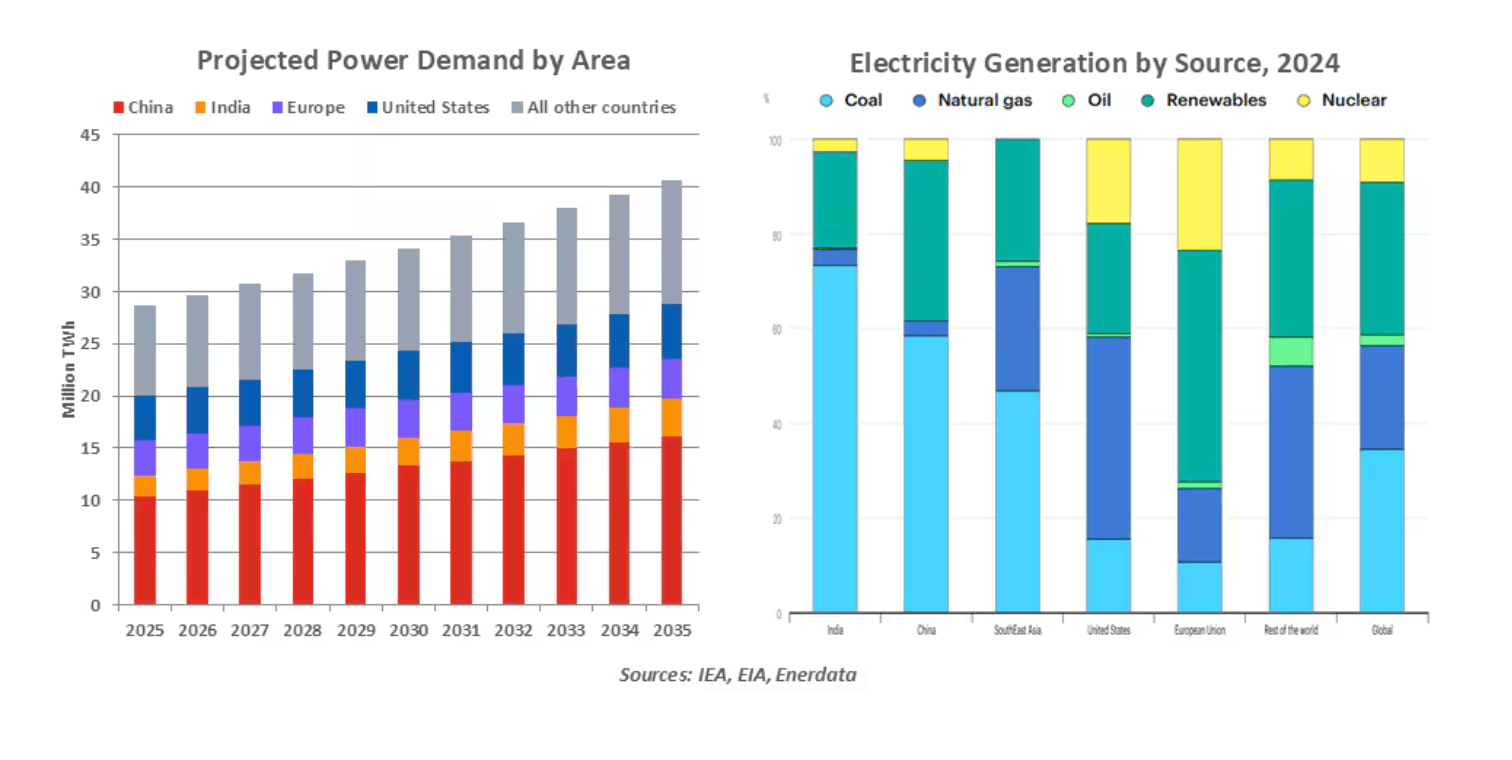
Power is required to give life to all of these technologies. Global demand for electricity has been rising rapidly, and is projected to increase at even greater rates in the decade ahead. By the middle of this century, the IEA anticipates that electricity will account for more than 38% of global energy consumption, almost double the fraction in 2020.
Regional needs are driven by a series of factors. China and the United States are the clear leaders in the AI race, investing substantial sums in infrastructure to support large language models. Manufacturing economies in the developed and developing world need cheap power to keep their plants efficient. Civilian demand for electricity is increasing, especially in developing economies where household incomes are rising.
India checks all of these boxes. The Energy Information Administration projects that country’s electricity needs will grow by double the global average over the next decade. India’s manufacturing and agricultural sectors are modernizing rapidly. India has been a hub for information technology, and hopes to continue supplying those services to the rest of the world. And with temperatures rising, the India Energy & Climate Center projects additions of 130 million to 150 million air conditioning units over the next ten years.
On the supply side of the equation, the portfolio of resources that countries use to provide power depends on many things. Some are blessed with ample reserves of particular fuels, which reduce costs and increase energy security. The industrial composition of the economy plays a role: service industries require different amounts and types of energy than manufacturing does. Environmental sensitivities and regulations weigh in.
Optimizing the energy mix has become even more important in the wake of two important shocks in the last four years. The war in Ukraine led Europe to cut off natural gas pipelines from Russia, and the war in Iran has disrupted supply chains for both oil and natural gas. This has left many nations scrambling to ensure access to sufficient fuel supplies.
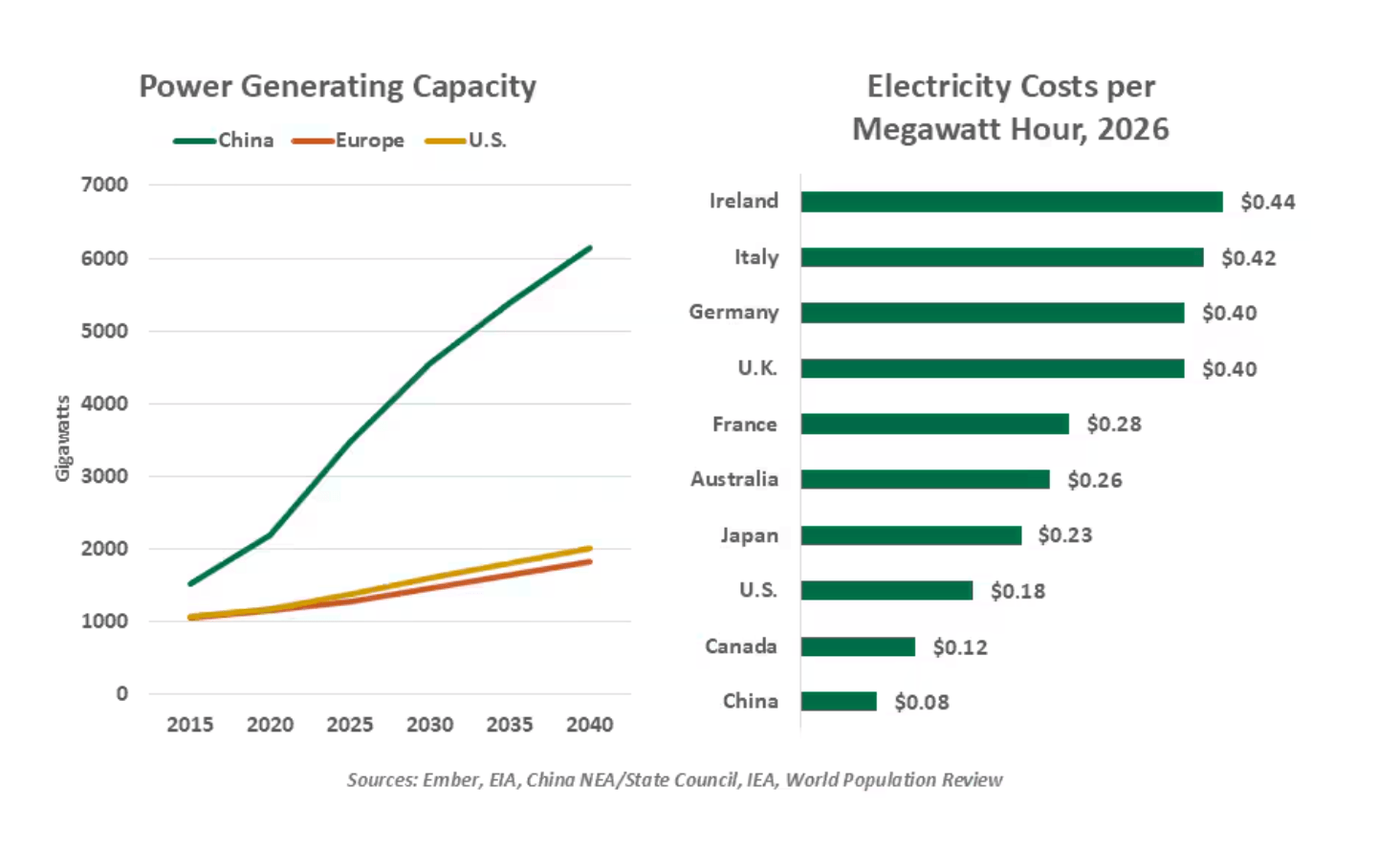
China has avoided the worst of these disruptions by taking a long view. Lacking native reserves of fossil fuels, and facing environmental concerns from its residents, China has championed the development of alternative sources. China leads the world in its installation of solar panels, and in the share of electronic vehicles (EVs) in its auto fleet. (It also has more than 4 million charging stations to support EVs, almost twenty times the number found in the U.S.)
China has also made substantial investments in its electricity infrastructure, including ultra-high voltage transmission lines to carry solar power from the source to factories. As a result, China has the lowest electricity costs among the world’s major economies, which provides an important competitive advantage.
Other countries around the world face very difficult balancing acts as they set strategies for generating power. There is a desire to limit reliance on outside sources, but native capacity may not be sufficient. Many countries have substantial reserves of coal, but have to consider environmental impacts before mobilizing them. Natural gas is a cleaner substitute for coal, but nations without domestic supplies have dealt with volatile costs. Nuclear power is typically cheap and clean, but communities are reluctant to accept the risk of accidents. Green sources like solar and wind encounter concerns around land usage, and they require costly storage facilities to overcome their intermittency.
Energy grids around the world are in need of investment to make them more efficient and secure. Utilities and governments in the United States are planning to spend more than $1 trillion over the next decade for this purpose. But nations facing budget constraints may find it challenging to appropriate the amounts required. Political dissonance and market apprehension can shorten time horizons and hinder commitments to long-term capital projects.
Electricity will be a major economic differentiator in the decades to come. A country’s ability to supply power will drive not only national income, but the quality of life. There will be tradeoffs to address, but sticking to the status quo will be a losing strategy.
When the light fixture over our kitchen table gave out, my wife bought a new one and asked me to install it. Given my history with wiring, that would really be a losing strategy. I’ll be taking my meals in the dark until a handyman can be located.
Carl Tannenbaum is the Chief Economist for Northern Trust.
Information is not intended to be and should not be construed as an offer, solicitation or recommendation with respect to any transaction and should not be treated as legal advice, investment advice or tax advice. Under no circumstances should you rely upon this information as a substitute for obtaining specific legal or tax advice from your own professional legal or tax advisors. Information is subject to change based on market or other conditions and is not intended to influence your investment decisions.
© 2026 Northern Trust Corporation. Head Office: 50 South La Salle Street, Chicago, Illinois 60603 U.S.A. Incorporated with limited liability in the U.S. Products and services provided by subsidiaries of Northern Trust Corporation may vary in different markets and are offered in accordance with local regulation. For legal and regulatory information about individual market offices, visit northerntrust.com/terms-and-conditions.
A message from Advisor Perspectives and VettaFi: Discover something new! Click here to register for our upcoming webcasts.
© Northern Trust
More Energy Topics >