Private Equity for Individual Investors: What the Minimums Really Mean
Membership required
Membership is now required to use this feature. To learn more:
View Membership Benefits
Key Takeaways
- Minimums measure entry, not fit: A fund minimum tells you the smallest commitment a vehicle will accept, but it says little about manager quality, diversification, liquidity, or how much your family should invest.
- Access requires diligence: Private-wealth platforms and lower-minimum vehicles can broaden access, although investors still need to evaluate the underlying manager, layered costs, valuation process, conflicts, and investor rights.
- Planning determines whether the investment works: Private equity should be coordinated with capital calls, cash flow forecasts, taxes, business ownership, estate structures, and the amount of wealth your family can prudently leave illiquid.
Private equity has become easier than ever for individual investors to buy. Founders, executives, physicians, and business owners now regularly see private funds offered through banks, wealth platforms, feeders, evergreen vehicles, or registered interval funds. However, just because these funds are more readily available, and at lower minimums, does not mean they should immediately be invested in.
Yes, a lower minimum can make an investment easier to purchase without improving the underlying manager, economics, liquidity, or fit with the family’s broader wealth. However, that does not mean the investment is appropriate, or its merits strong enough, to justify locking up capital.
Below, we cover how individuals access private equity, what fund minimums actually represent, how institutional and private-wealth access differ, and how diligence, taxes, capital calls, and total portfolio fit should shape the decision.
See more: A Technology Unlike Any Before It?
Can Individual Investors Invest in Private Equity?
Individual investors can access private equity through several structures, and the investment experience can differ materially across them.
Typically individuals invest in private equity through:
- Direct fund commitments: The investor becomes a limited partner and funds capital calls over a multiyear investment period.
- Feeder funds: An intermediary pools several investors into one larger commitment to the underlying fund.
- Private-wealth platforms: Banks, custodians, and alternative investment platforms distribute a selected menu of private funds, often through feeders.
- Evergreen vehicles: The subscription is generally funded at entry, while the vehicle continuously invests and may offer limited periodic redemptions.
- Registered funds: Interval funds, tender offer funds, closed-end funds, and certain business development companies can hold private assets under a registered structure.
Now, there are two different tiers of investor accreditation, and this is where confusion often comes up. Many funds will allow Accredited Investors, which is a broader group of individuals. Specifically, under the SEC’s accredited investor rules, an individual typically qualifies with a net worth above $1 million (excluding a primary residence), income above $200,000 individually or $300,000 with a spouse or partner, or certain professional qualifications.
Qualified Purchaser status, on the other hand, is a higher threshold. An individual generally qualifies by owning at least $5 million of investments, and funds relying on Section 3©(7) are generally limited to qualified purchasers.
These definitions establish eligibility, not suitability. They do not determine whether the investor understands the fund, can absorb a loss, has enough liquidity to meet future calls, or can hold the position through a long exit cycle. The SEC describes private equity as illiquid, with capital potentially committed for several years.
Our guide to private market investments for accredited investors compares private equity with private credit, venture capital, and direct investments.
What Does a Private Equity Minimum Investment Actually Mean?
The minimum is the smallest commitment or subscription the manager, feeder, or platform is willing to accept. It is an operating term of the vehicle. Importantly, it is not an allocation recommendation or evidence of investment quality.
The same minimum can create different obligations
A $250,000 commitment to a drawdown fund is economically different from a $250,000 subscription to an evergreen fund. Before investing it’s important for any investor to fully understand what the amount actually means:
- Total commitment: The maximum amount the investor agrees to contribute.
- Initial funding: The amount required at closing or subscription.
- Unfunded commitment: The remaining contractual obligation that may be called later.
- Fully funded subscription: The amount invested immediately into an evergreen or registered vehicle.
A traditional fund may call only part of a commitment during the first year, which can make the investment appear smaller than it is. The uncalled balance remains a future liability, and the manager generally controls when it becomes due.
The minimum is not the allocation
A family may be able to meet a $1 million minimum while being unable to build a diversified private equity program. One fund creates concentration by manager, strategy, and vintage. Several funds may improve diversification, but they also produce overlapping calls, delayed tax forms, additional monitoring, and larger cumulative obligations.
The appropriate commitment should be modeled against:
- Lifestyle needs: Spending, tuition, property purchases, family support, and emergency reserves.
- Tax needs: Estimated payments, business sale taxes, and tax due on allocated income without matching distributions.
- Business needs: Payroll, acquisitions, partner buyouts, guarantees, and operating volatility.
- Other illiquid assets: Real estate, direct deals, restricted stock, trusts, and existing private fund commitments.
The manager’s minimum is a constraint. Sometimes it fits the plan. Sometimes it makes the fund impractical.
Institutional Private Equity Access Versus Individual Access
Institutional access involves more than a larger check. Pensions, endowments, foundations, and family investment offices often build relationships across several funds and decades, which can affect capacity, economics, information, and governance.
Institutional investors may receive:
- Priority capacity: Existing limited partners may receive earlier visibility or allocations in oversubscribed funds.
- Negotiated economics: Larger commitments may qualify for lower fees, separate share classes, or side letter terms.
- Co-investment rights: Some investors receive opportunities to invest alongside the fund with reduced economics.
- Governance and reporting: Advisory committee access and deeper reporting can improve visibility into conflicts, valuations, and operations.
These benefits do not guarantee performance, but they show why two investors can access the same manager through different economics and rights.
How private-wealth access is packaged
Private-wealth channels can lower the entry point, but each structure creates its own tradeoffs.
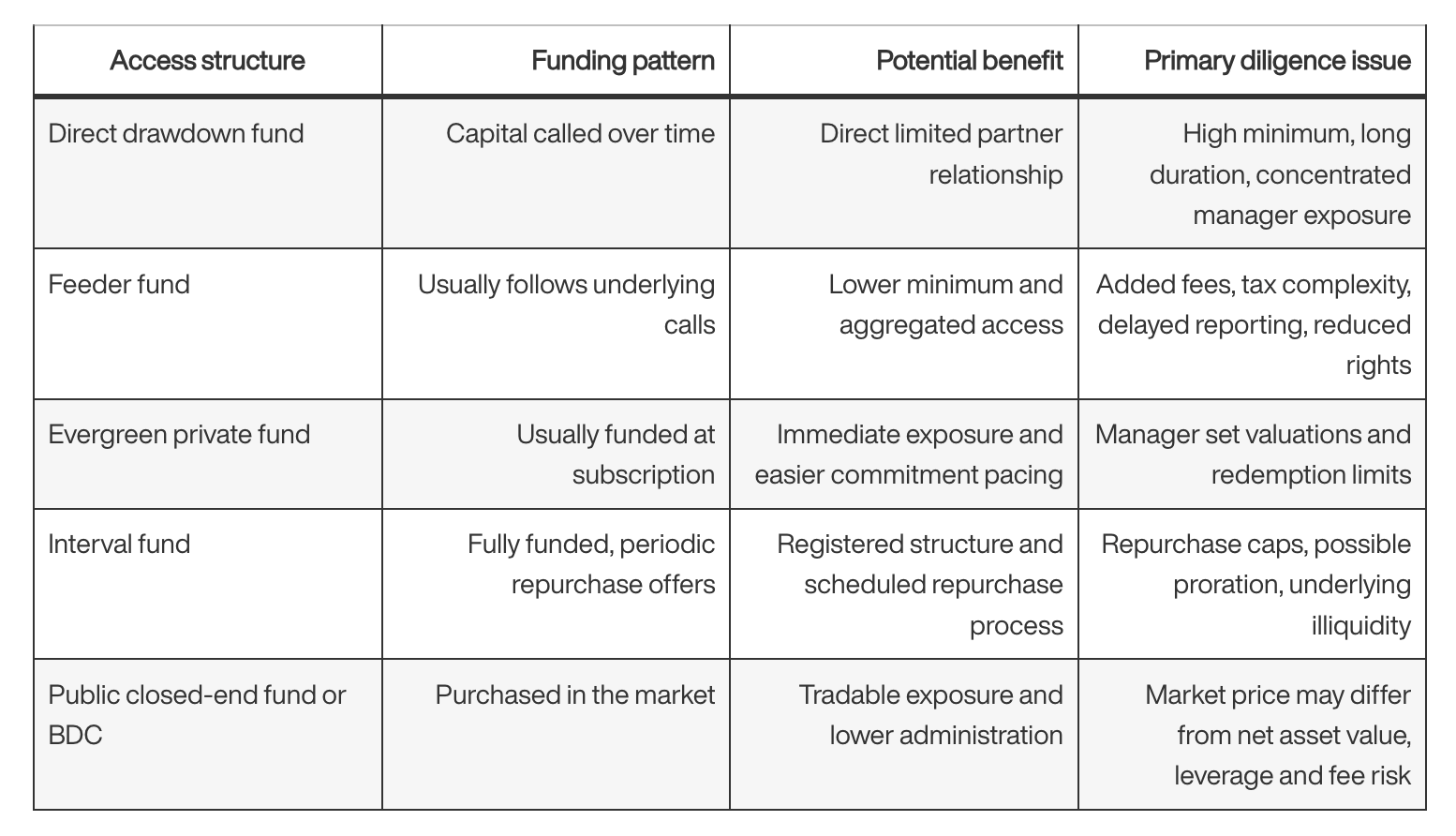
Interval funds illustrate why periodic liquidity is not the same as daily liquidity. FINRA notes that repurchase offers commonly occur at stated intervals and may cover 5% to 25% of fund assets. When requests exceed the offer, investors may receive only a prorated amount. Said another way – the fund’s stated “liquidity” is not guaranteed – it’s still up to the manager’s discretion.
And a “retail” feeder that on the surface appears to provide otherwise unavailable access, can add platform charges, administration costs, tax expenses, reporting delays, and fewer voting, information, or co-investment rights.
A platform can perform useful screening, but its menu reflects its relationships, capacity, economics, and commercial priorities. Strong selection still requires broader sourcing and comparison.
Why Private Equity Requires More Due Diligence
Private funds rely heavily on manager reporting, manager selected valuations, negotiated documents, and long holding periods, which increases both investment and operational diligence.
FINRA’s private placement guidance emphasizes independent research, verification of material claims, identification of conflicts, and review of liquidity restrictions. Those principles remain relevant when a fund is offered by a familiar institution.
Evaluate the team and strategy
Firm branding can obscure who produced the historical results and who will manage the new fund.
- Attribution: Identify which partners sourced, led, and exited the investments that drove prior returns.
- Team stability: Review departures, ownership changes, carried interest allocation, succession, and key person terms.
- Strategy consistency: Compare the new fund with prior funds by company size, sector, geography, check size, and leverage.
- Fund size discipline: Determine whether a larger fund can deploy capital without changing the opportunity set.
- Cycle experience: Review how the team handled impaired companies, difficult exits, and stressed financing markets.
A track record becomes less relevant when decision makers leave or the strategy changes materially.
Understand what produced the return
Private equity performance should be reviewed through several lenses:
- Realized versus unrealized: Distributed proceeds provide stronger evidence than valuations dependent on manager marks.
- Gross versus net: Net results show what investors retained after the complete fee burden.
- Return concentration: Determine whether one or two investments generated most of the gain.
- Value creation: Separate operating growth from leverage, multiple expansion, and favorable financing.
- Cash flow comparison: Where possible, compare fund cash flows with an appropriate public market equivalent.
Subscription credit lines can delay investor calls and increase reported internal rates of return by shortening the measured holding period, even when the investment multiple is unchanged. Investors should understand performance both with and without that financing effect.
In our view, a return needs to represent what an investor actually takes home – the net of fee, net of tax, return. And so for private funds we focus on Multiple on Invested Capital (“MOIC”), which represents the dollars an investor actually receives for dollars put in.
Review the terms and conflicts
The limited partnership agreement governs how economics, control, and risk are divided. The review should cover:
- Fees and carry: Management fee rate and base, step-downs, preferred return, catch up, waterfall, and carried interest structure.
- Layered expenses: Feeder fees, broken deal costs, transaction fees, financing expenses, organizational costs, and tax administration.
- Conflicts: Cross fund allocations, continuation vehicles, affiliated service providers, portfolio company transactions, and extensions.
- Protections: General partner commitment, key person events, clawbacks, removal rights, valuation procedures, and default remedies.
- Operations: Administrator, auditor, valuation committee, cybersecurity, compliance, and reporting controls.
The review matters because the investment may remain in place for ten years or longer with limited exit options.
Can Private Equity Create Better Tax Planning Opportunities?
Many private equity funds are partnerships, which means gains, income, deductions, and certain losses can retain their character as they pass through on Schedule K-1. That transparency can create useful planning opportunities.
A fund may allocate capital gains, interest, dividends, ordinary business income, depreciation, or other deductions. Some strategies may generate losses while value is being built, followed by gains when companies are sold. Those items may be coordinated with other passive activities, charitable planning, business income, or the timing of a liquidity event.
The tax attributes can improve a strong investment, but they should not compensate for weak economics.
A K-1 loss may not reduce current taxes
Before a federal loss becomes deductible, it may be limited by:
- Basis: The investor generally needs sufficient tax basis in the partnership interest.
- At-risk rules: The deduction may be limited to capital economically at risk.
- Passive activity rules: Passive losses generally offset passive income, not salary or active business income.
- Excess business loss rules: Large business losses may face an additional individual limitation.
- Character rules: Capital losses, ordinary losses, and interest expense follow separate limitations.
Investors need to know the loss character, timing, likelihood of use, and whether taxable income could arrive without enough cash distributions to pay the tax.
State tax treatment can diverge from federal: a Pennsylvania example
State rules do not always follow the federal result, and the gap can be significant. Pennsylvania, for example, separates personal income into eight classes, does not mirror the federal passive-activity and at-risk regimes, generally does not let a loss in one class offset another class or carry forward, and does not allow a resident’s basis to fall below zero. A single private equity K-1 can carry business income, interest, dividends, gains, and rents that land in different state classes, so a deduction usable federally may have limited state value. Items like these should be modeled one by one rather than described as a general state tax benefit, and investors should confirm how their own state treats each one.
Late K-1s, multistate filings, estimated payments, and taxable income without matching distributions add further complexity. Investors should maintain tax liquidity separately from capital-call liquidity and involve their CPA before committing. Our discussion of tax-efficient wealth management provides the broader context.
How Should Investors Plan for Private Equity Capital Calls?
An unfunded commitment is a future liability. The capital can remain invested while it waits, but it is not fully available for a property purchase, business acquisition, large gift, or another private fund.
Calls can cluster during difficult periods, when business cash flow, public markets, and private distributions are all under pressure. An average call schedule understates that risk.
A liquidity framework should separate:
- Expected calls: Capital likely to be requested over the next twelve to eighteen months.
- Stress calls: Additional liquidity for faster deployment or delayed distributions.
- Tax reserves: Cash for federal and state tax obligations.
- Family reserves: Spending, purchases, education, insurance, and emergencies.
- Opportunity reserves: Capital for a direct investment or business need without defaulting on existing commitments.
A pledged asset line can bridge a short timing mismatch, but it should not be the permanent funding plan. The line can be repriced or reduced as collateral falls, adding leverage when the family needs resilience.
Our high-net-worth cash and liquidity framework explains how to assign cash to known obligations, strategic reserves, and long-term capital.
A $25 million family can still become overcommitted
Consider a business owner with a $25 million net worth, including a $10 million liquid taxable portfolio, a $7 million operating business, $4 million of real estate, $2 million of retirement assets, and $2 million of rollover equity.
A $1 million minimum appears modest at 4% of net worth – it equals 10% of the liquid taxable portfolio before any additional commitments. If the family commits $1 million annually for three years because each fund is evaluated separately, it creates $3 million of contractual obligations without first designing a private markets program.
The comparison below uses hypothetical call patterns and assumes no investment return.
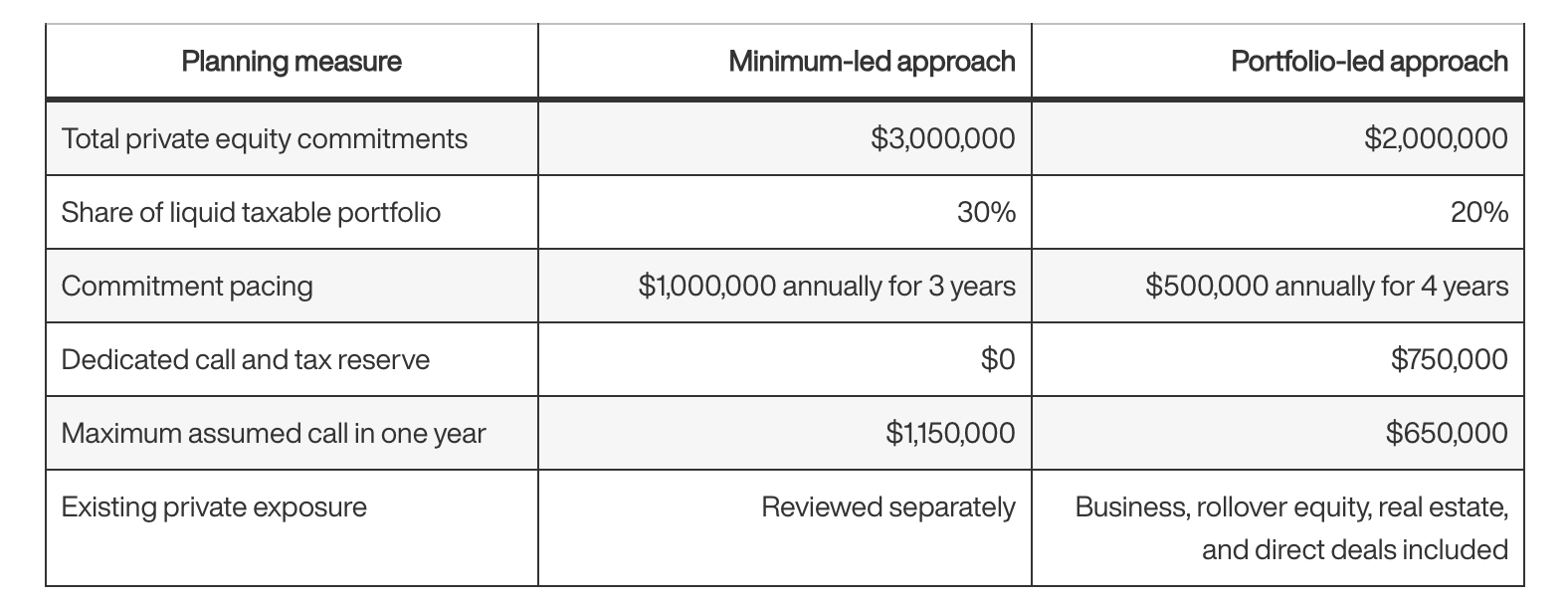
The portfolio-led approach does not guarantee a better return, and $2 million is not a universal allocation. It instead illustrates the sequence. The family defines an illiquidity budget, includes existing private exposure, sets commitment pacing, reserves cash, and then selects managers and structures that fit.
How Should Private Equity Fit Into the Rest of the Portfolio?
Private equity is often placed in an alternatives bucket, but the underlying economics may overlap substantially with public holdings.
A middle-market buyout fund may own leveraged companies that behave like public small-cap stocks. A growth fund may overlap with a concentrated technology portfolio. A real estate fund may add to property exposure already held personally. Less frequent valuation changes do not remove economic risk.
The portfolio review should test:
- Sector overlap: Compare fund exposure with public equities, employer stock, and the operating business.
- Leverage overlap: Add portfolio company debt to private credit, real estate borrowing, margin, and guarantees.
- Geographic overlap: Consider whether income, business value, real estate, and private investments depend on the same economy.
- Liquidity overlap: Combine fund commitments with restricted stock, direct deals, trusts, deferred compensation, and property.
- Exit overlap: Stress test weak public markets, delayed business proceeds, and limited private distributions at the same time.
Founders may already own a private equity portfolio of one
An operating company is an illiquid, concentrated private equity investment. After a sale, the founder may still hold rollover equity, earnouts, seller notes, indemnification escrows, or contingent payments. Adding several buyout and growth funds immediately after closing can replace one concentrated private position with several new positions that carry similar risk.
The allocation should include the business, human capital, transaction structure, and future income source. Our guide to private market investments for founders and entrepreneurs addresses those interactions in greater detail.
The period after a liquidity event may call for patience. Taxes, escrows, estate transfers, and spending may still be unsettled, and an early commitment can reduce flexibility for years.
The portfolio-led approach does not guarantee a better return, and $2 million is not a universal allocation. It instead illustrates the sequence. The family defines an illiquidity budget, includes existing private exposure, sets commitment pacing, reserves cash, and then selects managers and structures that fit.
How Should Private Equity Fit Into the Rest of the Portfolio?
Private equity is often placed in an alternatives bucket, but the underlying economics may overlap substantially with public holdings.
A middle-market buyout fund may own leveraged companies that behave like public small-cap stocks. A growth fund may overlap with a concentrated technology portfolio. A real estate fund may add to property exposure already held personally. Less frequent valuation changes do not remove economic risk.
The portfolio review should test:
- Sector overlap: Compare fund exposure with public equities, employer stock, and the operating business.
- Leverage overlap: Add portfolio company debt to private credit, real estate borrowing, margin, and guarantees.
- Geographic overlap: Consider whether income, business value, real estate, and private investments depend on the same economy.
- Liquidity overlap: Combine fund commitments with restricted stock, direct deals, trusts, deferred compensation, and property.
- Exit overlap: Stress test weak public markets, delayed business proceeds, and limited private distributions at the same time.
Founders may already own a private equity portfolio of one
An operating company is an illiquid, concentrated private equity investment. After a sale, the founder may still hold rollover equity, earnouts, seller notes, indemnification escrows, or contingent payments. Adding several buyout and growth funds immediately after closing can replace one concentrated private position with several new positions that carry similar risk.
The allocation should include the business, human capital, transaction structure, and future income source. Our guide to private market investments for founders and entrepreneurs addresses those interactions in greater detail.
The period after a liquidity event may call for patience. Taxes, escrows, estate transfers, and spending may still be unsettled, and an early commitment can reduce flexibility for years.
Build an illiquidity budget
An illiquidity budget defines how much wealth can remain inaccessible without compromising the plan. It should include the business, direct investments, real estate, restricted stock, rollover equity, deferred compensation, trusts, and private funds.
Stress testing should assume:
- No distributions: Private funds return no capital for several years.
- Accelerated calls: Managers deploy faster than expected.
- Lower exits: Private holdings sell later and at lower values.
- Public market decline: Liquid assets fall when calls are due.
- Family event: A tax payment, purchase, health event, or estate need requires cash.
An investor can meet the minimum and still lack enough liquidity to make the commitment safely, particularly when wealth is concentrated in a business, real estate, employer equity, or direct investments.
An illiquidity budget defines how much wealth can remain inaccessible without compromising the plan. It should include the business, direct investments, real estate, restricted stock, rollover equity, deferred compensation, trusts, and private funds.
Stress testing should assume:
- No distributions: Private funds return no capital for several years.
- Accelerated calls: Managers deploy faster than expected.
- Lower exits: Private holdings sell later and at lower values.
- Public market decline: Liquid assets fall when calls are due.
- Family event: A tax payment, purchase, health event, or estate need requires cash.
An investor can meet the minimum and still lack enough liquidity to make the commitment safely, particularly when wealth is concentrated in a business, real estate, employer equity, or direct investments.
A Six Question Framework for Evaluating a Private Equity Opportunity
Before committing, we organize the decision around six questions:
- Access: Is this a direct commitment, feeder, evergreen vehicle, interval fund, tender offer fund, or another structure, and what rights does it provide?
- Manager: Who generated the historical results, why is the strategy repeatable, and how have the team, fund size, and opportunity set changed?
- Economics: What are the management fees, carried interest, feeder costs, expenses, financing costs, and conflicts across every layer?
- Liquidity: How much is funded now, what remains callable, how quickly can calls accelerate, and what cash is reserved for taxes and family obligations?
- Tax: What income, gains, deductions, and losses may pass through, when could taxes be due, and can the attributes be used at both the federal and state level?
- Portfolio fit: How does the exposure interact with the investor’s business, public portfolio, real estate, debt, trusts, spending, and existing private investments?
Meeting the minimum answers whether the vehicle will accept the subscription. A sound investment decision requires evidence that the manager, economics, liquidity profile, tax treatment, and underlying exposure improve the total portfolio.
Final Takeaway
Broader private equity access is valuable when supported by institutional quality diligence and family level planning. It also makes availability easier to mistake for quality.
The objective is to build a deliberate program that the family can fund, understand, monitor, and hold through difficult periods while preserving enough liquidity for taxes, business decisions, and life outside the portfolio.
Private equity involves possible loss of principal, limited liquidity, valuation uncertainty, leverage, capital calls, fees, tax complexity, and long holding periods. Returns are not guaranteed. Investors should review fund documents with qualified investment, tax, and legal professionals before committing capital.
Frequently Asked Questions
What is the typical minimum investment in a private equity fund?
There is no universal private equity minimum. Direct commitments may require high six-figure or seven-figure amounts, while feeders, evergreen funds, and registered vehicles may accept subscriptions in the tens of thousands. The minimum reflects the structure and distribution channel, not the quality of the manager or the appropriate portfolio allocation.
What is the difference between an accredited investor and a qualified purchaser?
An accredited investor may qualify through income above $200,000 individually or $300,000 with a spouse or partner, net worth above $1 million excluding a primary residence, or certain professional credentials. A qualified purchaser generally owns at least $5 million of investments. Some private funds require the higher qualified purchaser standard.
Is accredited investor status enough to invest in every private equity fund?
No. Some funds are limited to qualified purchasers, qualified clients, institutional investors, or investors who satisfy additional suitability and minimum commitment requirements. A manager may also close a fund to new relationships or restrict capacity even when an investor meets every legal eligibility threshold.
Are lower-minimum private equity funds less attractive?
A lower minimum does not determine investment quality. It may reflect a feeder, registered fund, evergreen structure, or broader distribution strategy. Investors should compare the underlying manager, complete fee stack, portfolio, valuation policy, liquidity terms, reporting, conflicts, and investor rights rather than treating the entry threshold as a quality signal.
Are evergreen and interval private equity funds liquid?
They may provide periodic redemption or repurchase opportunities, but they are not equivalent to a daily traded fund. Interval fund repurchase offers can cover only a limited percentage of shares, and requests may be prorated. Evergreen funds may also impose caps, notice periods, gates, or suspensions when redemption demand rises.
Can private equity losses offset W-2 income?
Usually not directly. Partnership losses must pass federal basis, at risk, passive activity, excess business loss, and character limitations. Passive losses generally offset passive income rather than salary. States may apply their own income classes and basis rules, so the state benefit can differ materially from the federal result.
How much of a portfolio should be invested in private equity?
The appropriate allocation depends on liquid assets, spending, tax obligations, business ownership, real estate, existing private investments, time horizon, and commitment pacing. The analysis should include an illiquidity budget and stress tests for accelerated capital calls, delayed distributions, lower exit values, and simultaneous weakness in public markets or business cash flow.
Please read important disclosures here.
A message from Advisor Perspectives and VettaFi: Discover something new! Click here to register for our upcoming webcasts.
Membership required
Membership is now required to use this feature. To learn more:
View Membership BenefitsSponsored Content
Upcoming Virtual Events View All









