Wildfires offer a case study in how climate-related risks can spread to capital markets.
From severe wildfires in northern Ontario to record heat across Europe, extreme weather is back in the headlines. Such events are becoming more frequent and intense, and the risks associated with them are testing the limits of insurability. With our research partners at Columbia Climate School, we examine how strains on the insurance system can transmit climate-related risks through the capital markets.
California’s 2025 wildfires provide a case study. The Palisades and Eaton wildfires in Los Angeles in January 2025 cost insurers $40 billion—a new loss record for that category of natural disaster and, according to Swiss Re Institute, among the top 10 costliest insured loss events across all natural disaster categories to date. But these losses should be seen in the context of historical data showing that global catastrophe claims have trended sharply higher, particularly over the past decade.
Because of this trend, insurance premiums are rising, coverage is becoming more restrictive, some policies aren’t being renewed, and some insurers are retreating from higher-risk markets. The challenge affects not only insurers and asset owners but investors—especially those with exposure to insurance companies, real assets or municipal bonds. The issue is global, but California’s wildfires help to illuminate its key aspects.
Humans and Nature: A Combustible Mix
Two factors are driving rising wildfire risk and related insurance losses. Rising global temperatures are leading to increased variability in precipitation patterns and earlier snowmelt, resulting in longer, more destructive fire seasons. And increasing housing developments in the Wildland-Urban Interface (WUI)—areas where homes are close to wildfire zones—are putting more homes at risk.
The area burned by US wildfires each year has increased markedly, with recent seasons among the most severe on record. At the same time, the number of homes in proximity to wildfire risk zones has risen substantially since the 1990s—reflecting both expansion into fire-prone areas and the growing frequency, size and intensity of wildfires themselves. Together, these trends mean more homes are exposed when fires occur, amplifying potential losses.
See more: Insurers Endure Self-Harm to Side With Big Oil
From an insurance perspective, risk is rising and becoming harder to assess. For example, as housing in the WUI proliferates, the risk is no longer simply direct proximity to wildfire risk zones but fire spreading from one property to another. Indeed, flying embers are the primary source of property loss in a wildfire. Insurers are working with private data providers to develop better risk-assessment techniques, but the research is expensive and contributes to rising insurance costs.
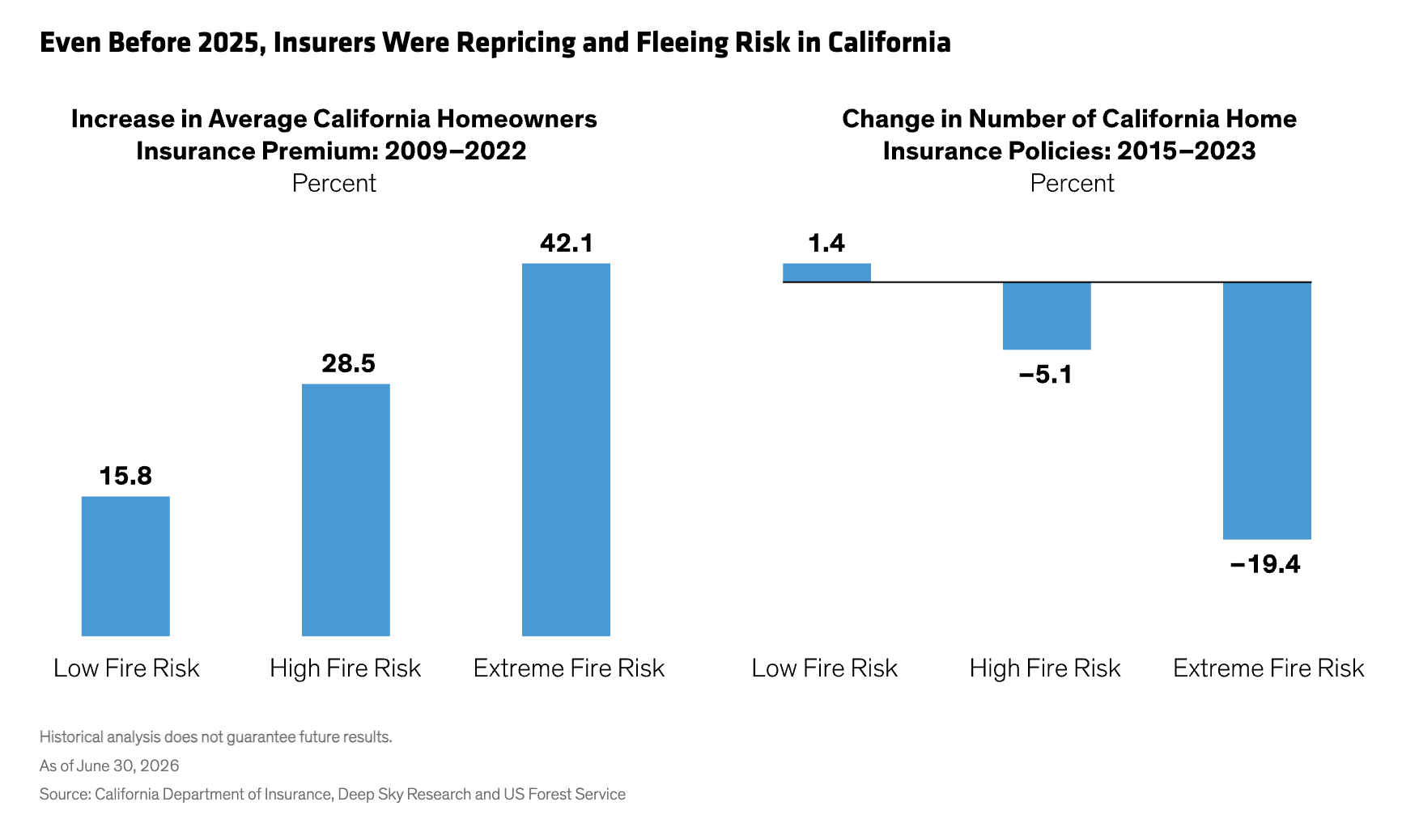
Even before the 2025 wildfires, many insurers in California either raised premiums in or withdrew from fire-prone areas (Display).
The social and economic costs are considerable. Most homebuyers require a mortgage but can’t obtain one without insurance, potentially limiting homeownership and affecting property values. Uninsured and underinsured households lack the resources to rebuild after a fire; as their numbers grow, state and local governments must provide more temporary housing and social services during recovery. Lower home values constrain property tax revenues and this, together with the rising costs of post-fire recovery, puts some municipalities’ bond ratings at risk.
States Struggle to Plug the Insurance Gap
Most US states have responded by introducing a Fair Access to Insurance Requirements (FAIR) plan for homeowners unable to obtain private coverage. Under the plan, insurers in each state contribute to a shared-risk fund. If catastrophic claims exceed the fund, assessments are levied on insurers in proportion to their market share.
But FAIR plans have limitations. While they are cheaper than indemnity plans offered in the private marketplace, they cover fewer hazards and pay out claims at smaller percentages. And the funding model is unwieldy: as greater fire risk causes premiums to rise, so too does demand for FAIR plans, the cost of which must be met through still-higher premiums.
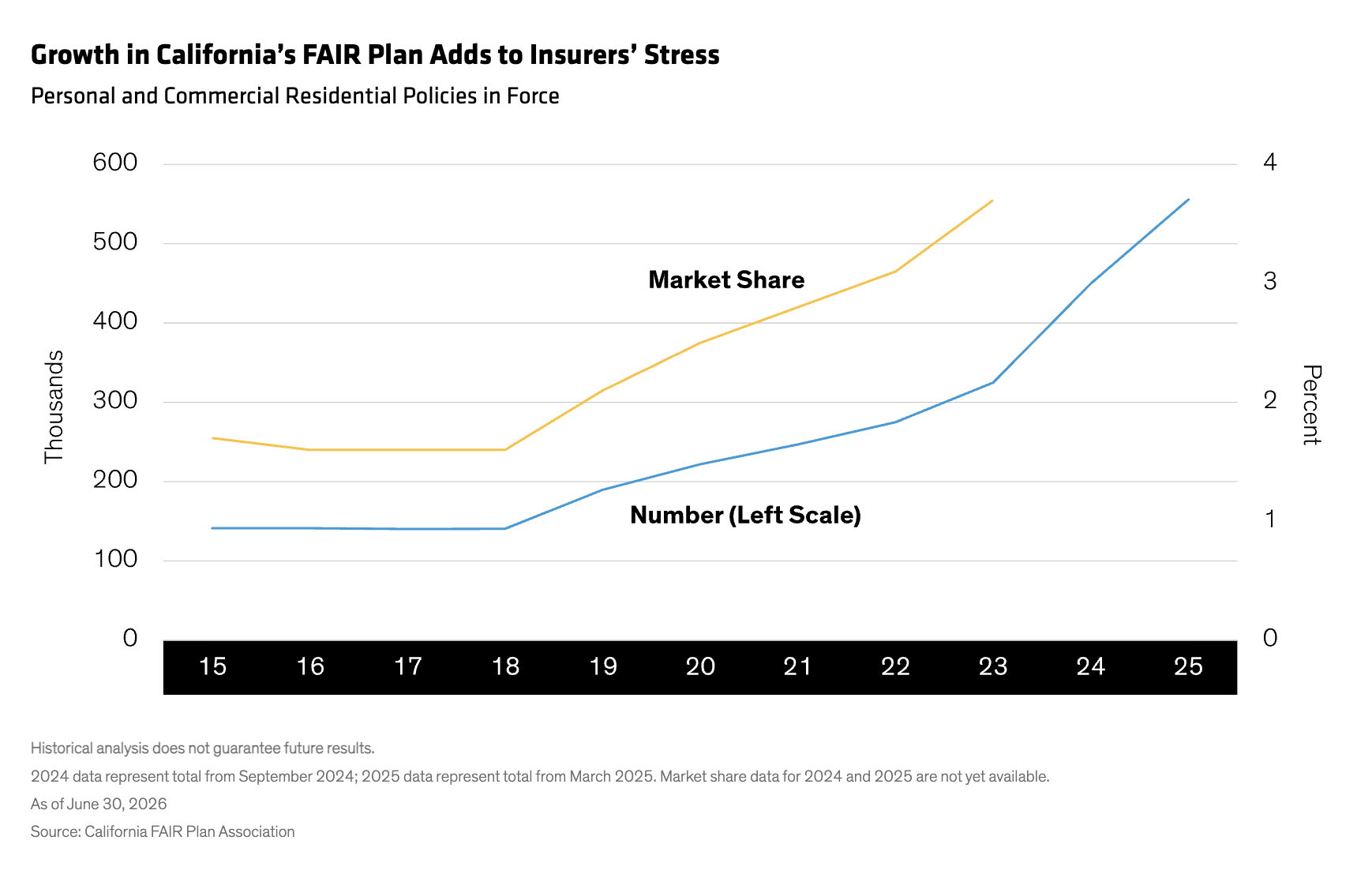
This hurts policyholders and insurers alike. In California, for example, some insurers are withdrawing from the state, leaving fewer insurers to shoulder the FAIR burden (Display).
The 2025 fires overwhelmed California’s FAIR fund, which had only $377 million in its account when the blazes began. The state quickly authorized a $1 billion assessment, which insurers passed on to policyholders in higher premiums. FAIR plans may provide interim relief, but in our view, they aren’t sustainable solutions. Indeed, some states have begun to move homeowners off them and back to the private market.
Rethinking the Indemnity Model
As traditional insurance becomes more challenging in high-risk areas, research has turned to possible alternatives.
One is parametric insurance, widely used by crop growers. It differs from indemnity insurance because it is triggered not by property loss or damage but by a predetermined condition. In crop insurance, this might be a specified amount of rainfall that could lead to flooding and crop loss.
Premiums are lower than for indemnity insurance, and payouts are quicker, but there are risks. For example, a weather event may not be strong enough to trigger a payout but may still cause damage. Parametric insurance’s application to wildfire coverage hasn’t been widely tested, but we see potential for it as a risk overlay used in conjunction with indemnity insurance.
Another approach under discussion is community-based insurance, in which coverage is offered to defined groups of homeowners rather than individuals. Advocates argue that it could help communities coordinate resilience measures and improve risk pricing. Regulatory barriers remain significant, however, limiting its use in many states.
Home hardening offers a more direct way to reduce risk. Homeowners can take steps to reduce their property’s vulnerability to wildfire, have the work professionally certified, and submit the certificate to an insurer. This may result in lower premiums or reversal of a previous denial. Such outcomes are not guaranteed, but the approach may make homes safer.
Understanding Insurance Risk Is Critical
We believe investors should understand where insurance markets are breaking down, where alternative risk-transfer mechanisms might emerge and how policy responses evolve. Understanding these dynamics will be key to managing exposures to insurers, real assets, mortgage portfolios, municipal bonds and insurance-linked strategies.
In our analysis, extreme weather is no longer merely a localized underwriting issue but a material factor shaping credit risk, asset valuation, municipal finance and long-term insurability.
The views expressed herein do not constitute research, investment advice or trade recommendations, do not necessarily represent the views of all AB portfolio-management teams and are subject to change over time.
Dr. Dale is a Senior Lecturer in Climate and the Director of the MA in Climate and Society program at Columbia University’s Climate School. Trained as a political scientist, she studies how environmental policy can foster or hinder effective climate change adaptation at all scales.
Sara Rosner is a Senior Vice President and AB’s Director of Responsible Investing Research.
Sydney Kyne is a Vice President and Credit Research Analyst in the Global Investment-Grade Credit department.
A message from Advisor Perspectives and VettaFi: Discover something new! Click here to register for our upcoming webcasts.
© AllianceBernstein
Read more commentaries by AllianceBernstein