For investors using direct-indexed equity strategies, tax-loss harvesting becomes a major focus, as it may help improve after-tax returns—but we think the calendar for tax-loss selling can make a big difference. Weekly tax-loss harvesting, in our view, offers the potential for more efficient tax-loss harvesting and more effective index tracking in turbulent markets.
Direct indexing is a highly popular approach to equity market exposure in separately managed accounts (SMAs). Here’s how it works: investors own a portfolio of stocks tailored to replicate the performance of a broader market index, like the S&P 500. Direct indexing offers investors personalization, the ability to own stock shares directly and potential tax efficiency through tax-loss harvesting.
See more: A Growing Divide in Leveraged Finance
Many tax-loss harvesting strategies feature a monthly cadence. Every month, portfolios are evaluated to identify stocks that can be sold at a loss to offset gains elsewhere. That’s 12 opportunities to trade and harvest tax losses each year, with no concerns about breaking the wash-sale rule against selling a security and buying a similar one within 30 days. As we see it, this cadence often reflects the constraints of processes that lack the scale, technology and infrastructure to support more frequent optimization.
But with taxes playing a sizable role in what individuals keep from their returns, is monthly the most effective calendar cadence?
Weekly Tax-Loss Harvesting: A More Nimble Approach?
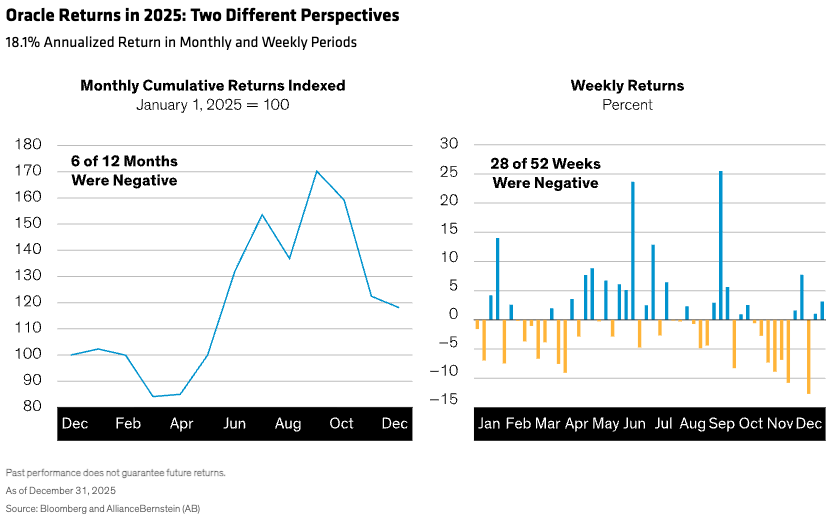
Our research indicates that weekly could be a more effective harvesting cadence, one with more chances to identify loss-harvesting opportunities. A month can be a long time in equity markets—many stocks that finish a month unchanged or higher might have been underwater during it. A manager checking in at month-end would be too late to catch these losses. For many stocks, monthly returns may obscure weekly performance that’s more volatile.
There were many such examples in 2025, including Oracle (Display). Its stock was volatile during the spring tariff turmoil, and it also posted a loss in the fourth quarter. Because the stock was in negative ground into May of that year, a monthly harvesting cadence would likely have created a chance to take advantage of the first-quarter loss. But Oracle rebounded strongly afterward, so the monthly cadence wouldn’t have found another net loss to harvest in 2025. A more frequent cadence may have been able to enter and exit the stock multiple times, with more flexibility to capitalize on the fourth-quarter slump.
One advantage of more opportunities to trade is the ability to “prune” a stock position over time as it declines, rather than all at once. With weekly trading, there’s less need to sell all of a stock position with more aggressive trading when looking to realize a tax loss. Larger, more aggressive trades might also heighten the risk that a stock rebounds soon after it’s sold, so a portfolio could miss out on part of the recovery while waiting out the wash-sale period.
How Tax-Loss Harvesting Cadence Affects Index Tracking
Generally speaking, more trading translates into higher tracking error—the measure of how closely a direct-indexing portfolio stays in step with its market index. But in particularly volatile market environments, like the one in 2025, the ability to reposition the portfolio more often may actually reduce tracking error by making it more nimble.
A portfolio with monthly harvesting would generally require numerous large trades if it has drifted substantially from the index, which could inflate its tracking error. Weekly harvesting, in contrast, may reduce tracking error by making smaller trades on harvesting day while still generating the same or greater tax losses. This means more bites at the apple—four times in a month instead of once—assuming a manager is able to manage comprehensively around the wash-sale rule.
It would seem logical that daily tax-loss harvesting would be even better, but in practice more frequent trading isn’t always better. Selling on every stock decline could leave a portfolio more exposed to short-term reversals. If a stock is sold after a brief drop, then quickly rebounds, wash-sale rules generally prevent managers from quickly buying it back. As a result, a portfolio may miss part of the recovery. A weekly cadence may strike a better balance by harvesting smaller, more regular slices of losses than a monthly process without reacting to every short-term move. This may increase chances to capture tax losses while helping guard against the risk that weaker pre-tax returns offset those tax benefits.
Many direct-indexing approaches are similar, but we think portfolio-construction choices can make a difference in overall performance, risk and loss generation. More frequent harvesting approaches require both the ability to navigate the dynamics of wash-sale rules and the operational capacity to trade more often. But in our view, it may also produce more consistent results, especially in fast-moving markets.
The views expressed herein do not constitute research, investment advice or trade recommendations and do not necessarily represent the views of all AB portfolio-management teams. The views should not be considered to be legal or tax advice. The tax rules are complicated, and their impact on a particular individual may differ depending on the individual’s specific circumstances. Views are subject to revision over time.
References to specific securities are presented to illustrate the application of our investment philosophy only and are not to be considered recommendations by AllianceBernstein L.P.
A message from Advisor Perspectives and VettaFi: Discover something new! Click here to register for our upcoming webcasts.
© AllianceBernstein
More Global Markets Topics >