The U.S. Department of the Treasury officially announced the investment lineup for the rollout of Trump Accounts, which includes five popular exchange-traded funds (ETFs). Trump Accounts are tax-advantaged investment vehicles that assists U.S. families with building long-term wealth for their children.
The program, which launched on July 4, gives children an early start to investing. The program provides a $1,000 federal seed contribution to eligible children under the age of 18 (those born between 2025 through 2028), and gives families, friends, and employers the ability to contribute up to $5,000 per child. Upon reaching age 18, the child gains full access to the account. They can then use the funds for further investing or other purposes.
Given the rising popularity of the ETF vehicle, this article delves into the ETF choices offered by the U.S. Treasury for this new program.
Key Takeaways:
- The Trump Accounts program launched on July 4, providing a $1,000 federal seed contribution to eligible children (those born between 2025 through 2028) alongside options for family and employer contributions.
- The program uses the State Street SPDR Portfolio S&P 500 ETF (SPYM) as its centralized default strategy, automatically filtering all initial account contributions into the rock-bottom 0.02% expense ratio large-cap fund.
- Four additional low-cost total market and large-cap trackers from BlackRock and Vanguard will become available in the coming months as custom choices for long-term compounding.
See More: S&P 500 Snapshot: Best Week in Two Months
S&P 500 Core Exposure
At launch, the Treasury is implementing a centralized default strategy for the Trump Accounts. All initial contributions will automatically flow into a single cornerstone fund, the State Street SPDR Portfolio S&P 500 ETF (SPYM). With an expense ratio of just two basis points, it's an ideal entryway for young investors to get access to the broad stock market.
Like its bigger brother, the State Street SPDR S&P 500 ETF (SPY), the fund tracks the S&P 500 Index for access to 500 of the largest, most dominant publicly traded corporations in the United States. However, it does so at a more accessible price per share, ideal for kickstarting investing for children.
As mentioned, SPYM will serve as the default fund which all funds will flow into until the U.S. Treasury increases the functionality of the Trump Accounts program. At that point, another broad market fund offered for increased functionality will be BlackRock's iShares Core S&P 500 ETF (IVV). Like SPYM, IVV also tracks the S&P 500 to provide exposure to mega-cap leaders across various sectors, including technology, healthcare, and finance. Because both SPYM and IVV are market-capitalization weighted, top-performing giants will heavily influence the daily movement of these funds.
Both SPYM and IVV offer rock-bottom expense ratios for stable, large-cap foundational investing to build a child's portfolio. IVV's fee is one basis point higher, with a 0.03% expense ratio.
Broadening the Investment Horizon
Whether new or experienced, investors can always benefit from increased optionality. As mentioned, SPYM will serve as the initial investing portal. However, another option for the Trump Accounts will be the State Street SPDR Portfolio S&P 1500 Composite Stock Market ETF (SPTM).
For families seeking a slightly wider lens, as opposed to staying in the mega-cap names within the S&P 500, SPTM is ideal. The fund tracks the S&P Composite 1500, which bundles the large-cap S&P 500, the midcap S&P MidCap 400, and the small-cap S&P SmallCap 600 into a single vehicle. By capturing roughly 90% of the total U.S. equity market, SPTM introduces small and midsized companies into the mix, offering a smoother bridge between large-cap stability and small-cap growth potential. It also does so at a low 0.03% expense ratio.
The Vanguard Total Stock Market ETF (VTI) and the iShares Core S&P Total U.S. Stock Market ETF (ITOT) also offer this level of aggregate stock market exposure and will be offered by the Trump Accounts. At expense ratios of just 0.03%, both contribute to the trend of low-cost ETF options offered by the Trump Accounts. Instead of relegating exposure to 500 or 1,500 companies through the aforementioned funds, these funds aim to hold virtually every investable public stock in the United States. This "investing in the field" exposure includes microcap startups alongside megacap conglomerates.
Performance Differences: S&P 500 vs. Total Market
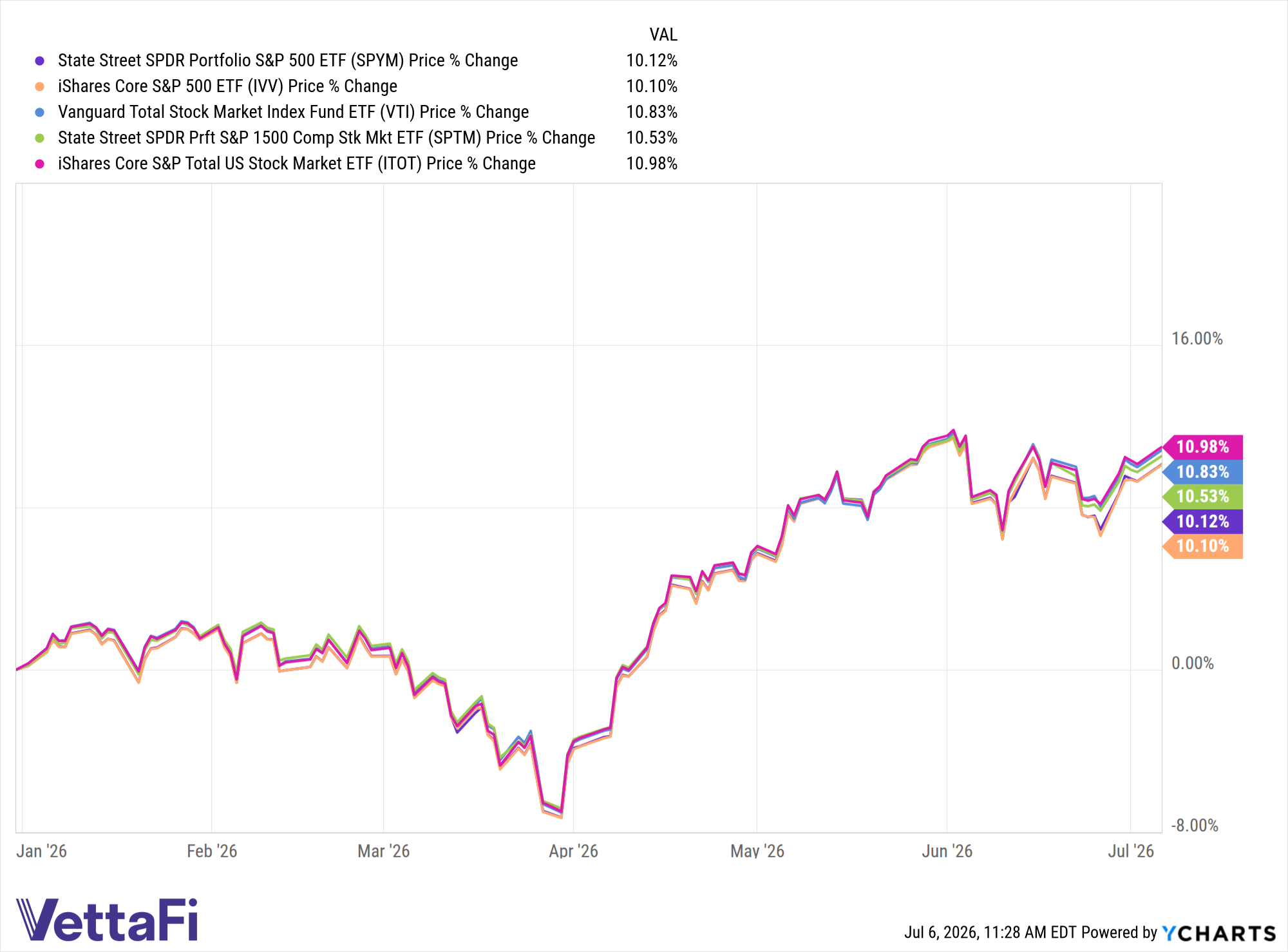
While all five options focus heavily on U.S. equities, performance can diverge among the funds. This could guide families to the best strategy to kickstart their child's investing career.
While SPYM and IVV offer the safety of investing in the S&P 500, small- and midcap stocks can also exhibit greater performance relative to their large-cap peers. As a result, total market funds like VTI and ITOT are outperforming large-cap-centric SPYM and IVV year-to-date. Conversely, small- and midcap companies can also exhibit greater volatility depending on current market and macroeconomic conditions. That's worth considering during the fund selection process. When smaller companies outperform, the all-cap exposure found in VTI and ITOT gives them a distinct edge over strict S&P 500 trackers. Conversely, during periods of megacap tech giant dominance over market returns, SPYM and IVV typically take the lead.
As mentioned in the news release, the Treasury will soon announce the official activation date for individual account adjustments, alongside step-by-step instructions for custodians looking to transition away from the default SPYM allocation into these broader total-market alternatives.

A message from Advisor Perspectives and VettaFi: To learn more about this and other topics, check out some of our videos.
Read more commentaries by VettaFi | Advisor Perspectives