Editor’s note: we’re publishing an early, abbreviated issue in advance of the U.S. holiday weekend. For those commemorating America’s 250th, we hope you enjoy the occasion.
Productivity is an essential component of economic success. It allows for growth without inflation; compensates for demographic deficits; and helps nations attract investment.
Unfortunately, productivity around the world is in the midst of a 39-day slump. That window corresponds with the FIFA World Cup, currently taking place across Canada, Mexico and the United States. Workers are watching matches surreptitiously, participating in chats about the tournament, and monitoring the brackets in office pools.
Technology departments at some companies have been called away from their normal routines to build models that simulate outcomes of the matches. These platforms are designed to sate client interest and to show off applications of artificial intelligence (AI). Reports of longer waiting times for tech support are, as yet, unconfirmed.
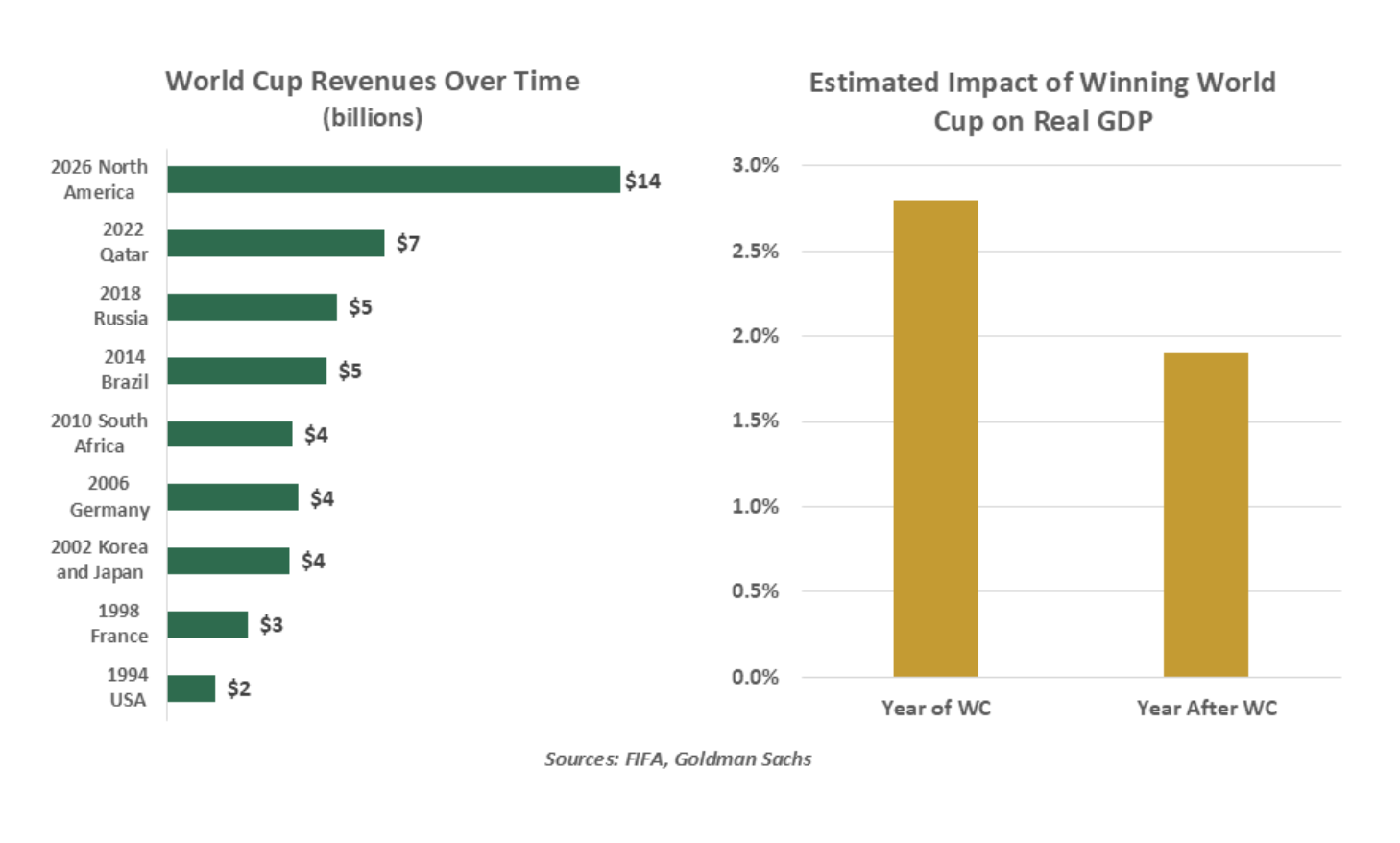
While the World Cup is creating distractions, it does attract a lot of money. Helped by an expansion to 48 teams from 32, this year’s rendition will earn a record amount of income for FIFA, the sport’s governing body. It has the United States to thank for that; not for this year’s co-hospitality, but for the financial legacy of the 1994 tournament.

The United States men’s national team has never been among the world’s most highly rated sides, but the U.S. owns the largest consumer market in the world. Soccer’s leaders had long wanted a share of that demand, and awarded the 1994 finals to America in the hope of tapping into it. The decision was controversial: there was no U.S. domestic league at the time, and there was concern over attendance.
Read more: A Coiled Spring: The Dollar’s Next Move
Up until that point, World Cup hosts had paid a steep price for the privilege, taking large losses on arenas and transit lines that fell quickly into disuse after the tournament ended. Some didn’t even get that far: Colombia was selected to host the 1986 edition, but backed out in 1982 after preparations faltered.
But what the U.S. lacked in soccer heritage, it made up for with marketing. The extensive sale of sponsorships, criticized in some corners back then as over commercialization, expanded a huge revenue source. The arenas were full, and television rights fees set a new standard. Ultimately, the event netted an estimated $100 million, the first World Cup to turn a profit.
Since then, FIFA has embraced an aggressive approach to marketing its events, sending worldwide soccer revenues soaring. This has helped finance the World Cup and a number of national federations. Several of the latter have seen their teams outperform expectations at this tournament. (Cape Verde, with just over a half a million inhabitants, made the knockout round.)
Host countries enjoy only modest economic gains. FIFA and the World Trade Organization estimated that U.S. gross domestic product (GDP) will be $17 billion higher as a result of the event, but this represents a very small increment in a $39 trillion economy. (Canada and Mexico, which are hosting many fewer matches, will see even smaller totals.) This revenue will be offset by costs for staging the event, leaving little left over.
There is some thought that World Cup hosts realize a branding benefit, which generates long-term tourism and investment that wouldn’t have arrived otherwise. But economists at Columbia University have found that this impact is very small. Overall, a recent Goldman Sachs analysis found that host nations realize almost no net economic benefit.
That same Goldman study showed that World Cup winners do appear to enjoy better economic results in the interval after their victories. On that basis, we should probably be supporting England, whose economy is faltering as it prepares for another leadership transition.
In sum, the World Cup is a bonanza for FIFA but breakeven at best for everyone else. That accounting does not include the loss of productivity, which is especially large for certain members of the economics department. Now if you will excuse me, there is a match that I want to watch…
Carl Tannenbaum is the Chief Economist for Northern Trust.
Information is not intended to be and should not be construed as an offer, solicitation or recommendation with respect to any transaction and should not be treated as legal advice, investment advice or tax advice. Under no circumstances should you rely upon this information as a substitute for obtaining specific legal or tax advice from your own professional legal or tax advisors. Information is subject to change based on market or other conditions and is not intended to influence your investment decisions.
© 2026 Northern Trust Corporation. Head Office: 50 South La Salle Street, Chicago, Illinois 60603 U.S.A. Incorporated with limited liability in the U.S. Products and services provided by subsidiaries of Northern Trust Corporation may vary in different markets and are offered in accordance with local regulation. For legal and regulatory information about individual market offices, visit northerntrust.com/terms-and-conditions.
A message from Advisor Perspectives and VettaFi: Discover something new! Click here to register for our upcoming webcasts.
© Northern Trust
Read more commentaries by Northern Trust