Navigating the New Era of Growth With An Active Mandate
Membership required
Membership is now required to use this feature. To learn more:
View Membership Benefits"Growth at all costs" is a common refrain when businesses are looking to scale aggressively. The phrase could also be applied to the capital markets, particularly with regard to how dominant the growth factor has been over the years.
Key Takeaways
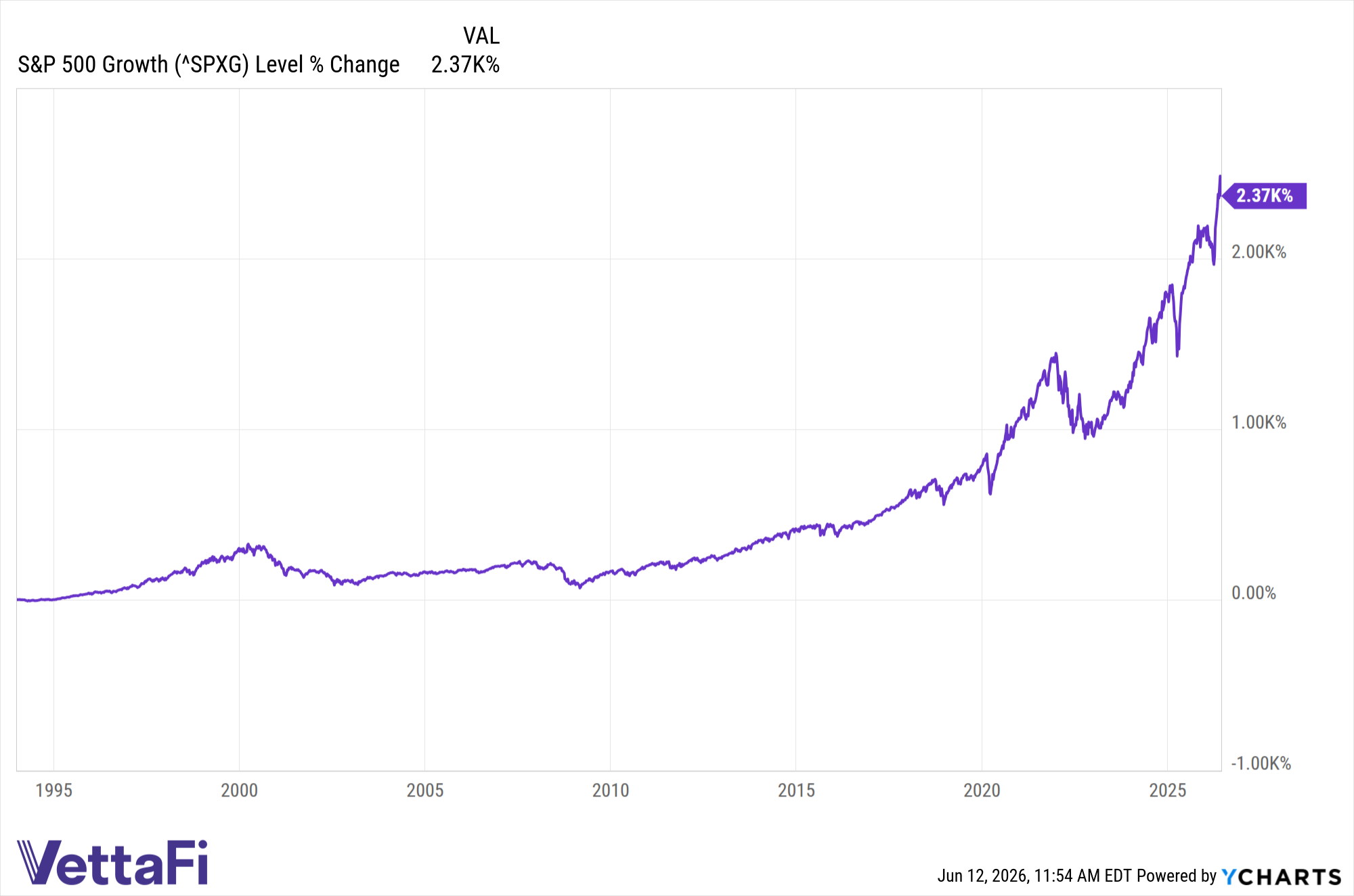
- The S&P 500 Growth Factor has surged over 2,000% since 1992, proving the compounding power of large-cap growth stocks, though the strategy for capturing this growth is shifting.
- Mega-cap tech giants like the Magnificent Seven are no longer moving together as a synchronized pack, meaning passive index funds now carry high single-stock concentration and structural risks while active managers can find value by being selective.
- Secular growth is expanding beyond tech into sectors like healthcare — driven by long-term biopharma trends like obesity treatments — and industrials, which are benefiting from aerospace demand and the infrastructure needed for AI data centers.
See more: West Coast Powerhouse: Inside Capital Group’s Rapid Growth at Exchange 2026
The Power of Growth
Created in 1992, the S&P 500 Growth Factor is up well over 2,000%. In the long-term investment horizon, this soundly illustrates the tremendous compounding power of large-cap growth equities. Powered by multi-year secular tailwinds and technological innovation that continues to evolve, growth exposure is an imperative portfolio component to capture capital appreciation for patient, forward-looking investors.
However, not all strategies to encapsulate the investment power of growth are the same. A conversation with Maria Karahalis, equity investment director and portfolio strategy manager at Capital Group, revealed this.
Growth's Evolution the Past Decade
When discussing names tied to growth over the past decade, companies like Apple, Microsoft, and now NVIDIA are typically cited. As Karahalis noted, structural dominance of the mega-cap growth cluster wasn't an overnight occurrence. The trend built steadily after 2015, accelerating as a tight pack of multi-trillion-dollar corporations that have undergone various monikers over the years such as FANG, FAANG, or the Magnificent Seven. Acronyms aside, they've certainly accounted for the lion's share of major market returns. This dynamic turned traditional passive growth vehicles into highly concentrated investment pools, which forced index-tracking investors to take outsized, single-stock positions.
More recently, however, a notable shift has materialized: a profound differentiation in how these mega-cap corporations trade relative to one another. Like band members deciding to pursue solo careers, they are no longer moving together as a synchronized pack. Some tech leaders continue to scale operational hurdles effortlessly, while others face slowing growth, multiple compression, or structural margin pressures. From an investment standpoint, this alters the strategy for active managers.
New Directions of Growth
"Recently, we've seen greater differentiation in how those companies trade relative to each other, which means getting them right is important," Karahalis emphasized. "It's not just about owning them all."
When index components stop trading as a cluster, buying an entire passive bucket forces investors to inherit structural vulnerabilities. Conversely, an active mandate allows an investment team to isolate true structural pioneers while bypassing extended, high-multiple names prone to tail risk. Karahalis notes that this setup creates an ideal environment for fundamental stock pickers.
"There've been companies apart from those very large-cap technology-oriented companies that have also contributed," Karahalis said. "That, to me, is a very exciting period to be in. You can add a lot of value through stock selection in a particular period when the market isn't just about momentum and a narrow group of stocks."
Innovation Beyond Tech Sector
There's been a prevailing sentiment circulating that markets are starting to broaden out. While mega-cap tech leaders have propelled the markets, investors are beginning to seek other avenues for outperformance such as international equities or small-cap companies. Additionally, they're also looking at other sectors outside of tech.
Secular expansion is actively manifesting in sectors that have been historically labeled as cyclical or defensive, driven by profound technological innovation and long-term demographic shifts. Karahalis identified healthcare as a prime example where a dramatic innovation revolution is currently unfolding, particularly in biopharma. Global leaders like Eli Lilly have emerged to address major global unmet needs, particularly in obesity and weight loss treatments. Karahalis notes that investors need to look at this with a multi-decade horizon.
"If we think about that opportunity, we believe we're 3 years into a 20-year growth cycle," Karahalis said. "This doesn't mean the stocks won't be volatile at times, but the long-term opportunity is really meaningful."
Similarly, the industrials sector is revealing high-conviction secular tailwinds, particularly within commercial aerospace. Despite temporary pandemic-era disruptions and near-term macroeconomic headlines, global demand for air travel continues to rebound. The most compelling structural opportunities reside with specialized components and parts suppliers, which operate inside an insulated ecosystem of essential replacement parts, maintenance, and multi-year contract visibility. Furthermore, specialized industrial operators are playing an indispensable role in building out the physical infrastructure and power systems required to support massive, artificial intelligence (AI) data centers.
The CGGR Active Blueprint
For investors seeking to capture the broadening landscape primed for growth, the Capital Group Growth ETF (CGGR) provides a highly flexible active solution. While the liquid ETF vehicle launched in February 2022, the underlying architecture is tethered to a high-conviction institutional strategy that Capital Group has continuously managed through all market cycles since 1984.
"The fund or the strategy pursues growth through the lens of capital appreciation so it takes a flexible approach to growth," Karahalis said of CGGR. "We do have the flexibility to invest in cyclicals or cyclical growth companies. Oftentimes, you'll hear us talk about investing in a turnaround opportunity. Think about that more though as a company whose business prospects we believe are underappreciated by the market."
The fund's operational structure relies directly on Capital Group's "The Capital System." In this process, portfolio management is distributed across various portfolio managers with years of industry experience. Each manager independently directs a separate sleeve of the overall portfolio according to their highest-conviction tactical approach. These individual sleeves are then blended into a single, unified fund designed to capture consistent relative performance while dampening single-manager style biases.
This multi-manager framework is then supported by a global, highly tenured team of career research analysts who also have years of market experience. To source investment ideas and verify operational metrics, Capital Group’s investment professionals conduct more than 20,000 corporate meetings annually. The firm encourages diverse perspectives and internal debate to stress-test investment risks. In short, this is active management at its purest form.
Not At All Costs
In the beginning, "growth at all costs" was mentioned. However, with an expense ratio of just 39 basis points, CGGR comes at a competitive cost. Given the rigorous amount of research employed by Capital Group, this is highly competitive and 12 bps lower than the FactSet Segment Average.
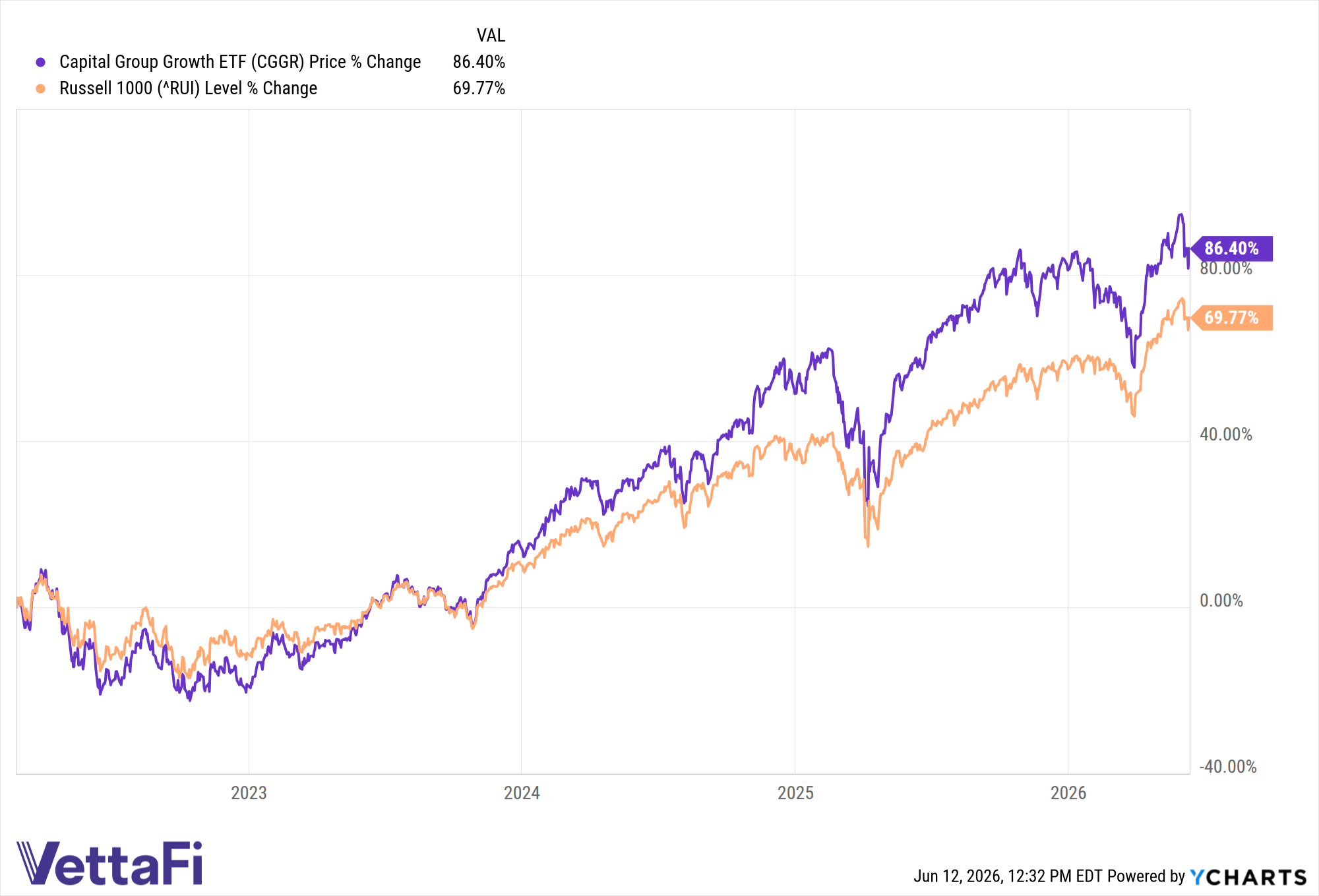
By prioritizing bottom-up security selection, CGGR naturally builds a diversified growth portfolio that's been outpacing the performance of the Russell 1000 Growth Index while structurally avoiding excessive single-stock or sector concentration. For those looking for a growth ETF with a truly active strategy, CGGR is a compelling option.
For more information on CGGR, click here.
For more news, information, and analysis, visit the Equity ETF Content Hub.
A message from Advisor Perspectives and VettaFi: To learn more about this and other topics, check out some of our webcasts.
Membership required
Membership is now required to use this feature. To learn more:
View Membership BenefitsSponsored Content
Upcoming Virtual Events View All









