The launch of multi-token crypto products (i.e., crypto index ETFs) signals that many issuers believe the next growth phase in crypto ETFs will be driven by investors who want a rules-based basket approach rather than single asset calls. It mirrors how equity investors often move from single-stock investing to index adoption once an asset class matures, and it also reflects the growing preference among advisors for simpler, portfolio building blocks. But flows into the category have been weak, while single crypto asset ETFs gain significant the attention. I believe this trend will partially reverse over time and we will potentially see more inflows into crypto index ETFs as the number of crypto products becomes too overwhelming to easily perform comparative due diligence. Here is what advisors and investors need to know before making a decision on if/when it is appropriate to invest beyond Bitcoin.
What are crypto index ETFs?
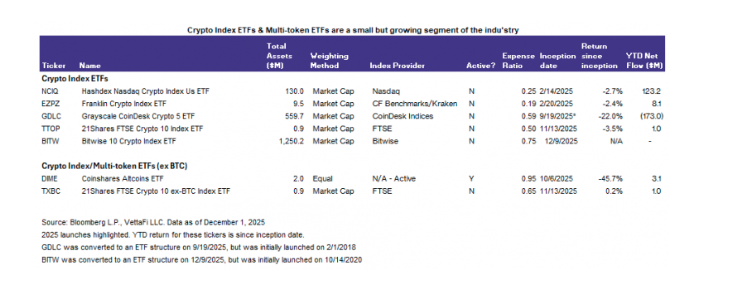
Crypto index ETFs diversify beyond Bitcoin in one product. The majority of these are market-cap weighted and look similar under the hood. At the core, these hold a large amount of Bitcoin (typically around 75%), some Ether (around 15%), XRP (5-6%), Solana (3%), and Cardano (less than 1%). Other allocations are typically less than 1% and include Chainlink, Stellar, and Dogecoin. Most of these also have a small, simple number of holdings (either 5 or 10).
Crypto index products remain comparatively under-the-radar versus single crypto asset ETFs. But they appeal to a specific investor mindset: 1) those that already understand the Bitcoin story and want to expand beyond Bitcoin, and 2) those not necessarily interested in making single asset pick. These baskets can also provide small exposure to assets that may not yet have standalone U.S. spot ETFs (although in small percentages). Stellar and Polkadot, for instance, do not yet have spot ETFs but are found in several crypto index ETFs.
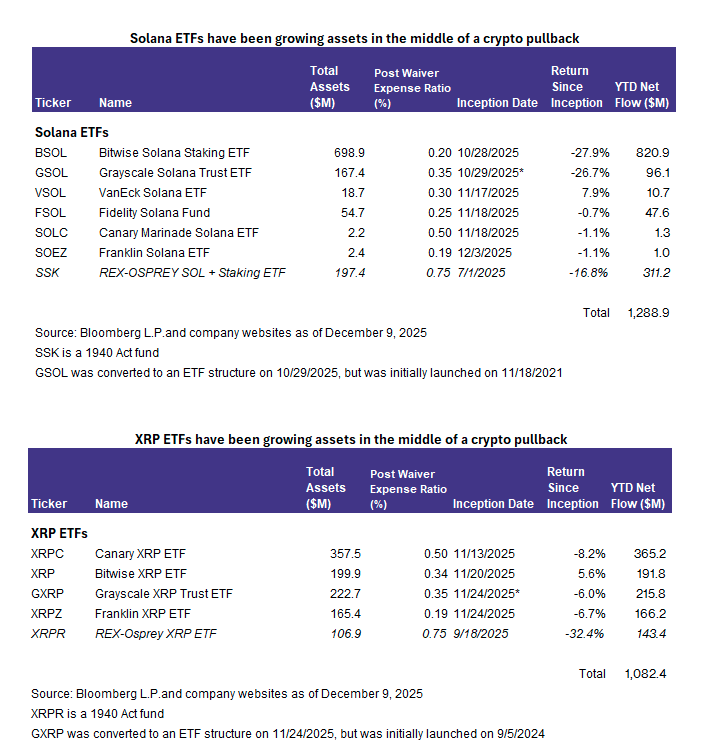
The issue is that many investors seem to like picking the winners. Crypto is an exciting field with some interesting narratives like Solana and XRP. Solana and XRP spot crypto ETFs have both seen relatively significant demand since their launch in October despite falling crypto prices. Both Solana and XRP ETFs have gathered over $1 billion in net inflows in each group in just over a month.
With the split between Bitcoin-only investors and those interested in individual token narratives, there is not yet a large crowd in the middle looking for diversified basket exposure. This will likely change over the next few years as investors navigate an overwhelming number of crypto products (currently there are over 150 crypto ETFs including around 75 launched in 2025).

Performance reality check
It’s important to acknowledge the trade-offs. Bitcoin’s volatility is famous, but historically it has often been less volatile than many smart-contract tokens like Ethereum or Solana. That means a large-cap basket may outperform Bitcoin-only exposure when crypto prices are doing well. But it can also underperform Bitcoin-only exposure in certain environments with falling crypto prices. But diversification isn’t something you choose only when convenient. The goal of these products is not to “beat Bitcoin every time,” but to provide a rules-based, evolving snapshot of the large-cap crypto market in one allocation.
ETF Lineup
Not all crypto index ETFs are built the same. In its most standard form, these are 1933 Act funds which have spot exposure to several cryptocurrencies. There are also 1940 Act funds which invest through exposures in other ETPs. And there are also ETFs that focus on multiple cryptocurrencies excluding Bitcoin.
- The Hashdex Nasdaq Crypto Index ETF (NCIQ) is the oldest of the group (although it only recently launched in February 2025). The ETF started as holding only Bitcoin and Ether (at the time, these were the only two spot products in the market). Later in September 2025, the ETF expanded to hold several more cryptocurrencies. It currently holds seven including XRP, Solana, Cardano, Chainlink, and Stellar.
- The Franklin Crypto Index ETF (EZPZ) launched a week after NCIQ and followed a similar strategy of Bitcoin/Ether. In December 2025, EZPZ expanded its holdings to hold other assets including XRP, Solana, Dogecoin, Cardano, Chainlink, and Stellar. Franklin has been extremely active in the digital asset space even beyond ETFs. The asset manager has a tokenized money market fund called the Franklin OnChain U.S. Government Money Fund (FOBXX)—the first of its kind to use a public blockchain.
- The Grayscale CoinDesk Crypto 5 ETF (GDLC) is perhaps the most well-known of the group. Grayscale has been very active in the crypto industry for many years as it fought to convert its Bitcoin product to an ETF. It continues to convert products into ETFs. GDLC was converted in September 19, 2025 yet was initially launched in February 2018. Because of its history, the ETF sits at $560 million in assets (the second largest of this group) although it has seen over $170 million in net outflows so far this year. GDLC is arguably the most straightforward of the group by keeping it simple with five holdings: Bitcoin, Ether, XRP, Solana, and Cardano.
- The Bitwise 10 Crypto Index ETF (BITW) shares a similar story to GDLC. This fund recently converted to an ETF on December 9, 2025. Like Grayscale, Bitwise is very active in the industry. Some of its smaller holdings include Litecoin, Sui, Avalanche, and Polkadot. Together, these make up less than 1% of holdings. At $1.25 billion, BITW is the largest crypto index ETF of the group (over twice as large as the next biggest product GDLC).
- The 21Shares FTSE Crypto 10 Index ETF (TTOP) is a unique entry in the space since it uses a 1940 Act Structure. It invests through both US ETFs (when available) and European ETPs. Similar in structure—21Shares also launched the 21Shares FTSE Crypto 10 ex-BTC Index ETF (TXBC) which omits Bitcoin from its holdings. It holds a diversified group of alt coin ETPs including an almost 50% allocation to Ether.
- Finally, the CoinShares Altcoins ETF (DIME) is also a 1940 Act fund which invests in other ETPs. It focuses solely on Layer 1 blockchains, but omitting Bitcoin and even Ethereum. It focuses on three investment themes: high-speed blockchains, interoperability protocols, and emerging platforms. Its ten holdings are equally weighted.
Bottom Line:
Crypto index ETFs are a natural next step in the adoption curve. While single asset crypto ETFs have been gaining attention due to intriguing narratives in digital assets like Solana and XRP, crypto index ETFs and multi-token ETFs may eventually earn more inflows as advisors and investors attempt to navigate the rapidly growing field of crypto ETFs.
For more news, information, and analysis, visit VettaFi | ETF Trends.
Originally published on ETF Trends
A message from Advisor Perspectives and VettaFi: Discover something new! Click here to register for our upcoming webcasts.
Read more commentaries by VettaFi