Summary:
- Energy security came into focus after Russia’s invasion of Ukraine drove a global energy crisis with an acute impact in Europe.
- Energy policy is focused on ensuring reliable and affordable power, especially as electricity demand grows, including from AI data centers.
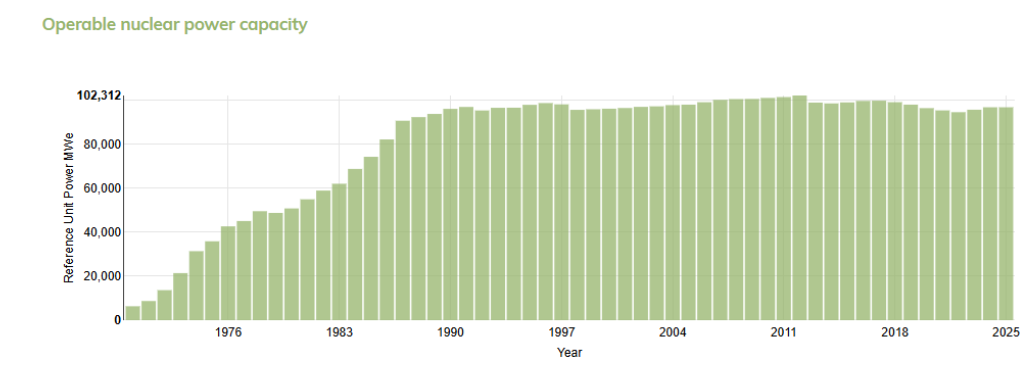
- Nuclear has an important role to play in energy security and climate goals, given its reliability and carbon-free power generation.
For most investors, energy security probably tends to be an afterthought until an event drives a jump in prices at the pump, as seen with Russia’s invasion of Ukraine. However, energy security is about much more than geopolitics, especially as demand for electricity is poised for growth.
Russia-Ukraine puts finer point on energy security…
Energy security was particularly topical in 2022, as Russia’s invasion of Ukraine sparked a global energy crisis, with pronounced severity in Europe. Oil prices temporarily rose above $120 per barrel in the first half of 2022, and even the U.S. felt the pain, despite being the world’s largest oil producer.
The Biden Administration responded with the largest-ever release from the US Strategic Petroleum Reserve (SPR) in coordination with the International Energy Agency (IEA). Both the SPR and the IEA were actually born out of the energy crises in the 1970s.
The impact of higher prices for oil and liquefied natural gas were broad, albeit most severe for the European Union. Prior to the invasion, Russia accounted for 50% of EU oil imports and over 60% of the EU’s natural gas imports.
In retrospect, the EU was able to pivot away from Russian imports in fairly quick order, limiting Russia’s ability to further weaponize its natural gas exports. However, improving energy affordability and being better prepared for price crises are key focuses of the EU’s energy policy going forward.
…But energy security is not just about wars or geopolitics.
While energy security tends to come into focus during geopolitical unrest or unexpected supply disruptions, it isn’t just an event-driven issue. Energy security also encompasses reliability and affordability, which are perennially important for the economy, quality of life, and safety. With electricity demand expected to grow globally, sufficient and affordable power is critical to economies and central to an ongoing artificial intelligence (AI) arms race.
From an energy security standpoint, AI is arguably a mixed bag. For example, AI can help energy companies combat cyberattacks, albeit those attacks have become more complex due to AI. Meanwhile, AI data centers are driving more electricity demand, which could put upward pressure on energy prices.
On the other hand, hyperscalers have been quick to support innovative power solutions, including advanced nuclear (read more). Hyperscalers have plenty of capital to back new projects, while their influence in Washington can also help ease the path for nuclear. Nuclear support is one area of continuity in energy policy from the Biden to the Trump administration (read more), with the U.S. military also focused on advanced nuclear as exemplified by an announcement last week.
In the U.S., power demand has largely been flat for 20 years, so a shift to growing electricity demand is notable. The U.S. will need plenty of affordable power from a range of sources, including renewables, natural gas, and nuclear. The political focus may even move from prices at the pump to monthly electricity bills.