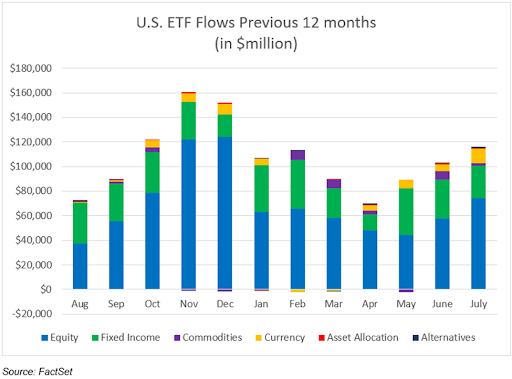
July U.S. ETFs saw gains in both flows and AUM as well as another elevated round of launches. In the tidal wave of funds coming to market, a few ETF strategies stand out for their innovation or for notable opportunities they provide.
Gone are the sleepy days of summer, at least in the U.S. ETF industry. In total, 111 new ETFs hit markets in July, according to FactSet data. The same number of ETFs also launched in June, making it a busy time for the industry. For reference, launches last year averaged 60 per month.
U.S. ETF AUM hit $11.88 trillion in July, with inflows of $116 billion, a 12.6% gain month-over-month. By category, flows into equities and currencies saw the largest month-over-month gains. Equity flows logged $74.5 billion, the highest monthly total this year, while flows into currency ETFs crossed $11.8 billion, more than double June’s flows.

Equity Investing Without Distribution Tax Concerns
Thousands of equity ETFs currently exist, making it more difficult to find a fund doing something different with core equity exposure. However, Roundhill still managed to surprise with their most recent launch, the Roundhill S&P 500 No Dividend Target ETF (XDIV). Where most issuers are going all in on income boosting or enhancements to benchmark equity exposure in challenging market environments, Roundhill looks to simplify equity investing. XDIV is the first ETF of its kind that focuses on tax efficiency by eliminating distributions.
The actively managed fund offers investors an opportunity to invest in the S&P 500 without notably increasing taxable income. XDIV invests primarily in S&P 500 ETFs but removes exposure the day before the ex-dividend date of the underlying ETFs. While it may incur distributions, the focus is on minimizing distributions as much as possible. For tax-conscious investors, it offers a new way to invest in equities long-term while maximizing after-tax return potential.
New Takes on ETF Sector Investing
Given mega-cap concentrations in broad equity indexes, some investors are turning to targeted sector exposure for diversification and risk management opportunities. Sector investors now find themselves with two new approaches to individual sector investing through State Street and WEBs Investments.
Those investors looking to boost income potential while diversifying across sectors have a variety of new options through State Street. The firm launched its premium income suite across the 11 individual sectors. Each fund invests in its respective Select Sector SPDR ETF, with the ability to invest individually in companies within the corresponding sector.
At the same time, it writes call options on the underlying sector fund, earning income off the premiums. The strike prices of the calls are positioned to balance income with capital appreciation. For example, the Communication Services Select Sector SPDR Premium Income Fund (XLCI) invests in the Communications Services Select Sector SPDR Fund (XLC). It also writes calls on XLC, generally with a one- to two-month expiry.
Meanwhile, WEBs Investments offers sector investors a dynamic means to potentially dampen volatility. Each fund tracks a Defined Volatility Index, with each individual sector index providing exposure to its respective Select Sector SPDR ETF. At the same time, short-term market volatility is measured from the most recent 21 trading days.
Each fund maintains a volatility threshold that differs depending on the individual sector. Should volatility rise, the strategy reduces exposure to equities via the underlying ETF. Instead, it moves into cash or Treasuries. When volatility falls, the fund increases its equity exposures. This provides dynamic exposure to equities, dampening volatility and delivering the potential for better risk-adjusted returns compared to direct investment.
Bucking the Climate Trend
While the actively managed Invesco Global Equity Net Zero ETF (IQSZ) doesn’t break new ground in its approach, the timing of the launch makes the fund notable. It’s no secret that the current U.S. administration has made eradicating climate policies one of its central pillars. At a time when many U.S. companies are retreating from publicized climate policies, climate investing becomes a contrarian play.
Last year, climate and weather disasters cost $182.7 billion in damages, according to the NOAA. Although policy pressures exist, companies and institutions are quietly folding climate risk into their business models. Citibank is currently hiring a climate quantitative modeler at the M.S. or Ph.D. level with specific climate risk experience. U.S. insurance companies are ramping up efforts to measure climate change risk. On the surface, efforts appear to be receding, but deepening awareness of climate risk and mitigation efforts continue, particularly abroad.
IQSZ invests in companies either currently working to reduce emissions or with plans to reduce emissions. It invests mostly in large- and midcap companies in developed markets and up to 30% in emerging market countries. The strategy also screens for quality, value, and momentum when selecting securities. The fund offers a diversified take on international exposure, providing contrarian opportunity for U.S. investors.
A message from Advisor Perspectives and VettaFi: To learn more about this and other topics, check out some of our videos.
Read more commentaries by VettaFi