The Marriner Eccles Building, home to the Federal Reserve Board, is an imposing structure that fronts the National Mall in Washington D.C. It was constructed in the wake of the Banking Act of 1935, which created clear separation between the Treasury Department and the central bank.
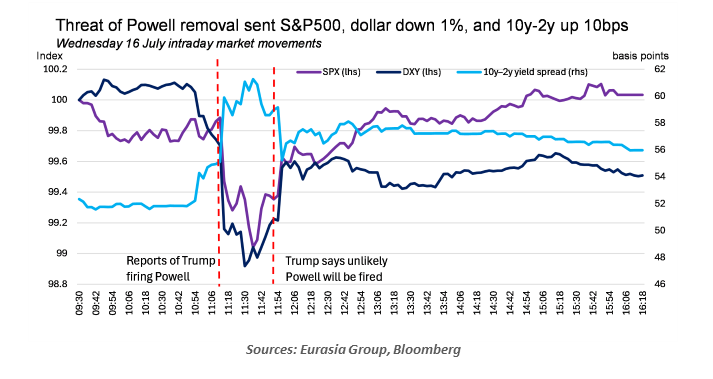
Ironically, the Eccles Building is now at the center of efforts to reduce the Fed’s independence. Tension between the President and the central bank has reached new heights, as the White House presses for lower interest rates. Even if the current Fed Chair remains in place, the attack he has endured may weaken the institution in a way that is very costly to the United States.
As we wrote earlier this year, political pressure on the Fed is not new. Stewards of the nation’s finances often want interest rates to be lower, which increases the flow of credit into the economy. But easy money can have inflationary consequences which are damaging to growth and market performance. For that reason, the U.S. Congress has given the Fed mandates to seek price stability and maximum employment over the long term, and the independence needed to meet these mandates.
Achieving these ends has been complicated over the past five years, first by the pandemic and more recently by this year’s trade war. Paradigm shifts like these make it hard to anticipate the course of economic variables, complicating the conduct of monetary policy. The Fed was criticized in some corners for keeping rates too low for too long in 2021, and has spent the past three years working to bring inflation back to the targeted level of 2%.

With that goal in sight, the Fed cut interest rates by 100 basis points last fall. But persistent strength in the job market (U.S. unemployment is only 4.1%) and the potential impact of tariffs on inflation have kept monetary policy on hold since last December. This has drawn the ire of the President, who has expressed his displeasure at Fed Chair Jerome Powell in no uncertain terms. The White House has once again floated the idea of firing Powell, or naming his successor well before his term ends next May.
The U.S. Supreme Court confirmed earlier this year that the Fed Chair could only be removed “for cause.” Enter the Eccles building: renovations of the facility have proven more costly than anticipated, leading some to suggest that Powell has been guilty of mismanaging the project. This might provide a pretext that the White House could use to dismiss Powell and install someone who is more sympathetic to the Administration’s wishes.
The attacks on the Fed have been unfortunate, and they may prove to be counterproductive. Markets have come to count on independent central banks, and they tend to react poorly when their standing is compromised. Ironically, the President’s campaign to lower interest rates in the short term could lead to higher long-term rates, as markets price the greater risk of inflation; this would not help the country’s finances.
Further, the Administration’s stance could make life difficult for the next Fed Chair. The other members of the Board, and the Fed staff, might not be welcoming to someone who would be seen as taking orders from the White House. Investors would be sensitive to any signs of such steering, giving little latitude to the new leader.
As most of our readers know, I worked for the Federal Reserve from 2008 to 2012. As the dates would suggest, it was an intense time. I developed a deep respect for the Fed’s mission, and for the people who work there. When they are under attack, I still take some offense. They don’t always get policy right, but they come by it objectively. The organization’s ethics are very high.
Marriner Eccles was passionate about the Fed’s independence. The headquarters building was named after him in 1982, at a time that the Fed was under intense political pressure for its campaign to tame inflation. Those efforts ultimately proved successful, vindicating the Fed’s approach. The Eccles Building may be in need of major renovation, but monetary policy is not.
Information is not intended to be and should not be construed as an offer, solicitation or recommendation with respect to any transaction and should not be treated as legal advice, investment advice or tax advice. Under no circumstances should you rely upon this information as a substitute for obtaining specific legal or tax advice from your own professional legal or tax advisors. Information is subject to change based on market or other conditions and is not intended to influence your investment decisions.
© 2025 Northern Trust Corporation. Head Office: 50 South La Salle Street, Chicago, Illinois 60603 U.S.A. Incorporated with limited liability in the U.S. Products and services provided by subsidiaries of Northern Trust Corporation may vary in different markets and are offered in accordance with local regulation. For legal and regulatory information about individual market offices, visit northerntrust.com/terms-and-conditions.
A message from Advisor Perspectives and VettaFi: To learn more about this and other topics, check out some of our webcasts.
© Northern Trust
Read more commentaries by Northern Trust