Doug Drabik discusses fixed income market conditions and offers insight for bond investors.
There are thousands of television news programs telecast from around 383 TV news channels, 44,000 radio stations providing news coverage, and over 100,000 newspapers globally, all creating noise for investors to digest. The DOW and S&P 500 Index have fluctuated over 17% from their highs to lows over the last year. Since May 2020, inflation (CPI) has gone from a low of 0.1% to a high of 9.1% and back to 2.8%. It is no wonder why any investor might at least pause in this period of uncertainty. Wouldn’t it be nice to be able to ignore the noise and have a better feeling of certainty? Individual bonds can mitigate or eliminate much of the uncertainty created by the noise and provide greater assurance for investors wanting or needing a source of capital preservation.
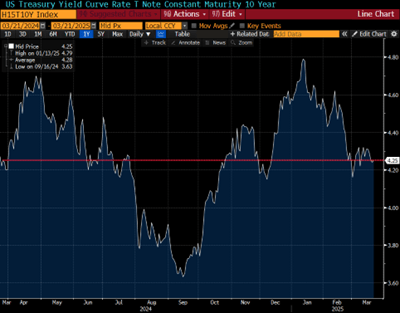
The most important fixed income benefit for many investors is that it is a product designed to preserve wealth. This holds true whether the economy is in a 1% or a 10% rate environment. Since the interest rate environment has been elevated for nearly two years, a reminder about fixed income’s role in the portfolio may help channel perception about rates. Getting caught up in media noise and confusion can unnecessarily bias long-term focus. Let’s look at the ten-year Treasury as an example. The graph looks back one year on 10-year yields. Despite the interim volatility, the 10-year Treasury closed Friday at 4.25%, just two basis points different than the 4.27% rate recorded one year earlier.
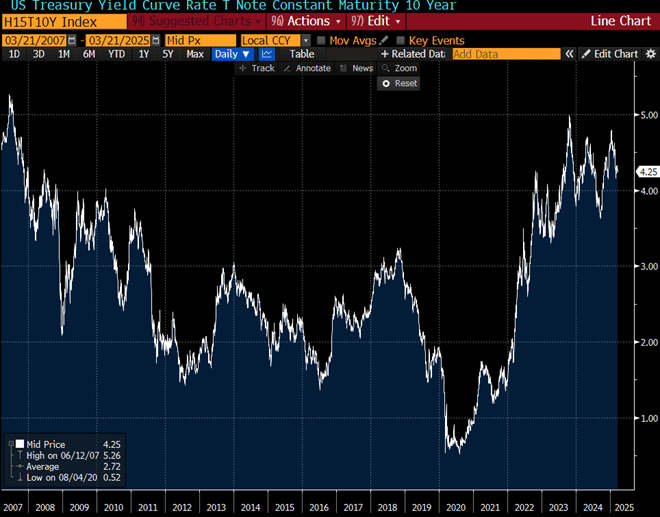
Now let’s expand that look and put it in perspective. As investors, we sometimes feel like we missed an opportunity if we purchase a bond at 5.1%, and a week later, we could have purchased it at 5.2%. Trying to time the market can be frustrating but may be less of a concern with the fixed income allocation. In this example, the market may have moved the other way, and the same bond yielded only 5% a week later. The two important takeaways are that fixed income’s primary purpose is often to preserve wealth. When purchased and held to maturity, the income, cash flow stream, and the date of the return of face value do not change regardless of environmental changes, market noise, or any other interim event. In other words, individual bonds provide a known result, rendering their benefits different from other investments in preserving wealth. The second takeaway is that the market is providing a secondary fixed income benefit with higher rates. Look at the next graph and realize that regardless of when a bond was purchased over the last year, it was good timing in perspective to the last 17 years.