In a press conference following this week’s FOMC meeting, Fed Chairman Ben Bernanke provided markets with a clearer understanding on how the Fed expects to phase out its current quantitative easing (QE) program. This timetable is justified both by economic progress and by the significant future costs which a too-large Fed balance sheet is likely to entail. Moreover, the timetable, while never previously explicitly outlined, should not have been a surprise to most market observers. Nevertheless, Mr. Bernanke’s words have been met by a sharp selloff across a wide range of financial assets. For investors, it is important to distinguish between logical market reactions and over-reactions while still positioning portfolios for an environment of rising interest rates.
A Clearer Message from the Fed
At 2:00 pm on Wednesday, June 19, 2013, following a two-day policy meeting, the Federal Open Market Committee of the Federal Reserve released its usual short statement on monetary policy. Few words were changed in the statement (compared to the statement from the previous meeting) except for a recognition that risks to the outlook for the economy and the labor market had “diminished since last fall”. This was actually quite significant since the latest version of QE, the monthly purchase of $85 billion in Treasuries and mortgage-backed securities, was initiated last fall.
At 2:30 pm , in an opening statement to his post-FOMC meeting press conference, Fed Chairman Ben Bernanke provided far more clarity on the Fed’s thinking by enunciating the Fed’s expectations on both when it would begin to phase out QE and when it expected to complete the phase out. In particular, Mr. Bernanke noted:
“If the incoming data are broadly consistent with this forecast, the Committeecurrently anticipates that it would be appropriate to moderate the monthly pace ofpurchases later this year; and if subsequent data remain broadly aligned with ourcurrent expectations for the economy, we would continue to reduce the pace ofpurchases in measured steps through the first half of next year, ending purchasesaround midyear. In this scenario, when asset purchases ultimately come to an end,the unemployment rate would likely be in the vicinity of 7%, with solid economicgrowth supporting further job gains – a substantial improvement from the 8.1%unemployment rate that prevailed when the Committee announced this program.”
He also made it clear that the Fed did not intend to raise the federal fund rate from its current 0-0.25% range, until the unemployment rate was at least down to 6.5%.
Why QE Needs to be Phased Out
It needs to be said that a timetable for ending QE is far easier to justify than the program itself. The current QE program combined with a near-zero federal funds rate amounts to the most extreme dose of monetary stimulus applied by the Federal Reserve in its 100-year history. With the economy in its fifth year of recovery, unemployment down 2.4% from its peak, home prices and stock prices up sharply over the past year and financial stress clearly much lower than a few years ago, it is hard to justify such an extreme approach. It is also unlikely that this monetary ease is really helping growth. In fact, by reducing the income of savers, discouraging lending by artificially lowering long-term rates and convincing people that they don’t need to borrow ahead of higher rates, recent monetary policy may have been more of a drag to the economy than a boost.
Equally important, the Fed’s fast-expanding balance sheet carries dangers of its own. Up to this point, the Fed has increased the size of its balance sheet without causing a surge in the money supply by paying banks interest on the reserves they hold with the Fed (as opposed to lending out to the private sector). However, this also implies that in order for the Fed eventually to raise the federal funds rate, it will need to increase the interest paid on reserves in tandem.
The problem is that even if the Fed sticks to Bernanke’s timetable, banks would be holding a projected $2.5 trillion on reserve with the Fed by middle of 2014. If the Fed over the next few years raised the federal funds rate to a roughly“neutral” level of 4% (roughly 2% higher than core inflation),the 4% interest that it would then have to pay on bank reserves would cost $100 billion per year, which could leave it in a net negative income situation. If it tried to avoid this by selling bonds and shrinking its balance sheet it could push long-term interest rates to spike. Conversely, if the Fed postponed rate hikes altogether, it could set the economy up for inflation. The bottom line is that the bigger the Fed’s balance sheet gets, the more expensive it will be to maintain and the more disruptive it will be to dismantle. The Fed knows this as should those who watch the Fed. While Mr. Bernanke’s explicit announcement of a timetable for ending QE surprised markets, the timetable itself should not have.Market Reactions and Over-Reactions
Since these announcements, as can be seen in the table below, global fixed income, equity and commodity markets have seen sharp selloffs. However, it is important to distinguish between those market movements that are justified by the Fed’s actions and those that are not.
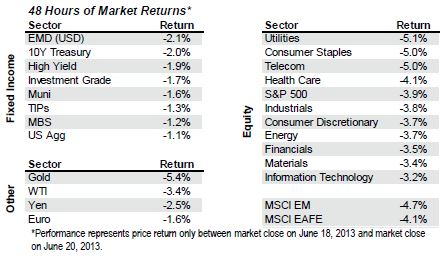
For the most part, the selloff in fixed income markets seems justified. Between the close of business on Tuesday and the close of business on Thursday, the yield on 10-year Treasuries rose by 24 basis points. Even with this, 10-year Treasuries on Thursday were yielding 2.42% compared to a year-over-year core CPI inflation rate of 1.68%, resulting in an ex-post real yield of 0.74%, far below the average real yield roughly of 2.5% seen over the last 50 years. Other areas, such as high- yield bonds, saw bigger losses, partly in reaction to the equity market movement. However, in a normalizing economy, real interest rates still have a long way to rise to get to a “normal” level.
For the stock market, the overall reaction seems extreme, with the S&P 500 losing twice as much in two days as the 10- year Treasury bond. It should be noted that, by laying out a path to ending QE, Ben Bernanke has not increased uncertainty – he has reduced it. It should also be noted, as the Fed Chairman repeatedly did in his news conference, that this timetable is data dependent. The Fed can keep QE around longer, (and thus, presumably, maintain low long-term interest rates) if they believe the economy needs it.
Sadly, the Federal Reserve may now be the victim of their own rhetoric. Having spent years over-hyping the benefits of QE, they appear to have convinced some market participants that the economy can’t get by without it.
This is very likely wrong. The housing market is in a firm recovery and, even with somewhat higher mortgage rates, overall housing affordability will remain far better than in recent decades. While fiscal drag has hurt the U.S. economy in recent years,there is little likelihood of further significant federal tightening over the next few years while state and local government employment is now beginning to rise. Most importantly, a move toward more normal interest rates should help convince many businesses and consumers alike that the economic crisis is over and reduce the hesitancy to act which is always the most pernicious aspect of a weak economy.
Over the next few months, this should become clear and equity markets should reflect this. In the meantime, it is important for investors to continue to position their portfolios for rising interest rates, with a tilt towards growth equities and away from long- duration, high-quality fixed income.
Any performance quoted is past performance and is not a guarantee of future results.
Diversification does not guarantee investment returns and does not eliminate risk of loss.
Opinions and estimates offered constitute our judgment and are subject to change without notice, as are statements of financial market trends, which are based on current market conditions. We believe the information provided here is reliable, but do not warrant its accuracy or completeness. This material is not intended as an offer or solicitation for the purchase or sale of any financial instrument. The views and strategies described may not be suitable for all investors. This material has been prepared for informational purposes only, and is not intended to provide, and should not be relied on for, accounting, legal or tax advice. References to future returns are not promises or even estimates of actual returns a client portfolio may achieve. Reference to specific securities, asset classes and financial markets are for illustrative purposes only and are not intended to be, and should not be interpreted as, recommendations. Any forecasts contained herein are for illustrative purposes only and are not to be relied upon as advice or interpreted as a recommendation.
J.P. Morgan Asset Management is the marketing name for the asset management businesses of JPMorgan Chase & Co. Those businesses include, but are not limited to, J.P. Morgan Investment Management Inc., Security Capital Research & Management Incorporated and J.P. Morgan Alternative Asset Management, Inc.
JPMorgan Distribution Services, Inc., member FINRA/SIPC MI-MB-TimetableForQE_June2013
© JPMorgan Chase & Co., June 2013
© J.P. Morgan Funds
